Folding Umbrella OEM Packing Requirements for United Arab Emirates Buyers
By Vincent Xi | Editorial Author
For a United Arab Emirates B2B manufacturing RFQ, issue folding umbrella OEM packing requirements as a controlled, SKU-level return schedule. Identify the finished umbrella reference, packaging layers, pack quantities, artwork responsibilities, carton constraints, inspection evidence, and commercial scope. Require every bidder to return proposed materials, dimensions, mass, counts, charges, assumptions, and exclusions against the same fields.
Treat a quotation stating only standard export packing as incomplete until the supplier identifies what it includes. Confirm whether the quoted pack-out covers the sleeve, individual protection, retail carton, insert, barcode application, inner carton, master carton, assembly work, inspection records, and delivery inputs required by the RFQ. Compare prices only after those inclusions are aligned.
The cited YJ Umbrella page discusses packaging and shipping planning as sourcing variables and presents sleeves, hangtags, barcodes, and retail packaging as customization options. This is an attributed description of a supplier-authored page, not a universal packing rule, a United Arab Emirates legal requirement, or evidence of another company's capabilities.
Author basis: The author profile identifies Vincent Xi as an Editorial Author. No first-hand factory, testing, procurement, or delivery experience is asserted.
United Arab Emirates folding umbrella OEM packing requirements for an RFQ
Build the RFQ around a supplier-return schedule rather than a descriptive packaging paragraph. Each buyer instruction should have a matching supplier response field and approval record.
| RFQ field | Buyer must define | Supplier must return | Approval evidence |
|---|---|---|---|
| Finished-unit identity | Purchase order reference, SKU, colorway, product revision, and approved sample reference | Matching identifiers on the quotation, packed sample, and inspection record | Records that reconcile the same product and packaging revisions |
| Packed-unit measurements | Reference points, orientation, required unit, tolerance, and method for closed length, widest packed point, and unit mass | Proposed values followed by sample-measured and production-measured values, measurement date, method, and equipment identifier | Measurement record tied to the inspected unit |
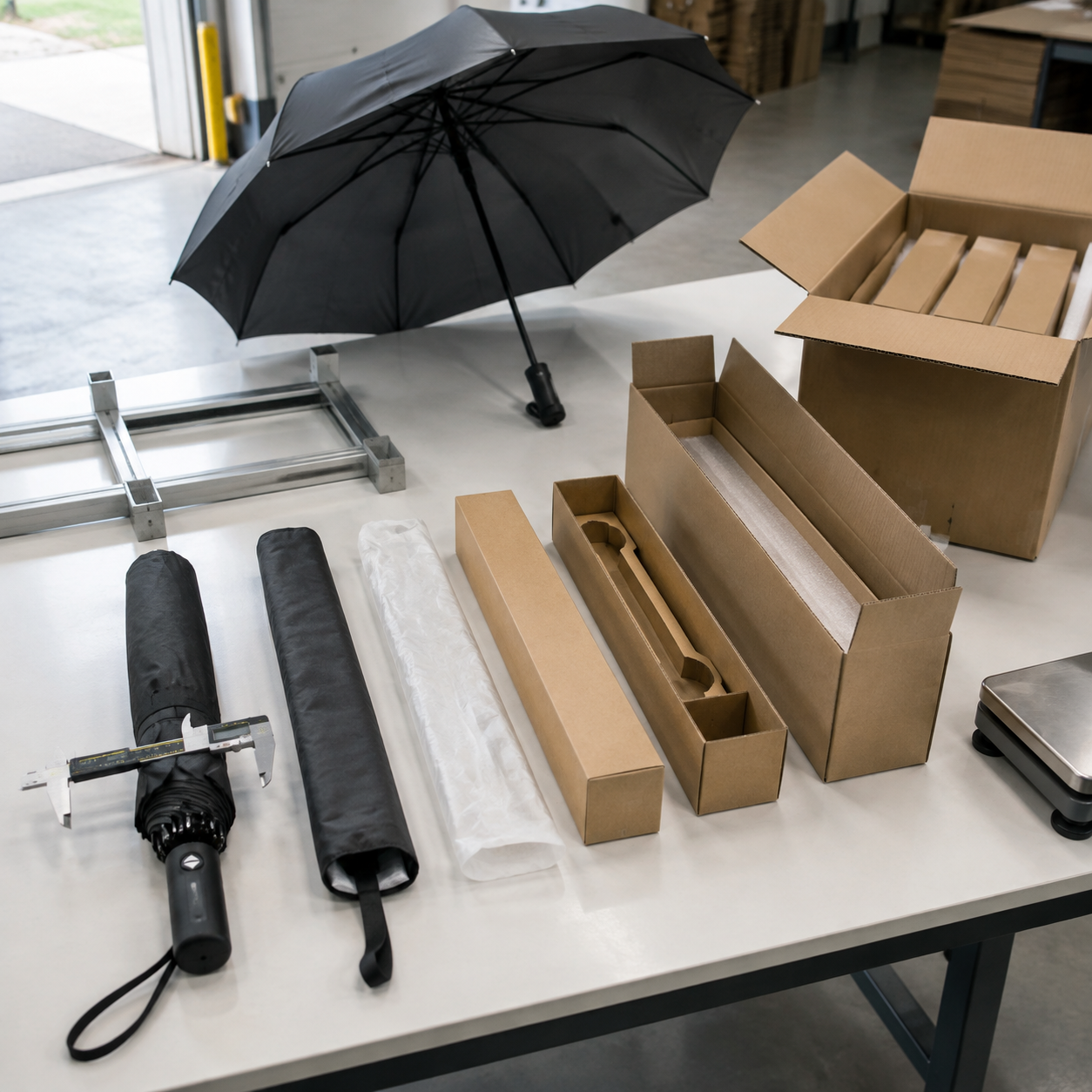
| Pack-out condition | Closure position, strap position, sleeve fit, required protection, cleanliness, dryness, and orientation | Assembly sequence and complete packed sample | Views showing insertion, closure, removal, and finished condition |
| Packaging layers | Required sleeve, protective layer, retail pack, insert, guard, inner carton, and master carton | Material, construction, finish, dimensions, tolerance, closure, print method, and quantity used for each applicable layer | Revision-controlled packaging bill of materials and assembled sample |
| Pack quantities | Quantity at every packaging level and whether mixed SKUs or colorways are permitted | Proposed counts, assortment matrix where applicable, and reconciliation method | Sample count, carton record, carton marks, and packing-list match |
| Carton controls | External-dimension and gross-mass limits, construction, closure, orientation, and reinforcement expectations | Proposed and measured external dimensions, net mass, gross mass, packed quantity, and carton construction | Closed-carton and open-carton evidence tied to the approved pack-out |
| Artwork and controlled data | Artwork revision, barcode file, SKU mapping, placement reference, destination data, and carton-mark content | Applied proof, placement proposal, verification record, and change log | Written approval of the applied proof and controlled data |
| Inspection evidence | Measurement method, sampling instruction, defect categories, acceptance criteria, required views, and report fields | Sample and production records tied to the purchase order and packaging revision | Completed report identifying the checked item, method, result, and disposition |
| Commercial scope | Required price breakdown, delivery basis, named handover place, included work, and exclusions | Packaging component costs, assembly charges, delivery assumptions, and freight-planning inputs | Normalized quotation covering the required pack-out scope |
Require returned values to be tagged as supplier proposed, sample measured, production measured, buyer approved, or not applicable. Do not treat an untagged or blank value as approved production data.
Use a declared linear unit for product and carton dimensions and a declared mass unit for unit, net-carton, and gross-carton mass. The RFQ should also define measurement orientation and reference points so that the supplier, inspector, and freight provider use comparable inputs.
Define packing requirements by layer and pack format
Select the pack format from the order's intended distribution use, then approve it around the referenced folding umbrella. The following are buyer decision categories, not claims about a supplier's standard pack or destination law.
| Intended use | Packing requirements to define | Evidence to request before approval |
|---|---|---|
| Corporate distribution without a retail-shelf pack | Fitted sleeve, any required individual protection, pack orientation, and direct carton arrangement | Sleeve-fit views, packed-unit measurements, carton count, and condition after the agreed handling check |
| Retail SKU | Sleeve, retail carton, insert where required, barcode placement, closure, and master carton | Approved dieline, applied artwork proof, complete assembled sample, buyer-defined barcode result, and packed dimensions |
| Presentation pack | Fitted box or insert, closure retention, umbrella orientation, and protection around the handle and frame | Complete sample showing fit, pressure points, removal, closure, and condition after the agreed check |
| Mixed colorway or SKU carton | Approved assortment matrix and separate identifiers | Open-carton count, SKU verification, carton reconciliation, and packing-list match |
| Abrasion-sensitive finish | Approved guard, tissue, separator, or individual cavity | Surface-condition record before packing and after the agreed pack-handling check |
| Freight-constrained order | Orientation, void limits, carton quantity, and external carton limits | Measured packed-carton dimensions and gross mass plus evidence that the product is not bent, crushed, or overcompressed |
The cited UmbrallaOEM page discusses the sleeve, hangtag, barcode, and master carton as connected parts of a retail SKU. Use that as source context for evaluating the complete pack, not as proof of a universal construction or acceptance result.
For every applicable packaging component, require the quotation and packaging bill of materials to state:
- Component identifier and position in the pack sequence.
- Material description, construction, color, and surface finish.
- Relevant material field, such as thickness, grade, flute, or basis weight, where selected by the buyer.
- Finished internal or external dimensions, measurement basis, and tolerance.
- Closure, sealing, folding, and assembly method.
- Print method, artwork revision, print location, and proof status.
- Quantity used per packed umbrella or carton.
- Proposed, sample-measured, production-measured, and approval status.
- Itemized price inclusion or addition.
- Written approval requirement for changes to material, dimensions, finish, print, closure, construction, or source.
Show the physical sequence explicitly: finished umbrella, fitted sleeve, individual protection if required, retail pack if required, insert or guard if required, inner carton if used, and master carton. Mark optional components as included, excluded, or not applicable.
For artwork and data, the buyer or its authorized United Arab Emirates importer should issue the approved files, SKU mapping, destination instructions, and carton-mark content. Require the supplier to return an applied proof. Where barcode performance is contractual, specify the data, verification method, sample basis, and acceptance criterion rather than approving visual appearance alone.
Approve the packed sample before comparing quotations
The UmbrallaOEM source recommends evaluating a complete umbrella sample. For this RFQ, apply that principle to the complete production-intent pack-out: the referenced folding umbrella, fitted sleeve, protective components, retail pack where applicable, and carton should be reviewed as an assembled system.
Do not use a flat dieline as the sole fit evidence for a fitted retail or presentation pack. Require the proposed pack to be assembled around the referenced sleeved umbrella and record the results for insertion, removal, closure, reopening, internal movement, pressure points, and finished-product condition against buyer-defined criteria.
Quotation comparison should use the same returned fields for every bidder:
- Packaging cost by component.
- Pack assembly and application charges.
- Quantity at each packaging level.
- Measured packed-unit and carton dimensions.
- Carton net mass and gross mass.
- Calculated shipment volume, with the formula shown.
- Delivery basis and named handover place.
- Included services, exclusions, and provisional inputs.
Keep measured, calculated, estimated, and provisional values visibly separate.
Example A: carton and shipment arithmetic
Example A is an undated planning illustration for a hypothetical folding umbrella RFQ. Every exact value below is either an editorial assumption or an arithmetic result for that hypothetical scope. None is supplier data, current market data, a freight rate, or a recommended pack. Replace and verify every input in the selected supplier's dated quotation, approved packed sample, production record, final packing list, and current freight quotation.
| Example input or result | Hypothetical scope and derivation | Status and verification required |
|---|---|---|
6,000 umbrellas | Assumed order quantity for the hypothetical SKU-specific order | Editorial assumption; replace with the quantity in the dated RFQ and supplier quotation |
60 umbrellas per master carton | Assumed pack count for the same hypothetical order | Editorial assumption; verify against the approved umbrella, packaging layers, orientation, and carton |
100 master cartons | Calculated as 6,000 umbrellas / 60 umbrellas per carton | Editorial arithmetic; reconcile with production pack-out and the final packing list |
60 cm x 40 cm x 35 cm per master carton | Assumed closed external dimensions for each hypothetical master carton | Editorial assumption; supplier must measure the assembled carton and identify the method used |
0.084 m^3 per master carton | Calculated as 0.60 m x 0.40 m x 0.35 m | Editorial arithmetic; freight provider must confirm its applicable measurement basis |
8.4 m^3 for the shipment | Calculated as 100 cartons x 0.084 m^3 per carton, before any pallet, bulge, or provider adjustment | Editorial arithmetic; recalculate from confirmed production dimensions and current booking rules |
15 kg gross per master carton | Assumed gross mass for each hypothetical packed carton | Editorial assumption; supplier must measure and record the equipment identifier and result |
1,500 kg gross for the shipment | Calculated as 100 cartons x 15 kg per carton | Editorial arithmetic; reconcile with measured carton records, packing list, and freight booking |
The example does not establish a suitable carton count, carton size, packing density, or gross mass for an actual order. Derive those values from the referenced folding umbrella, approved packaging bill of materials, carton construction, pack orientation, and measured production pack-out.
United Arab Emirates label, landed-cost, and delivery controls
The supplied evidence does not establish a mandatory United Arab Emirates label language, origin-marking phrase, importer statement, warning, recycling claim, customs document, duty, tax, port charge, clearance fee, delivery surcharge, or destination-specific protection rule for an order. Do not ask the supplier to guess these requirements or reuse content from another shipment without current approval.
| Destination input | Responsible verifier | RFQ or release evidence |
|---|---|---|
| Destination city, delivery point, consignee, and sales-channel instructions | Buyer or authorized United Arab Emirates importer | Current written instruction tied to the purchase order |
| Required label content, language, origin marking, importer fields, warnings, and environmental statements where applicable | United Arab Emirates importer and relevant legal, customs, or compliance adviser | Current written requirement approved before artwork release |
| Barcode data, SKU mapping, placement, and verification method | Buyer or authorized data owner | Controlled file, applied proof, and agreed verification result |
| Carton marks and packing-list identifiers | Buyer issues content; supplier applies and reconciles it | Approved carton-mark proof and final reconciliation record |
| Supplier shipment documents | Supplier, with review by the importer or appointed broker | Current document list tied to the shipment |
| Booking limits, handover requirements, and freight quotation basis | Appointed freight provider or broker | Current written instruction based on measured shipment data |
| Packaging, freight, and delivery cost inclusions | Supplier and freight provider within their respective quotations | Itemized inclusions, exclusions, delivery basis, named place, and quotation date |
The cited Ark Umbrella page describes that company's own process as collecting market, quantity, packaging, and compliance expectations before quotation and carrying out carton checks and export-document work later in its process. This attributed workflow is not a United Arab Emirates requirement and does not establish another supplier's practice.
For landed-cost review, ask each commercial party to state its own scope. Do not use the delivery basis or named handover place as a substitute for an itemized statement of packaging, assembly, freight, document, handling, and delivery inclusions and exclusions.
Release packing requirements with production QC evidence
Hold shipment release until current records show that the production pack-out matches the approved revision. The buyer should define the sampling instruction, defect categories, acceptance criteria, evidence format, and decision authority in the order documents.
| Inspection area | Buyer-defined check | Evidence to retain |
|---|---|---|
| Identity and revision | Purchase order, SKU, colorway, product sample, packaging bill of materials, artwork, barcode file, and carton mark agree | Record listing every checked identifier and revision |
| Layer sequence | Every required sleeve, protective layer, insert, retail pack, inner carton, and master carton is present and correctly oriented | Open-pack views and component record |
| Dimensions and mass | Packed-unit dimensions, external carton dimensions, net mass, and gross mass are measured using the agreed methods and units | Measurement views, equipment identifier, measurement date, and recorded values |
| Quantity and assortment | Unit count and any approved mixed-SKU matrix match the pack plan | Open-carton count, SKU record, and carton reconciliation |
| Artwork and data | Print, placement, SKU identity, barcode data, and carton marks match the approved assets | Artwork comparison and buyer-defined verification result |
| Product and pack condition | Inspected items meet the purchase order's defined limits for crushing, abrasion, bent components, closure condition, contamination, marks, and substitutions | Defect record tied to the sample and pack revision |
| Carton construction and closure | Construction, closure, reinforcement, orientation, and resealing match the approved pack-out | Closed-carton and open-carton evidence |
| Final reconciliation | Inspection values, carton marks, packing list, and booking data agree | Release record listing discrepancies, disposition, and approver |
If the contract names a sampling, handling, drop, compression, moisture, or stacking standard, identify the current document and edition, applicable clauses, conditions, and acceptance limits. Keep the standard's stated requirements separate from any additional buyer requirement or supplier practice.
Do not state that packaging passed a test or holds certification unless a current document identifies the applicable sample, packaging revision, protocol or certification scope, conditions, result, date, and issuer. A supplier webpage, generic certificate image, or unrelated report does not establish production-pack performance or current certification.
Practical RFQ checklist for United Arab Emirates packing requirements
Use this SKU-level checklist when issuing the RFQ. Require the supplier to mark each line as a quoted inclusion, priced option, exclusion, or not applicable and to identify the supporting document or returned value.
Before issuing the RFQ
- [ ] Identify the RFQ, purchase order reference, SKU, colorway, product revision, and approved umbrella sample.
- [ ] State the intended distribution use and required sequence of sleeve, protection, retail pack, insert, inner carton, and master carton.
- [ ] Define the quantity at each packaging level and whether mixed SKUs or colorways are permitted.
- [ ] State the required measurement units, orientation, reference points, methods, and tolerances.
- [ ] Set buyer-defined external carton dimension and gross-mass limits where required.
- [ ] Attach controlled artwork, barcode data, SKU mapping, placement references, and carton-mark instructions.
- [ ] Attach current destination instructions supplied by the buyer or authorized United Arab Emirates importer.
- [ ] Define inspection sampling instructions, defect categories, acceptance criteria, required evidence, and approval authority.
Supplier quotation return
- [ ] Return a packaging bill of materials covering every applicable layer, material, construction, finish, closure, dimensions, tolerance, and quantity used.
- [ ] Identify each value as
supplier proposed,sample measured,production measured,buyer approved, ornot applicable. - [ ] Itemize packaging component costs, assembly charges, artwork or application charges, and any optional work.
- [ ] State pack quantities, assortment rules, carton construction, orientation, closure, and reinforcement.
- [ ] Return proposed packed-unit dimensions, carton dimensions, unit mass, carton net mass, and carton gross mass.
- [ ] State the delivery basis, named handover place, quotation date, inclusions, exclusions, assumptions, and provisional inputs.
- [ ] Show shipment-volume arithmetic and identify whether each input is measured, calculated, estimated, or provisional.
- [ ] Confirm the packed-sample submission, applied artwork proof, and inspection-record scope included in the quotation.
Sample and production approval
- [ ] Inspect the complete production-intent pack around the referenced folding umbrella, not only a flat dieline or empty carton.
- [ ] Record sleeve fit, insertion, removal, closure, reopening, internal movement, pressure points, and product condition.
- [ ] Verify artwork revision, SKU identity, barcode data, placement, and carton marks against approved files.
- [ ] Record sample measurements with the date, method, units, reference points, and equipment identifier.
- [ ] Reconcile the approved sample, packaging bill of materials, quotation, purchase order, and inspection instruction.
- [ ] Obtain written approval before any material, construction, dimension, finish, print, closure, or source substitution.
- [ ] Before shipment release, reconcile production measurements, carton counts, carton marks, packing list, shipment data, and current freight instructions.
- [ ] Retain the discrepancy record, disposition, and named approval authority with the final release documents.
Evidence method and limitations
| Source context | Supported use | Boundary |
|---|---|---|
| Vincent Xi author profile | Author name, role, and profile URL | Does not support factory experience, testing work, procurement outcomes, credentials, or delivery experience |
| YJ Umbrella | Attributed discussion of packaging and shipping planning, sleeves, hangtags, barcodes, and retail packaging | Does not establish ZheBrella capabilities, a required pack, independent test results, or destination law |
| UmbrallaOEM | Attributed treatment of connected retail-SKU packaging elements and complete-sample evaluation | Does not establish a universal construction, production acceptance result, or certification |
| Ark Umbrella | Attributed description of that company's quotation, carton-check, and export-document workflow | Does not establish a United Arab Emirates legal rule, another supplier's workflow, or ZheBrella services |
Methodology: Packaging-related statements from the supplied pages were kept as attributed source context. The operational content was then organized as buyer-defined RFQ fields, supplier return data, sample-approval evidence, quote-comparison inputs, a practical RFQ checklist, and production-release controls. Recommendations are presented as contractual controls for the buyer to adopt or modify, not as universal manufacturing facts. Example A uses only the assumptions and arithmetic displayed in its table.
Limitations and verification: The cited commercial pages are not independent test reports, United Arab Emirates regulatory rulings, customs advice, live freight quotations, or current certification documents. Publication and access dates were not supplied. The evidence does not verify ZheBrella manufacturing capabilities or destination-specific legal requirements. Check actual packaging materials, dimensions, tolerances, mass, quantities, artwork, test results, documents, services, and charges against the selected supplier's dated quotation, approved packed sample, production inspection evidence, final packing list, and current shipment documents. The authorized United Arab Emirates importer and relevant professional advisers should confirm destination requirements before artwork, production, or shipment approval.
Release the packing specification only when the quotation, purchase order, approved packed sample, packaging bill of materials, artwork, measured carton data, inspection instruction, final packing list, and shipping inputs describe the same revision-controlled pack-out.
Discuss Your Requirements
Review our manufacturing capabilities, then share your specifications for a supplier-fit review.