Folding Umbrella Sourcing Compliance Requirements for United States Buyers
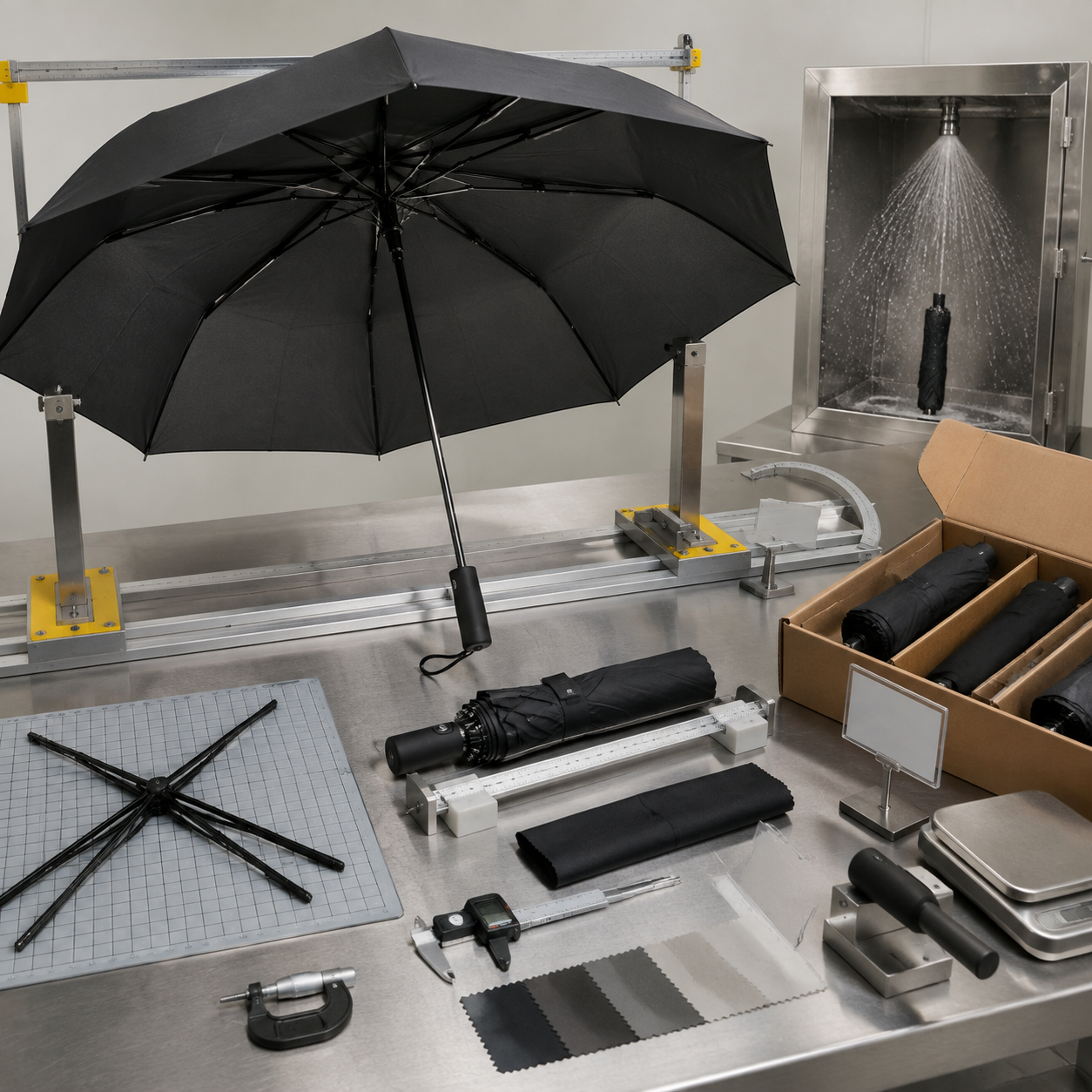
By Vincent Xi, Editorial Author
Author note: The linked profile identifies Vincent Xi as an Editorial Author. It does not support claims of personal product use, factory visits, testing, certification work, or sourcing outcomes, so no such experience is claimed here.
For a United States B2B buyer, folding umbrella sourcing compliance requirements should be resolved through the RFQ and release process, not left for a final document check. The RFQ needs to identify the intended user, exact SKU and revision, operating mechanism, component materials, decoration, packaging, claims, manufacturing origin, distribution states, and any added electrical or child-oriented features.
Do not accept compliant as a complete supplier response. That word does not identify the requirement assessed, sample tested, covered components, report date, production revision, issuing party, or shipment lot. Require evidence that can be matched to the folding umbrella being ordered.
Use distinct procurement gates:
| Gate | Buyer decision | Evidence expected | Hold condition |
|---|---|---|---|
| RFQ release | Is the final product sufficiently defined for an applicability review and comparable quotation? | Product brief, draft bill of materials, drawings, claim list, distribution scope, evidence register, and open-issue log | Intended user, construction, claim, origin, or ownership remains undefined |
| Production release | Does the quoted and sampled construction match the approved compliance and specification baseline? | Controlled bill of materials, approved artwork, production-equivalent sample, scoped reports, and change record | Evidence covers a different model, component, material, color, factory, or revision |
| Shipment release | Does the identified production lot match the approved baseline and agreed inspection plan? | Lot-linked inspection report, closed corrective actions, invoice, packing list, marking evidence, and written buyer approval | A critical defect, unapproved substitution, document mismatch, or unresolved exception remains open |
United States folding umbrella compliance requirements by RFQ decision
Applicability depends on the final folding umbrella, not the category name alone. Record how the product will be presented and used, its mechanism and accessible materials, coatings, inks, decorations, claims, packaging, manufacturing origin, distribution states, and added features. Classify each RFQ control as a legal obligation, claim-substantiation requirement, customer requirement, or buyer-selected quality control.
| Decision area | Source-supported boundary | RFQ evidence | Hold condition |
|---|---|---|---|
| Intended-user classification | The CPSC children's-product guidance provides federal classification context. It does not classify an unspecified folding umbrella SKU. | Written classification rationale tied to the final design, intended use, presentation, packaging, marketing, and added features | The ordered SKU has no documented classification rationale |
| Children's-product certification, when applicable | The CPSC Children's Product Certificate guidance addresses certification when applicable children's-product safety rules apply and describes the supporting third-party testing context. Applicability must be established for the final SKU. | Product-specific certificate where required, applicable-rule list, supporting reports, sample identity, issuer details, and laboratory scope | A certificate is requested or accepted without an applicability basis, or its supporting evidence cannot be matched to the ordered construction |
| Country-of-origin marking | The federal country-of-origin marking regulation is the source for the federal marking analysis. The importer or qualified customs adviser should resolve treatment for the final article, packaging, marking method, and any claimed exception. | Marked production-equivalent sample, approved artwork, manufacturing-origin record, and written disposition of any exception | Wording, country name, location, visibility, permanence, article-versus-container treatment, or exception handling remains unresolved |
| California distribution | The California chemical-warning program information supplies the state warning-framework context. It does not establish whether an unspecified folding umbrella creates a relevant exposure or requires a warning. | Component and material inventory, scoped analytical evidence where relevant, exposure assessment, legal disposition, and approved artwork if a warning is required | California distribution is in scope but the exposure and warning decision is undocumented |
| Performance and environmental claims | No supplied source verifies UV, wind, water, recycled-content, chemical-free, or similar claims for a particular SKU. Treat each proposed claim as unavailable for use until SKU-specific evidence is approved. | Exact claim wording, method, acceptance criterion, sample identity, result, issuer, issue date, and authorization for any third-party mark | A claim relies on material shorthand, an unrelated report, an expired authorization, or a supplier declaration with no matching scope |
| Product changes | Re-reviewing a changed material, coating, component, process, sub-supplier, factory, artwork, or claim is a recommended buyer change-control practice. It is not presented as a statutory RFQ format. | Prior notice, revised bill of materials, applicability impact review, updated evidence, and written buyer approval | A substitution or process change enters production without approval |
The regulatory sources establish context and boundaries. The evidence registers, stage gates, and hold conditions above are procurement controls recommended for the purchase contract; they are not claims that a law prescribes a particular RFQ workflow.
Translate compliance requirements into folding umbrella specifications
Compliance evidence is useful only when it can be matched to a controlled product definition. Attach the specification baseline to the RFQ and carry the same model code and revision through the quotation, sample approval, reports, purchase order, inspection record, invoice, and packing list.
| Specification control | RFQ entry | Acceptance evidence | Hold condition |
|---|---|---|---|
| SKU identity | Buyer model code, revision, operating type, panel configuration, colorway, decoration, sleeve, and retail pack | Controlled cover sheet and revision history | A quotation, sample, report, or shipping record uses an ambiguous or different identity |
| Geometry and mass | Open span, canopy arc, rib length, folded length, shaft dimensions, handle envelope, and finished mass, each with unit, method, sample state, and tolerance | Dimensioned drawing and measured sample report | A critical characteristic lacks a unit, method, tolerance, or result |
| Component definition | Canopy construction, declared fiber, coating, ink, shaft, ribs, stretchers, runner, springs, joints, tips, handle, strap, fastener, sleeve, labels, adhesives, and packaging | Component-level bill of materials, physical references, supplier declarations, and scoped reports where applicable | A material is described only by trade shorthand or cannot be linked to supporting evidence |
| Mechanism | Manual, automatic-open, or automatic-open-and-close operation; lock behavior; reset method; operating-force method where specified; cycle procedure; and failure definitions | Approved sample, mechanism record, and inspection instruction | Test conditions or acceptance criteria are missing, or production behavior differs from the approved sample |
| Color and decoration | Artwork revision, color reference, process, placement datum, tolerance, opacity criterion, durability method, and approval route | Controlled artwork, physical color approval, print strike-off, and agreed durability result | Production uses an unapproved file, color, ink, coating, process, or placement |
| Packaging | Sleeve fit, retail pack, protective materials, barcode ownership, carton quantity, carton dimensions, gross and net mass, moisture controls, marks, and orientation | Packed reference sample, approved dieline, carton specification, and packing report | Packing data conflict, products deform, or required carton information is incomplete |
| Supplier change control | Prior written notice for changes to materials, sub-suppliers, factory, tooling, process, artwork, or packaging | Signed clause, impact review, revised evidence package, and buyer approval | An unapproved change enters production |
Illustrative RFQ measurements to verify
The following values are editorial examples for a hypothetical United States RFQ assumed to be issued on 15 January 2026. They are not market benchmarks, standards, supplier capabilities, test results, or recommended safety thresholds. Every value must be replaced or confirmed in the dated supplier quotation, controlled drawing, approved sample report, or agreed test plan before purchase-order release.
| Characteristic | Hypothetical buyer assumption | Scope, source, and required verification |
|---|---|---|
| Open canopy span | 980 mm target with a +/-10 mm tolerance per finished, fully opened sample | Editorial assumption for the hypothetical RFQ issued on 15 January 2026; verify the datum, fixture, measurement path, sample count, and result in the supplier quotation, drawing, and sample report |
| Folded overall length | 290 mm maximum per finished umbrella with the strap secured, excluding sleeve and retail pack | Editorial assumption for the hypothetical RFQ issued on 15 January 2026; verify the product state, datum, method, and result in the supplier quotation and approved sample report |
| Finished product mass | 410 g maximum per finished umbrella, excluding sleeve and retail pack | Editorial assumption for the hypothetical RFQ issued on 15 January 2026; verify the scale resolution, product state, sample count, and individual results in the agreed test record |
| Mechanism endurance | 500 complete opening-and-closing cycles per unit across 3 production-equivalent units | Editorial assumption for the hypothetical RFQ issued on 15 January 2026; verify cycle sequence, speed, reset method, failure categories, sample identity, and disposition in the agreed test plan |
| Decoration placement | +/-3 mm per decorated panel relative to the approved placement datum | Editorial assumption for the hypothetical RFQ issued on 15 January 2026; verify the artwork revision, fixture, inspection method, and measured deviation in the supplier record |
| Export-carton pack | 24 finished umbrellas per export carton with a 12.5 kg maximum gross carton mass | Editorial assumption for the hypothetical RFQ issued on 15 January 2026; verify carton dimensions, net and gross mass, closure, orientation, and transport assumptions in the supplier and forwarder quotations |
The RFQ should also state the disposition for an out-of-tolerance result and identify who may authorize a concession. Passing these illustrative measurements would not, by itself, establish legal compliance, durability, or commercial suitability.
Labeling compliance requirements before artwork release
Keep legal marking decisions, substantiated claims, and buyer-created logistics data in separate artwork layers and approval records.
- Country of origin: Use the linked federal regulation for the marking analysis. Have the importer or qualified customs adviser approve the country name, article-versus-container treatment, location, visibility, permanence, method, and any exception for the final construction.
- California warning decision: When California distribution is declared, retain the component inventory, exposure analysis, decision owner, decision date, and approved wording if a warning is required. Do not treat a substance declaration as an exposure determination.
- Claims and authorization marks: Freeze the exact wording and confirm that the evidence covers the ordered SKU, material, color, coating, and use condition. Do not print a certification, environmental, or authorization mark without current documentation permitting that use.
- Buyer operational fields: Control the SKU, revision, color name, barcode, distributor details, care wording, lot reference, and carton marks contractually. Treat them as buyer requirements unless qualified review identifies an applicable legal obligation.
- Artwork release: Maintain a controlled file set for the umbrella, sleeve, retail packaging, and shipping carton. Record the owner, revision, approval date, file identity, and withdrawal of superseded artwork.
Require a marked and packed production-equivalent sample before production release. For procurement acceptance, an artwork file alone should not be treated as evidence of actual placement, legibility, attachment, permanence, sleeve fit, barcode readability, or pack completeness.
Landed-cost controls for folding umbrella procurement
Compare quotations on the same SKU revision, order scope, evidence package, packaging, currency, delivery rule, named place, and exclusions. Separate product price from samples, tooling, testing, inspection, packaging, freight, insurance, brokerage, duty, examination charges, inland delivery, storage exposure, and buyer-supplied materials.
Require the proposed customs description, composition, manufacturing origin, unit value, packing data, and classification rationale. The importer and customs adviser should verify classification and duty treatment against the current Harmonized Tariff Schedule at award and again before entry. No tariff code or duty rate is assigned here because the final product facts have not been supplied.
State the selected rule, edition, and named place from the ICC Incoterms rules in the quotation and purchase order. Address compliance responsibility, testing, customs classification, customs value, importer-of-record responsibility, title, payment, document acceptance, and shipment release separately in the contract.
Illustrative landed-cost calculation to verify
This calculation uses editorial assumptions for the same hypothetical United States RFQ issued on 15 January 2026. The amounts are not observed prices, supplier quotations, or market benchmarks. Replace each input with a dated buyer forecast or written quotation from the relevant supplier, inspection provider, forwarder, or customs adviser.
| Cost input | Hypothetical assumption and calculation | Scope, source, and verification |
|---|---|---|
| Order quantity | 5,000 finished folding umbrellas for the hypothetical SKU revision and order | Editorial assumption for the hypothetical RFQ issued on 15 January 2026; verify against the dated buyer forecast and supplier quotation |
| Product unit price | USD 4.20 per finished folding umbrella for the hypothetical order | Editorial assumption for the hypothetical RFQ issued on 15 January 2026; verify the delivery rule, named place, packaging, currency, validity, and exclusions in the supplier quotation |
| Product extension | USD 21,000 per hypothetical order, calculated as 5,000 finished folding umbrellas x USD 4.20 per finished folding umbrella | Example arithmetic for the hypothetical RFQ issued on 15 January 2026; recalculate after the quantity and unit price are verified |
| Samples and tooling | USD 600 per hypothetical order | Editorial assumption for the hypothetical RFQ issued on 15 January 2026; verify inclusions, ownership, maintenance, and refund treatment in the supplier quotation |
| Pre-shipment inspection | USD 350 per hypothetical production lot | Editorial assumption for the hypothetical RFQ issued on 15 January 2026; verify scope, location, reporting, travel, and reinspection exclusions in the inspection-provider quotation |
| Freight, insurance, duty, brokerage, and inland delivery | USD 4,550 per hypothetical consolidated shipment | Editorial assumption for the hypothetical RFQ issued on 15 January 2026; verify classification, origin, route, validity, and exclusions in forwarder and customs-adviser quotations |
| Modeled landed subtotal | USD 26,500 per hypothetical order, calculated as USD 21,000 + USD 600 + USD 350 + USD 4,550 | Example arithmetic for the hypothetical RFQ issued on 15 January 2026; recalculate after every input is verified |
| Modeled unit subtotal | USD 5.30 per finished folding umbrella, calculated as USD 26,500 / 5,000 finished folding umbrellas | Example arithmetic for the hypothetical RFQ issued on 15 January 2026; recalculate after every input is verified |
Do not use the example as a target price. The award worksheet should preserve each source, quotation date, validity period, currency, exchange-rate treatment, delivery basis, tax treatment, exclusions, and unresolved-cost owner.
Delivery evidence tied to procurement release
A delivery commitment should identify its starting event, duration basis, due date, dependencies, and proof of completion. Replace a broad lead-time promise with dated milestones that correspond to buyer decisions.
| Milestone | Dated input or evidence | Release decision |
|---|---|---|
| RFQ scope locked | Final product brief, applicability matrix, quotation scope, and open-issue register | Compare bids only after scope differences are identified |
| Materials and artwork approved | Final bill of materials, physical references, print strike-off, marking files, and packaging files | Authorize the production-equivalent sample |
| Production-equivalent sample approved | Signed sample identity, measurement record, mechanism result, markings, packing result, and linked revisions | Authorize production only for the approved construction |
| Production complete | Production-lot identity, finished quantity, packing status, change declaration, and inspection booking | Authorize final inspection |
| Exceptions closed | Inspection report, corrective-action evidence, concession record, and reinspection result where applicable | Proceed only after the named release owner closes or accepts each exception |
| Cargo ready | Invoice, packing list, carton data, origin-marking evidence, transport booking, and required compliance records | Issue or withhold written shipment release |
| Final delivery | Carrier record, customs status, received quantity, condition record, and document status under the agreed delivery arrangement | Close the order after recorded exceptions are resolved |
For each milestone, define whether duration uses calendar days or business days, the event that starts the clock, the committed calendar date and time zone, buyer approvals that pause the schedule, slippage-notice requirements, recovery-plan ownership, and responsibility for documented rework, reinspection, storage, or missed-booking costs. Treat cargo readiness, carrier acceptance, departure, customs release, and final delivery as separate events.
Lot evidence for shipment release
The inspection plan should test the controlled specification and approved sample. It should identify the production lot, sample-selection method, sample size, defect classes, acceptance settings, measurement tools, conditioning rules, reporting format, rework process, reinspection responsibility, exception authority, and shipment-release owner.
| Inspection area | Evidence to capture |
|---|---|
| Identity and quantity | SKU, revision, mechanism, colorway, decoration, sleeve, retail pack, lot identity, and finished quantity matched to approved records |
| Dimensions and mass | Units, datums, fixtures, sample state, conditioning rules, tolerances, tools, and measured results |
| Operation | Opening, locking, closing, reset behavior, operating force where specified, rebound, cycle procedure, and predefined failure categories |
| Frame and assembly | Shaft alignment, runner movement, ribs, stretchers, joints, tips, handle attachment, seams, strap, fasteners, and accessible edges checked against the specification |
| Water-related criteria | Buyer-approved exposure method and defined observations for leakage, wetting, shedding, drying, coating appearance, and odor |
| Decoration | Artwork identity, placement, registration, physical color approval, opacity, adhesion, abrasion, and transfer under the agreed method |
| Marking and traceability | Approved country marking, legally reviewed warning where required, SKU data, barcode data, lot reference, sleeve, retail artwork, and carton marks |
| Packing | Pack completeness, sleeve fit, protective materials, carton count, dimensions, gross and net mass, marks, closure, moisture controls, orientation, and visible damage |
Do not describe a supplier house test or buyer-selected quality check as a legal requirement. If the buyer selects a published statistical sampling standard, identify its exact edition, inspection level, acceptance settings, switching rules where used, and buyer-defined defect examples in the contract. Selecting a sampling method is a contractual quality-control practice; it does not certify the folding umbrella or establish legal compliance.
RFQ release checklist
- [ ] Define the United States sales channel, intended user, use case, distribution states, claims, manufacturing origin, and added features.
- [ ] Assign owners for product classification, legal review, customs, evidence, artwork, quality, cost, schedule, and shipment release.
- [ ] Link the model code and revision to the mechanism, component bill of materials, colorway, decoration, sleeve, and retail pack.
- [ ] Attach drawings with a unit, datum, method, tolerance, sample state, and conditioning rule for each critical measurement.
- [ ] Separate legal obligations, claim evidence, customer requirements, and buyer-selected quality checks in the applicability matrix.
- [ ] Require every report to identify the model, revision, tested component or material, color or coating, sample source, method, result, issuer, and issue date.
- [ ] Request a Children's Product Certificate and supporting evidence only when the final classification and applicable rules require them.
- [ ] Approve country-of-origin treatment, any California warning decision, exact claims, authorization marks, and production artwork before release.
- [ ] Approve physical material references, color samples, print strike-offs, a production-equivalent sample, and a packed reference sample.
- [ ] Prohibit unapproved changes to materials, coatings, inks, components, sub-suppliers, factory, tooling, process, artwork, and packaging.
- [ ] Compare itemized quotations that use the same specification, evidence scope, quantity basis, delivery rule, named place, currency, and exclusions.
- [ ] Require dated approval, production, inspection, corrective-action, cargo-readiness, transport, entry, and final-delivery milestones.
- [ ] Make production and shipment release conditional on matched evidence, disclosed changes, closed exceptions, and written buyer authorization.
Sources, methodology, and limitations
| Supplied source | Use in this article | Boundary |
|---|---|---|
| Vincent Xi author profile | Author name, role, and profile URL | Does not support personal sourcing, factory, testing, certification, or product-use claims |
| CPSC children's-product guidance | Intended-user classification context | Does not classify an unspecified folding umbrella or resolve every applicable requirement |
| CPSC Children's Product Certificate guidance | Certificate and supporting-test context when applicable children's-product rules apply | Does not establish that a certificate or report matches the ordered SKU, construction, or production lot |
| Federal country-of-origin marking regulation | Federal marking analysis | Does not decide final marking or exception treatment without the article, origin, and packaging facts |
| California chemical-warning program | California warning-framework context | Does not establish chemical presence, exposure, warning need, or wording for an unspecified SKU |
| Harmonized Tariff Schedule | Tariff-schedule lookup | Does not independently establish final classification, origin treatment, customs value, or entry rate |
| ICC Incoterms rules | Selected delivery-rule context | Does not replace contract terms for compliance, testing, title, payment, customs treatment, evidence acceptance, or release authority |
| Custom folding umbrella commercial page, factory-information commercial page, and umbrella buying commercial page | Retained as supplied commercial research leads and citation records | No company, factory, product, performance, certification, price, capacity, minimum order, delivery, or customer-outcome claim from these pages is adopted as verified fact |
Methodology: Regulatory propositions were limited to the scope of the supplied CPSC, eCFR, OEHHA, USITC, and ICC pages. Those propositions were translated into RFQ decisions, evidence fields, ownership, and hold conditions. Supplier-authored commercial pages were retained for citation traceability but were not used to verify company or product claims. Technical and cost figures were labeled as hypothetical buyer assumptions, and the displayed cost totals were derived only from the arithmetic shown in the landed-cost table.
Limitations and items to verify: This article is procurement guidance, not legal, laboratory, customs, tariff, or engineering advice. Applicability depends on the final intended user, construction, accessible materials, coatings, decorations, claims, packaging, manufacturing origin, customs classification, and distribution states. Requirements, tariff treatment, source text, and product construction may change between RFQ, production, shipment, and entry. Recheck the official sources on the documented decision date and obtain qualified advice for the final SKU. Verify every report for scope, sample identity, method, issuer, issue date, current status, and production-lot relevance. Verify every illustrative measurement and cost in the supplier quotation and controlled specification. Nothing here establishes that a supplier, factory, laboratory, certificate, report, product, price, delivery date, marking decision, warning decision, tariff code, or shipment complies with an applicable requirement.
Discuss Your Requirements
Review our manufacturing capabilities, then share your specifications for a supplier-fit review.