Golf Umbrella OEM Business Continuity Planning for European Buyers
Editorial Author: Vincent Xi, Editorial Author. Author profile: https://www.zhebrella.com/authors/vincent-xi/. Editorial experience basis: Compiled from public technical and operational reference documents; Vincent Xi has not conducted personal factory audits, physical laboratory destructive testing, or private commercial procurement projects for this article.
European golf clubs, tournament operations desks, and corporate hospitality buyers should execute golf umbrella OEM business continuity planning by locking four technical controls before issuing a binding purchase order: specifying a full fiberglass frame to mitigate wind shear breakage, mandating a double-vented pongee canopy to reduce inversion stress, establishing an on-site replacement buffer, and contractually separating factory production days from international freight windows. Aligning these manufacturing parameters with a documented storm and disruption procedure protects operations against unexpected lot rejections, transit delays, and severe weather spikes across European destinations. A published sourcing guide recommends a full fiberglass shaft and ribs, a double-vented canopy in 190T or 210T pongee, a 60–62 inch arc (approximately 152–157 cm) for one player plus a golf bag, and a 68 inch arc (approximately 173 cm) where two adults require shelter (How to Choose a Professional Golf Umbrella). An OEM supplier listing specifies starting minimum orders of 100 units, trial orders of 50 units, and production windows of 30–45 days (custom OEM golf umbrellas). These published data points represent supplier statements rather than universal market standards. In parallel, a USGA Green Section study emphasizes that emergency operating plans must be established long before storm systems materialize (Storm Readiness and Response for Golf Courses). European procurement teams must adapt these operational structures while verifying distinct EU, EEA, UK, and national regulatory mandates.
Business Continuity Planning Inside Golf Umbrella Manufacturing
Within this briefing, business continuity planning defines a buyer's capacity to maintain unbroken gear availability for course staff, hospitality teams, and players during sudden weather events, shipping disruptions, or manufacturing rejections. An umbrella does not serve as life-safety infrastructure; rather, continuity focuses on mitigating operational supply vulnerabilities. Golf courses operate as open, high-wind environments where substandard umbrellas invert or snap, creating inventory depletion, guest dissatisfaction, and reputational damage for sponsoring brands (HF Umbrella guide). Effective procurement continuity couples high-durability hardware specifications with a predictable replenishment timeline established prior to the operating season.
European buyers must isolate three discrete operational tiers:
- Manufacturing continuity: Locks shaft and rib materials, canopy vent construction, fabric weave, printing methods, replacement component availability, and formal factory production slots.
- On-site inventory continuity: Establishes distribution protocols, protected dry-storage staging, and reserve buffer quantities maintained at clubhouses or regional distribution hubs ahead of forecast shifts.
- Market-access continuity: Governs cross-border regulatory compliance. Commercial compliance requirements in an EU Member State (such as the EU General Product Safety Regulation) differ from broader EEA frameworks and the UK regulatory regime (such as the UK General Product Safety Regulations). Marketing references on an overseas supplier website do not demonstrate legal compliance across every European jurisdiction.
This briefing claims no private field tests. Each tier must be evaluated against written supplier contracts and destination-specific legal, labour, and insurance guidelines.
Europe-Facing Trade-Offs in Frame, Vent, Fabric, and Arc
The engineering trade-offs outlined below originate from the cited brand-manager guide. They represent that publisher's technical recommendations rather than proprietary laboratory testing from this site, and the source data lacks explicit wind-tunnel thresholds, batch tolerance bands, or publication revision dates.
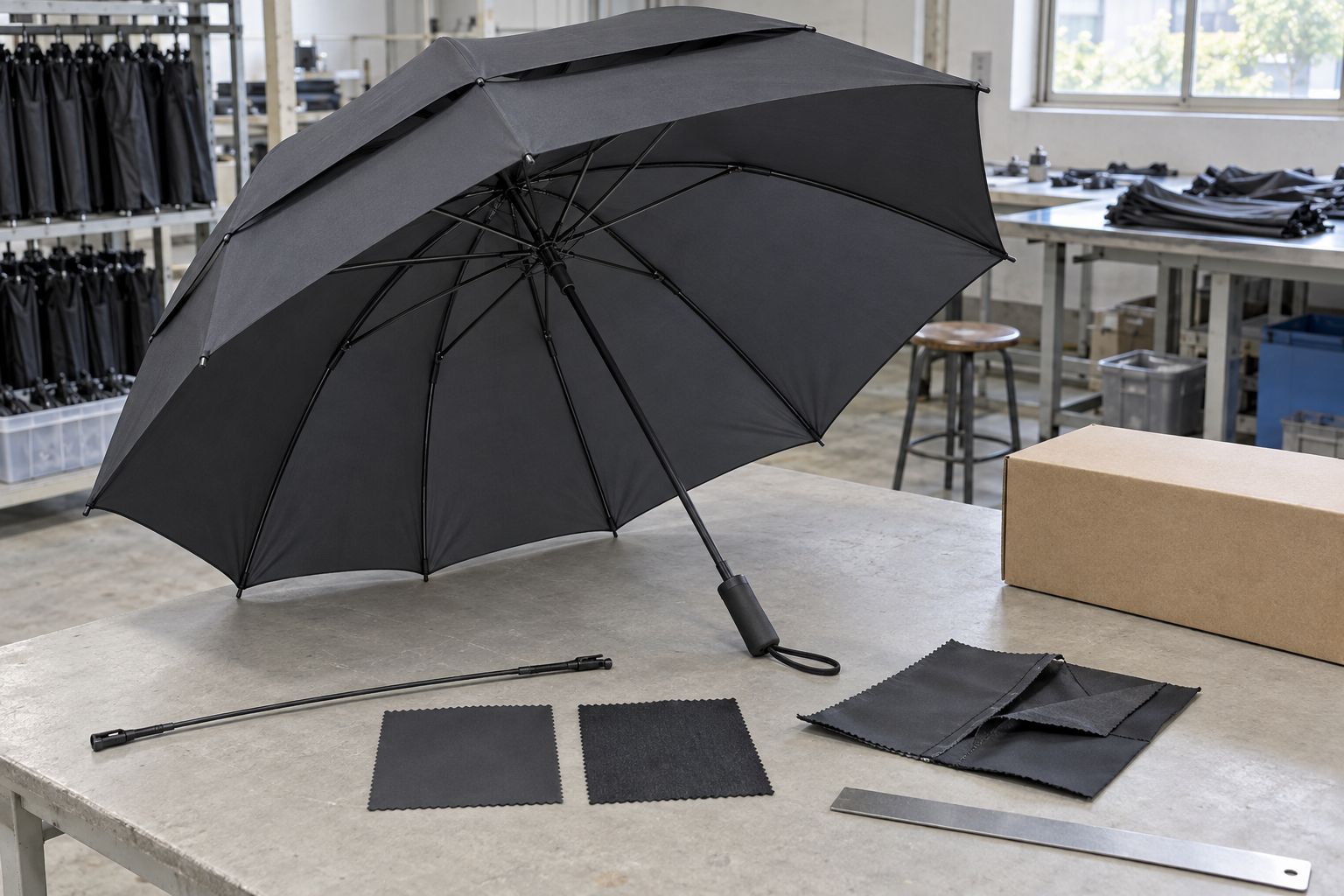
Full fiberglass versus metal. The sourcing guide advises buyers to mandate full fiberglass shafts and ribs due to their elastic recovery under gust loading and non-conductive properties compared with metal alternatives (HF Umbrella guide). While non-conductive framing provides material durability, it does not constitute lightning protection; golf course safety protocols must require individuals to seek indoor shelter during lightning hazards. When contracting for full fiberglass, the purchase specification must mandate fiberglass for the central shaft, primary ribs, and spreader stretchers. Hybrid frames containing concealed steel or aluminum components should be explicitly excluded.
Double vent versus single canopy. The sourcing analysis recommends double-vented canopies that allow updrafts to escape between overlapping tiers, preventing frame inversion on open terrain (same guide). The structural trade-off involves additional stitching lines and increased quality-inspection checkpoints against significantly reduced wind failure rates. The purchase order must define the panel overlap dimension and elastic tie-down reinforcement; subjective terms such as "windproof" must not be accepted as engineering specifications.
190T versus 210T pongee. The guide identifies 190T and 210T pongee polyester weaves as standard golf canopy fabrics (same guide). Thread-count designations reflect yarn density (threads per square inch) rather than hydrostatic head resistance or tear strength. As-of context: sourcing guide published online, accessed as of 2024. The European purchase agreement should require the precise fabric designation, coating specifications (such as polyurethane backing or water-repellent treatments), and verified testing parameters for water penetration.
60–62 inch arc versus 68 inch arc. According to the sourcing guide, standard 60–62 inch arcs (approximately 152–157 cm) provide coverage for one individual and a golf bag, whereas a 68 inch arc (approximately 173 cm) accommodates two adults and expands branding surface area (same guide). Unit: linear inches/centimetres measured along the outer canopy curvature. Larger canopy diameters increase total surface area and aerodynamic drag. For continuity planning, canopies with larger wind profiles carry greater structural stress, potentially raising in-season replacement rates. Contracts must explicitly state canopy arc in centimetres or inches, including measurement methodology and dimensional acceptance tolerances.
Selecting these hardware parameters reduces unexpected inventory attrition during peak seasonal winds but does not replace clubhouse risk management, storm drainage, or personnel evacuation plans.
Published OEM Quantity and Lead Time as Planning Benchmarks
A commercial OEM golf umbrella product page lists stated manufacturing accreditations under ISO 9001 and Sedex 4P, minimum order quantities (MOQ) starting at 100 units, sample/trial order minimums of 50 units, and manufacturing lead times between 30 and 45 days. The same page highlights over 11 years of factory operation, sample provision, and a 1-year bulk order warranty (Hongjie custom golf umbrella page). These statements belong exclusively to that supplier's published representations; they do not represent site credentials, audited European manufacturing baselines, or verified active certifications.
ISO 9001 is a process-oriented quality management system standard; possessing an ISO 9001 certificate does not certify umbrella structural strength or storm performance. Sedex 4-Pillar audits assess labour, health and safety, environmental, and business ethics standards rather than technical product safety. European buyers must demand current certificate documentation, audit scopes, expiration dates, and the precise legal entity issuing commercial invoices. Promotional claims must never substitute for audited documentation.
Procurement planners should apply published metrics strictly as negotiable benchmarks:
- 100 units: Baseline minimum order quantity stated for custom OEM production. Unit: finished golf umbrellas. Scope: supplier's published custom order offer. As-of context: catalog listing reviewed as of 2024; subject to change in live binding quotations. Source: custom OEM golf umbrellas listing (https://www.umbrellas-factory.com/custom-golf-umbrella/).
- 50 units: Published trial-order quantity for custom runs. Unit: finished golf umbrellas. Scope: supplier's published trial order offer. As-of context: catalog listing reviewed as of 2024; subject to change in live binding quotations. Source: custom OEM golf umbrellas listing (https://www.umbrellas-factory.com/custom-golf-umbrella/).
- 30–45 days: Published production lead time. Unit: calendar days. Scope: factory-floor manufacturing duration only, excluding digital proofing cycles, physical pre-production sample sign-offs, ocean freight, customs clearance, and inland transit. As-of context: catalog listing reviewed as of 2024. Source: custom OEM golf umbrellas listing (https://www.umbrellas-factory.com/custom-golf-umbrella/).
Example calculation — an assumption to verify in the supplier quote, not a measured transit result: Consider a European tournament venue requiring 200 branded units on site. Assuming a production lead time of 45 days and an estimated 35-day transit window for sea freight, customs clearance, and inland delivery to an EU or UK hub, the total planning window is 45 + 35 = 80 days prior to event rollout (excluding sample approval cycles). Incorporating an assumed 10 percent safety buffer (20 units) yields an order volume of 220 units. This exceeds the 100-unit factory MOQ and bypasses trial limits. Modifying freight modes or buffer assumptions alters this schedule directly. Buyers must not interpret 80 days or 220 units as fixed commercial terms or industry averages.
When contracting with a single manufacturing partner on a 30–45 day factory schedule, the continuity protocol must document contingency mechanisms: scheduled partial air-freight dispatches, secondary reserve inventories, or pre-approved generic loaner stock. This briefing claims no multi-facility manufacturing network.
Storm-Response Content as a Demand Input
A management study published in the USGA Green Section Record (volume 63, issue 18) emphasizes that weather preparedness protocols must be fully established prior to adverse weather warnings, as storm trajectories frequently shift, stall, or gain intensity without advance warning (USGA article). The source's scope centers on agronomic and facility management for United States golf courses. It does not reflect European legal statutes, UK health and safety frameworks, or historical European storm data. Procurement managers can utilize its procedural framework to structure equipment continuity while verifying local regulatory compliance independently.
The USGA analysis identifies critical response components: documented evacuation procedures, central emergency directories, defined staff roles, comprehensive insurance records, retained restoration contractors, and equipment training. Facility guidance includes elevating sensitive mechanical and electrical equipment out of flood-prone zones, clearing stormwater pathways, maintaining photographic equipment inventories for insurance documentation, and establishing personnel and guest safety as absolute priorities over property rehabilitation (same USGA article).
For an OEM umbrella procurement contract, these principles translate into actionable controls:
- Integrate bulk umbrella inventories, spare canopy textiles, and replacement rib sets into audited photographic asset registries if accepted under the facility's commercial insurance policy.
- Designate specific staff members authorized to decommission damaged frames and issue buffer stock from secure storage.
- Maintain direct factory and logistics emergency contact information alongside service contractor listings, noting contractual production windows on file.
- Ensure inventory replenishment never supersedes venue safety; post-storm response protocols must prioritize personal well-being over asset replenishment.
Insurance policy language, commercial deductibles, and business-interruption coverage terms vary substantially across European jurisdictions. This briefing provides no insurance or legal counsel.
Decision Table for Specification and Approval
"Published benchmark" denotes specifications and claims documented in the cited external sources, not commercial guarantees from this site.
| Decision Area | Specification Mandate | Published Benchmark | Continuity Impact | Pre-Approval Verification Check |
|---|---|---|---|---|
| Frame Integrity | Shaft, rib, and stretcher composite construction | Full fiberglass shaft and ribs for elastic flex recovery and electrical non-conductivity (HF guide) | Decreases frame snapping in squalls, lowering emergency reorder risks | Cross-sectional rib photos; reject mixed metal components if full fiberglass was contracted |
| Canopy Ventilation | Single vs double vent and seam engineering | Double vent enabling wind escape to counter canopy inversion (HF guide) | Mitigates canopy inversion and frame distortion on open courses | Inspect physical vent overlap and elastic retainers; reject unverified "windproof" claims |
| Canopy Textile | Fiber composition, thread density, and coatings | 190T or 210T pongee polyester weave (HF guide) | Governs tear resistance and print adhesion; thread count alone does not ensure waterproofness | Batch lab test documentation verifying hydrostatic water resistance |
| Canopy Dimension | Arc measurement, dimensional tolerances, capacity | 60–62 inch arc (single golfer plus bag); 68 inch arc (two adults) (HF guide) | Larger canopy profiles expand shelter but increase wind drag loads | Physical sample measurement verifying linear arc and allowable tolerances |
| Order Volume | Contracted production lot, trial lot, spare ratio | 100-unit starting custom MOQ; 50-unit trial run (Hongjie page) | Defines minimum threshold for subsequent replacement shipments | Contractually binding MOQ confirmed on formal invoice documentation |
| Schedule Control | Production window vs arrival date | 30–45 production days; shipping transit excluded (Hongjie page) | Unrecorded transit buffers cause seasonal delivery failures | Written separation of production, freight, customs clearance, and inland transit |
| Emergency Procedures | Photographic inventory, contacts, release rights | Documented emergency protocol; photo inventories for loss claims (USGA article) | Connects damaged assets directly to replacement execution and loss recovery | Verification with local facility risk officer and property insurer |
| Destination Rules | Specific EU Member State, EEA nation, or UK | External sources provide no EU/EEA/UK conformity filings | Regulatory non-compliance can trigger customs delays or product import seizures | Destination-specific regulatory and customs legal assessment |
RFQ Checklist
- Ask the supplier to identify shaft and rib material for every frame component, and to state in writing whether the frame is full fiberglass or mixed metal.
- Require the manufacturer to describe double-vent construction, the fabric designation, any coating, and the inspection method to be used on the production lot.
- Specify the arc as a 60–62 inch class, a 68 inch class, or an exact centimetre equivalent, and require the measurement method plus the acceptance tolerance.
- Ask the supplier to separate production lead time in days from artwork approval, packing, freight, and delivery into the named European destination, and to state the Incoterm on the quote.
- Require the manufacturer to state the firm minimum order and any trial quantity in units, and to confirm whether spare canopies or spare ribs ship with the lot or only on a later order.
- Specify the destination as one named EU Member State, one EEA state, or the UK, and ask which product documents apply to that destination only.
- Require the manufacturer to attach current copies of any ISO, Sedex, or other certificate it cites, including scope, expiry, and the legal entity named on the document.
- Ask the supplier to define warranty length, the difference between a defect and wind misuse, and the replacement lead time in days if a lot is rejected on arrival.
- Specify the labeling language and packing marks the destination warehouse requires, and prohibit unapproved logos or certification marks on the product and the carton.
Acceptance, Spares, and the Reorder Trigger
European buyers must evaluate a physical pre-production sample against contractual criteria before approving bulk factory output. Verify arc radius, rib elasticity, vent construction, stitching consistency, and fabric density directly on the sample. Never assume cycle-life durability thresholds, as the cited source materials omit open-and-close mechanical endurance metrics. Retain a sealed, dated counter-sample at the buyer's European operating office for batch reconciliation.
Formalize the replenishment trigger before seasonal course opening. Example assumption to verify in the supplier quote, not a measured failure rate: if more than 5 out of every 100 golf umbrellas deployed during a monthly operating period suffer structural failure, the procurement officer issues a replenishment order within five business days. This 5 percent rate represents an operational modeling threshold rather than an empirical defect rate.
Store reserve inventory in dry, elevated environments to prevent humidity damage. Incorporate stock records into audited photographic logs only after confirming property insurance provisions. Following severe storms, adhere strictly to the USGA life-safety workflow—prioritizing personnel and visitor welfare ahead of physical property cleanup—and tally salvageable umbrella inventory only after course safety is certified (USGA article).
How These Figures Were Derived, and What to Verify
Method. The quantitative benchmarks and design recommendations in this briefing derive directly from three publicly accessible references cited herein. Frame construction standards, vent configurations, and pongee yarn counts (190T and 210T) originate from the HF Umbrella sourcing guide. Minimum production volumes (100 units), trial thresholds (50 units), manufacturing lead times (30–45 days), and references to ISO 9001 and Sedex 4P derive from Hongjie's published golf umbrella page and reflect that vendor's claims as of 2024. Operational disaster planning protocols and photographic inventory practices derive from USGA Green Section Record, volume 63, issue 18. The 80-day delivery timeline, 220-unit order volume, and 5-in-100 replenishment benchmark constitute arithmetic modeling examples constructed from published metrics combined with explicit logistics assumptions. They represent planning models that require empirical verification within binding commercial quotes. No proprietary market demand, search volume, or pricing statistics are used. This site asserts no independent factory certifications, proprietary laboratory data, or manufacturing capacity.
Limitations. The referenced source materials do not provide document revision dates, sample sizes, aerodynamic test velocities, or standardized test methodologies. Supplier web metrics remain subject to unannounced revision. Commercial references to ISO 9001 or Sedex audits do not constitute proof of active compliance, nor do they define structural umbrella durability. Furthermore, USGA emergency guidelines do not supersede legal, workplace safety, or environmental directives enforced within individual EU Member States, EEA signatories, or the UK. Commercial and legal requirements enforced in one jurisdiction cannot be assumed in another. This briefing does not provide binding engineering, insurance, or legal counsel. Prior to contract execution, buyers must validate quotes, test reports, destination compliance filings, and emergency procedures with accredited technical and legal professionals.
Discuss Your Requirements
Review our manufacturing capabilities, then share your specifications for a supplier-fit review.