Golf Umbrella Sourcing: Production Scalability Planning for Malaysia
Vincent Xi, Editorial Author Author profile
Decision first for Malaysian B2B buyers: treat golf umbrella sourcing production scalability planning as three written gates, not as a factory slogan. Before any purchase order, lock (1) monthly capacity in pieces for the named golf-umbrella SKU against the actual Malaysia release calendar, (2) sample-to-mass lead times that start only after fabric, print, and frame are frozen, and (3) QC records that stay the same from a trial lot to the largest call-off. Do not award on MOQ plus a headline annual-capacity figure.
The figures in this brief are supplier-stated claims taken from three public OEM and process pages. Each number keeps the source unit and scope. They are not a universal factory promise and they are not ZheBrella plant statistics. Reconfirm every figure on the live quotation.
- One golf-umbrella OEM page states a 50-piece trial (pieces; that OEM's published trial quantity; undated page), a 100-piece MOQ (pieces; same page), samples in 5–7 days (days; same page), mass production in 30–45 days (days; same page, after sample), customization across 27–72 inch canopy sizes (inches; same page), capacity that exceeds 2 million units annually (units/year; same page), and growth described from 100 pcs to 100,000+ pcs (pieces; same page) (Golf Umbrella Supplier and Manufacturer, Custom OEM).
- A commercial-umbrella process article that includes golf models states an 8-stage process and mass production of 25–35 days (calendar days; commercial umbrellas including golf models on that process page; undated page, with a 2023 golf-umbrella audit cited for a print defect) (Umbrella Manufacturing Process: 8 Stages, 25–35 Day Lead).
- One OEM factory overview describes dual manufacturing bases in China and Cambodia (manufacturing-origin references, not sales-market targets) and states that automated systems reduce waste 15–20% (percent waste reduction; that OEM's described golf-umbrella process; publication timestamp not provided on the cited page) (Inside a Golf Umbrella Factory).
This brief stays on production scalability planning for golf umbrella procurement in Malaysia. It is an RFQ decision brief, not a consumer roundup or a full category manual. Use the table and RFQ checklist to specify, compare, verify, approve, or order.
Production scalability planning for golf umbrella orders in Malaysia
Write the RFQ so a Malaysia inbound program cannot fail silently at usual scale breakpoints: the mill cannot repeat the approved pongee lot, print registration drifts after the sample, frame jigs are not duplicated for a second shift, or mass is quoted as 30 days while fabric and booking buffers are omitted.
The three cited manufacturing pages do not publish a Malaysia-specific golf-umbrella product standard, a tropical test method, an inbound inspection regime, or an SST/customs packing-mark rule. Name canopy size, fabric, frame, print method, packing, and country of origin on the RFQ. Do not assume the factory will infer those controls from the ship-to country.
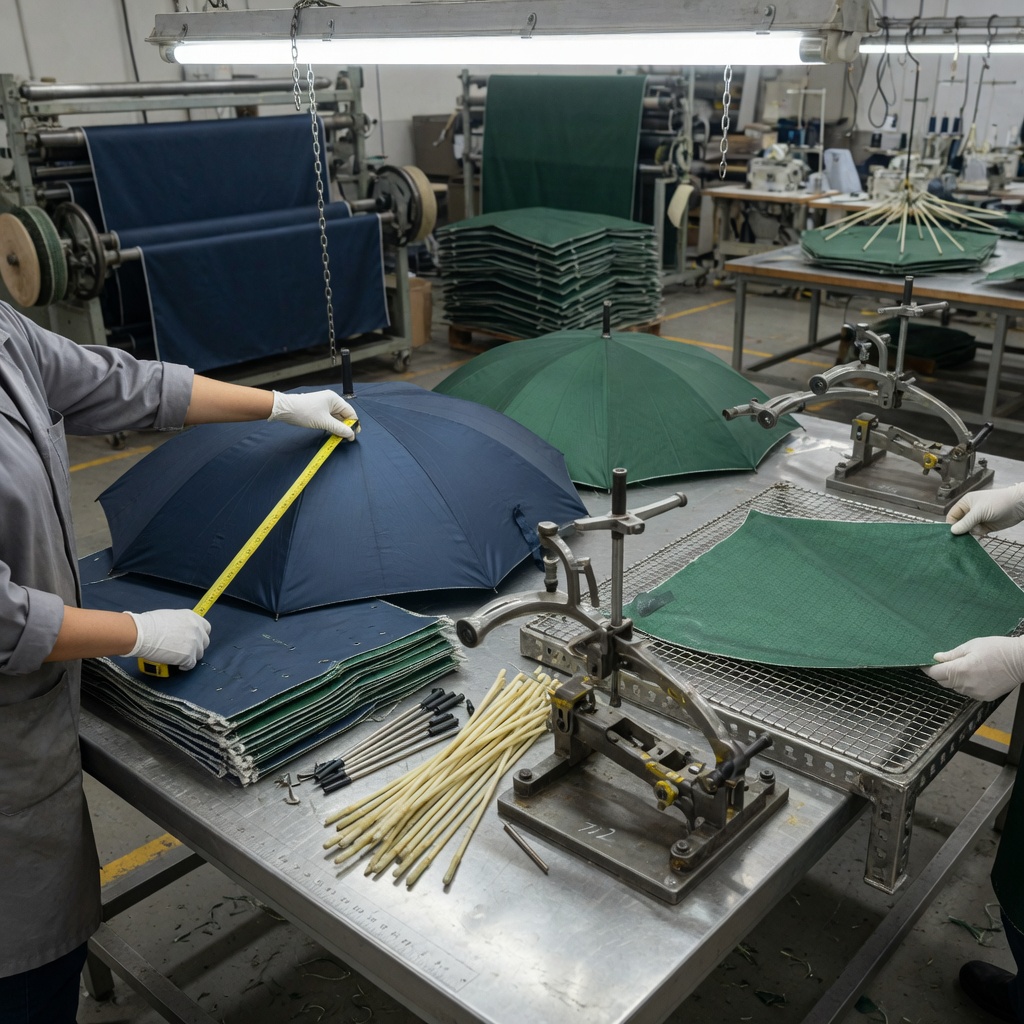
The OEM factory overview describes machinery for fabric slitting, overlocking, panel cutting, sewing, and frame integration, and presents automation as a waste-reduction and flexibility claim for that plant's golf-umbrella process. China and Cambodia on that page are producing-location statements only (Inside a Golf Umbrella Factory).
The process article assigns commercial umbrellas, including golf models, an 8-stage sequence and a 25–35 day mass window (calendar days; commercial/golf scope on that undated process page, which also cites a 2023 golf-umbrella print-defect audit) (Umbrella Manufacturing Process: 8 Stages, 25–35 Day Lead).
Example calculation to verify on the supplier quote, not a quoted price or a plant statistic: 12,000 pieces of one golf-umbrella SKU over 6 months at 2,000 pieces per month (pieces and months: buyer program assumption to verify, not a cited-page figure) will not fit a single 30–45 day mass window (days; one OEM's published mass band after sample; undated page) unless overlapping lots and fabric slots are booked. If published capacity exceeds 2,000,000 units annually (units/year; that OEM's undated annual figure), a 100,000-piece call-off is 5% of a 2,000,000-piece baseline (example calculation: 100,000 ÷ 2,000,000 × 100; lower if the claim is worded as exceeding 2 million). That share applies only if capacity is real, golf-line specific, unloaded, and open for Malaysia delivery. Ask for monthly SKU capacity in pieces, not a headline annual number.
Lock MOQ, trial lots, and capacity proof before unit cost
MOQ is a scalability tool as well as a cost and quality tool. A 50-piece trial (pieces; one OEM's published trial quantity; undated golf-umbrella page) lets a buyer check print, frame, and canopy geometry before a 100-piece MOQ (pieces; same OEM page). That path can reduce stranded inventory on a first Malaysia program. It does not prove the line can hold registration, rib alignment, and stitch density at 10,000 pieces (pieces; example volume to verify on the quote, not a sourced factory slot) or at the 100,000+ pcs growth band on that same page (pieces; OEM-stated growth description, not a reserved slot).
Compare these order patterns in the RFQ:
- Trial then first bulk. Specify trial quantity, pass/fail checks for the bulk lot, and whether trial fabric and print films are the mass tools or only a mock-up.
- Repeating mid-volume releases. Specify whether each Malaysia shipment is a new cut-and-sew lot or a call-off from reserved capacity.
- High-volume reservation. Specify monthly peak in pieces, not only annual total. A large annual figure can still miss a peak month if golf-umbrella frames, large-canopy sewing, or print cooling share capacity with other SKUs.
The 15–20% waste-reduction figure is an OEM process claim tied to automation, not a discount to deduct from every quotation (percent; that OEM's described golf-umbrella process; undated page). Ask what waste means (fabric offcuts, rejected panels, or finished units), whether it applies to large golf canopies, and how rejected panels are quarantined so they do not re-enter a Malaysia-bound lot.
Dual-origin language is a scale variable, not a sales-market target. Name the producing plant, country of origin for customs, and whether a second plant is allowed only after a repeated first-article approval. Origin splits can protect a Malaysia delivery calendar; they can also split tooling, shade lots, and QC discipline.
Put sample and mass lead times on a single RFQ clock
Lead time is the second scalability lever. The cited pages do not agree on a single mass window, so buyers must specify the clock rather than average the pages.
The published windows are 5–7 days for samples (days; one golf-umbrella OEM's sample window; undated page) and 30–45 days for mass after sample (days; same OEM page), versus 25–35 days for mass on the commercial/golf process page (calendar days; 8-stage process including golf models; undated page). Those windows are not interchangeable. A 5–7 day sample that uses substitute fabric, a digital print stand-in, or a hand-built frame does not validate a 25–35 day or 30–45 day mass lot.
For Malaysia procurement, write the clock as:
- Artwork and material freeze date (buyer-controlled).
- Pre-production sample (PPS) days after freeze, including courier time to the Malaysia approving office if physical sign-off is required.
- Mass days after PPS written approval, with fabric mill lead shown separately if the mill is not already stocked.
- Packing, inland, and international transit as extra lines. Factory mass days are not Malaysia receiving days.
If the supplier quotes 25–35 days, ask which of the eight stages are included (especially printing, frame finishing, and final QC). If they quote 30–45 days, ask what extra work sits in the longer band. Do not merge the two published bands into a new 25–45 day statistic; they are different pages with different scopes.
Trade-off: compressing sample days often increases mass risk. The 2023 golf-umbrella audit cited on the process page identified heat-transfer print shifts and called for rigid cooling racks (year 2023 as stated on that process page; golf-umbrella print defect discussed there). Put cooling method, rack count, and dwell time in the approved process. If the quote does not name those controls, treat heat-transfer as unproven at mass.
Freeze canopy, frame, and print controls that must hold at volume
Large golf umbrellas consume more fabric, longer ribs, and more packing cube than compact sticks. The OEM page that publishes 27–72 inch sizes (inches, canopy size range; that supplier's stated customization range; undated page) is a reminder to freeze size, not a menu to keep open after the first article. A move to a 68–72 inch canopy (inches; upper end of that same published range) changes panel pattern, rib load, tip finish, carton dimensions, and how many units fit a Malaysia inbound pallet. Treat a second size as a new SKU.
Specify, rather than paraphrase:
- Fabric. The process article tells buyers to specify fabrics such as 190T Pongee plus frame materials for reliable large-scale sourcing (190T is a thread-count style designation as used on that undated page; commercial/golf buyer-spec guidance, with a 2023 print audit in the same article). If 190T pongee is the approved cloth, name mill, color code, water-repellent finish, and whether a substitute needs written approval. The cited pages do not publish a Malaysia humidity or UV test method; write those as buyer specifications only if the quote attaches a named method.
- Frame. The same OEM customization list names pongee fabrics and fiberglass frames among available constructions. Name shaft, rib, joint, runner, and wind-vent. Freeze those materials in writing so a later lot cannot mix constructions without a new first article.
- Print method. Name heat-transfer, screen, or digital, ink system, maximum colors, and the cooling/rack control that addresses the 2023 shift issue. Require a signed strike-off that uses the mass method.
- Process map. Map the eight stages to the SKU and, for dual-base suppliers, mark which stages occur in which plant.
Trade-off: tighter material locks raise first-lot time and the cost of late artwork changes. Loose material language lowers the first quote and then breaks shade continuity across Malaysia replenishment shipments.
Attach QC records to the PO; do not infer them from certificates
Volume without records is not a scalable process. The process article states that buyers must demand QC records and durability logs, and must specify fabrics and frames. Put those documents on the PO as deliverables, not as a courtesy email.
Ask for, then approve:
- Incoming fabric inspection (width, shade, hand-feel vs sealed swatch).
- Print strike-off vs mass first-piece after the stated cooling dwell.
- In-line sewing and frame checks (stitch type, density method the buyer names, runner function) on a defined sample size per lot.
- Final AQL plan the buyer names (the sources do not publish a default AQL; do not assume one).
- Lot traceability from fabric roll to carton, so a Malaysia receiving reject can isolate a roll or a print day.
- Durability logs the factory actually keeps. If they do not perform a test, do not write it as if they do.
- Failed-lot disposition: sort, rework, replace, and the clock for each, stated in pieces and days.
One cited OEM states it is ISO 9001 and Sedex 4P certified. ISO 9001 is a quality-management system standard; a current certificate is not a product test report and is not proof that a golf umbrella lot met PO canopy and frame specs. Sedex 4P is a social-audit format some buyers request. Both claims belong to that named supplier on that page, not to ZheBrella, and should not be copied onto a Malaysia RFQ as if every golf-umbrella factory holds them. If a certificate matters, request the current document, site address, and expiry date. Do not treat an undated web claim as a live certificate.
Malaysian import classification, SST treatment, packing marks, and inbound inspection are not specified on the factory pages used here. Those items belong with the buyer's customs broker and the invoice/packing-list set. Scalability planning still needs origin, HS description, carton count, and gross weight on the same document pack that QC uses.
Buyer decision table: choose a scale path before the RFQ
Use this table to compare production paths for a Malaysia golf umbrella program. Each row is a decision to specify or verify. Figures rest on the cited pages and remain subject to the quote.
| Scale path | Order pattern to specify | Capacity proof to request | Lead-time clock to confirm | QC / documents to approve before mass | Main trade-off |
|---|---|---|---|---|---|
| Trial and first custom lot | 50-piece trial then 100-piece MOQ if using the published OEM pattern (pieces; one OEM page; undated) | Named line and plant; whether trial locks mass tools | Sample 5–7 days after freeze (days; same OEM page); mass only after PPS | Swatch, strike-off, first-article canopy and frame | Faster learning vs higher unit cost and incomplete process proof |
| Repeating mid-volume releases | Staged POs (piece count per Malaysia shipment) | Monthly golf-umbrella SKU output, not mixed annual totals | Mass 25–35 or 30–45 days after PPS (days; two cited pages—do not blend); mill lead separate | In-line checks, lot traceability, print cooling | Continuity vs hidden variation if jigs or shade lots are not duplicated |
| High-volume 100,000+ pieces | Multi-month reservation, peak month named, SKU freeze date (pieces; OEM-stated growth band, not a reserved Malaysia slot) | Peak-month capacity; mill allocation; overtime plan | Buffers beyond advertised mass days | Lot genealogy, durability logs, change-control, origin per plant | Lower unit cost vs lock-in, change cost, and split-origin risk |
| Dual-plant build (if offered) | First mass at one approved plant; second plant only after repeated first-article | Capacity by plant; which of the eight stages sit in each plant | Extra days for second-plant qualification | Duplicate jigs, shade standards, and QC records | Malaysia calendar protection vs shade/tooling drift |
| Large-canopy SKU (27–72 inch range) | Exact inch size, vent, and closed length on the PO (inches; OEM published range; undated page) | Capacity is for that canopy size, not a compact SKU | Extra cut/sew/pack time; carton cube for Malaysia inbound | Rib alignment, canopy diameter, tip finish, pack check | More coverage vs more fabric, freight cube, and frame load |
Approve mass only if the quote names the producing plant, remaining monthly slots in pieces for the frozen golf-umbrella SKU, a PPS that uses mass fabric/print/frame, a buyer-named AQL, and signed change-control. Hold if capacity is annual-only, the sample method differs from mass, or a cited certificate lacks site and expiry. Reject as non-scalable if there is no lot traceability, no cooling control for heat-transfer, an unapproved plant switch, or an MOQ that is actually per color/print rather than per SKU.
Do not treat a factory marketing page's annual figure as a reserved 100,000-piece golf umbrella slot. Ask for the unit, the month, and the SKU family.
RFQ checklist for golf umbrella procurement and production scalability planning
Each item can be specified, compared, verified, approved, or restated on the purchase order.
- Program calendar. Malaysia receiving months, piece count per release, and whether leftover units may ship early.
- SKU freeze. Canopy size in inches, closed length, colorways, logo positions, wind-vent yes/no, and whether a second size is a new SKU.
- Trial and MOQ. Whether a 50-piece trial is required, pass/fail data for bulk, and MOQ in pieces per SKU and per color (pieces; published OEM pattern to confirm on the quote). Do not accept 100 pieces if it is actually 100 per print.
- Capacity table. Monthly golf-umbrella capacity for the next two quarters, current load, remaining slots in pieces, and overtime/second-shift inclusion.
- Plant and origin. Producing factory address, country of origin, and whether dual bases may be used. Manufacturing origin is not a sales-market target.
- Sample clock. PPS days after freeze; PPS unit count; whether PPS fabric is the mass mill lot; Malaysia courier destination if physical approval is required (restated 5–7 day sample windows on the quote).
- Mass clock and transit. Mass days after written PPS approval; 25–35 day process-page band or 30–45 day OEM band, with inclusions listed. Packing, inland haul, and international transit as separate lines. Factory mass days are not Malaysia receiving days.
- Fabric spec. 190T pongee or the approved cloth; mill; shade code; finish; substitution rule.
- Frame spec. Fiberglass or other approved materials; shaft/rib/joint/runner; spare-rib policy if required.
- Print spec. Method, colors, size, and cooling-rack/dwell control for heat-transfer shift risk identified in the 2023 golf-umbrella audit.
- Process map. Eight stages mapped to work centers and plants; automation steps if waste-reduction claims are part of the bid.
- QC, AQL, and failed lots. Incoming, in-line, and final records; durability logs; first mass piece vs PPS; buyer-named AQL; critical defects (frame failure, canopy holes, unsafe tips) and major defects (print shift, shade, stitch); sort/rework/replace clocks before the next Malaysia release.
- Change control. Written approval for mill, frame sub-supplier, print shop, or plant change before a Malaysia replenishment lot.
- Packing. Units per inner, inners per export carton, carton size/weight, polybag spec, palletization, and marks without implying unearned certificates. The cited pages do not publish a Malaysia humidity packing standard.
- Document pack. Invoice, packing list, origin statement, and—only if held—current ISO 9001 or Sedex documents with site and expiry. Do not request certificates the factory has not claimed.
- Reservation, golden sample, and re-order sameness. Monthly piece reservation and cancellation window; golden sample in Malaysia plus a sealed factory sample; next lot uses the same fabric rules, print files, and jigs, or repeats PPS.
Method, source context, and what to verify
Author and experience basis. This procurement brief is published under the named editorial author Vincent Xi, Editorial Author, with job title Editorial Author and profile URL https://www.zhebrella.com/authors/vincent-xi/. No first-person factory visit, lab test, client result, unpublished capacity figure, or first-person use claim is used. The public author profile supports role attribution only.
How the data was derived. Concrete figures were extracted from three public supplier/process pages: Inside a Golf Umbrella Factory, Umbrella Manufacturing Process: 8 Stages, 25–35 Day Lead, and Golf Umbrella Supplier and Manufacturer, Custom OEM. Each number keeps the source's unit (percent, days, pieces, inches, annual units) and scope (that OEM's process, the process article's 8-stage commercial/golf path, or that OEM's published MOQ/capacity/size range). The 2023 audit year is stated where the process article gives it. Other pages are treated as undated public statements and must be reconfirmed on the live quotation. Two source contexts are used: (1) factory-process and automation/capacity narrative from the OEM factory overview, and (2) staged manufacturing lead-time plus QC/spec guidance from the process article and the custom OEM page.
Limitations / what to verify. Third-party OEM pages are not ZheBrella plant records. Waste 15–20%, mass 25–35 days or 30–45 days, sample 5–7 days, MOQ 100 pieces, trial 50 pieces, size 27–72 inches, and annual capacity above 2 million units can all be marketing or plant-specific. ISO 9001 and Sedex 4P, where mentioned, are that named supplier's stated certificates and need current documents with site and expiry. The pages do not publish prices, AQL defaults, Malaysia SST/customs rules, independent lab results, or a tropical-climate test method. Buyer program counts such as 12,000 pieces over 6 months are example calculations to verify on the quote, not sourced demand figures. Verify every number, plant, certificate, and process control on the RFQ response before approving mass production for Malaysia delivery.
Discuss Your Requirements
Review our manufacturing capabilities, then share your specifications for a supplier-fit review.