Golf Umbrella Wholesale Supplier Production Scalability Planning for Europe
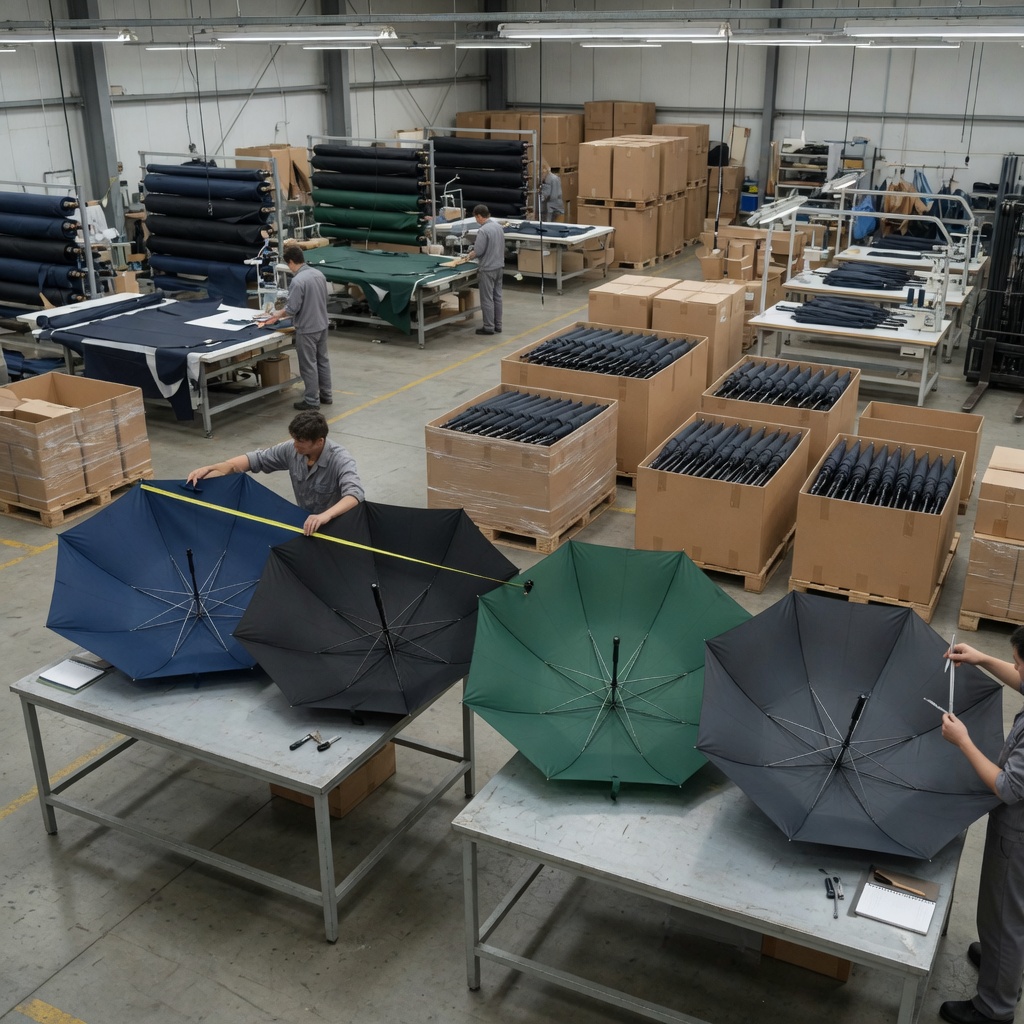
Editorial author: Vincent Xi, Editorial Author at ZheBrella.
Before you award a golf umbrella wholesale supplier for Europe, treat production scalability planning as a written lock on four items: golf-only line capacity for the reserved weeks; MOQ by colourway and print; the mass-production clock start after pre-production sample sign-off; and a packing plan that splits EU, EEA, and UK marks when those destination rules differ. The work is capacity booking plus specification control, not a catalogue search.
Work in this order: specify the golf SKU and the on-shelf or event date in Europe; compare published factory signals; verify golf-only takt time and destination files on a dated quote; approve a reserved line-week; then order. Mixed-SKU pieces-per-day marketing is not a reserved slot.
The three supplier-published OEM pages cited below are manufacturing-origin disclosures, not Europe sales-market claims. They state mixed-umbrella output in the thousands of pieces per day and annual ceilings from 500,000 pieces per year to 3 million-plus pieces per year. On those same pages, golf or custom MOQs are quoted at 500–1,200 pieces, with one factory also listing 100 pieces in-stock / 600 pieces custom. Mass production is quoted at 20–35 days after sampling. One of the three pages tells buyers to place peak-season orders 3–4 months in advance. Those figures are self-reported, may mix compact and golf SKUs, carry no last-updated date on the excerpts used here, and are not independently audited in this article. A Europe RFQ must still isolate golf canopy size, rib count, print method, QC sample rate, and the EU, EEA, or UK destination rules that change packing, labelling, and chemical documentation.
Capacity metrics that constrain golf umbrella wholesale supply
Annual capacity on a factory website is a planning ceiling, not a reserved slot for your golf SKU. Reconcile the following supplier-published examples on a dated quote; do not copy them into a contract.
- One OEM factory page states a 5,000 m² site, 4 production lines, up to 3,000 umbrellas per day, 30,000–50,000 umbrellas per month depending on type, and 500,000 umbrellas per year (World Umbrellas factory page; as published, last-updated date not stated on the excerpt used here). Golf umbrellas are listed with a separate MOQ, which implies the daily and monthly totals are mixed-type output.
- Another manufacturer page states a 6,000 sqm factory, 5,000+ pieces daily output, and 1.5 million+ pieces annual capacity, positioned as a path from sampling to mass production (T-Umbrella; as published, last-updated date not stated on the excerpt used here).
- A third OEM page states 3 million+ pieces annual capacity and 3 production lines, with golf umbrellas listed among supported products (Ark Umbrella manufacturer page; as published, last-updated date not stated on the excerpt used here). The “since 2010” line on that page is a company-history statement, not an audit certificate.
A larger published annual number helps only if unused line hours exist in your ship week and if golf umbrellas consume those hours at a known rate. A buyer-specified 60–70 inch golf canopy (about 152–178 cm open arc; example specification to confirm in the RFQ, not a figure from the three factory pages) uses more fabric, longer ribs, and usually a heavier shaft than a compact folding umbrella. If a line’s 3,000 pieces/day figure is dominated by smaller SKUs, golf throughput can be materially lower.
Treat any conversion of mixed daily output into golf pieces as an example calculation to verify in the supplier quote, not as a fact: if golf units take 1.3–1.8× the cycle time of a compact unit (assumption only), 3,000 mixed pieces/day might equate to roughly 1,700–2,300 golf pieces/day. Only the factory’s golf-specific takt time at your rib count, canopy fabric, and print method can confirm this.
Ask for capacity in four units for the same reserved week: (1) open golf umbrellas per line per day at your rib count and canopy fabric; (2) printed versus unprinted split; (3) QC hold rate and AQL sample size as specified by the buyer; (4) packed export cartons per day at your carton spec. Factory area (5,000 m² versus 6,000 sqm in the cited examples) is a weak proxy unless sewing, rib assembly, printing, and packing bottlenecks are named.
Hold the award if the quote restates mixed-SKU daily or annual ceilings and cannot name golf pieces per day on a reserved week. Reject the award if the only capacity evidence is an undated website slogan.
MOQ, sampling, and mass-production windows in published factory data
Wholesale supply for golf umbrellas usually fails first on MOQ and calendar, not on a mock-up. Published ranges from the same three pages:
| Signal (verify current; date not stated on excerpts) | World Umbrellas factory page | T-Umbrella | Ark Umbrella manufacturer page |
|---|---|---|---|
| Golf / custom MOQ | 100 pcs in-stock or 600 pcs customised | Custom golf typically 500–1,000 pcs | Standard 500–1,200 pcs |
| Sample lead time | 5–7 days | 7–12 days | 7–10 days |
| Mass production | 20–30 days | 25–35 days | 25–35 days (bulk) |
| Peak-season planning note | Not stated on the cited excerpt | Not stated on the cited excerpt | Place orders 3–4 months in advance |
Sources: World Umbrellas, T-Umbrella, Ark Umbrella. Treat every cell as supplier-published and time-check it in writing on a dated quotation. Do not average the three factories into a typical-industry MOQ.
Measurable trade-offs:
- Lower MOQ versus line efficiency. A 600-piece custom golf MOQ is easier for a first Europe programme, but a factory quoting 3 million pieces/year can de-prioritise small runs when peak demand hits. Split a 5,000-piece annual need into two 2,500-piece drops only if the supplier confirms both drops stay on the same BOM and print standard (example volume ladder to verify, not a sourced factory offer).
- Sample days versus mass-production days. Quoted sample windows of 5–12 days do not include art-approval cycles, physical colour strikes, or shaft/handle substitutions. Quoted mass windows of 20–35 days typically start after written sample approval. If the destination needs extra hangtags or UK-specific marks, add a documentation gate before cutting.
- In-stock 100-piece MOQ versus custom 600+. In-stock golf SKUs can move faster but rarely match a later branded colourway, wind-vent spec, or fibre content at higher volume. Using in-stock as a bridge only works if the custom BOM is already frozen.
Your RFQ should ask for a golf-only capacity calendar for the exact week you need goods at a named EU, EEA, or UK port or warehouse.
Production scalability planning for peak-season golf umbrella orders in Europe
For wholesale supply into Europe, treat the on-shelf or event date as a buyer calendar input, not as a demand statistic. Corporate hospitality, course pro shops, and outdoor events often need golf umbrellas in a named spring or summer week (planning scenario to specify, not a measured market size from the three factory pages). The only peak-booking figure in the cited set is Ark Umbrella’s note that peak-season orders should be placed 3–4 months in advance for production planning (Ark Umbrella; as published, last-updated date not stated on the excerpt used here). Use that as a planning hypothesis to test against your volume, not as a rule that applies to every destination in Europe or every factory.
A practical booking model (every invented number is an assumption to verify):
- Reverse from the required on-shelf or event date in Europe, not from the factory ready date. Add ocean or rail transit, destination handling, and a quality-hold buffer. Transit and import time are not stated on the three factory pages; obtain them from the forwarder against a named Incoterm and a named EU, EEA, or UK place.
- Freeze the BOM before any 3–4 month booking window you are asked to accept. Canopy fabric, rib material (steel versus fibreglass), shaft, handle, auto-open hardware, print colours, and carton inner quantity all change sewing and packing hours. Polyester or pongee canopies are common buyer specifications in this product family (confirm fibre, gsm, and coating on the quote; not a tested claim from the three pages).
- Reserve printed versus unprinted capacity separately. Full-cover logos on an eight-panel golf canopy (example panel count to specify) consume print slots that a plain wholesale run does not.
- Plan two QC gates: pre-production sample and during-production or pre-shipment inspection. If AQL sampling increases from a small pilot to a 10,000-piece drop (example volume), packing hours can rise even when sewing hours look linear. AQL here is a buyer-specified inspection plan, not a published factory standard on the three pages.
- Do not assume unused annual capacity is available in March–May. A factory stating 1.5 million or 3 million pieces/year can still be fully loaded on golf and large-stick lines in the weeks Europe programmes need goods.
Example calendar (assumption to verify, not a quote): event goods needed in Germany in early May → latest factory ex-works target in March → sample approval in January → RFQ and capacity reservation in November–December of the prior year. This Germany date is a destination example; it does not make German packing or labelling rules apply to other countries in Europe. If the supplier cannot name a reserved line-week in writing, you do not have scalability; you have an unbooked queue.
EU, EEA, and UK specification differences that affect line loading
Europe is not one compliance file. The cited factory pages do not publish restricted-substance dossiers, UKCA/CE statements, or country packing rules, so this section is a procurement specification warning, not a claim that any named factory is certified or that one rule covers all of Europe. State EU, EEA, and UK requirements separately in the RFQ whenever they differ for your SKU. UKCA and CE are named here only as document types buyers often request; this article does not state that either mark is required for every golf umbrella or that any cited factory holds a current certificate.
- Destination split. Goods remaining in the EU customs union, goods entering an EEA state, and goods entering Great Britain do not automatically share the same marking, importer-of-record, and market-surveillance file. If the delivery point is Northern Ireland, do not assume the same file as Great Britain. Name the first landing place and the final selling countries.
- Chemicals and materials. Canopy coatings, inks, adhesives, and handle plastics can trigger restricted-substance documentation. Ask for a lot-level substance declaration against your specified regulation set for each named destination. EU rules and UK rules are not automatically the same file. Do not treat a factory “audited” adjective (T-Umbrella uses “audited factory” as a marketing claim on that page) as a substitute for a current test report on the actual golf canopy lot.
- Labelling and language. Care labels, fibre content, and importer details may need different languages by EU Member State or by UK destination. Extra labels are packing-line hours, not a free PDF.
- Packaging and waste. National packaging and extended-producer-responsibility duties, carton marks, and pallet specs can differ by country. A UK-only programme and a France-plus-Germany programme are two packing SKUs if marks differ. Confirm the importer’s duties for each selling country; this article does not state a single packing rule for Europe.
- Product safety file. Golf umbrellas are generally not toys, but pointed ferrules, auto-open springs, and wind-vent construction still belong in a technical file the importer can produce. That file is the buyer’s or importer’s duty unless a written agreement says otherwise. Do not assume a notified-body process applies unless your specified use and claims put the SKU in a regulated category; verify with the importer and counsel.
Consolidating EU and UK versions onto one sewing run can save cutting hours but can add a second packing pass. Production scalability planning should cost that second pass before you promise a single ex-works date.
None of the three source pages is a legal text for the EU, the EEA, or the UK. Verify current official requirements with your importer and counsel. Do not treat an undated factory audit phrase as EU, EEA, or UK market access.
Buyer decision table: scalability signals versus order risk
Use this table to compare suppliers and to approve or reject a golf umbrella wholesale award. Every row is a specify / compare / verify / approve / order action. Published ranges are examples from the cited pages, not ZheBrella promises.
| Decision signal | Why it matters for golf wholesale | Example published range (verify; mixed SKUs possible; excerpts undated) | Risk if you do not lock it | What to put in the purchase order |
|---|---|---|---|---|
| Golf-only daily output | Large canopies and extra ribs reduce mixed-line throughput | Up to 3,000 pcs/day mixed (World Umbrellas); 5,000+ pcs/day mixed (T-Umbrella) | Peak week is given to smaller umbrellas | Named line, golf takt time, reserved dates |
| Annual capacity versus your share | Ceiling is not a reservation | 500,000 / 1.5M+ / 3M+ pcs per year across the three pages | Your 8,000 pcs (example share) is invisible next to 3M | Written capacity hold, cancellation calendar |
| Production lines dedicated or shared | Print and rib jigs are the usual bottleneck | 4 lines (World Umbrellas); 3 lines (Ark Umbrella) | Changeovers erase the 20–35 day promise | Changeover hours and max SKUs per week |
| Custom golf MOQ | Sets whether a Europe pilot is even possible | 600 custom or 100 in-stock; 500–1,000; 500–1,200 pcs | Forced overbuy or rejected artwork | MOQ by colourway and by print, not only by style |
| Sample lead time | Drives art and hardware freezes | 5–7 / 7–12 / 7–10 days | Mass line starts on an unapproved handle | Sample type (size, print, hardware) and approval form |
| Mass lead time after approval | Cash and event dates | 20–30 / 25–35 / 25–35 days | Late for a spring event in Europe | Clock start = written PP sample sign-off |
| Peak booking window | Outdoor-season dates in Europe are not flexible | 3–4 months advance (Ark Umbrella) | Paying air freight or missing events | Reservation date + volume band |
| Factory area | Weak capacity proxy | 5,000 m²; 6,000 sqm | Believing square metres = golf slots | Bottleneck process named (print, sewing, pack) |
| Inspection plan | Defective vents and runners scale with volume | Not quantified on the cited pages | High AQL fails after the ship window | AQL, inspection stage, hold-and-repair hours |
| EU versus UK packing SKU | Second pack pass consumes the last week | Not stated on factory pages | Goods held for marks | Separate SKUs or a confirmed dual-mark pack method |
RFQ checklist for production scalability planning
Send this as one packet. Each item is something the Europe buyer must specify, the supplier must answer with a number or document, or the importer must approve before production starts.
SKU and quality
- SKU definition (golf umbrella only): arc size in cm and inches, open diameter, panel count, canopy fabric/fibre and gsm, coating, rib material and count, shaft, handle, auto-open or manual, wind vent yes/no, closed length, unit weight target. Do not accept a mixed umbrella SKU line.
- Print and colour method: panel print versus sewn-in logo versus transfer; colour standard; outdoor fade as a test method you name, not as a slogan.
- QC and AQL: inspection stages, sample size, critical defects (runner failure, broken rib, canopy hole, incorrect logo), and repair/re-pack hours inside the lead time.
- Change control: how a rib, fabric mill, or ink substitution is approved so the importer’s technical file stays valid for the named destinations.
Volume, calendar, and capacity reservation
- Volume ladder: pilot quantity, first drop, and optional second drop, with dates needed in Europe (not only ex-works).
- Golf-only capacity calendar: pieces per day on the actual line, for the reserved weeks, after deducting other confirmed orders; printed versus unprinted split.
- MOQ by colour and by print: confirm whether 500–1,200 pcs is per design or per total style, and whether in-stock 100 pcs (if offered) uses a different BOM.
- Sample path: days for size sample, printed sample, and pre-production sample; who pays; how many revision rounds are inside the quote.
- Mass-production clock: 20–35 day class quotes must state the exact start event (deposit, fabric in house, or signed PP sample).
- Peak-season hold: if you need spring goods in Europe, ask whether a 3–4 month booking is required for your volume, in writing, with a release date and cancellation calendar.
- Scalability trigger: the volume at which lead time, MOQ, or print method changes, and the notice you must give to keep the original date.
EU / EEA / UK destination file (do not write Europe as one box)
- Destination legal set: list EU Member State(s), EEA state(s), and/or UK (Great Britain and, if applicable, Northern Ireland) separately.
- Restricted substances: lot-level documentation for canopy, ink, and handle against the regulation set that applies to each named destination; separate EU and UK packs if both apply; do not accept an undated factory brochure as the file.
- Labelling pack: fibre, care, importer, and language variants; confirm whether EU and UK versions are one or two packing SKUs.
Export pack, delivery, and evidence
- Export pack: pieces per inner, inners per export carton, carton size and gross weight, pallet pattern, moisture protection, and marks—without assuming a flag graphic on the carton.
- Incoterm and delivery place: named place in the EU, EEA, or UK; who books inspection; who files import data.
- Evidence pack with the quote: current line count, a golf-specific production schedule table for the reserved weeks, the date those capacity numbers were last updated, and the bottleneck process (print, sewing, or pack).
Reject a quote that restates website slogans (for example 1.5M+ or 3M+) without a golf-week reservation and a destination-specific packing plan.
How this article’s figures were derived, and what you must still verify
Source contexts. (1) Planning numbers above come from three supplier-published pages: a factory/capacity page describing a 5,000 m² site and golf MOQ/lead times (World Umbrellas); a manufacturer homepage stating 6,000 sqm, daily and annual output, and custom golf MOQ/lead times (T-Umbrella); and an OEM page stating 3 million+ annual capacity, three lines, MOQ/lead times, and a 3–4 month peak-season planning note (Ark Umbrella). They are commercial disclosures about umbrella OEM production, including golf umbrellas, not official publications of the EU, the EEA, or the UK. Manufacturing origin is not a sales-market target for this page. (2) EU, EEA, and UK comments are specification prompts because those factory pages do not publish destination legal files; current official requirements must be confirmed with the importer and counsel for each named selling country.
Methodology. Figures were copied in the units given (m², sqm, pieces per day/month/year, pieces MOQ, calendar days). Mixed-type daily output was not converted into certified golf throughput; any 1.3–1.8× cycle-time example is labelled as an assumption for the quote. Canopy inch/cm sizes, panel counts, and example volume ladders are buyer-specification examples to verify, not measurements from the three pages.
Limitations / what to verify. Self-reported capacity can include many umbrella types; golf umbrellas may be a minority of the 500,000–3,000,000 piece ceilings. Excerpts used here are undated. “Audited factory” is not a named standard or a current certificate in this article. Lead times omit art approval, fabric procurement, inspection failure, and Europe-bound logistics. Chemical, labelling, and packaging duties depend on the importer’s countries and can change, and they do not apply uniformly across the EU, EEA, and UK. Confirm every number on a dated quotation, with a golf BOM, reserved line-week, and a named EU, EEA, or UK delivery point before you approve production.
Vincent Xi is the named editorial author for this wholesale-supply planning page. No factory visit, laboratory test, or customer outcome is claimed.
Discuss Your Requirements
Review our manufacturing capabilities, then share your specifications for a supplier-fit review.