Golf Umbrella Wholesale Supplier Batch Traceability Plan for United States Buyers
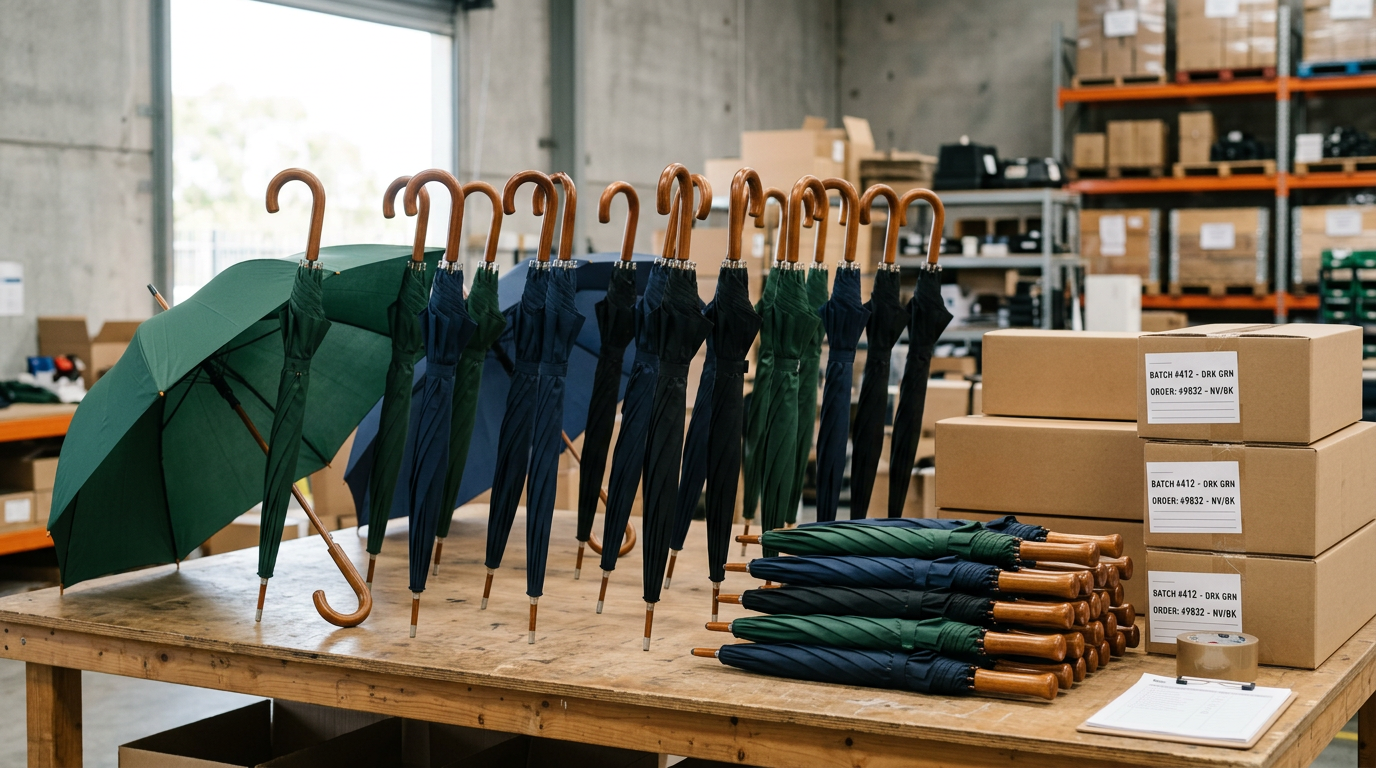
A golf umbrella wholesale supplier batch traceability plan gives a United States buyer a clear way to link each delivered umbrella to the batch that produced it. The plan defines how a batch is identified, what records follow the canopy, shaft, handle, ribs, and packing through production, and how that identity stays with the goods through shipment, receipt, and onward distribution. When the definition, the records, and the labels are agreed before ordering, the buyer can check a delivery against the order, separate one batch from another, and ask focused questions when a difference appears.
This guidance is written for a buyer who is comparing wholesale supply options and preparing an RFQ. It does not describe a single product variant or a single supplier process. Instead, it sets out the decisions the buyer and the supplier must agree, the fields that belong on batch records and labels, and the checks that belong at receipt. The buyer uses the same plan to compare responses, to keep ordering and receiving consistent, and to keep the record of what was ordered, what was made, and what was delivered together in a form that can be reviewed later.
What a Batch Traceability Plan Should Cover for Golf Umbrella Wholesale Supply
A workable plan starts with a shared definition of a batch. The buyer and supplier agree what makes umbrellas part of the same batch, for example umbrellas made from the same agreed material lots, in the same production run, under the same agreed specification. The definition should be narrow enough to separate batches when a question arises, and stable enough to apply across repeat orders. If the definition changes, the change should be recorded and agreed before the next order, so earlier batches keep their original identity.
The plan should also cover the components that make up the finished umbrella. Canopy fabric, shaft material, ribs, tips, handle material, fasteners, and packing are each linked to a lot or source record where the buyer and supplier agree that the link is needed. The buyer does not need the same level of detail for every component, and the plan should state which components are tracked by lot, which are tracked by production run, and which are tracked only by finished batch. That choice should be written down, so a later review does not depend on memory or on a general description of the production process.
Production records form the next part of the plan. The supplier records the batch identity, the component lots used, the production sequence, and the inspection and packing results that belong to that batch. The buyer asks what fields are recorded, who records them, and how a correction is made when an entry is wrong. A correction should keep the earlier entry visible and show the reason for the change, so the history of the batch remains clear. The plan should also state how records are stored, how they can be retrieved by batch number, and how long they remain available to the buyer under the agreed arrangement.
Labeling and packing carry the batch identity from production to receipt. Each carton, inner pack, and umbrella label that the buyer and supplier agree to mark should show the same batch identity in the same form, so the buyer can match the goods to the shipment documents without opening every carton. The plan should define the label fields, the placement of the labels, and the way a mixed carton is marked when it contains more than one batch. Where the buyer needs a particular label format for onward distribution, that format should be agreed before production, not added after packing is complete.
How to Build the Batch Traceability Plan Step by Step
- Define the batch in writing, including what starts a new batch, what keeps umbrellas in the same batch, and how a batch number is formed.
- List the components and materials to be tracked, and agree which are tracked by lot, which are tracked by production run, and which are tracked only by finished batch.
- Agree the production record fields, including batch identity, component lots, production sequence, inspection results, and packing results.
- Agree the label and packing fields, including batch number, order reference, quantity by batch, and carton identity, and agree where each field appears.
- Agree how batches are kept separate during production, inspection, packing, and loading, and how a mixed shipment is identified.
- Agree the shipment documents that travel with each delivery, including how batch identity appears on the packing list and delivery note.
- Agree the receipt check, including what the buyer checks on arrival, what is recorded, and how a mismatch is raised with the supplier.
- Agree how records are retained and shared, who holds each record, and who the buyer contacts when a batch question arises.
Each step should produce a written agreement that both sides can use at ordering, production, and receipt. When a step is left open, the buyer should note the gap in the RFQ and ask the supplier to close it in the quotation. A plan that is agreed in outline only is difficult to use when a delivery arrives with more than one batch, when a carton label is unclear, or when the buyer needs to find the record for a particular batch after distribution has started.
United States Buyer Controls for Batch Records, Labeling, and Delivery
A United States buyer should set receipt controls that match the way the goods will be received, stored, and distributed. The buyer defines the delivery lots in advance, asks the supplier to keep those lots separate in packing and loading, and checks the batch identity on the cartons against the packing list before the goods are put into stock. When a delivery contains more than one batch, the buyer records each batch separately and keeps the batches separate in storage until the receipt check is complete. That separation makes it possible to hold one batch while releasing another, and to trace a later question to the batch that it belongs to.
Labeling controls should be agreed for the United States receipt and onward distribution. The buyer asks the supplier to identify any labeling or documentation the buyer needs for receipt, storage, and onward distribution, and to agree who provides each item. The buyer should also ask how the supplier handles a label that is missing, damaged, or inconsistent with the packing list, and what replacement or correction is provided. A clear label process reduces time spent checking cartons at receipt and reduces the risk that batches are mixed during put-away.
Delivery controls should cover the shipment as a whole and each batch within it. The buyer and supplier agree the delivery quantity by batch, the carton count by batch, and the way the shipment documents show those quantities. The buyer checks the count by batch at receipt, records any difference, and raises it with the supplier using the batch number, order reference, and carton identity. The plan should also state how a partial delivery is handled, how a missing carton is reported, and how a replacement delivery is linked to the original batch or to a new batch.
Landed cost should be handled as a set of agreed fields, not as a single figure to be assumed. The buyer asks the supplier to show the product, freight, handling, and any other agreed charges as separate fields in the quotation, and to state what each field includes and what it excludes. The buyer also asks how a change in shipment, packing, or delivery terms would change those fields, and who bears each charge under the agreed terms. Keeping the fields separate makes it possible to compare quotations on the same basis and to check the final invoice against the agreed fields by batch and by delivery.
Comparing Wholesale Suppliers on Traceability
When comparing wholesale suppliers, the buyer should use the same traceability questions for every supplier and record each answer against the same batch definition. A supplier who can describe the batch definition, the record fields, the label fields, and the receipt check in the same terms as the RFQ is easier to compare than a supplier who describes traceability in general terms only. The buyer should look for consistency between the written plan, the sample label, the sample packing list, and the sample record, and should ask for clarification where the samples do not match the written description.
The buyer should also ask how the supplier handles a change during production. A change in material lot, a change in production sequence, or a change in packing should create a clear record, and the buyer should be able to see whether that change starts a new batch or remains within the existing batch under the agreed definition. The supplier should state who approves the change, how the buyer is informed, and how the change is shown on the label and shipment documents. A plan that leaves change handling undefined is difficult to use when a repeat order does not match the earlier delivery in every detail.
| Decision area | What to agree before ordering | What to ask the supplier to record | How the buyer uses it at receipt |
|---|---|---|---|
| Batch definition | The meaning of a batch, what starts a new batch, and how a batch number is formed | The batch number for each production run and any change to the definition | Match the batch number on cartons and documents to the order before put-away |
| Component lots | Which components are tracked by lot and which are tracked by finished batch | The component lots used for each batch and the production sequence | Ask for the lot link when a component question arises for a batch |
| Production records | The record fields, who records them, and how a correction is shown | Batch identity, component lots, inspection results, and packing results | Check the record fields against the order and record the receipt result by batch |
| Labeling and packing | Label fields, label placement, and how a mixed carton is marked | The label and packing marks applied to each carton and inner pack | Check labels against the packing list and keep batches separate in storage |
| Shipment and delivery | Delivery quantity by batch, carton count by batch, and shipment documents | The batch identity on the packing list and delivery note for each carton | Count by batch at receipt and raise a difference by batch number and carton identity |
| Record retention and follow-up | How records are retained and shared and who the buyer contacts | The retention arrangement and the contact route for a batch question | Retrieve the record by batch number and keep the follow-up with the batch file |
The table gives the buyer a way to compare suppliers without relying on a general claim about traceability. Each row asks for a decision that can be written into the order, a record that can be checked, and a receipt action that can be carried out. When a supplier cannot answer a row in those terms, the buyer should record the gap and decide whether the gap can be closed before ordering or whether the supplier should be set aside for that order.
RFQ Checklist
- Ask the supplier to state the batch definition that will apply to the order and how batch identity will appear on labels and packing.
- Require the supplier to list the material and component lots used for each batch and the production records that link them to the finished umbrellas.
- Specify the label fields, packing marks, and shipment documents that must travel with each batch.
- Ask the supplier to describe how batches will be kept separate during production, packing, and shipment.
- Require the supplier to state how delivery lots will be identified on arrival and how a mixed delivery will be handled.
- Specify the landed cost fields to be shown separately in the quotation, including product, freight, handling, and any other agreed charges.
- Ask the supplier to state how batch records will be retained and shared, and who the buyer contacts when a batch question arises.
- Require the supplier to confirm the acceptance check for each batch, including what the buyer checks, what is recorded, and what happens when a batch does not match the order.
Use the checklist to keep every quotation on the same basis. When a response leaves a checklist item open, ask the supplier to answer that item in writing before the order is placed, and keep the answer with the order file so the receipt check can use the same terms.
Discuss Your Requirements
Review our manufacturing capabilities, then share your specifications for a supplier-fit review.