Promotional Umbrella OEM Material Options for Europe
By Vincent Xi, Editorial Author
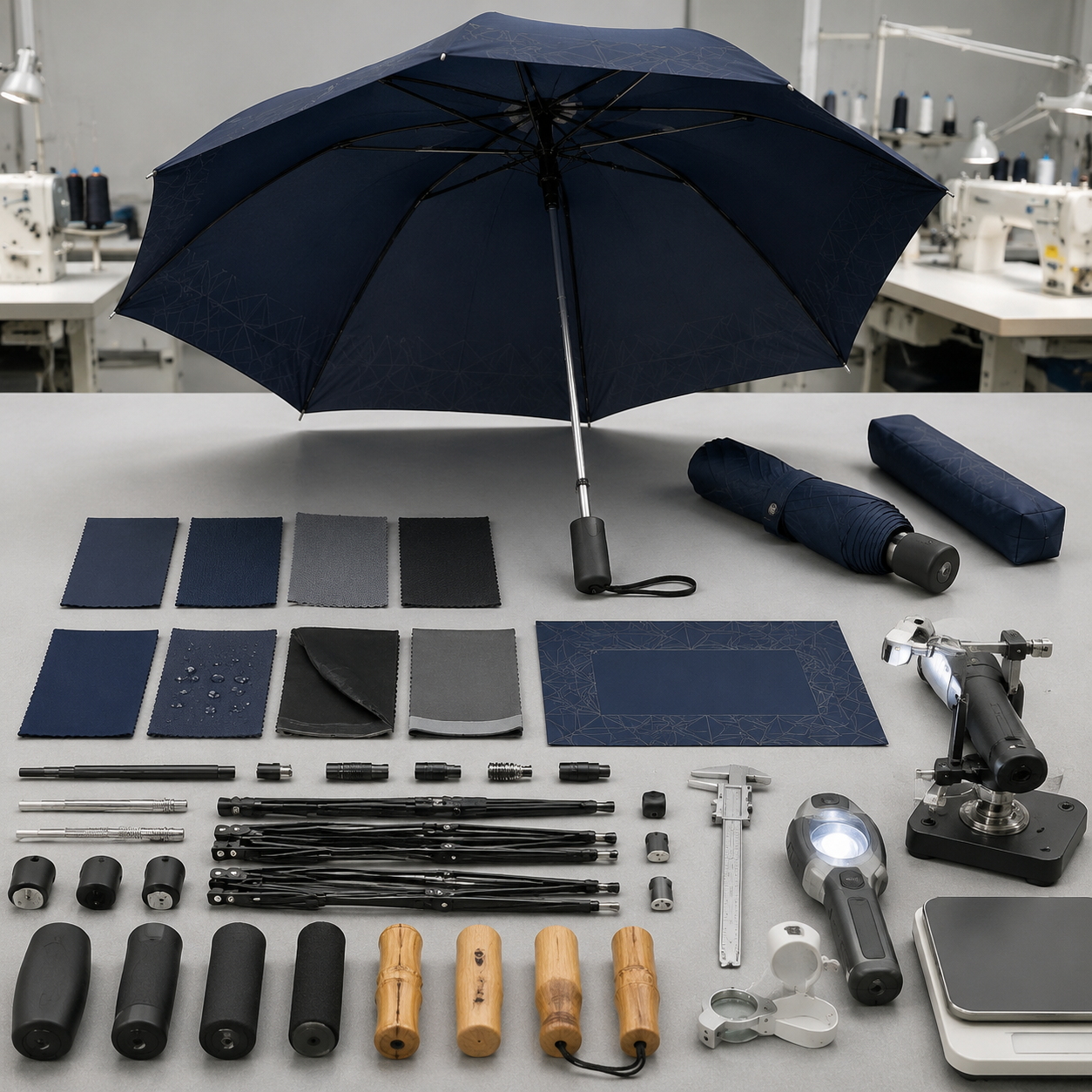
For a Europe-bound B2B manufacturing RFQ, the main promotional umbrella OEM material options are conventional polyester or recycled-content polyester canopies; coating and finish options such as black-backed constructions or reflective trim; metal, fiberglass, or mixed-material frame assemblies; and declared handle materials such as wood or bamboo. The supplied TopUmbrella and Ark Umbrella pages identify these categories as supplier-authored sourcing topics, so they are candidates to specify and sample, not proof of availability, performance, compliance, or certification for a proposed order.
For a manufacturing RFQ, the appropriate material option is the one that meets the buyer-defined appearance, decoration, claim-evidence, finished-sample, and destination-specific requirements. No option is inherently compliant across Europe.
The material decision is therefore a controlled stack rather than a single canopy choice. Buyers need to specify the canopy composition and construction, coating or finish, frame and shaft materials, handle and trim, decoration system, sleeve, and any material-related claims.
Supplier terms such as pongee, RPET, fiberglass frame, or metal-look handle can help screen options, but they are not complete specifications. A comparable quote should identify each component, connect proposed claims to supporting documents, and state which swatch, decorated panel, or finished sample represents the quoted construction.
Use the same bill of materials, dimensions, artwork, evidence requirements, packing scope, and substitution rules for every supplier. Route destination checks separately for an EU member state, a non-EU EEA state, or the precise UK destination. An undefined Europe compliant statement does not identify the applicable destination, component, document, or result.
Author and evidence note: Vincent Xi is identified by the approved author profile as Editorial Author. The profile supports author identification only. No first-hand factory, manufacturing, testing, certification, or customer-outcome claim is made.
How the supplied sources are used
The cited pages are supplier-authored sourcing context. They help identify questions for an RFQ, but they do not establish the performance, compliance, certification, or availability of a proposed promotional umbrella.
| Source context | Relevant material topic | Appropriate procurement use | Evidence boundary |
|---|---|---|---|
| TopUmbrella supplier editorial | Discusses recycled-content canopies, PFAS-free fabric requests, supporting documents, and screen or digital decoration choices | Define claim scope, request supporting records, and plan decoration trials | Does not prove a finished-product result, current certificate, or Europe-wide legal requirement |
| UmbrallaOEM sourcing article | Emphasizes measurable finished specifications and interactions among frame geometry, joints, runner action, sewing, and assembly | Link component declarations to approval of the complete sample | Does not prove that a material will meet an unstated performance target |
| Ark Umbrella factory-information article | Lists canopy, coating, frame, handle, sample-record, and QC topics for quotation and production review | Build RFQ fields, sample gates, and inspection questions | Does not verify the construction, capability, compliance, or quality of a proposed order |
Material options for Europe-bound promotional umbrella manufacturing
Ask each supplier to complete the same component matrix. Alternative materials should appear as separate quote lines so that price or lead-time differences do not obscure changes to the specification.
| Component decision | Buyer-defined RFQ fields | Supplier response required | Approval blocker |
|---|---|---|---|
| Canopy | Intended claim, composition, appearance, color reference, decoration, and evidence requirement | Fiber declaration, construction reference, mass-per-area unit and method, finish, coating, supplier material code, and sample linkage | Only a trade name or broad fabric family is supplied |
| Coating or finish | Layer in scope, intended function or claim, acceptance method, and result format | Finish identity, application face, process, proposed method, target, report reference, and tested-sample identity | Evidence covers a different fabric, layer, or finish |
| Frame and shaft | Component names, finished-product checks, and required disclosure | Material family, supplier grade or reference, section dimensions, finish, joint design, and assembly method | The quote says only metal, fiberglass, or another broad family name |
| Handle and trim | Base material, surface system, color, dimensions, attachment, and acceptable variation | Material declaration, finish system, assembly method, and document list for any claim | Appearance is stated without identifying the underlying material |
| Decoration | Artwork revision, location, coverage, color reference, and inspection method | Decoration process, ink or transfer system, curing conditions, material-compatibility proposal, and decorated sample | The trial uses a different canopy construction, color, coating, or finish |
| Sleeve, strap, and closure | Composition, finish, color, construction, and claim scope | Component references, assembly details, and linkage to any material claim | These parts are omitted from the bill of materials or claim calculation |
| Substitutions | Components, sources, and processes requiring written approval | Change notice, comparison data, revised documents, and replacement-sample proposal | The supplier reserves an undefined right to use equivalent materials |
Canopy material options and claim scope
The Ark Umbrella source presents polyester, pongee, recycled-content fabric, ultraviolet-related coatings, black coatings, and reflective trim as quotation topics. These references identify options to investigate; they do not demonstrate suitability for a particular order.
Conventional polyester and pongee terminology
Record fiber composition and fabric construction as separate fields. If a supplier uses pongee, retain it as supplier terminology until the quote also identifies the composition, construction reference, material code, and measurement basis.
For each canopy option, request:
- Component name and supplier material reference.
- Declared fiber composition and the basis of that declaration.
- Supplier construction code and mass per unit area, including the unit and measurement method.
- Color reference, viewing conditions, and proposed tolerance method.
- Finish or coating applied to each face.
- Sewing thread, seam construction, panel reinforcement, strap, closure, and sleeve materials.
- Decoration process and relevant curing conditions.
- Swatch, decorated-panel, and finished-sample identifiers.
- Proposed production-lot traceability.
This structure prevents one familiar fabric label from standing in for several uncontrolled variables.
Recycled-content options
The TopUmbrella source discusses recycled-content canopies and supporting documents. Use that context to request evidence for the exact claim proposed on the finished product.
The supplier should define:
- Whether the claim applies to the canopy, sleeve, strap, complete umbrella, or another stated scope.
- The claimed content basis, included components, excluded components, and calculation records.
- The material reference covered by each supporting document.
- Document owner, issuer, scope, issue date, validity status, and relevant product or material.
- Linkage among the quoted material, document, approved sample, and production lot.
- Proposed finished-product claim wording.
Do not infer certified status from RPET, a logo, a material name, or a general declaration. If the buyer includes a voluntary standard, state it as a buyer requirement and obtain a current document that identifies the certificate owner, issuer, scope, validity, and material linkage. A supplier's internal sourcing or inspection practice is not automatically a requirement of that standard.
Coatings, finishes, and functional claims
For a water-repellent, ultraviolet-related, black-backed, reflective, PFAS-free, or other material claim, identify the exact coating, layer, trim, ink, adhesive, or component covered. Require the proposed assessment method, acceptance target, reporting unit where applicable, issuer, sample identity, report date, and connection to the quoted construction.
The TopUmbrella source presents PFAS-free fabric as a sourcing topic. It does not establish a requirement across Europe. If that wording is included in the RFQ, the buyer should define the substances or substance groups in scope, material layers covered, proposed test method, reporting limit, sampling basis, tested sample, and report date. Evidence for an uncoated base fabric should not be treated as evidence for unlisted coatings, inks, adhesives, or trim.
Frame, shaft, handle, and small-part materials
The UmbrallaOEM article frames finished specifications around interactions among frame geometry, joints, runner action, sewing, and assembly. That supports a component-level RFQ followed by approval of the assembled sample; it does not establish a performance result for a named material.
| Component | Material fields to request | Finished-sample checks to define |
|---|---|---|
| Ribs and stretchers | Base material, supplier grade or reference, cross-section, section dimensions, finish, joint type, and end-retention method | Alignment, buyer-agreed deflection or inversion procedure, permanent-deformation criterion, joint condition, and visible defects |
| Shaft | Base material, grade or reference, section dimensions, surface treatment, connection design, and corrosion-protection proposal | Straightness method, joint play, lock operation, surface condition, and result after any agreed exposure procedure |
| Runner, joints, and rivets | Base material, finish, hinge construction, rivet specification, and proposed lubrication | Movement, retention, sharp-edge inspection, wear criterion, and surface condition |
| Handle | Base material, coating or plating system, color reference, dimensions, attachment, and variation limit | Retention method, finish condition, handling check, and any buyer-defined impact procedure |
| Tips, ferrule, springs, and fasteners | Material, finish, dimensions, and retention method | Secure assembly, edge condition, color consistency, and surface condition |
| Sleeve, strap, and closure | Fiber or base material, finish, color, closure construction, and claim status | Fit, stitching, fraying criterion, closure retention, and consistency with the stated material claim |
The Ark Umbrella source also lists wood and bamboo among quotation options. If either is proposed for a handle, ask for material identification, moisture-measurement method, proposed limit, coating system, allowable appearance variation, cracking criteria, and any buyer-required sourcing records. Treat a natural or metallic appearance as a finish description until the underlying material is declared.
Decoration approval on the selected canopy material
The TopUmbrella article presents screen and digital decoration as sourcing choices. Use that as a prompt to compare processes, not as proof that either process is compatible with the quoted canopy.
A decoration trial should use the proposed fiber composition, construction, color, finish, coating, artwork revision, and coverage. The approval record should identify:
- Artwork revision and placement drawing.
- Canopy material, finish, coating, and color references.
- Print, transfer, or other decoration process.
- Ink, transfer medium, primer, adhesive, and curing conditions where applicable.
- Color-measurement or visual-approval method and viewing conditions.
- Buyer-defined adhesion, rub, fold-flex, show-through, edge-definition, and opacity checks.
- Decorated-panel and complete-sample identifiers.
- Approved deviations and responsible approver.
An untreated swatch should not release decoration on a coated production canopy. Changes to the fabric source, construction, finish, coating, ink, transfer medium, adhesive, curing process, or decoration subcontractor should trigger review at the buyer-defined approval gate.
Europe material-evidence routing: EU, non-EU EEA, and UK
The supplied research pages are not official regulatory sources. Use them to identify sourcing questions, then verify current requirements through official destination-specific sources or appropriately qualified advisers. Do not reuse an undefined Europe-wide assurance across distinct destinations.
| Destination route | RFQ destination field | Supplier evidence request | Buyer verification |
|---|---|---|---|
| EU | Name the destination member state and intended distribution route | Bill of materials, claim-to-component matrix, applicability statement, declarations, reports, labeling proposal, traceability records, and relevant packaging information | Check current EU-level requirements and any destination-country implementation or additional control |
| Non-EU EEA | Name the destination state and distribution route separately from the EU route | Destination-specific applicability statement and document index | Confirm which current requirements and local implementation details apply to the named state rather than assuming the EU file is sufficient |
| UK | Record the precise UK destination and distribution route | UK-destination applicability statement, material evidence, labeling and traceability proposal, and relevant packaging information | Confirm the current route and destination-specific obligations before order release |
| Country or buyer overlay | List each material, claim, language, labeling, documentation, or packaging control identified for the program | A supplier response and evidence reference for every listed control | Verify each control against a current authoritative source or a documented buyer requirement |
For each regulated or voluntary claim, build a claim-to-component matrix covering the canopy, coating, ink, handle, structural finish, sleeve, strap, closure, adhesive, trim, and packaging where relevant. A base-fabric document should not be treated as evidence for unlisted coatings, decoration materials, structural parts, or finished-product claims.
Supporting documents should identify the owner, issuer, scope, issue or validity date, method where applicable, tested sample or material reference, result, and link to the quoted order. Label an internal supplier check as supplier practice unless a current authoritative source establishes it as a requirement for the named destination.
Illustrative RFQ assumptions to verify in the supplier quote
Every value below is an example buyer assumption for one hypothetical quote comparison. These values are not sourced product measurements, supplier capabilities, market averages, test results, tolerances, or recommendations. Verify or replace each value in the supplier's written quote and production-representative sample record before ordering.
| Comparison field | Example assumption and scope | Verification requirement |
|---|---|---|
| Order quantity | 2,000 finished umbrellas for one hypothetical order line quoted to the same specification | Example assumption; verify in each supplier quote |
| Finished open diameter | 1,050 mm per finished umbrella, measured open using the buyer-approved method | Example assumption; verify on the supplier's complete sample |
| Finished closed length | 340 mm per finished umbrella, including the assembled handle and end components but excluding outer packaging | Example assumption; verify on the supplier's complete sample |
| Maximum finished mass | 420 g per finished umbrella, including its matching sleeve but excluding individual and shipping packaging | Example assumption; verify using the agreed weighing method |
| Decoration bounding box | 180 mm wide x 90 mm high per decorated umbrella on the nominated canopy panel | Example assumption; verify against controlled artwork and the decorated sample |
For these hypothetical fields, ask the supplier to propose tolerances, instruments, conditioning where relevant, measurement points, repeat-measurement rules, and disposition criteria. Approve or replace those proposals before comparing prices.
Material approval gates
The UmbrallaOEM source supports the use of measurable finished specifications and complete-sample approval. The Ark Umbrella source identifies canopy cutting, stitching, water repellency, frame strength, open-close function, print clarity, handle assembly, and carton checks as QC topics. These are areas for the buyer to define; the sources do not provide an acceptance method, target, sampling plan, or release result for the proposed order.
| Gate | Controlled record | Material-related reason to stop approval |
|---|---|---|
| Quotation | Component matrix, proposed materials, claim scope, evidence index, exclusions, and alternatives | A component is unidentified or suppliers quoted different material scopes |
| Swatch | Material reference, composition declaration, construction, color, finish, coating, source record, and claim evidence | The swatch cannot be linked to the quote or supporting evidence |
| Decorated panel | Actual canopy construction, finish, artwork revision, decoration materials, process, curing record, and inspection result | The panel differs from the proposed production system |
| Finished sample | Complete bill of materials, dimensions, mass, frame assembly, handle, trim, sleeve, decoration, and packing basis | Components differ from approved records or required results are incomplete |
| Pre-production confirmation | Production material references, current document status, approved-sample identity, and subcontracted-process list | An unapproved source, material, finish, ink, adhesive, or process is present |
| Production inspection | Buyer-defined sampling plan, material identity checks, findings, deviations, and disposition | Production cannot be traced to the controlled specification and approved sample |
Quote comparison and substitution control
Normalize each quote before selecting a supplier. The comparison should show the same order scope, component specification, decoration, sample basis, packing basis, currency basis, and delivery basis. Record exclusions and proposed alternatives instead of allowing them to remain in footnotes or informal messages.
For any proposed material substitution, require:
- The affected component and current approved reference.
- The proposed replacement material and source reference.
- A side-by-side comparison of composition, construction, dimensions, finish, appearance, claims, and supporting documents.
- The effect on decoration, assembly, sample results, price, and schedule.
- Revised evidence and a replacement sample when the change could affect approval.
- Written buyer approval before production use.
The purchase order should reference the controlled bill of materials, approved artwork, sample identifiers, evidence index, inspection criteria, packing specification, and change-notification process. A matching generic material name is not sufficient evidence of equivalence.
Material-focused RFQ release checklist
- [ ] Name the European destination and classify the route as EU, non-EU EEA, or UK.
- [ ] Issue one component-level bill of materials for all suppliers to quote.
- [ ] Separate canopy composition, construction, color, finish, coating, and claim status.
- [ ] Define the scope and evidence required for recycled content, PFAS-free wording, or any other material claim.
- [ ] Identify structural parts, handle, trim, sleeve, strap, closure, thread, ink, transfer media, and adhesives.
- [ ] Trial decoration on the quoted canopy construction, color, finish, and coating.
- [ ] Link every supporting document to the quoted material, approved sample, and proposed production lot.
- [ ] Record buyer requirements, any named standard's requirements, supplier practices, and destination checks separately.
- [ ] Approve measurement methods, tolerances, sampling, nonconformance handling, and inspection records.
- [ ] Prohibit unapproved changes to materials, finishes, component sources, decoration inputs, and subcontracted processes.
Release the order only when the component matrix, evidence index, decorated panel, complete sample, quote basis, destination route, and substitution controls describe the same proposed product.
Methodology and limitations
Methodology: Material-related topics were extracted from the supplied supplier-authored pages and separated from the buyer controls developed for this RFQ. The TopUmbrella page provides sourcing context for recycled-content requests, PFAS-free fabric requests, supporting documents, and decoration choices. The UmbrallaOEM page provides context for measurable finished specifications and assembly interactions. The Ark Umbrella page provides context for quotation fields, material candidates, sample records, and QC topics. Those topics were converted into component fields, evidence requests, sample gates, and release decisions. No laboratory value, legal conclusion, supplier capability, or product-performance result was derived from the pages. The numerical RFQ fields are explicitly labeled hypothetical buyer assumptions requiring supplier verification.
Limitations and items to verify: The cited pages are supplier-produced material, not independent laboratory reports, official regulatory guidance, or evidence of ZheBrella manufacturing capabilities. They do not prove the performance of a proposed order, current certification, legal applicability in every European destination, or equivalence between suppliers. Before approval, verify the complete bill of materials, production-representative decorated sample, measurement and test methods, tolerances, document scope, current certificate status where relevant, claim-to-order linkage, destination-specific requirements, inspection plan, packing specification, and substitution controls with the proposed supplier and appropriately qualified advisers.
Discuss Your Requirements
Review our manufacturing capabilities, then share your specifications for a supplier-fit review.