Promotional Umbrella Sourcing: Production Scalability Planning for Canada
By Vincent Xi, Editorial Author, ZheBrella
Decision before deposit. For Canadian B2B buyers, promotional umbrella sourcing production scalability planning is the go/no-go file in front of the purchase order—not a unit-price race. Approve mass production only when five artifacts exist: a signed pre-production sample (PPS) against a frozen bill of materials; a capacity calendar split by process for that exact construction; a Chinese New Year shutdown and last-deposit date for the production year; named inspection stages and defect classes; and a backward schedule from the Canada warehouse or 3PL date using quoted inspection and transit, not assumed sailing days.
After artwork and a production sample are approved, one published commercial umbrella process guide states that mass production requires 25 to 35 days through eight factory stages. A separate patio-umbrella planning guide stacks a 60 to 90 day door-to-door envelope when pre-production, raw-material booking, factory time, and ocean freight are included. Those figures are planning anchors from the named sources below. They are not a quote for every folding, stick, or golf-style promotional SKU, and patio construction is a heavier analog than most campaign giveaways.
Frame material, canopy construction, print method, packing, and inspection level change line throughput and the cost of a failed lot. This page stays on one promotional umbrella procurement job: specify, compare, and verify scalable production before mass production is approved.
Go, hold, or reject before the mass-production cut
Use this gate table to compare quotes. A lower unit price that fails a gate is not a valid alternate for a dated Canada campaign.
| Gate | Go — deposit is eligible | Hold — do not approve mass cut |
|---|---|---|
| Sample | PPS signed against frozen BOM, print, and carton | Artwork open; strike-off on paper only; hybrid ribs undocumented |
| Calendar | Materials, print, sew/assembly, pack, and inspection split in days | A single “25–35 days” blob with no SKU split |
| Holiday | Factory shutdown memo vs Canada in-hand date | Last-deposit date untested against Chinese New Year |
| Capacity | Pieces per day for this BOM, shared-line disclosure, overtime assumption | Headline monthly umbrella capacity only |
| QC | Incoming + in-process + pre-shipment; AQL classes written; report identity named | “In-house QC” with no records, method, or failed-piece rule |
| Substitution | Fabric mill, rib material, and print method locked after PPS | “Or equivalent” fabric or silent steel/fiberglass mix |
| Canada timing | Warehouse/3PL date, not the event date; Incoterm and document pack named | Event date used as the factory due date |
What production scalability planning covers in promotional umbrella procurement
Production scalability planning, in this procurement context, is matching a campaign quantity and Canada in-hand date to real bottlenecks: fabric and frame supply, print capacity, sewing and assembly, finishing, carton packing, and inspection slots. It is not a catalog, a consumer guide, or a factory ranking.
A useful plan answers five questions before deposit:
- What is the approved production sample (BOM, print method, pantone, rib count, shaft, tips, sleeve, and carton)?
- How many calendar days sit between sample sign-off and ex-works, and what is excluded (holidays, reprint, failed AQL)?
- Which materials and constructions keep line speed predictable at the intended quantity?
- What QC records and inspection gates must exist before mass production and before shipment?
- How will Canada campaign timing (event kits, branch allocation, and bilingual artwork only if the buyer’s brief requires it) interact with factory calendars and quoted transit?
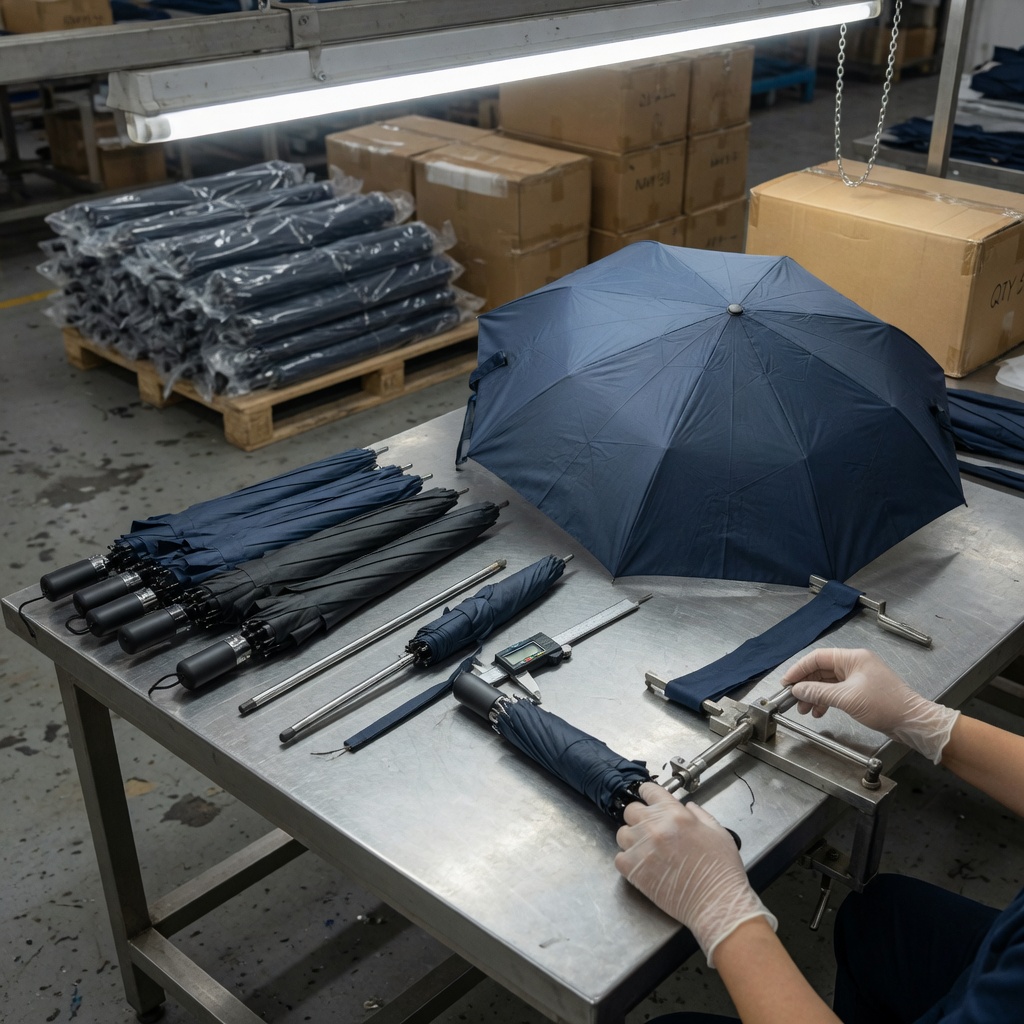
One commercial process write-up describes eight stages: incoming QC, cutting, printing, sewing, frame assembly, joining, finishing, and packaging. Mass production in that account is 25 to 35 days after sample approval (Leeline Promotion, umbrella manufacturing process). Read that as a factory-floor sequence as presented by that publisher—not as a certified lead time, not as a ZheBrella factory clock, and not as a door-to-door promise into a Canadian warehouse.
Patio-category planning is useful only as a logistics envelope, because canopy size, pole sections, and packing cubes differ. That guide cites bulk door-to-door spans of 60 to 90 days, built from 7 to 14 days pre-production, 10 to 20 days raw-material sourcing, 15 to 25 days factory production, plus ocean freight (Giant Umbrella Company, patio production planning). Promotional stick and folding programs may quote shorter factory days; they may also slip if custom print, new dye lots, or fiberglass rib supply is tight. The RFQ must force the supplier to split those buckets for the actual SKU.
Lead-time building blocks: factory days versus door-to-door envelopes
Buyers scale poorly when they confuse factory “production days” with “in-hand in Canada.”
| Clock | Usually includes | Usually excludes | Why it matters for scale |
|---|---|---|---|
| Sample cycle | PPS, print proof, construction check | Artwork revisions, new tooling, courier delays | Unlocked artwork is the most common reason calendars collapse |
| Mass production after sample approval | Cutting through packing in the eight-stage commercial sequence | Material shortages, reprint, failed inspection, overtime limits | The 25–35 day figure is a factory-floor range to test in the PO |
| Door-to-door stack (patio analog) | Pre-production + materials + factory + ocean | Canada clearance, inland cartage, missed sailings, CNY shutdown | 60–90 days is a conservative envelope from a different product family |
Data point 1 (factory duration). Scope: commercial umbrellas described in an eight-stage process. Measure: 25 to 35 days of mass production after sample approval. Unit: calendar days on the factory floor, not door-to-door days. Source: Leeline Promotion process guide. As-of: as published on that process page; re-confirm against the live page and the named factory calendar in the quote.
Data point 2 (stacked door-to-door analog). Scope: bulk patio umbrellas, not promotional folding/stick units. Measure: 60 to 90 days door-to-door, of which 7–14 days pre-production, 10–20 days raw-material sourcing, and 15–25 days factory production, plus ocean freight. Unit: calendar days in that publisher’s planning stack. Source: Giant Umbrella Company production-planning article. As-of: as published on that planning page. Limitation: patio BOM and cube are not interchangeable with promotional umbrellas.
If a Canadian campaign needs umbrellas on a branch floor in May (planning example, not a sourced deadline), working backward from the in-hand date often pushes sample lock into the prior autumn—before Chinese New Year capacity resets. One patio-planning source tells buyers to lock specifications in Q4, with September specs, October samples, November 15 deposits, and AQL 2.5 inspections (Giant Umbrella Company). Treat November 15 as that publisher’s example milestone, not a universal banking date. Ask the factory for its actual last-deposit date before the holiday shutdown in the production year you are booking.
Do not treat a short-dispatch marketing line as a mass-production plan. Example risk control (not a sourced factory lead time; verify in the quote): a “3-day dispatch” claim can be plausible only for stock or reprint-from-inventory lots. A 2026 promotional sourcing guide uses short-dispatch and DDP language that must be reconciled against the 25–35 day mass-production sequence and quoted ocean schedules into Canada (ExcelTent promotional umbrella sourcing guide). Fast dispatch is not a substitute for capacity planning on a new print, new fabric lot, or first-run construction.
Frame and canopy choices that change high-volume throughput
Scalability is not only whether a factory can take 5,000 units. It is whether the BOM stays within materials the line already runs, whether print is a bottleneck, and whether field failures force a second production wave.
The 2026 promotional sourcing guide compares steel, fiberglass, aluminum, and wood frames and states that high-volume orders of 5,000 units benefit from single-layer canopies paired with full fiberglass frames, positioning fiberglass as rust-proof and flexible (ExcelTent).
Data point 3 (high-volume construction example). Scope: promotional umbrellas as discussed in that 2026 sourcing guide. Measure: 5,000 units as the guide’s high-volume example; construction recommendation is single-layer canopy + full fiberglass frame. Source: ExcelTent guide. As-of: that page’s “2026 edition” label. This is a publisher recommendation, not a lab result, not a minimum order, and not a named factory’s certified capacity. Verify quantity and construction in the supplier quote.
The commercial process guide specifies 190T Pongee for 1,500+ open-close cycles and 55 lb tear strength, versus standard polyester (Leeline Promotion).
Data point 4 (fabric durability spec as published). Scope: canopy fabric called out in that manufacturing-process article. Measures: 190T Pongee; 1,500+ open-close cycles; 55 lb tear strength (the source states pounds; the lab method is not stated here). Source: Leeline Promotion. As-of: that process page. Require the actual test method, sample size, and lab identity in the QC pack.
Put these specification choices on the RFQ rather than assuming them:
- Steel: one of four named frame families; control rust and dent risk with coating and packing rules, not adjectives.
- Fiberglass: positioned as rust-proof and flexible at the 5,000-unit example; lock rib count, diameter, and joint type; ban undocumented steel/fiberglass hybrids.
- Aluminum: named in the same comparison; if kits must travel lighter for branch allocation in Canada, specify wall thickness, joinery, and carton compression limits.
- Wood: can add grain, moisture, and finishing variance unless the quote splits those process days.
- Single-layer canopies: the volume path in the 5,000-unit example; double-layer or vented golf canopies change stitch time and print placement.
Print method is a hidden capacity constraint. State production print method, colors per panel, bleed, PMS references, opposite-panel alignment, and whether a strike-off on production fabric (not paper) is a gate.
Chinese New Year capacity and Canada in-hand dates
Canadian promotional programs are often tied to spring outdoor events, summer field marketing, golf days, and Q2–Q3 brand kits. Factory capacity in many umbrella supply chains still resets around Chinese New Year through labor turnover, delayed raw materials, and a queue of pre-holiday deposits. Chinese New Year is a manufacturing-calendar risk, not a sales-market target.
The patio-planning source advises buyers to lock specifications in Q4 before Chinese New Year: September specs, October samples, November 15 deposits, and AQL 2.5 inspections (Giant Umbrella Company). That calendar is the strongest published holiday-capacity signal in the source set. It is not a Canadian customs timetable and not proof of any factory’s shutdown dates in a given year.
A practical backward plan for a Canada in-hand date:
- Fix the latest acceptable warehouse date in Canada (not the event date).
- Subtract ocean transit + destination handling as quoted on the chosen Incoterm—do not invent a sailing day-count.
- Subtract inspection and rework allowance (failed AQL can consume a full reprint window).
- Subtract mass-production days (test the 25–35 day commercial range against the SKU).
- Subtract material booking (the patio analog cites 10–20 days; require the SKU split).
- Place sample approval early enough that a rejected strike-off does not collide with the last pre-holiday slot.
If bilingual panel copy (English/French) is part of the campaign brief, treat it as an artwork-critical path item. This article does not assert a labeling statute from the source set. Extra copy and second-language alignment add proofing cycles that belong in the September–October sample window. Confirm any bilingual consumer-label duty with the importer of record and current government publications, not from this page.
Ask in writing for weekly output for this construction, shared-line disclosure, overtime ceiling, and what happens to deposits and already-cut fabric if a sailing is missed.
Quality control documentation buyers should require before mass production
The commercial process guide tells buyers to demand raw QC records, durability testing logs, and safety certificates, and it ties 190T Pongee to the cycle and tear figures above (Leeline Promotion). The patio-planning guide names AQL 2.5 as the inspection level in its six-step plan (Giant Umbrella Company).
AQL 2.5 is an acceptance sampling level named by that planning article. If the RFQ invokes a sampling standard, name the standard, inspection level, and AQL for critical/major/minor defects in the PO. ISO 2859-1 or ANSI/ASQ Z1.4 are examples of documents buyers use to construct such plans—only if that is the document the inspection will actually follow. Naming AQL 2.5 is a buyer specification. It is not a product certification, not a factory certification, and not evidence a lot was inspected unless the report exists. Distinguish three layers:
- Requirement in a standard (how a sampling plan is constructed if you invoke it).
- Practice in a supplier quote (what they inspect, at which stage, with which AQL).
- Document you will accept (signed report, photos, measurements, failed-piece disposition).
Incoming. Fabric lot number, density/T-count vs 190T claim, color lot, rib straightness, shaft wall thickness, runner smoothness, tip fit. Rejecting fabric after it is cut is how 25-day plans become 45-day plans. The 45-day figure is a planning warning, not a sourced lead time; use it only to force a written rework allowance.
In-process. Print registration on the production canopy, stitch density at stress points, rib-to-joint fastening, automatic vs manual open if specified.
Pre-shipment. Open-close cycling on a stated sample, canopy tautness, runner lock, tip retention, shaft straightness, carton drop or compression if routing is ocean freight into Canada, pack-list accuracy for branch splits.
Durability logs should state method, not adjectives. “1,500+ open-close cycles” is useful only if the RFQ states cycle rate, angle, pass/fail (deformed rib, torn canopy, runner failure), and whether testing is on production units. “55 lb tear strength” needs the test standard and specimen size. Do not treat “safety certificates” as present unless the current PDF is attached to the PPS pack. This page does not assert that any factory is certified.
RFQ checklist for production scalability planning
Send this as a single request-for-quote pack. Each item is used to specify, compare, verify, approve, or order.
- SKU identity: folding / stick / golf-style promotional umbrella; open diameter; closed length; rib count; auto or manual open; sleeve.
- BOM freeze: shaft material and diameter; each rib material (no “or equivalent” without a change order); runner, ferrule, tips, spring, canopy fabric with T-count.
- Fabric evidence: if quoting 190T Pongee, attach the mill sheet and the method behind 1,500+ open-close cycles and 55 lb tear strength—or substitute lab data the factory will stand behind.
- Print pack: vector art, PMS, max colors, panel map, bleed, production print method, bilingual lines only if the campaign brief requires them.
- Sample ladder: digital proof → strike-off on production fabric → PPS → golden sample sealed for mass production; who retains the sealed PPS.
- Quantity math: target units, overrun/underrun, and whether 5,000 units is one lot or split lots (use 5,000 only as a planning example unless it is the real order).
- Capacity declaration: pieces per day for this BOM, number of lines, shared-line disclaimer, overtime assumption.
- Calendar split: days for materials, print, sew/assembly, finishing/pack, and inspection—not a single “25–35 days” blob.
- Holiday disclosure: Chinese New Year shutdown start/stop for the production year; last deposit date that still enters the pre-holiday queue (test the published November 15 example, then replace it with the factory’s date).
- Canada in-hand date: warehouse or 3PL date, not the event date; named Incoterm and named place; who books inspection.
- Commercial terms that affect scale: currency, quote validity, deposit vs balance trigger, and whether balance waits on inspection release.
- Inspection plan: sampling standard if used; AQL for critical/major/minor (AQL 2.5 is one published starting point); incoming, DUPRO, and final stages.
- QC documents: incoming records, durability logs, instrument identity if measurements are claimed, DUPRO photo protocol, and any safety documents with current scope—no certificate names unless the PDF is attached.
- Failure and packing rules: critical defects (broken rib, inoperative runner, wrong pantone, missing print); rework vs remake; extra days added to the 25–35 day window; who pays for re-cut fabric; inner counts for Canadian branch kits; carton photo from the PPS.
- Substitution, shipment, and comparison: fabric mill, rib material, and print method cannot change after PPS without a new sample and calendar; booking window and document list (CI, PL, packing photos, inspection release) as quoted; compare unit price and the capacity calendar—a cheaper steel-frame quote that cannot meet the Canada in-hand date is not a valid alternate.
- Approval block: buyer sign-off that PPS matches the golden sample before any mass-production cut; merchandiser and production-controller names for peak-season capacity questions.
Patio 60–90 day door-to-door math belongs in the comparison only as a conservative logistics stress test, labeled as patio-category evidence, not as the promotional SKU’s quoted transit.
How these figures were derived, and what to verify
Source context 1. A commercial umbrella manufacturing-process article listing eight stages, a 25–35 day mass-production window after sample approval, incoming-QC expectations, and 190T Pongee cycle/tear figures (https://www.leelinepromotion.com/umbrella-manufacturing-process/).
Source context 2. A patio-umbrella production-planning article with a 60–90 day door-to-door stack, pre-production and material day-ranges, Q4 lock advice before Chinese New Year, a November 15 deposit example, and AQL 2.5 (https://giantumbrellacompany.com/insight/patio-umbrella-manufacturing-lead-times-production-planning/).
Source context 3. A 2026 promotional umbrella sourcing guide comparing steel, fiberglass, aluminum, and wood, and citing a 5,000-unit high-volume construction example (single-layer canopy + full fiberglass) (https://exceltent.com/the-ultimate-promotional-umbrella-sourcing-guide/).
Method. This editorial synthesis, by Vincent Xi, Editorial Author at ZheBrella (author profile), maps those published process and planning figures onto one buyer task: promotional umbrella sourcing production scalability planning for Canadian procurement. Numbers are copied with their units and attributed to their publishers. Patio figures are labeled as a different product family. No factory was audited for this page. No first-person production, laboratory, factory-visit, or customer-outcome claim is made. No search-demand, CPC, difficulty, traffic, or ranking metric is stated or implied for the primary keyword.
Limitations / what to verify in the supplier quote. Promotional folding and stick umbrellas do not share patio BOM, cube, or line time; do not copy 60–90 days into a PO without a SKU-specific routing. The 25–35 day range starts after sample approval and can exclude holidays, reprints, and failed inspection. 190T, 1,500+ cycles, and 55 lb tear strength are published specifications, not results from this site. 5,000 units is one guide’s high-volume example. November 15 is one publisher’s deposit example. AQL 2.5 is an inspection specification, not a certification. Chinese New Year dates and last-deposit cutoffs move every year. Canada duty, brokerage, inland cartage, and bilingual consumer-label rules are not in the source set and must be confirmed with the importer of record and current government publications—not from this article. Short-dispatch and DDP marketing lines must be reconciled with mass-production capacity before a campaign-critical order is approved.
For Canadian teams, the order-ready output of this page is a frozen PPS, a split capacity calendar, a named inspection plan, and a holiday-aware Canada in-hand date—not a generic country guide and not a second product theme.
Discuss Your Requirements
Review our manufacturing capabilities, then share your specifications for a supplier-fit review.