Promotional Umbrella Wholesale Supplier Product Development Capability for Europe
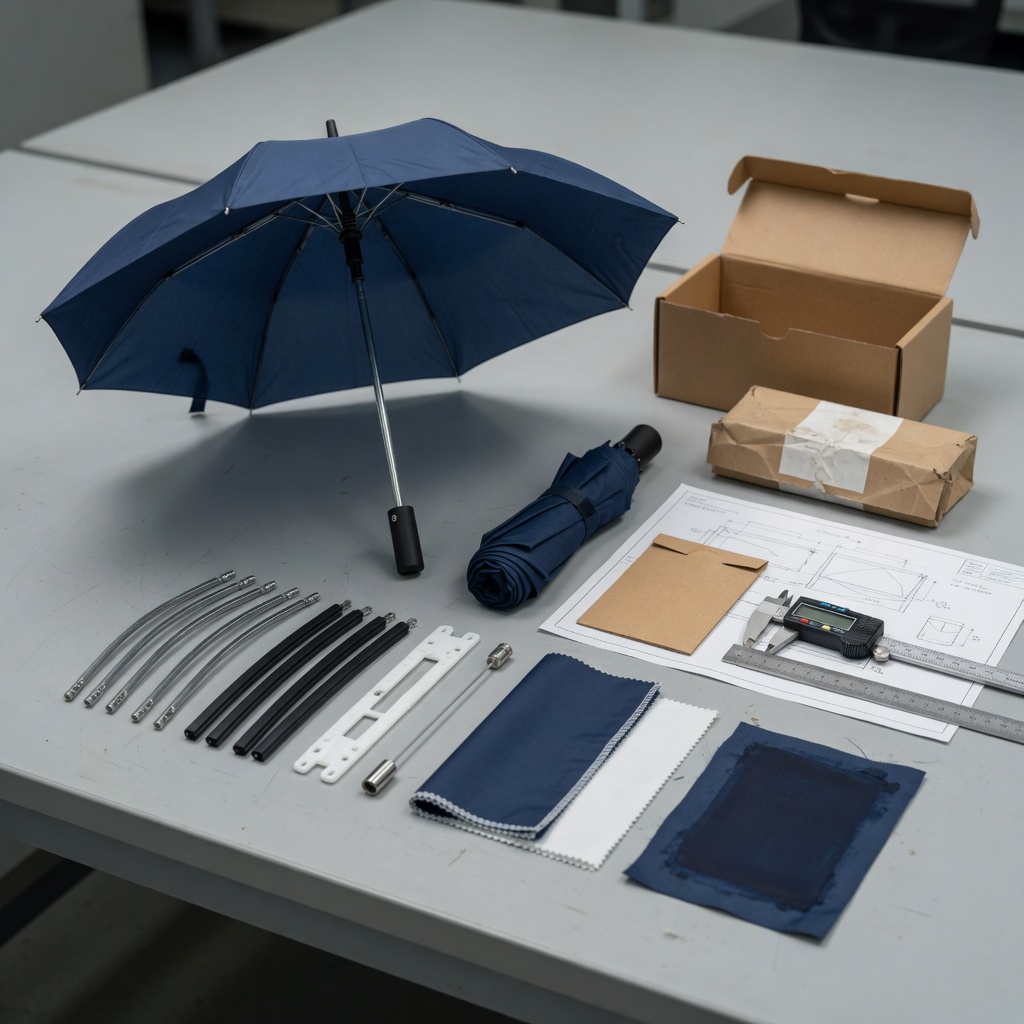
Product development capability for promotional umbrella wholesale supply in Europe means a supplier can convert a logo file, a physical sample, or a dimensioned drawing into one production-ready SKU: frame geometry in millimetres, canopy cut and print registration, handle and runner fit, and a pack-out that matches a named EU member state, EEA country, or UK destination. That definition is the RFQ answer European B2B buyers should score before unit price. If those four items are not written, sampled, and signed, a low price is not a qualified promotional umbrella wholesale supply offer.
Treat that sequence as a pass/fail RFQ gate, not as brochure language. Ask for an engineering drawing or sample card, a print strike-off on the production canopy fabric, a packed sample with destination carton marks, and a defect list tied to inspection. Price-only awards fail at sampling or at the first bulk inspection when structure, print, and packaging were never engineered together for the named European destination.
Labelling, packaging, and restricted-substance rules are not uniform across Europe. Name the destination country. Do not write “EU spec” as a stand-in for an EU member state, an EEA country, or the UK. Public OEM/ODM language from manufacturer pages is used here as a demand checklist, not as an endorsement and not as a claim about ZheBrella production.
By Vincent Xi, Editorial Author (ZheBrella author profile). No factory visit, laboratory test, or customer-outcome claim is made in this article.
Product development capability: what Europe wholesale buyers should lock before price
For promotional umbrella wholesale supply, product development capability means turning an incomplete brand brief into a bill of materials, a process, and an approved sample. Incomplete briefs typically include a logo, a pantone, a target open diameter, and a campaign date. The missing work is the rest of the SKU: rib count and shaft diameter, runner and ferrule, canopy fabric and coating, print method and registration tolerance, handle material, tip and cap, folded length, sleeve, inner carton, and export carton marks.
Public manufacturer pages describe that path in similar language. Use the language as a list of written deliverables. It is not proof that any named factory will meet a European campaign calendar, and it is not evidence of ZheBrella plant practice.
- One factory-direct page states that it offers one-stop OEM/ODM solutions for golf, folding, straight, and promotional umbrellas from sample to bulk production, and that it turns ideas, sketches, or samples into production-ready solutions with custom sampling to verify structure, printing, materials, and packaging (Kinte manufacturer page).
- Another OEM factory page states that it supports promotional brands with OEM/ODM development and custom logo printing, and that its team translates size, frame, canopy fabric, and handle requirements into workable samples, combining product development with manufacturing and AQL 2.5 QC (Ark Umbrella manufacturer page).
- A third factory page states that Huizhou HeSanJiang Umbrella Co., Ltd. provides OEM and ODM solutions for promotional item companies; that a 5000 square meter factory integrates manufacturing, product research and development, and quality control; that it states over 20 years experience; and that product development can be based on drawings and samples (HeSanJiang / World Umbrellas factory page).
Those statements are supplier self-descriptions on undated public pages. Do not compare unit price until three physical deliverables exist for the named SKU:
- An engineering drawing or sample card with millimetre dimensions (open diameter, folded length, shaft, rib count).
- A print strike-off on the actual canopy fabric, not on paper.
- A packed sample that matches the export carton specification for the named destination country.
Trade-off to measure: non-standard diameter, automatic open, a unique handle mould, or multi-colour print on a high panel count increases sample iterations and bulk failure modes. A stock frame with a one-colour screen print on a standard folding size freezes faster. A new handle mould plus a full-bleed digital print is a separate development SKU, not a last-week artwork change.
Europe destinations: EU, EEA, and UK are not one specification
Keep the product and RFQ decision primary. The award still fails when the RFQ says “Europe” and the factory assumes one label language, one packaging format, and one restricted-substance file.
Specify the country of use and the delivery Incoterms city. An EU member state, an EEA country, and the UK can require different marking languages, different packaging-waste or producer-responsibility paperwork, and different customer documentation packs. Do not treat a REACH-style chemical file as covering the UK, or a UK mark set as an EU mark set. If the same artwork will ship to an EU member state and to the UK, treat them as two documentation scopes even when the umbrella construction is identical.
Put the following in the RFQ without assuming a single pan-European rule:
- Destination country and whether the goods are giveaways, resale, or staff kit.
- Required languages on hangtag, care label, or carton, if any.
- Whether the buyer or the supplier is the importer of record.
- Restricted-substance declaration scope the buyer’s compliance team will actually review (fabric, coating, plastic handle, metal plating, inks). Ask for mill or compound declarations against the buyer’s current restricted list, not a generic “EU compliant” sentence.
- Packaging: individual sleeve material, carton burst/ECT if the buyer’s 3PL requires it, barcode type, and whether inner packs must match store or event kits.
- Whether a second destination-country carton mark is a second SKU for MOQ, plates, and leftover cartons.
If a supplier cannot name the destination country on the sample card and carton artwork, product development is not finished. A sample that looks correct on a factory table can still be wrong for a named European 3PL if folded length, carton count, or label language was never scoped.
Sample development, MOQ, and measurable construction trade-offs
None of the cited manufacturer excerpts publish a single sample-day number or a single MOQ that applies to every promotional umbrella. Treat any “typical 7–15 days / 500 pcs” figure heard on a sales call as an example calculation/assumption to verify in the supplier quote for that construction, not as a market constant. Ask for sample lead time in calendar days from locked artwork and locked BOM, and ask for MOQ after sample sign-off, by SKU.
Construction variables that change both development effort and bulk risk:
- Frame and open type. Straight stick, folding (2-fold / 3-fold), golf/oversize, and automatic open/close use different rib and shaft stacks. Automatic mechanisms add moving parts and function-failure modes (runner, spring, lock) that must be named on the defect list. Specify open diameter (cm), number of ribs, shaft material (for example steel vs fibreglass), and folded length (mm) on the drawing.
- Canopy. Fabric type (for example pongee/polyester), nominal yarn/denier or a GSM if the mill provides it, coating (water-repellent vs UV-oriented promotional use), panel count, and whether the edge is bound or cut. Higher panel counts and darker grounds make print registration harder.
- Print. Screen, transfer, or digital; number of colours; coverage (logo vs all-over); and whether the print sits on one panel or crosses seams. Request a strike-off on the production fabric, not on paper.
- Handle, tip, runner, ferrule. Material, colour match, mould ownership if a custom handle is required, and whether the handle is suitable for the stated automatic/manual action.
- Packaging. Individual PE vs paper sleeve vs gift box; units per inner; export carton size; hangtag if a named retail or event channel requires one.
Example calculation to verify in the supplier quote (assumption, not a published price or lead time): if a campaign needs 8,000 folding umbrellas in two pantones on a stated 23-inch 8-rib frame, treat “two colours” as two screen setups plus registration risk across seams. Confirm open diameter in centimetres on the drawing rather than relying on the inch trade name; 23 inch × 2.54 = 58.42 cm is an example conversion to check against the golden sample, not a factory specification. Ask the factory to quote (a) one-colour vs two-colour setup, (b) whether a third colour on a small logo area can be avoided by using a woven or printed label instead, and (c) the extra sample iteration if the second colour misses registration on a dark canopy. Use the quote line items; do not use this paragraph as a cost model.
MOQ trade-off: a supplier page may advertise “flexible MOQ” (Ark Umbrella manufacturer page). Flexibility is not a number. Ask: MOQ per colourway; MOQ if two destination-country carton marks are required; whether screens, plates, or moulds are a separate charge or amortized; and whether leftover handles or printed canopies from sampling are billable. A lower MOQ on a non-standard handle often means the mould cost is still in the sample invoice.
Quality control from development sample to bulk production
A first sample without a written QC plan is not a production-ready SKU. Split QC into incoming materials, in-process (frame assembly, canopy sew, print), and final (function, appearance, pack-out).
One cited manufacturer page states that development is combined with manufacturing and AQL 2.5 QC (Ark Umbrella manufacturer page). AQL 2.5 is a common inspection reference under sampling systems such as ISO 2859-1; it is not, by itself, a product certification, and this article does not treat the page statement as a current accredited certificate. Distinguish the standard’s sampling idea from the factory’s own practice: the buyer must still define critical / major / minor defects for umbrellas (for example: frame that will not lock open; rib that punctures canopy; print colour outside agreed delta; missing warning or care mark if the buyer’s destination file requires it; wrong carton count).
Require the following in the development file:
- Golden sample: one unit retained by the buyer, one by the factory, photographed next to a steel ruler showing open diameter and folded length in millimetres.
- Print standard: pantone or lab dip plus a strike-off on production fabric, with a stated viewing condition.
- Function checks: open/close cycles on automatic units (define cycle count as a buyer requirement; do not assume a factory default), runner smoothness, canopy tautness, and tip/ferrule security.
- Pack-out: sleeve, inner, export carton, and any destination mark, checked against the RFQ country.
- Inspection: who inspects (factory QC, buyer, or third party), AQL or other sampling level, and whether inspection is before or after packing. If the supplier cites AQL 2.5, ask for the inspection level (I/II/III), lot size basis, and the defect list used on promotional umbrellas—not a generic garment AQL sheet.
- Freeze rule: no bulk fabric cutting, printing, or carton marking until written sample sign-off.
The 5000 square meter factory figure and the “over 20 years” experience figure are company statements on a factory page (HeSanJiang / World Umbrellas factory page). They describe claimed site scale and claimed operating history. They do not replace a current process audit, a material test report, or a measured sample. Ask for the current quality manual excerpt that covers sampling and bulk, dated, not a brochure sentence about factory area.
Buyer decision table: specify, compare, verify, approve, order
Use this table when scoring promotional umbrella wholesale supply partners on product development capability. Every row is an RFQ or sample-gate action.
| Decision factor | Specify in the RFQ | Trade-off to measure | How to verify before bulk |
|---|---|---|---|
| Destination | Named EU, EEA, or UK country; importer of record; languages on pack | Extra carton/label SKUs vs one generic export mark | Packed sample with the actual mark set |
| Open diameter and folded length | Values in cm / mm, plus rib count | Larger canopy and more ribs increase print and frame cost and carton cube | Measure golden sample with a ruler; photo on file |
| Frame and open type | Straight / folding / golf; manual vs automatic | Automatic adds parts and function-test load | Cycle test on sample; written defect definition |
| Canopy fabric | Fibre, construction, colour, coating intent | Coated or heavier fabrics change sew and print | Mill declaration + fabric swatch on the sample card |
| Print method and colours | Process, colour count, coverage, registration tolerance | More colours and seam-crossing art increase rejects | Strike-off on production fabric, signed |
| Handle / tip / runner | Material, colour, mould new vs stock | New mould time and MOQ vs stock handle | Sample + mould ownership note |
| Packaging | Sleeve, inner pack qty, export carton, barcode | Retail-ready pack vs event giveaway pack | Full pack-out sample, carton count check |
| QC / AQL | Inspection stage, sampling level, defect list | Tighter AQL and more critical items raise cost and lead time | Written SOP; if AQL 2.5 is offered, lock level and defects |
| Sample ownership | Who pays iterations; who keeps golden samples | Extra iterations protect brand colour at the cost of days | Sample sign-off form with date and photo |
| MOQ and leftover | MOQ per colourway and per destination pack | Lower MOQ may hide mould or plate charges | Quote line items, not a “flexible MOQ” sentence |
| Artwork lock date | File format, pantones, bleed, and freeze date | Late art forces reprint or missed ship window | Written freeze; no bulk start before sign-off |
| Documentation pack | Material declarations scoped to buyer list | Broader chemical scope adds mill lead time | Files named to destination country, not “Europe” |
Compare at least two constructions on the same table (for example a 3-fold automatic vs a manual straight stick) so the European campaign owner sees cube, function risk, and print risk together.
Practical RFQ checklist for product development capability
Send this with the artwork. Each line should produce a quote item, a sample gate, or a yes/no. If a supplier answers “OEM/ODM yes” but cannot complete items 4, 7, 11, 13, and 14, product development capability is not evidenced for a European wholesale order.
- Product family and use: promotional umbrella for a named campaign; giveaway, resale, or staff kit.
- Destination country (EU member state, EEA country, or UK) and delivery point; do not write “Europe” only.
- Quantity by colourway and by destination pack, plus whether a second drop is expected.
- Open diameter (cm), rib count, shaft material, folded length (mm), and a weight target if the 3PL has one (state it as a target to verify on sample).
- Frame type: folding 2-fold/3-fold, straight, golf/oversize; manual or automatic open/close.
- Canopy: fabric name/construction, colour, coating intent, panel count, edge finish.
- Print: method, colours, pantones, placement drawing, registration tolerance, and whether print may cross seams.
- Handle, tip, runner, ferrule: stock vs custom mould; material; colour; grip requirement; who owns the mould after sampling.
- Function tests required on sample and on bulk (open lock, automatic cycle count if used, canopy tautness).
- Packaging: individual sleeve material, inner quantity, export carton dimensions target, marks, barcode, hangtag yes/no; palletisation only if the named 3PL requires it.
- Sample plan: number of development samples, golden sample split, strike-off, packed sample, and calendar days from locked art.
- MOQ after sample approval, per SKU and per carton mark; mould/plate/screen charges listed separately; leftover sampled parts billable or not.
- QC: in-process checks; final inspection location; sampling plan (if AQL, state the level and the umbrella-specific defect list); who pays a third-party inspector.
- Material declarations: which parts (fabric, ink, plastic, metal) and against which buyer restricted list; no “EU compliant” as a substitute sentence.
- Approval: named buyer sign-off, photo standard, and a rule that bulk fabric cutting cannot start before written approval.
- Incoterms, lead time from approval to ex-works or FOB, and whether destination carton marks are in the critical path.
- After-sales: how a non-conforming lot is defined, isolated, and replaced; spare handles/ribs if the program is multi-drop.
- Artwork freeze: vector file type, pantone list, bleed, and the calendar date after which colour or logo changes are a new sample SKU.
Method, source context, and limitations
How the data were derived. Factual statements about OEM/ODM sampling, drawing-to-sample development, a 5000 square meter factory integrating manufacturing, R&D and QC, “over 20 years” experience, and AQL 2.5 QC are taken from the three public manufacturer pages listed in cited_sources. They are used as examples of how suppliers describe product development capability, so European buyers know what to demand in an RFQ. No ZheBrella factory size, test result, certification, customer name, or first-person visit is claimed.
Source contexts. (1) Manufacturer self-descriptions of OEM/ODM sampling and construction-to-sample translation. (2) Manufacturer self-descriptions of site scale, operating history, and an AQL inspection reference. Both are brochure-level public pages, not third-party audits.
Concrete data points (unit, scope, as-of, source).
- Factory area: 5000 square meters, stated as the company’s factory integrating manufacturing, product research and development, and quality control; scope: Huizhou HeSanJiang Umbrella Co., Ltd. self-description; as-of: undated page excerpt used for this article; source: factory page.
- Operating history: over 20 years experience, stated for the same custom umbrella manufacturer providing OEM/ODM for promotional item companies; scope: company self-description; as-of: undated page excerpt; source: factory page.
- Inspection practice stated: AQL 2.5 QC, described together with translating size, frame, canopy fabric, and handle requirements into samples; scope: Ark Umbrella manufacturer page self-description; as-of: undated page excerpt; source: manufacturer page.
- Process claim: custom sampling to verify structure, printing, materials, and packaging, from idea/sketch/sample to bulk; scope: Kinte manufacturer page self-description; as-of: undated page excerpt; source: manufacturer page.
Limitations / what to verify. These figures and practices are not independently measured in this article. Factory area and years of operation can change and are not a substitute for a dated audit. AQL 2.5 is a stated inspection reference on one page, not proof of a current accredited certificate or of a defect list suitable for promotional umbrellas. ISO 2859-1 is named only as the sampling-system context for AQL language; this article does not claim that any factory is certified to that standard. Sample days and MOQs are not published as fixed numbers in the excerpts and must be taken from the supplier quote for the actual construction. European chemical, labelling, packaging, and importer rules must be confirmed by the buyer’s compliance team against current official texts for the named destination country (EU member state vs EEA vs UK); this page does not apply one rule to all of Europe. Golden samples, strike-offs, and packed cartons remain the only production-ready evidence.
Author: Vincent Xi, Editorial Author, https://www.zhebrella.com/authors/vincent-xi/.
Discuss Your Requirements
Review our manufacturing capabilities, then share your specifications for a supplier-fit review.