Umbrella Sourcing Product Development Capability for Canadian B2B Procurement
Editorial research by Vincent Xi, Editorial Author, ZheBrella (author profile).
RFQ decision. Treat umbrella sourcing product development capability as a pass/fail gate in Canadian B2B procurement, not as a catalog extra. Do not lock volume pricing or a seasonal in-DC date until the supplier names an engineering owner, states a sampling calendar, accepts IP and tooling clauses, defines prototype tests for the SKU, and shows capacity on the same construction as the approved sample. A unit price without that chain is a false saving: late first articles, unmanufacturable ribs or runners, color drift, and weak NDA practice show up as missed seasonal windows and unsellable inventory in Canada.
This page is a procurement specification aid, not a factory brochure. It synthesizes publicly described practices from three manufacturer pages so a buyer in Canada can force comparable RFQ answers on R&D, sampling, IP, and scale. It does not claim a site visit, laboratory test, or named customer result. Every figure below is a self-reported description on those pages; re-confirm each figure with a current quote, audit, and sample order.
What product development capability covers in an umbrella OEM RFQ
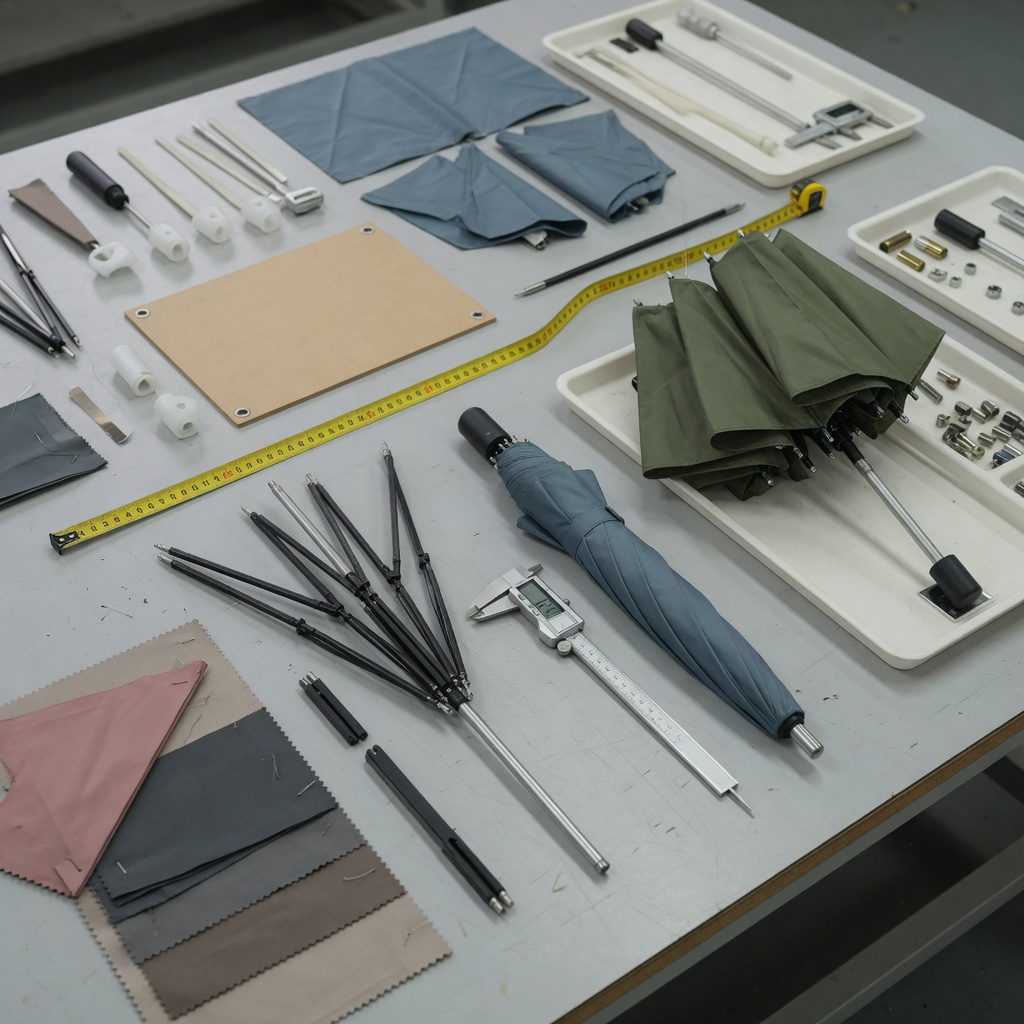
Product development capability is the documented chain from idea to approved pre-production sample. It is not a stock umbrella list. For a stick or folding program, the RFQ should require the supplier to show how it will interpret 2D/3D drawings or a physical sample; select shaft, rib, runner, and ferrule materials; choose canopy fabric and coating; engineer the opening mechanism (manual, auto-open, or auto-open-close); place branding so it survives folding and rain; and define export packaging.
The commercial inputs still belong to the buyer: open diameter, folded length, rib count, shaft diameter and material, fabric construction and mass, print method, and any performance claim the brand will make. State linear dimensions in millimetres and rib count as an integer. If the supplier cannot show how those inputs become a first article with a named owner and a calendar, the OEM label is only a trading function—stop before tooling.
Public OEM descriptions to convert into RFQ questions
Use the following public descriptions as questions, not as a ranking and not as audited current performance.
- One manufacturer page frames the work as generating product ideas, preparing prototypes, using NDAs with manufacturers, selecting suppliers on experience and certifications, and managing cost through the development cycle (Huifeng Umbrella).
- Another describes an R&D department that works through client collaboration, technical feasibility assessment, and prototype testing. That page states that the factory develops 3–4 patented products per year (unit: patented products per year; scope: that company’s R&D as described on the page; as-of: stated on the public page; publication or last-updated date not independently confirmed in this desk research) and that it supports product development and customization for approximately 2,000 enterprises each year (unit: enterprises per year, approximate as stated; same page, scope, and as-of limitation) (Rainscene Umbrella Factory).
- A third describes a facility that integrates product research and development with OEM/ODM work from drawings and samples, free design support as stated on the page, and 5–7 day sampling times (unit: days; scope: OEM sampling from drawings and samples as described on that factory page; as-of: stated on the public page; publication or last-updated date not independently confirmed), in a 5,000 sqm plant (unit: square metres; scope: that facility as described) operated by a manufacturer with 20+ years of history (unit: years; scope: manufacturer history as stated on the same page) (World Umbrellas factory page).
In-house R&D versus trading translation
The main trade-off is control versus speed of quotation. An in-house engineering group can challenge a drawing that will bind, crack a rib, or print off-register when the canopy is tensioned. A trading office can return a price quickly but may only discover the problem after a sample has already missed an in-store date in Canada.
Price these trade-offs in the RFQ, not after the first article:
- Sampling calendar versus test depth. A 5–7 day first sample (self-reported example on the World Umbrellas factory page cited above; not a service-level agreement) protects a seasonal window only if the RFQ also names which checks happen in that window (dimensional, open/close cycle, print adhesion, fabric color against a stated standard). Faster samples with no recorded checks shift risk into the first production lot.
- Patent or exclusive-design activity versus tooling ownership. An annual patent count describes internal IP activity only. It is not evidence that the buyer owns the design, molds, or exclusivity, and it is not a ranking of mechanism quality. The purchase contract still needs language that the molds, lasts, and artwork files are owned or escrowed.
- Facility scale versus dedicated prototype capacity. A 5,000 sqm integrated plant (self-reported on the World Umbrellas factory page cited above) is a floor-area figure only. It does not prove that prototypes are built on a separate bench rather than pulled from a busy line. Ask which area builds first articles and whether that bench is staffed at peak.
- Cost of development versus unit price. Charging for samples, jigs, or print plates is often cheaper than absorbing free revisions that never freeze a bill of materials. Ask for a development fee schedule tied to revision rounds. Do not pay tooling deposits until NDA and ownership clauses are signed.
None of the cited pages give a landed-cost model for Canada, a bilingual labeling specification, or a customs process. Those remain buyer-side tasks with a broker and counsel; do not treat them as supplier-documented capabilities.
Sampling, IP, and first-article calendars for Canada
Sampling is the first measurable output of product development capability. The RFQ should state: calendar days from approved file (or received physical sample) to first article on the buyer’s desk; how many revision rounds are included; who pays freight on samples to Canada; and what approved means (signed dimensional report, photos of open and closed states, fabric lot card).
Treat the 5–7 day OEM sampling statement on the World Umbrellas factory page as a self-reported example, not a contractual lead time (World Umbrellas factory page). A program that needs goods in Vancouver or Montreal for a Q1 or back-to-school set must still add development time, production, and transit. A first article that slips even a short delay (example: two calendar weeks—an assumption to test against your in-DC date, not a source statistic) often forces air freight or a missed set. Ask for timestamps from a recent comparable sample order, not a brochure number.
IP practice should be in place before files leave the buyer. Huifeng’s article discusses using NDAs with manufacturers during new product or designer-brand development (Huifeng Umbrella). An NDA alone is not enough. The purchase contract should state who owns the design, molds, and print separations; whether the factory may sell a close variant after the program ends; and how samples and rejected goods are destroyed or returned. Share CAD and artwork only after the NDA is signed. If the supplier refuses to name an engineering contact and only offers a salesperson, product development capability is not demonstrated—do not proceed to tooling.
Prototype testing is the second output. Rainscene describes technical feasibility assessments and prototype testing as part of R&D collaboration (Rainscene Umbrella Factory). Name the tests that matter to the SKU (for example cycle open/close, rib deflection under a stated load, colorfastness method the brand already uses) rather than accepting a generic QC-passed photo. If a wind or durability claim will appear on packaging or a website in Canada, the test method and pass/fail limit belong in the RFQ. The cited pages do not publish those methods, so they cannot be assumed. Do not name a product standard in the RFQ unless the buyer already holds the method and will require a current report on the actual first article.
Capacity that can repeat the approved umbrella construction
Development that cannot be produced is a failed procurement. After the sample is approved, the factory must run the same construction at the forecast quantity without substituting ribs, runners, or fabric lots.
Use the World Umbrellas facility-scale and history figures, and Rainscene’s enterprise-support figure, only as conversation starters (World Umbrellas factory page; Rainscene Umbrella Factory). Ask for the current monthly output of the relevant line (stick versus folding), the share of capacity reserved for custom versus stock, and whether the prototype shop is staffed when the main lines are at peak.
A 20+ year history, as one page states, is not by itself proof of a current R&D bench. Ask for the equipment that matters to umbrellas: rib forming, shaft cutting, sewing or ultrasonic welding of panels, print, and a defined inspection table for first articles. Dated video of that area is more useful than a campus photo. If custom work is only slotted when stock production is slack, seasonal peaks in Canada will collide with every other buyer’s peak.
Certifications appear in general terms in the Huifeng development article as a supplier-selection factor (Huifeng Umbrella). No named, dated certificate is confirmed in the excerpts used here. Do not treat “certified factory” as proven. Request current documents (scope, expiry, and the legal entity name that matches the contract) and distinguish a management-system certificate from a product test report. This article does not assert that any factory holds a given standard.
Buyer decision table: umbrella sourcing product development capability
Use the table to force like-for-like answers. Every row is a specification, a verification act, or an order gate. Public examples are self-reported on the cited pages; they are not audited current performance and must be re-verified in the quote. Award volume only if the engineering-owner, sampling-calendar, IP/tooling, prototype-test, and same-construction capacity rows all have a written, dated reply.
| Criterion | What the RFQ must specify | How to verify before PO | Public example (self-reported; verify current) | Risk if weak |
|---|---|---|---|---|
| In-house R&D / engineering owner | Named engineer or R&D contact; CAD/drawing intake; feasibility review before tooling | Org chart, redacted development file under NDA, video of prototype bench | Rainscene describes an R&D department using client collaboration, feasibility assessment, and prototype testing; 3–4 patented products annually (as stated on that page) | Drawings translated by a trader; unmanufacturable ribs or runners |
| Sampling calendar | Days from approved drawing or received sample to first article; included revision rounds; sample freight terms to Canada | Written SOP plus timestamps from a recent comparable sample | World Umbrellas states 5–7 day sampling times for OEM based on drawings and samples (as stated on that factory page) | Missed in-DC dates in Canada; air-freight rescue |
| Facility supporting development | Floor area and process flow for prototype versus mass production; years operating as manufacturer | Layout, dated video tour, headcount on prototype work | 5,000 sqm facility integrating research and development; 20+ year manufacturer (World Umbrellas factory page, as stated) | Samples built on a busy line that production cannot repeat |
| Scale after approval | Monthly capacity on the relevant construction; custom versus stock split; MOQ after PP sample | Capacity letter, production calendar, NDA references | Rainscene states support for approximately 2,000 enterprises each year (as stated on that page) | Approved sample, then allocation given to stock programs |
| IP and NDA | NDA before file share; ownership of design, molds, and artwork; ban on close variants | Signed NDA, contract clauses, sample destruction process | Huifeng article discusses NDAs during new product or designer-brand development | Parallel SKUs in other channels; lost exclusivity |
| Design support from drawing/sample | Accept 2D/3D or physical sample; who pays for first CAD interpretation | Sample of a prior drawing-to-sample pack (confidential details removed) | World Umbrellas describes OEM/ODM from drawings and samples and free design support (as stated on that factory page) | Buyer must hire a third-party designer just to be understood |
| Prototype testing scope | Tests and pass/fail limits the buyer requires (dimensional, cycle, print, fabric) | Test records on the actual first article, not a generic stock SKU | Rainscene describes prototype testing as part of R&D | Marketing claims on listings in Canada that the lot cannot support |
| Cost of development | Sample fees, jig/plate fees, revision fees, and what is credited against PO | Written fee schedule tied to revision count | Huifeng article stresses managing costs through custom development | Hidden tooling charges after a verbal free-sample offer |
If the supplier answers with a catalog PDF or a salesperson-only contact, treat product development capability as not demonstrated and do not issue a production PO.
RFQ checklist for custom umbrella product development
Issue this as a single packet with the NDA. Every item is something a buyer can specify, compare, verify, approve, or use as an order condition. Non-response on items 2, 7, 9, 10, or 11 is a no-award.
- Legal names: contracting entity, factory address, and the name that will appear on any certificate or invoice.
- NDA executed before CAD, artwork, or branded sample photos are sent.
- Input package: 2D/3D drawings and/or a physical sample, plus target open diameter, folded length, rib count, shaft diameter and material, runner type, and ferrule type (state linear dimensions in millimetres and rib count as an integer; treat any example dimensions as items to confirm in the quote).
- Canopy: fabric construction, mass (state unit, for example g/m² if used—an assumption to verify in the quote), coating, color standard (for example a physical swatch, or a buyer-held color reference), and whether panels are sewn or welded.
- Mechanism: manual, auto-open, or auto-open-close; any venting; spare-part policy for tips and runners.
- Branding: print or transfer method, locations, size, and the durability check the buyer will use to approve.
- First-article calendar: number of calendar days from approved file to sample dispatch; number of free revision rounds; who pays sample freight to Canada.
- Definition of approved sample: signed dimensional sheet, open and closed photos, fabric lot card, and print strike-off.
- Tests the buyer requires, with method and pass/fail (do not assume a factory’s internal check equals a named standard unless a current report is attached).
- Tooling and IP: who pays for and owns molds, jigs, and print plates; storage period; destruction of rejected samples. No tooling deposit until these clauses are signed.
- Capacity: monthly output on this construction, MOQ after PP sample, and whether custom shares a line with stock.
- Packaging: inner pack, master carton, and labeling content. Destination-market language and any bilingual consumer-label rules for Canada must be confirmed by the buyer with counsel or a broker; they are not specified on the cited factory pages.
- Incoterms, payment milestones tied to sample approval and PP sample, and lead time from PP approval to ex-works or FOB.
- Traceability: how fabric lots, rib lots, and print lots will be marked on cartons for a warehouse claim in Canada.
- Evidence pack: dated video of the prototype/inspection area, redacted example of a prior drawing-to-sample project, and current copies of any certificates the factory claims (entity name and expiry matching the contract).
- Change control: written process if a rib, fabric mill, or print house is substituted after PP approval.
Methodology, limitations, and what Canadian buyers must still verify
Methodology. This article is desk research. It uses three publicly available manufacturer pages that describe their own product-development, sampling, and OEM practices. Data points are quoted as those pages state them: 5–7 day sampling times, a 5,000 sqm facility integrating R&D, and a 20+ year manufacturer history (World Umbrellas factory page); an R&D department developing 3–4 patented products annually and supporting approximately 2,000 enterprises each year (Rainscene Umbrella Factory); and process steps including prototypes, NDAs, supplier selection on experience and certifications, and cost management (Huifeng Umbrella). Publication or last-updated dates for the pages were not independently confirmed from the excerpts used. No factory was audited for this piece.
Limitations. All facility, patent, enterprise-count, and sampling figures are self-reported marketing or factory-page statements. They may be outdated, scoped to a different legal entity, or not applicable to the construction a buyer in Canada needs. No current ISO or other certificate is confirmed. No test method, wind rating, or fabric standard is endorsed. Landed cost, GST, customs classification, and bilingual labeling for consumer goods in Canada are not covered by the source pages and must be obtained from a licensed customs broker and legal review. A supplier or manufacturing-origin reference is not a sales-market invitation; this page is written for Canadian B2B procurement of umbrellas only.
What to verify on the next call or visit. Re-state every number in the RFQ and require a dated reply. Confirm the engineering contact, the actual prototype bench, the sampling SOP with recent timestamps, NDA and mold-ownership clauses, and capacity on the exact umbrella type. Approve a PP sample from the production process, not only a hand-built show sample. Do not treat this article as a substitute for a factory audit, a lab report, or a contract.
Vincent Xi is the named Editorial Author for this desk research. No first-hand factory visit, laboratory test, or client outcome is claimed. Buyers should treat every capability statement as unverified until documents, samples, and a commercial offer are in hand.
Discuss Your Requirements
Review our manufacturing capabilities, then share your specifications for a supplier-fit review.