Windproof Umbrella OEM Communication Workflow Review for European Manufacturing Buyers
By Vincent Xi, Editorial Author Author profile
European B2B procurement should not request a binding OEM quote until a revision-controlled file set freezes the windproof umbrella. That manufacturing object is the frame and canopy bill of materials, print, sample ladder, wind-test pass/fail, inspection plan, and the destination pack for a named EU member state, a named EEA state, or the United Kingdom. A windproof umbrella OEM communication workflow review is the control that turns catalogue adjectives and chat photos into named drawings, sample IDs, and a market file that does not treat EU, EEA, and UK placement as one filing.
Vincent Xi is the named Editorial Author for this ZheBrella manufacturing brief. This page does not claim factory-floor testing, client results, awards, certifications, or personal sampling by the author.
Put the destination country on the first RFQ page. Those three administrations do not share one safety file, one chemical declaration, or one packaging-mark layout. Photo-only approval and verbal rib changes shorten the calendar; they also make AQL disputes and wind-test mismatches unenforceable. Written hold points add days, and they are what the purchase order can police.
Fail-closed order of work
- Specify construction, print, tests, AQL, packing marks, and named destination documents in English, each with a revision ID.
- Compare OEM quotes only against that frozen pack. Catalogue substitutes and unpriced extras are not comparable offers.
- Verify prototype, pre-production sample (PPS), and gold sample as three classes, measured against the current drawing revision.
- Approve PPS in writing (named person, date, sample ID, drawing revision) before bulk cutting.
- Hold shipment if AQL fails, carton marks do not match the importer sheet, or the named EU, EEA, or UK pack is missing.
This page is a buyer-side manufacturing communication brief. It is not a complete product guide, not a factory ranking, and not a certification claim for ZheBrella or for any vendor named in the source pages.
Freeze frame, canopy, and print before the OEM quote
A quote issued against a lifestyle photo is not comparable. Freeze construction in the RFQ before anyone issues a price, and require every quote to repeat the same drawing revision ID in the price table.
- Frame: shaft material and diameter (mm), rib count and material, joint type, runner, ferrule, handle, open mode (manual or automatic), and the wind-management build (vented double canopy, flexible ribs, or both).
- Canopy: fabric type, colour standard (Pantone or equivalent), coating, seam type, panel count, and finished diameter measured on the approved frame.
- Print: process, colour count, control panel, maximum print area, and bleed. Example bleed assumption to verify in the artwork pack: 3 mm (millimetres; artwork-pack assumption, not a published factory default).
- Tolerances: state millimetre tolerances on the drawing, not in chat. Example assumption to verify in the supplier quote (not a published factory default): ±5 mm on open canopy diameter and ±3 mm on closed length.
- RFQ cover fields: target quantity by SKU and colour, Incoterms 2020, importer of record, and the named destination country.
- File rule: one English-language tech pack is the controlling record. A chat "OK" does not amend dimensions, print, or destination files unless copied into a dated change order with a new revision ID.
One OEM catalogue page advertises custom windproof umbrellas with reinforced fiberglass ribs and double-layer canopies. That page publishes commercial bands of 500–1,000 pieces MOQ and 15–30 days lead time, plus QC language for fabric wear, a level-10 wind-resistance claim, an ISO 9001 mention, and a 1-year warranty (Hongjie custom windproof umbrella OEM page). Scope: that manufacturer's published commercial page only. Units: pieces (MOQ), days (lead-time band), years (warranty duration). As-of date: not stated on the supplied page excerpt. Those figures are not the buyer's MOQ, lead time, test method, or certificate until they reappear on a quote that matches the frozen bill of materials, with certificate numbers, scope, and expiry where ISO 9001 is still claimed.
A wide MOQ band looks cheap until print plates, extra rib tooling, or a third-party wind report are priced as extras. Require each extra as its own line. A quote that bundles "windproof OEM" as a single SKU price is not decision-ready. Require a drawing or dimension table (shaft length, closed length, open canopy diameter, rib length) with a revision letter. Two OEM prices are comparable only when both quotes cite the same revision ID.
Communication workflow review: sampling, PPS, and AQL hold points
Treat prototype, PPS, and gold sample as three manufacturing states. Mixing them is how bulk fabric is cut against an unapproved print.
- Prototype — construction and mechanism only.
- Pre-production sample (PPS) — bulk fabric lot, production artwork, production frame.
- Gold / sealed sample — the physical standard for AQL comparison. State who retains the gold sample (factory, buyer, or both) until inspection and any commercial remedy window in the PO have closed.
A factory-published 9-step in-house workflow lists LED fabric inspection, overlocking, cutting, stitching, topping, tips, hand sewing, QC that includes open-close and waterproof tests, then customized packaging. The same page states 3-day samples and a 100-piece MOQ for OEM windproof umbrellas (Baisite 9-step manufacturing workflow). Scope: that factory's published process article only. Units: steps (process list), days (published sample time), pieces (published MOQ). As-of date: not stated on the supplied page excerpt. Use the station list as a communication agenda. Do not treat 3-day sampling or a 100-piece MOQ as transferable terms for the frozen BOM.
Accepting the prototype as PPS saves calendar days and transfers colour, fabric, and print-registration risk into bulk. Requiring PPS from the bulk lot costs sample days and is the only way print and fabric can fail before cutting.
Name inspection in the PO. ISO 2859-1 is a sampling-procedure standard that may be specified; it is not a cited factory's published practice unless the quote names it. Example assumption to verify in the supplier quote (not a legal default and not a factory claim): ISO 2859-1, General Inspection Level II, AQL 1.5 critical / 2.5 major / 4.0 minor, with critical defined as broken ribs, failed joinery, or canopy holes. Put the defect list in the same language as the PO.
Write this communication workflow review around named hold points: incoming fabric inspection (the published LED station is a useful checkpoint), print strike-off on production fabric before bulk print, PPS dimensions versus the current drawing revision, named-person PPS approval before bulk cutting, and final random AQL including open-close checks and a waterproof or spray check if specified.
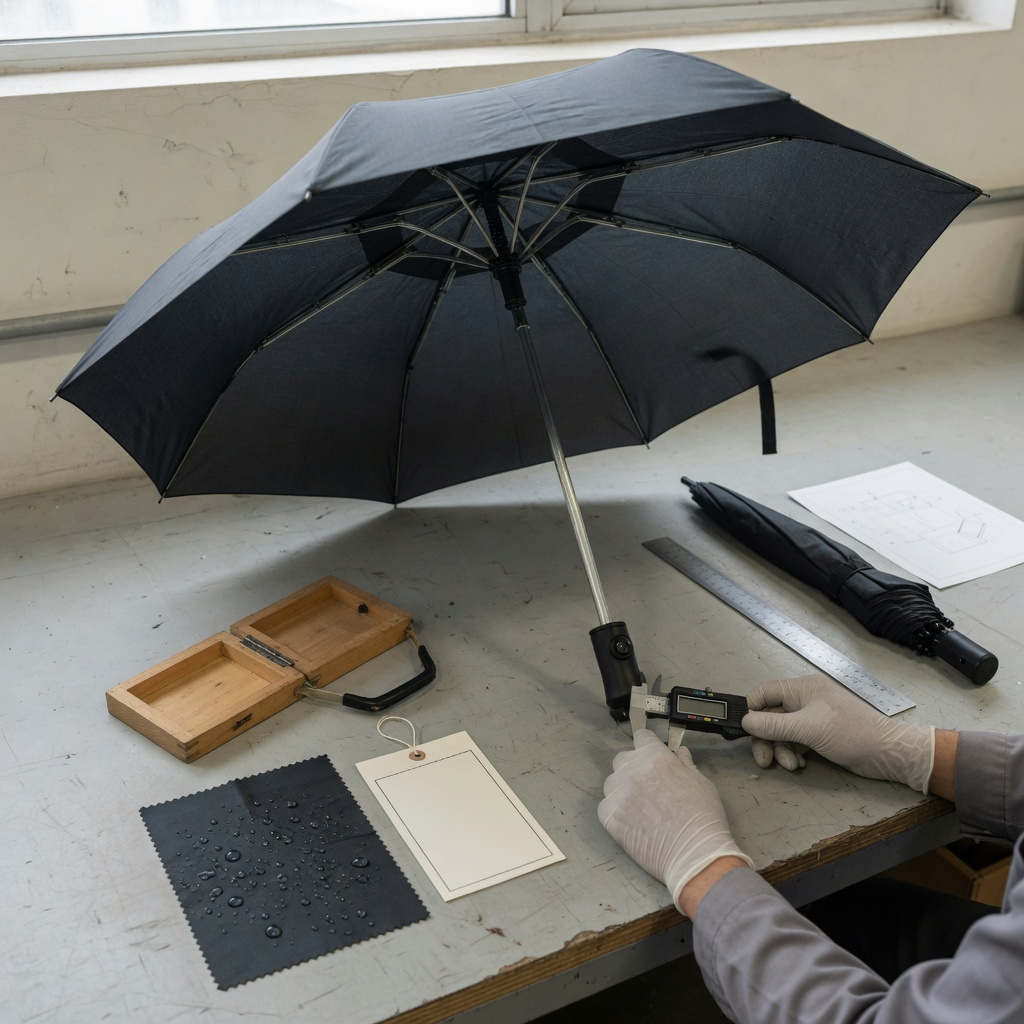
Require open canopy (top and underside), closed profile, runner and joints, handle, print close-up with a ruler, and a short open-close video. Photo and video confirm colour and workmanship only after dimensions are frozen with a measuring scale in frame. A screenshot without sample ID, drawing revision, named approver, and date is not PPS approval.
Time-zone delays, revision cycles, and file control
For Europe-bound manufacturing, plan overlap in writing and keep drawings, not chat, as the controlling record. Example planning assumption to confirm with the factory calendar: China Standard Time (UTC+8) is typically 6–8 hours ahead of European civil time, depending on UK time versus CET/CEST and daylight saving. Put a daily overlap window in the RFQ. Move specification changes only through a dated change order that cites the previous revision ID.
One published rush-project write-up is useful only as a communication pattern. It describes an order of 300 pieces of custom double-canopy fiberglass golf umbrellas completed in 20 days, with evening discussions covering a 13-hour time difference, remote photo and video sample confirmation, in-house production prioritization, and DDP air freight (HF Umbrella 20-day project write-up). Scope: that vendor's published case about a United States-destination rush order, not a Europe placement. Units: pieces (order quantity), days (stated project duration), hours (stated time difference). As-of date: not stated on the supplied page excerpt. Take overlap hours, video as a supplement to files, and a single-thread factory contact. Do not treat the write-up as a European sea-freight SLA, as a tax template for EU, EEA, or UK DDP, or as an invitation to copy that destination's Incoterms.
Evening chat can produce a same-day photo and conflicting approvals. Direct factory contact can remove trading-company delay only if the revision-controlled pack remains the record.
Revision rules: every drawing, artwork file, and sample report carries a revision ID; a change after PPS approval restarts the affected sample class; name one factory merchandiser and one buyer-side approver; if the factory replies in a new thread, restate the current revision ID before any approval; packing configuration (units per inner, inners per carton) and lot or date coding are communicated specs, not shipping-day afterthoughts.
Do not copy the published DDP air path into an EU member-state, EEA, or UK order without a tax opinion. Incoterms 2020 change who is importer of record and which safety file must travel with the goods.
Europe: destination files that the OEM communication must freeze
Keep the product decision primary: the purchase is a windproof umbrella manufacturing run. The RFQ must still name where the goods will be placed on the market, because "Europe" is not one administration.
- EU member states. Umbrellas intended for, or likely to be used by, consumers and placed on the EU market are generally treated as consumer products under the General Product Safety Regulation (Regulation (EU) 2023/988), applicable from 13 December 2024. Scope: EU legal-framework date, not UK law and not a factory test report. Non-EU manufacturers typically need an identified EU economic operator and traceability elements. Confirm operator duties with the importer's counsel. Put the operator's legal name, as supplied by the importer, in the same thread as the canopy spec; do not ask the OEM to invent one.
- EEA states (Iceland, Liechtenstein, Norway). These are not EU member states. Do not assume an EU responsible-person appointment and an EU technical file automatically satisfy every EEA national administration.
- United Kingdom. The UK is not in the EU or the EEA. UK product-safety duties and UK REACH are separate from EU GPSR and EU REACH. An EU chemical declaration is not, by itself, a UK file.
- Other European placement. If goods will be placed in a European country that is not an EU member state, not an EEA state, and not the UK, do not reuse an EU or UK pack. Name that country and let the importer state which file applies.
- Country-level packaging. Extended producer responsibility and packaging marks are national. Registration and artwork differ by member state. Do not instruct the factory that "EU packaging" is a single layout.
Request in the same thread as the canopy spec: an EU REACH or UK REACH declaration covering dyes, coatings, adhesives, metals, and plastics, including SVHC statements against the list current on the PO date (choose the regime that matches the named destination); alignment with Regulation (EU) No 1007/2011 if a hangtag will carry fibre names for EU placement (do not extend that regulation to the UK by implication); and origin and carton marks that match the importer's instruction sheet for the named country.
ISO 9001 on a catalogue page is a management-system claim until a current certificate with scope and expiry is produced (Hongjie page ISO 9001 mention). It is not a wind test and not GPSR technical documentation. ISO 9001's requirements are not the same thing as that company's demonstrated practice on the lot. One dual-market stock (EU plus UK) looks efficient; it doubles chemical and operator paperwork if the OEM only maintains an EU pack. Decide the market pack before the quote, not after fabric is cut.
Wind-resistance tests and inspection documents to put in the contract
"Windproof" is not a self-executing European legal class. Define the test in the same communication pack as the BOM. Convert catalogue lines such as "level-10 wind resistance" and "tested for wind pressure" into contract fields (Hongjie custom windproof umbrella OEM page): method (wind tunnel, calibrated fan, or other protocol) and any standard reference; what "level-10" means in metres per second or Beaufort, written in the PO; sample size (n umbrellas), construction ID, and whether the tested unit is the PPS construction; pass/fail for inversion, permanent deformation, rib or joint fracture, canopy tear, and runner failure; lab identity (in-house or third party), report date, stills or video; and the lot rule (PPS-only versus every bulk lot).
In-house fan tests are faster and cheaper; they are harder to compare across OEMs. Third-party tunnel time adds calendar days and produces a file a downstream retailer can read. Choose in the RFQ and price the chosen test as its own quote line.
Pair wind evidence with mechanical checks already named in published workflows: repeated open-close and a waterproof or spray check (Baisite workflow QC step). Example cycle count to agree in the quote: 50 open-close cycles on the AQL sample — verify, do not treat as an industry law. A 1-year warranty, where a catalogue offers it, is a commercial remedy to restate in the PO; it is not an AQL and not a safety file (Hongjie custom windproof umbrella OEM page).
Inspection files, not chat assurances: incoming fabric record; PPS approval form; final AQL report with defect photos; packing list matching SKU, colour, carton quantity, and carton marks; chemical declaration; and, where the importer requires it, a GPSR-related technical-file index (EU) or the UK equivalent index — never one substituted for the other.
Buyer decision table: communication checkpoints versus order gates
Every row is a specify, compare, verify, or approve action for a Europe-bound windproof umbrella manufacturing order.
| Communication checkpoint | Specify in the RFQ | Compare across OEM quotes | Verify before PPS approval | Order gate (fail-closed) |
|---|---|---|---|---|
| Construction freeze | Frame BOM, canopy, diameter (mm), tolerances, open mode | Frozen BOM priced, not a catalogue substitute | Closed length, rib length, canopy diameter vs drawing rev | No PO until drawing rev and PPS match |
| Colour and print freeze | Pantone (or equivalent), process, control panel, bleed | In-house vs subcontract print; who pays rejects | Strike-off on bulk fabric with ruler photos | No bulk print without written strike-off |
| Sample ladder | Proto vs PPS vs gold; counts; who retains gold | Sample days; PPS from bulk lot or not | Sample ID marked; open-close video on file | No bulk cutting without signed PPS |
| Wind-resistance evidence | Method, speed with unit, n, pass/fail | In-house vs third party; test priced as a line | Report construction ID equals PPS | PO cites report ID or requires lot test |
| AQL and workmanship | Standard, level, critical/major/minor numbers | Who pays failed inspection and rework days | Defect list in PO language; inspector access | Ship-hold on AQL fail; no silent downgrade |
| Chemical / safety file | Named EU member state, EEA state, or UK | Which declarations the OEM will issue | Document dates vs current SVHC list | No ship without the named destination pack |
| Packaging marks and packing config | Importer artwork; units per carton; country marks | Who prints marks; who holds EPR registration | Carton photos vs instruction sheet | Cartons omitting required marks are not shippable |
| Traceability | Lot/date code on carton and, if required, unit | What the OEM can print without delaying the run | PPS carton photo matches the instruction | Lots without the agreed code are not shippable |
| Quote extras | Plates, rib tooling, third-party wind report, extra PPS | Included vs optional lines | Quote revision matches BOM revision | Unpriced extras are not "included" |
| Communication SLA | Overlap hours, English files, one approver, change orders | Response time; factory-direct merchandiser or not | Every change on the revision log | Unlogged chat changes are non-binding |
Practical RFQ checklist for windproof umbrella manufacturing
Use each line to specify, compare, verify, approve, or order a Europe-bound run. Drop any line that cannot be enforced.
- Name the destination as a specific EU member state, a specific EEA state, or the UK — not "Europe" alone.
- Attach a frozen BOM (shaft, ribs, runner, joints, handle, tips, canopy layers, sleeve/case) and millimetre dimensions with numerical tolerances.
- State wind-management construction in build language (double canopy, flexible fiberglass ribs, or both), not as an adjective.
- Require a drawing or spec sheet with revision ID; reject quotes that cite only a photo.
- Define proto / PPS / gold, quantity per SKU, whether PPS uses the bulk fabric lot, and who retains the gold sample; require PPS stills, a short open-close video, and a dimensional sheet before approval.
- Name the wind test: method, speed with unit, sample size n, pass/fail, in-house or third party; attach the report as a PO exhibit; price it as a quote line.
- Name mechanical QC (open-close cycle count agreed in the quote, waterproof/spray check if required, incoming fabric station) and AQL (standard, level, critical/major/minor, defect definitions, who inspects).
- Request chemical declarations aligned to EU REACH or UK REACH according to destination, against the SVHC list current on the PO date.
- Request a technical-file index for EU GPSR placement or the UK safety-file index — never one as the other. If an EU economic operator is required, the importer supplies that legal name.
- Attach importer carton-mark and inner-label artwork, including country-specific packaging marks, units per inner, inners per carton, and lot/date-code location.
- State Incoterms 2020 and importer of record; do not assume DDP from unrelated published cases. Name English as the controlling language; require a change-order log; name one factory merchandiser and one buyer approver; state the daily overlap window; chat-app messages do not amend the PO unless copied into that log.
- Copy catalogue claims (MOQ, days, ISO 9001, warranty duration) into the quote only with certificate numbers, scope, and expiry where they matter; list plates, extra tooling, extra PPS rounds, and third-party tests as optional or included lines. Block bulk production until written PPS approval is filed against the same revision ID as the PO. Confirm HS classification with the importer's customs broker (complete umbrellas are commonly declared in heading 6601 — verify per construction and destination).
Source context, methodology, and what to verify
Source context 1. OEM and factory pages that publish in-house process steps, sample days, MOQ bands, wind-resistance slogans, ISO 9001, warranty duration, and commercial OEM language. These are commercial publications, not independent laboratory reports. URLs: Hongjie custom windproof umbrella OEM page; Baisite 9-step manufacturing workflow.
Source context 2. One supplier-published rush-project narrative that documents time-zone handling, remote photo/video confirmation, and DDP air freight for a 300-piece, 20-day order destined outside Europe (HF Umbrella 20-day project write-up). It is used only to isolate communication mechanics for a Europe-bound RFQ, not as a destination template and not as an invitation to that sales market.
Methodology. Exact figures — 300 pieces, 20 days, a 13-hour time difference, a 9-step process list, 3-day samples, a 100-piece MOQ, 500–1,000 piece MOQ, 15–30 day lead times, a level-10 wind claim, ISO 9001, and a 1-year warranty — are taken from those supplier pages and attributed to them, with as-of dates not stated on the supplied excerpts. Regulatory instruments (EU GPSR application from 13 December 2024; EU REACH versus UK REACH; EU fibre-labelling Regulation (EU) No 1007/2011) are named as document-request frameworks for destination control, not as evidence that any factory is certified, appointed, or compliant. Example values (AQL numbers, 3 mm bleed, ±5 mm / ±3 mm dimensional tolerances, 50 open-close cycles, 6–8 hour time offsets, HS heading 6601) are labeled as assumptions to confirm in the quote or with the importer's broker.
Limitations / what to verify. The supplied pages do not publish wind-test methods, laboratory accreditation, current ISO certificates, or Europe-destination compliance packs. MOQ and lead time change with fabric, print, and season. A non-European DDP air example does not set VAT, EORI, or safety-file practice for an EU member state, an EEA state, or the UK. "Level-10 wind resistance" has no contract meaning until speed, method, and pass/fail are written. National packaging EPR rules are not interchangeable across EU member states. This editorial is not legal advice; the importer must confirm operator duties, chemical lists, and packaging registrations for the named destination. ZheBrella does not, in this article, claim the MOQs, lead times, certificates, warranties, or test results quoted from other manufacturers.
This communication workflow review is an editorial process brief for European manufacturing buyers of windproof umbrellas. It is not a substitute for the current certificates and test reports that must sit on the purchase order.
Discuss Your Requirements
Review our manufacturing capabilities, then share your specifications for a supplier-fit review.