Windproof Umbrella OEM Compliance Requirements for Europe
By Vincent Xi | Editorial Author
Procurement answer: For Europe-bound B2B orders, windproof umbrella OEM compliance requirements belong in the RFQ as destination-specific manufacturing release conditions, not as a request for a generic certificate. Each quote should connect the legal route, economic-operator roles, product risk analysis, bill of materials, chemical evidence, wind-test method, artwork, and batch inspection to the same model and revision.
This scope assumes a conventional, unpowered handheld umbrella intended for consumer distribution in Europe. Electrical functions, a child-directed design, material substitutions, or a different destination require a fresh applicability review before quote approval or production.
Hold the order if a bidder offers only a generic Europe compliant statement, presents CE documentation without identifying applicable legislation, supplies chemical evidence that cannot be mapped to the production BOM, or states a wind speed without the specimen identity and test protocol. None of those items establishes compliance or performance for the quoted SKU.
Europe Compliance Requirements Start With the Destination Route
Europe is not a single regulatory row. The RFQ must distinguish the EU, non-EU EEA destinations, Great Britain, Northern Ireland, and other European countries. A conclusion supported for one route must not be copied to another without checking the applicable law, implementation status, operator chain, and intended placement date.
Source-backed data for the RFQ
| Concrete data point | Scope and date context | Source and procurement use |
|---|---|---|
| 13 December 2024, a calendar date | The date from which the General Product Safety Regulation applies to products within its EU scope | The official GPSR text. Record the intended EU placement date and verify the law current for that date. |
| 10 years, a document-retention period starting when the covered product is placed on the EU market | Applies to the manufacturer's relevant GPSR technical documentation where the regulation applies | The official GPSR text. The contract should identify the document owner, storage location, covered SKU, and retention-start event. |
| Above 0.1% weight by weight, a concentration threshold in the relevant article | Applies to the Candidate List communication context described by ECHA; check the Candidate List and applicable interpretation on the RFQ issue date and again at production release | ECHA Candidate List communication guidance. Require the substance identity, concentration basis, affected article or component, declaration date, and data owner. |
| 45 calendar days, measured from receipt of a qualifying consumer request | Response period for the applicable consumer-information duty described by ECHA; verify the rule and Candidate List current on the request date | ECHA Candidate List communication guidance. Assign the response owner, source-data holder, and escalation route. |
These figures are legal procurement inputs. They are not wind-performance targets, test results, or proof that a component or finished umbrella complies.
EU orders
For an EU order, use the GPSR text to record the applicability decision for the configured product and intended placement date. Where the GPSR applies, the RFQ file should identify the manufacturer, importer where applicable, and the EU-established responsible economic operator required for the supply route. It should also cover product or batch identification, operator contact details, technical documentation, internal risk analysis, applicable instructions and warnings, and the information needed for the intended distance-sales offer.
The GPSR manufacturer definition can include an entity that has a product manufactured and markets it under that entity's name or trademark. A private-label buyer should therefore document its role against the actual branding, contract, and supply chain rather than assuming it has importer obligations only.
Create a country row for each intended EU destination. Record the required safety-information language and any unresolved national packaging, registration, or producer-responsibility issue. The supplied sources do not determine every national outcome, so labels and packaging should remain on hold until a current primary source and named reviewer support the country decision.
Non-EU EEA orders
For Iceland, Liechtenstein, or Norway, use EFTA's EEA-Lex resources to check whether the relevant EU act has been incorporated for the destination and intended placement date. An EU application date does not by itself prove the same legal position in every non-EU EEA destination.
The reviewer should record the act checked, destination, incorporation status, check date, relevant national measure, language conclusion, and source link. Keep the order on hold while incorporation or local implementation remains unresolved.
Great Britain orders
Great Britain requires its own product-safety and chemical file. Use the current UK product-safety guidance for businesses as the supplied official starting point for the configured product, responsible businesses, traceability, instructions, and any applicable marking assessment. Use HSE's UK REACH guidance for the chemical route.
These pages are not SKU approvals. Record the law and guidance checked, review date, responsible business, supporting product evidence, labeling conclusion, and issues requiring specialist review before release.
Northern Ireland orders
Do not merge Northern Ireland with Great Britain. HSE's REACH guidance distinguishes the UK REACH route in Great Britain from the EU REACH route in Northern Ireland. Product-safety, economic-operator, marking, and labeling conclusions also need a current review for the actual Northern Ireland supply route.
Require a separate legal basis, operator chain, chemical assessment, artwork decision, and evidence pack. A Great Britain declaration is not automatically the Northern Ireland file.
Other European destinations
For a European country outside the EU, EEA, and UK, create a country-specific RFQ row supported by current national sources. The supplied evidence does not establish product-safety, chemical, language, customs, operator, packaging, or producer-responsibility requirements for those destinations. Keep product labels, inserts, and cartons on hold until each applicable issue has a cited conclusion, owner, and approval date.
CE marking and electrical features
The official EU CE-marking guidance explains that CE marking is used only when applicable EU legislation requires it and must not be used for products outside that legislation. The page does not provide a product-specific scope decision for the quoted umbrella.
Require an applicable, not applicable, or unresolved decision for the exact SKU. The return should identify the product feature, relevant legislation, reviewer, decision date, and supporting document. A CE logo, generic certificate, or declaration for another configuration is not a scope analysis.
The European Commission's RoHS scope information concerns electrical and electronic equipment. If the umbrella has an electrical or electronic function, require a documented RoHS scope review for that configuration. Do not infer applicability from ordinary metal frame parts or infer compliance without current product-linked evidence.
Lock the Windproof Umbrella SKU Before Reviewing Evidence
Compliance evidence must identify the construction being manufactured, not an umbrella family or visually similar sample. Establish a controlled relationship among the model code, BOM revision, drawing revision, artwork revision, packaging revision, test specimen, approval sample, purchase order, and production lot.
| Control area | Supplier return required | Hold condition |
|---|---|---|
| Product identity | Model code, mechanism, accessories, intended user, destination, and revision set | The quote, sample, evidence, and order describe different configurations |
| Dimensions and mass | Open span, canopy arc, closed length, shaft length, finished mass, and packed mass, each with units, endpoints, inclusion rules, method, and tolerance | Measurements use undefined or inconsistent methods |
| Canopy system | Panel and vent construction, fabric code, fabric mass per area, coating, treatment, thread, ink, film, primer, adhesive, and cure conditions | Declarations or reports cannot be linked to listed BOM entries |
| Frame and mechanism | Shaft, ribs, stretchers, runner, springs, latch, joints, rivets, tips, ferrule, material specifications, plating, and coatings | Material specifications, drawings, or component identities are missing |
| Branding and packaging | Print process, artwork coverage, color-control method, sleeve, insert, labels, protective material, carton, and packed dimensions | Tested construction or approved artwork differs from production without accepted equivalence |
A signed approval sample is a manufacturing control, not legal-compliance proof. Its identifier should still connect the approved appearance and construction to inspection and change control.
The purchase order should prohibit unapproved changes to materials, treatments, coatings, inks, sub-suppliers, tooling, mechanisms, construction, and packaging. A change request should identify the affected BOM entries, reason, risk impact, replacement evidence, sample or retest requirement, and buyer disposition. Production remains on hold until approval is recorded.
The supplied commercial sourcing reference may be used to formulate bidder questions about materials, printing, and documentation. It is not a legal source, independent test report, certificate, or proof of any property for the quoted SKU.
Build Component-Level Safety and Chemical Evidence
Where the GPSR applies, its official text supports the requirement for the manufacturer's internal risk analysis and technical documentation. For the configured umbrella, the RFQ should require assessment of hazards relevant to its actual design, such as exposed frame ends, frame breakage, pinch or entrapment points, runner or latch failure, spring-driven opening, foreseeable inversion or collapse, detached parts, chemical contact, and deterioration that could affect safe use.
For each identified hazard, require the exposed user, severity rationale, likelihood rationale, design control, verification method, residual risk, warning or instruction decision, evidence owner, and closure status. A fabric declaration does not cover the frame, mechanism, handle, print system, or finished-product hazards.
Map every chemical declaration and report to the production BOM. The evidence record should identify the issuer, covered entity and site, material or component code, sub-supplier, legal or substance scope, list version, issue date, validity basis, specimen identity, test method where used, reporting limit, result, laboratory, report date, and relationship to the finished SKU.
Use ECHA's Candidate List communication guidance only for the duties it describes. Keep that assessment separate from restrictions, other chemical regimes, and buyer-defined substance requirements. A Candidate List declaration is not evidence of compliance with every chemical obligation.
If a bidder proposes a PFAS-free, recycled-content, or certification claim, require the exact claim definition and current product-linked evidence. For a PFAS-free claim, the file should identify the substance list, covered material matrices, test method, reporting limits, specimen identity, and report date. For a certification claim, require the scheme, covered organization, site, material or product scope, validity dates, and transaction evidence where the scheme requires it. Do not extend a document beyond its recorded scope or validity.
Set an RFQ rule that a safety data sheet for a process mixture is not accepted as the sole evidence for a finished article. The bidder must connect process information and finished-component evidence to the controlled production BOM.
Define Windproof Compliance Requirements as Contract Tests
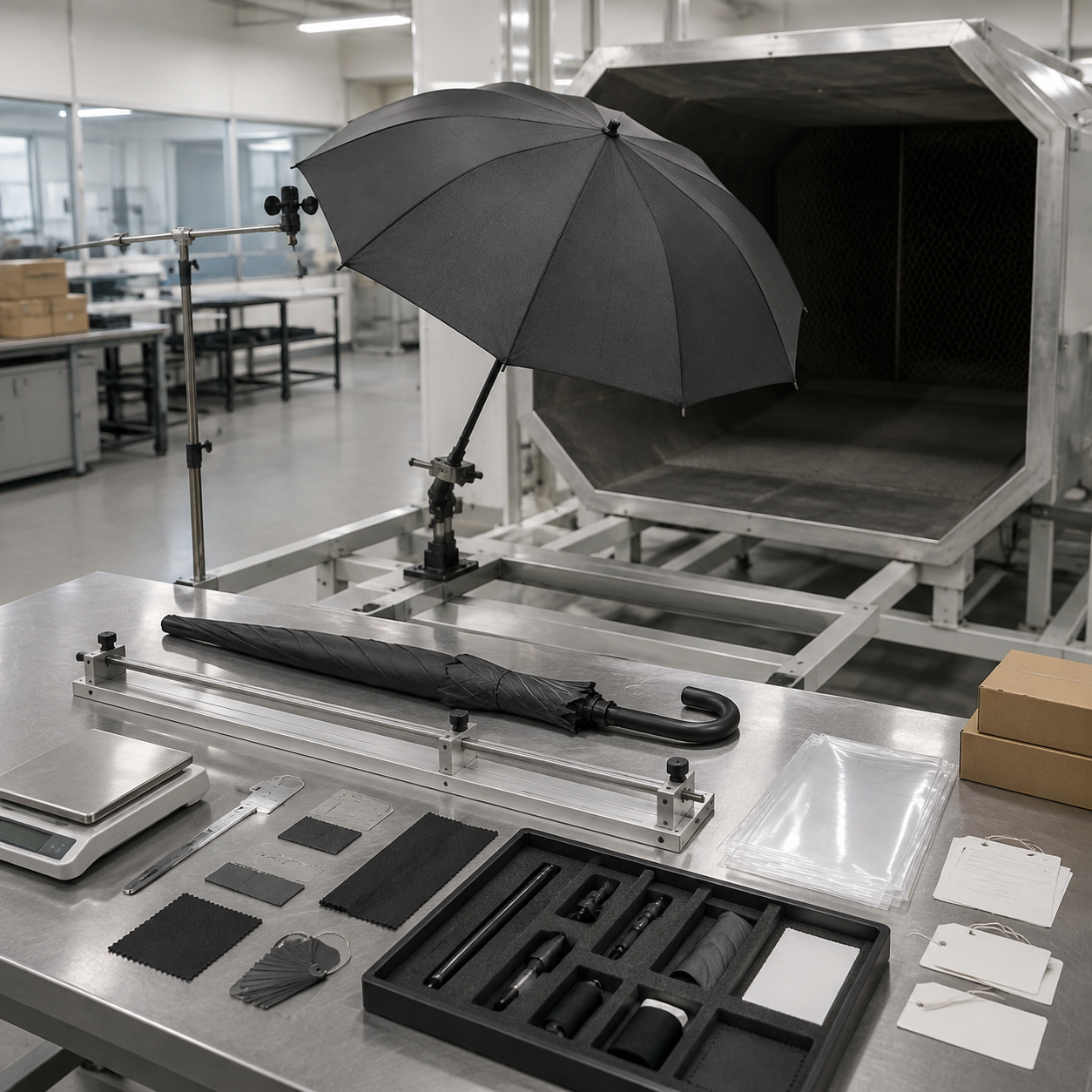
No supplied official source establishes a universal wind-speed threshold or test protocol for the quoted umbrella. The windproof claim therefore needs a buyer-approved contractual method alongside the destination-specific legal file.
The supplied commercial umbrella-testing overview may inform questions about wind and related tests. It is not legislation, a formal standard supplied with this package, a product-specific report, or evidence that a quoted umbrella passed.
Require each bidder to complete the same test schedule:
| Test field | Required record |
|---|---|
| Claim and specimen | Exact claim wording; model, BOM, drawing, artwork, and packaging revisions; specimen source; production status; and specimen identifiers |
| Product measurements | Canopy span, canopy arc, closed length, and finished mass, with units and measurement definitions |
| Conditioning and fixture | Dry or wet condition, conditioning method, airflow-duct geometry, fixture design, and handle, shaft, and canopy restraints |
| Airflow measurement | Instrument, range, uncertainty, calibration status, measurement point, reported statistic, and unit |
| Exposure sequence | Air-speed profile, increments, dwell, orientation, gust sequence, and deviations from the agreed method |
| Acceptance | Defined failure modes, permitted inversion behavior, permanent-deformation method, recovery interval, post-test opening and closing checks, and buyer pass rule |
| Test record | Specimen-level observations, raw data, photo and video references, test date, location, operator, report issuer, and release disposition |
The following values are illustrative buyer assumptions for RFQ drafting only. They are not legal requirements, formal standards, or product-performance claims. Each value applies to the locked model and revision at quote review and must be confirmed in the supplier quote and agreed laboratory method before use.
| Example field | Assumption to verify |
|---|---|
| Specimen quantity | 3 finished specimens, a specimen count for each locked model, BOM, and artwork combination |
| Airflow progression | 2 metres per second per step, an increment applied to each specimen only after the test facility confirms fixture safety and measurement capability |
| Step dwell | 30 seconds per orientation, an exposure duration for each agreed test orientation |
| Recovery observation | Inspect after 10 minutes, a post-test interval, and record permanent set in millimetres |
Do not turn an assumed target wind speed into a product claim. The buyer should set the target, orientations, wet or dry state, permitted inversion behavior, and acceptance criteria after reviewing the product design and proposed test method.
Define failure before testing. Contractual failure categories may include permanent rib or shaft deformation, broken or detached joints, torn fabric or seams, detached tips, unintended closure, mechanism failure, inability to reopen, or loss of safe operation. The protocol should state whether reversible inversion is permitted and who may classify borderline results.
A speed result is not comparable evidence when specimen quantity, measurement location, duration, orientation, conditioning, calibration status, and failure definition are absent. Do not transfer a report from another vent design, frame, print construction, or BOM revision unless the buyer accepts a documented technical-equivalence assessment.
Opening durability, rain resistance, seam leakage, and corrosion claims should remain separate test lines. If a standard is proposed, require its exact title, edition, scope, deviations, and result. Record whether it is a legal requirement, buyer specification, laboratory method, or supplier practice. Never present a supplier practice as a statutory requirement or imply certification without a current scope document.
Connect Compliance Evidence to Manufacturing Release
The supplied commercial manufacturer page may help formulate supplier-side inspection questions. It is not evidence that a factory, SKU, or production lot was audited, inspected, or passed.
The purchase order should define the production-lot identifier, inspection timing and location, sampling method, sample-size inputs, defect definitions, acceptance rules, measurements, functional checks, approved-sample comparison, artwork and packaging checks, corrective-action process, reinspection responsibility, report format, and shipment-release authority.
If a bidder proposes an acceptance-quality-limit approach, require the cited method and exact plan, including lot size, inspection level, defect classes, acceptance and rejection values, and switching rule. A statement such as standard AQL is not a complete inspection instruction.
The batch-release report should identify the purchase order, model, BOM revision, artwork revision, packaging revision, production lot, inspected quantity, selected specimens, individual findings, defect dispositions, report date, and approver. A general factory process description cannot replace a lot-linked release record.
Practical Manufacturing RFQ Checklist for Europe
Attach this checklist to the RFQ and require bidders to return it with referenced evidence. A checked item must identify the applicable file, revision or issue date, evidence owner, and responsible reviewer. Leave manufacturing or shipment on hold when a required item is unchecked or supported only by a generic statement.
- [ ] Identify every destination. State each European country, whether its route is EU, non-EU EEA, Great Britain, Northern Ireland, or another country-specific route, and the intended placement timing.
- [ ] Record the legal review. Cite the current primary source, review date, applicability conclusion, unresolved questions, and reviewer for each destination rather than accepting
Europe compliant. - [ ] Allocate economic-operator roles. Name the proposed brand owner, manufacturer, importer where applicable, responsible economic operator where required, and the legal and electronic contact details needed for the route.
- [ ] Lock the product configuration. Align the model code, BOM, drawings, mechanism, dimensions, tolerances, materials, treatments, artwork, packaging, approval sample, quote, and purchase order to controlled revisions.
- [ ] Complete the product risk analysis. List hazards, exposed users, design controls, verification methods, residual risks, warning decisions, evidence owners, and closure status for the exact SKU.
- [ ] Map chemical evidence to components. Connect declarations and reports to canopy fabric, coatings, print system, thread, adhesives, handle, frame parts, plating, tips, packaging, and other applicable BOM entries.
- [ ] Resolve CE and powered-feature scope. Return an
applicable,not applicable, orunresolvedconclusion supported by the relevant product feature, legislation, reviewer, decision date, and document. - [ ] Approve destination artwork. Verify product identifiers, operator details, warnings, safety information, required languages, packaging, inserts, and distance-sales information before printing.
- [ ] Define the windproof claim and test. State the exact claim, specimen revisions, conditioning, fixture, airflow measurement, exposure sequence, failure definitions, acceptance rule, raw-data format, and report issuer.
- [ ] Separate other performance claims. Give opening durability, rain resistance, seam leakage, corrosion, or environmental claims their own methods, specimens, evidence, and acceptance decisions.
- [ ] Control substitutions and reorders. Require advance notice, affected BOM entries, risk assessment, replacement evidence, sample or retest decision, and written approval before any change enters production.
- [ ] Specify lot inspection. Define the production-lot identifier, sampling method, sample-size inputs, defect classes, acceptance rules, measurement checks, report format, corrective action, and release authority.
- [ ] Require a lot-linked release report. Match the purchase order, SKU revisions, inspected quantity, selected specimens, findings, dispositions, report date, and approver before shipment.
- [ ] Make quotes comparable. Separate sampling, testing, documentation, inspection, correction, reinspection, and retesting costs and lead times so bids are compared on equivalent evidence scopes.
- [ ] Maintain an open-issues register. Assign every unresolved legal, language, chemical, test, artwork, certification-scope, or country question an owner, required evidence, due point, and closure authority.
Approve, Hold, or Reject the Manufacturing Release
Approve only when the destination route and operator roles are resolved, legal and technical records identify the quoted SKU, the windproof claim meets the agreed protocol, destination artwork is approved, and the batch-release process is fixed in the contract.
Hold when a legal route, language, responsible operator, chemical scope, evidence link, test method, country review, or certification scope remains unresolved. Each hold item needs an owner, required evidence, due point, and closure authority.
Reject the claim or configuration when the bidder cannot identify the tested product, relies on a generic CE or Europe compliant statement, withholds the test method, supplies evidence for a materially different BOM, or introduces an unapproved substitution. An unsupported performance or environmental claim may instead be removed if the remaining legal, safety, and contractual requirements are satisfied.
Evidence Method and Limitations
Methodology: Claims were separated by source class and mapped to a European destination, configured SKU, RFQ field, evidence owner, and release decision. Official contexts used were the GPSR text, ECHA guidance, EU CE guidance, European Commission RoHS page, EFTA EEA-Lex resource, UK product-safety guidance, and HSE REACH guidance. Each statement was limited to the territory and subject addressed by its source.
The commercial sourcing reference, commercial manufacturer page, and commercial testing overview were retained only as sources of supplier questions. They were not treated as legal authority, independent verification, certification, factory-audit evidence, product test results, or production-lot evidence.
Limitations and verification: This package does not assess an actual SKU, BOM, contract, laboratory report, certificate, factory, or production lot. Before ordering, verify the law current on the intended placement date, current Candidate List, EEA incorporation status, separate Great Britain and Northern Ireland routes, country language rules, national packaging and producer-responsibility duties, any named standard and edition, laboratory competence and claimed scope, reporting limits, specimen identity, document validity, and production-lot linkage. Reassess when the destination, intended user, electrical functions, materials, treatments, construction, artwork, accessories, supplier, or sub-supplier changes. No certification, test result, audit result, or compliance status is inferred without a current supporting document.
Author basis: The approved profile identifies Vincent Xi as Editorial Author. No personal factory visit, product test, certification, client outcome, or first-person product-use experience is asserted.
Discuss Your Requirements
Review our manufacturing capabilities, then share your specifications for a supplier-fit review.