Windproof Umbrella OEM Customization Options for United States Buyers
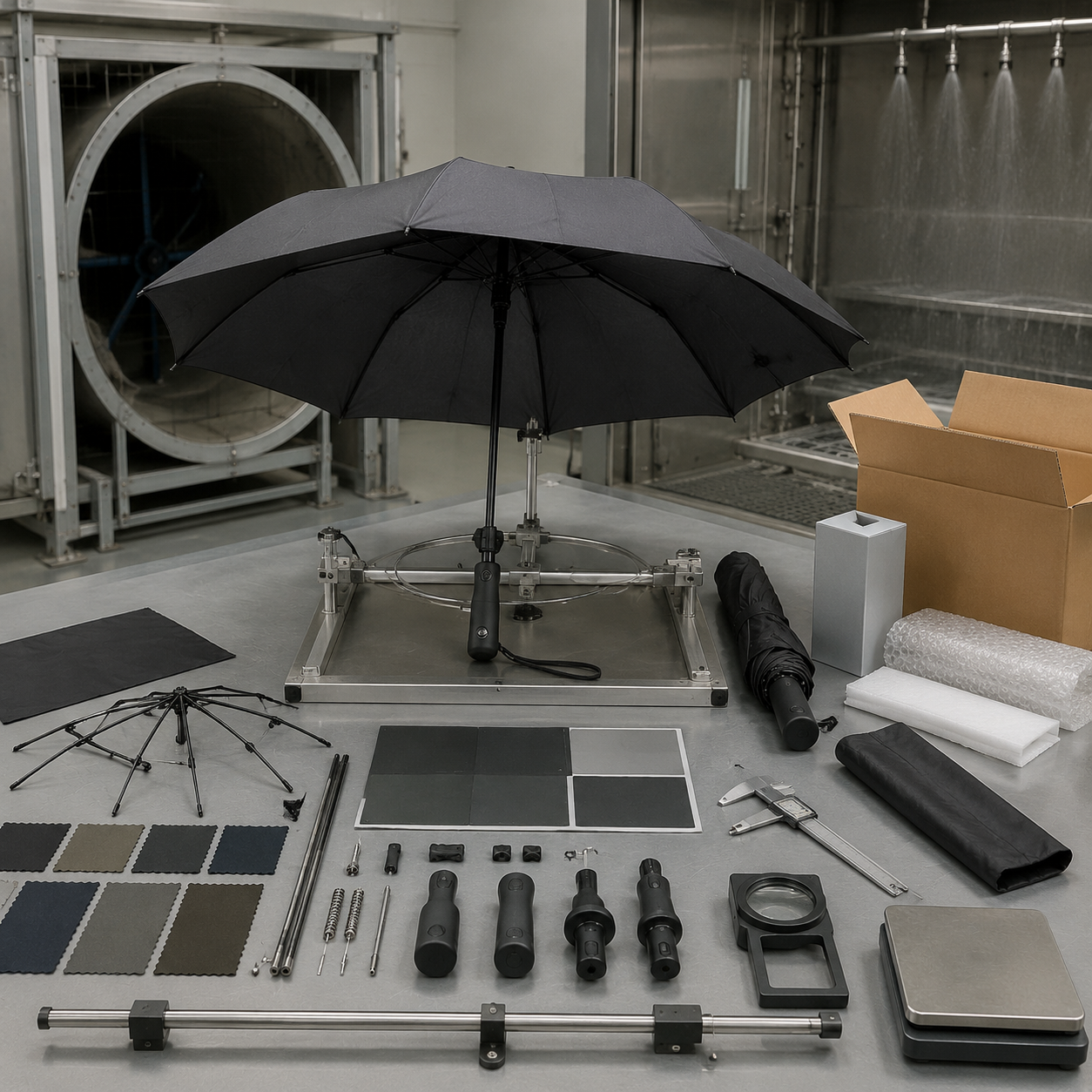
By Vincent Xi, Editorial Author
Author note: The profile identifies Vincent Xi as an Editorial Author. No first-hand product use, factory visit, testing, client work, or customer outcome is claimed in this article.
For United States business-to-business buyers, windproof umbrella OEM customization options should be treated as controlled manufacturing variables, not catalog preferences. The sourcing decision depends on whether a supplier can reproduce the approved SKU with the specified frame, canopy, mechanism, decoration, labeling, packaging, and test conditions.
Start with a single defined base model. Asking suppliers to quote against different folding formats, canopy constructions, or measurement methods produces prices that are not directly comparable. Each RFQ should therefore identify the drawing revision, bill of materials, artwork, test protocol, packout, destination, and saleable-unit basis used for the quotation.
Treat windproof as a proposed performance claim until the exact customized SKU has an agreed test method and acceptance criteria. Decoration, fabric, handle, vent, or frame changes can alter the test basis, cost, packing dimensions, and delivery schedule.
Award gate: Do not place an order while a material deviation, test condition, labeling owner, tooling term, landed-cost exclusion, inspection rule, or delivery trigger remains unresolved.
Windproof umbrella customization options for United States RFQs
Convert every option into a nominal specification, tolerance, measurement method, approved physical reference, or clearly marked supplier proposal. Stable RFQ line identifiers should follow each requirement through the quotation, sample review, inspection record, and purchase order.
| Customization area | Buyer-controlled RFQ fields | Supplier return | Approval evidence |
|---|---|---|---|
| Base format | Folding or straight-stick construction, operating method, intended channel, open diameter, canopy arc, closed length, packed length, packed mass, units, tolerances, and measurement points | Model reference, dimensioned drawing, measured sample results, limitations, and deviations | Signed product specification and measured engineering sample |
| Canopy construction | Panel geometry, conventional or vented design, vent overlap, seams, edge treatment, attachment points, reinforcement zones, and printable areas | Pattern drawing, assembly detail, proposed tolerances, and reinforcement locations | Approved canopy drawing and assembled sample |
| Frame and shaft | Component map for shaft, ribs, stretchers, runner, joints, springs, locks, fasteners, tips, finishes, dimensions, and permitted alternatives | Material designations, component dimensions, finish details, tolerances, bill of materials, and substitution list | Controlled bill of materials and approved frame sample |
| Fabric and treatment | Fiber composition, fabric construction or trade designation, mass per area, color reference, coating or treatment, finish, seam compatibility, and required test methods | Material declaration, proposed tolerances, treatment description, availability, and evidence linked to the quoted material | Approved swatch and production-material sample |
| Opening mechanism | Manual opening, automatic opening, or automatic opening and closing; lock, release, closure, operating-force fields, and cycle-test method | Mechanism description, component list, operating limits, safety observations, and proposed cycle protocol | Functional sample and agreed test record for the same component revision |
| Branding and color | Artwork revision, process, location, printable dimensions, orientation, physical color reference, registration tolerance, and durability method | Process recommendation, substrate compatibility, setup requirements, printable-area limits, and constraints | Production-material strike-off or decorated sample |
| Handle and trim | Dimensions, material, finish, texture, attachment, trim colors, stock or custom status, tooling need, and visible tolerances | Component drawing, material and finish proposal, tooling quotation, ownership terms, and replacement route | Approved component sample and written tooling record |
| Unit packaging | Sleeve and retail-pack materials, dimensions, closure, protection function, artwork, barcode zone, label area, and pack hierarchy | Pack drawing, proposed materials, packed dimensions, mass fields, and deviations | Complete packed sample and approved packaging specification |
| Export packout | Carton construction, internal protection, moisture-control proposal, unit orientation, quantity field, gross and net mass fields, handling marks, and warehouse constraints | Carton drawing, measured packed data, material declaration, and shipment-volume calculation | Packing trial and signed carton specification |
Use the same field structure throughout the manufacturing package:
> Requirement ID | characteristic | nominal value | tolerance | unit | measurement or test method | sample stage | required evidence | approval owner
Require the supplier to classify each line as compliant, conditional, deviation, supplier proposal, or unavailable. A conditional response should state the dependency, cost effect, schedule effect, and proposed resolution. An empty response should not be treated as compliance.
The purchase order should identify the approved revisions of the specification, bill of materials, drawings, artwork, packaging specification, test matrix, defect taxonomy, and retained reference sample. Physical samples complement these documents; they do not replace written tolerances or change-control terms.
Decoration, component, and packaging customization options
Customization approval should cover both appearance and manufacturing consequences. A print method can affect substrate choice, a handle can require tooling, and a packaging change can alter carton dimensions or freight assumptions.
| Option | Manufacturing controls to request | Approval checks |
|---|---|---|
| Screen or spot-color printing | Ink system, production substrate, artwork revision, panel position, print dimensions, physical color reference, registration tolerance, curing method, and process limits | Coverage, edge definition, alignment, show-through, flexibility, color comparison, and agreed durability method |
| Digital or sublimation printing | Fabric and coating compatibility, artwork profile, printable area, seam allowance, color-control method, and process constraints | Production-material sample, color appearance, detail retention, panel distortion, alignment, and agreed water or abrasion method |
| Heat transfer | Transfer construction, substrate compatibility declaration, application parameters, placement, edge criteria, and production controls | Adhesion, edge appearance, flexibility, alignment, substrate condition, and agreed durability method |
| Sewn or woven label | Material, dimensions, fold, location, orientation, stitch construction, content artwork, and surrounding-fabric requirements | Legibility, placement, orientation, stitch security, edge finish, and effect on the sleeve or canopy |
| Custom handle or hardware | Component dimensions, material designation, finish, attachment method, visible tolerances, tooling scope, ownership, maintenance, storage, transfer, and replacement terms | Component sample, fit, finish, attachment, approved appearance, and signed tooling record |
| Sleeve and retail packaging | Material, dimensions, closure, protection function, artwork revision, barcode zone, label area, and carton relationship | Complete packed sample, fit, artwork placement, barcode position, protection, and carton compatibility |
On the undated page supplied for this article, Ark Umbrella lists screen printing, digital sublimation, heat transfer, woven labels, sleeves, and retail packaging among services for its own orders. That first-party statement supports asking Ark to confirm those processes in a current quotation. It does not establish another supplier's capabilities or a current ZheBrella product program.
For color-critical work, identify the approved physical swatch or production-material strike-off, the viewing or measurement method, tolerance, and disposition process for an out-of-tolerance result. An on-screen artwork file alone is not a sufficient production color reference.
For a custom component, record whether the proposal uses new tooling, modified tooling, or a stock part with a custom finish. The tooling agreement should address ownership, storage, maintenance, modification, replacement, transfer, and end-of-program disposition. Payment for tooling should not be assumed to establish ownership unless the written terms say so.
Make the windproof claim specific to the customized SKU
The word windproof does not define the apparatus, airflow measurement point, umbrella orientation, exposure, permitted inversion, recovery method, or acceptable damage. The RFQ should require a supplier test proposal before the claim is approved for packaging or sales materials.
| Protocol element | Required definition |
|---|---|
| Sample identity | Exact SKU, bill-of-materials revision, canopy construction, component revisions, sample code, selection method, and conditioning procedure |
| Test setup | Apparatus type, umbrella orientation, operating state, airflow measurement location, instrument identity, calibration status, and speed unit |
| Exposure | Ramp profile, target condition, exposure duration, repetition method, interruption rule, and invalid-test rule |
| Sample plan | Sample quantity, production or pre-production status, selection method, replacement-sample rule, and treatment of invalid tests |
| Acceptance criteria | Rules for inversion, recovery, permanent deformation, canopy attachments, seams, ribs, stretchers, shaft, runner, lock, release, tips, handle, and post-test operation |
| Test record | Photographs, raw observations, failure descriptions, deviations, report date, sample disposition, and responsible organization |
A demonstration for another model should be treated as contextual evidence, not proof for the quoted SKU. The tested sample must match the approved frame, canopy, mechanism, and component revisions if the result is to support the finished-product claim.
No product standard is asserted here as universally applicable. If the buyer's compliance review identifies a relevant standard, the RFQ should state its exact title, edition or date, applicable scope, required clauses, evidence type, and responsible party. A supplier's internal test remains that supplier's practice unless the purchase contract adopts it. Do not describe a product as certified without a current document that identifies the product, issuing body, scope, and validity.
United States labeling and import controls
These are RFQ ownership controls, not a legal determination for a finished product. The United States importer, customs broker, applicable retailer, and qualified compliance adviser should review the final materials, claims, packaging, age grading, importing arrangement, and destination before shipment release.
| Control area | Buyer input | Required supplier return | Approval owner |
|---|---|---|---|
| Importing roles | Purchasing entity, intended importer of record, consignee, destination, and broker contact | Quoted shipment responsibilities, export-document assumptions, consignee data needed, and excluded services | Buyer and customs broker |
| Country-of-origin treatment | Requested wording, location, permanence, product treatment, and packaging treatment | Marking proposal, artwork, placement drawing, material or process description, and packed-sample photographs | Importer and customs or compliance adviser |
| Product claims | Proposed product name, windproof language, instructions, warnings, intended user, and age grading | Claim-to-test mapping, proposed instructions, report references, and disclosed evidence gaps | Buyer legal or compliance reviewer |
| Materials evidence | Final bill-of-materials request, intended channel, document matrix, and evidence acceptance rules | Material declarations and available reports showing document holder, material or product identity, sample code, method, date, result, and scope | Qualified compliance adviser |
| Retail and logistics labels | Buyer-controlled barcode data, retailer rules, routing requirements, artwork, and pack hierarchy | Final artwork, placement drawing, label materials, pack hierarchy, and sample photographs | Buyer and applicable retailer or logistics reviewer |
| Traceability | Required purchase-order, lot, batch, or production-date linkage and record-retention expectation | Coding proposal, code location, production-record linkage, readable sample, and retention method | Buyer quality representative |
Do not accept an unqualified United States compliant statement as evidence. The supplier response should identify the applicable requirement or buyer specification, responsible party, supporting document, exact product or material scope, document date, and unresolved gap. A raw-material report or report for a different umbrella should not be represented as finished-SKU evidence without a documented applicability review.
Label artwork should remain under revision control. The approved file, placement drawing, substrate, application process, packed sample, and inspection criteria should all reference the same SKU and revision.
Normalize landed cost across customization options
Compare quotations using the same currency, quantity, SKU mix, artwork, tooling allocation, packout, shipment basis, named place, destination, and saleable-unit assumption.
> Landed unit cost = goods price + customization and tooling allocation + samples and inspection + origin handling + freight and insurance + duties and tariffs + brokerage and examination charges + destination transport + storage and handling + agreed nonconformance allowance, divided by saleable units received.
This formula is a quotation-comparison framework, not a statement of charges for a specific shipment. The United States importer's customs broker should verify classification, duty and tariff treatment, entry assumptions, country-of-origin treatment, and importer responsibilities for the final SKU at the relevant entry date.
The undated Ark Umbrella page lists FOB, CIF, and DDP shipment planning for Ark's own orders. That supplier statement does not confirm current availability, identify the named place or governing rules version, or show that a quotation includes every origin and destination charge.
A comparable supplier quotation should state:
- Currency, goods-price basis, named place, quote validity, payment milestones, and tax assumptions.
- MOQ by SKU, color, artwork, mechanism, and packout, rather than only an aggregate order quantity.
- Included customization, setup, tooling, samples, testing, inspection, packaging, documentation, and exclusions.
- Tool ownership, storage, maintenance, replacement, transfer, modification, and amortization terms.
- Unit-pack and export-carton dimensions, quantity field, gross and net mass fields, protective materials, and shipment-volume basis.
- Responsibility for origin handling, export documents, freight, insurance, duties, customs examination, demurrage, appointments, and destination transport.
- Assumed order mix, inspection scope, shipment method, cargo-ready window, destination, and saleable-unit denominator.
Request a revised quotation whenever customization changes materials, tooling, process steps, expected yield, pack dimensions, shipment timing, or freight basis. Do not compare a price that excludes tooling, inspection, or destination charges with one that includes them until those line items have been reconciled.
Control delivery for a customized United States order
Use a calendar schedule with dated milestones instead of an unsupported total lead-time statement. Each milestone should identify its trigger, owner, required buyer input, approval dependency, output, and recovery action.
| Stage | Schedule controls | Release evidence |
|---|---|---|
| Specification freeze | Final SKU, drawings, bill of materials, artwork, test matrix, labeling inputs, and unresolved deviations | Signed specification package and deviation log |
| Sampling | Material confirmation, component samples, decoration strike-off, engineering sample, packed sample, review window, and resubmission route | Approved samples and recorded dispositions |
| Production release | Material availability, tooling readiness, approved revisions, test readiness, and buyer authorization | Written bulk-production authorization |
| Quality review | In-process checks, final inspection, corrective-work allowance, reinspection route, and shipment-release authority | Accepted inspection result or approved corrective action |
| Cargo handover | Final packout, cargo-ready confirmation, document set, booking responsibility, handover point, and shipment basis | Approved shipping documents and unchanged product revisions |
| Import and delivery | Broker inputs, customs allowance, destination appointment, warehouse requirements, and exception owner | Delivery record and traceability to the shipped lot |
The quotation should define when production lead time starts. It should also explain the schedule effect of late artwork, failed samples, unavailable materials, component substitutions, failed tests, inspection rework, buyer revisions, split shipments, or missed bookings.
Require written authorization before changing a material, component, process, manufacturing location, artwork, color-control method, test protocol, label, packaging material, packout, or shipment basis. The change request should state the affected SKU and revision, reason, technical effect, cost effect, schedule effect, validation required, and disposition of existing material.
Source evidence and numerical boundaries
| Source context | Date context | Evidence retained | Boundary applied |
|---|---|---|---|
| Vincent Xi author profile | No publication or update date is stated in the supplied profile context | Author name, role, and profile URL | Supports attribution only; it does not support a first-hand experience claim |
| Ark Umbrella manufacturer page | Undated in the supplied page context | Supplier-stated customization services, shipment-planning terms, MOQ, production volume, and quality-check value | Applies only to Ark's first-party statements and requires confirmation in a current quotation |
| Umbrella Source commercial-umbrella page | Undated in the supplied page context | Commercial-umbrella wind information was reviewed for category boundaries | Commercial products are outside the portable windproof umbrella specification and are not used as an SKU benchmark |
| TopUmbrella category article | Dated in the supplied article context | Beach-umbrella dimensional information was reviewed for category boundaries | Beach products are outside the portable rain-umbrella specification and their dimensions are not transferred into this RFQ |
The following numerical statements are retained only within the scope shown:
- On the undated supplied Ark Umbrella page, Ark states that its branded OEM MOQ starts at 500 finished umbrella pieces per branded OEM order. The unit is finished umbrella pieces per order, the scope is Ark's stated branded OEM program, and the date context is an undated supplier page. This is not a current quotation or a ZheBrella MOQ.
- On the same undated supplied Ark Umbrella page, Ark states production of more than 3,000,000 umbrellas per calendar year for its own operation. The unit is umbrellas per calendar year, the scope is Ark's supplier-stated operation, and the date context is an undated supplier page. This does not establish current available capacity, allocation, or ZheBrella capacity.
- On the same undated supplied Ark Umbrella page, Ark states that its leak, frame, and opening-cycle checks use AQL 2.5. The value is a dimensionless AQL value, the scope is the checks Ark describes for its own operation, and the date context is an undated supplier page. The statement does not provide a complete sampling plan and is not a certification or a stated ZheBrella practice.
If a supplier proposes an AQL-based inspection plan, require the lot definition, sampling scheme, inspection level, sample size, defect classes, limits by class, accept-or-reject rule, and disposition process. A supplier-stated value becomes a buyer requirement only when it is incorporated into the approved quality plan and purchase contract.
Practical RFQ checklist for windproof umbrella customization options
Run this checklist before comparing final bids and again before issuing the purchase order. A checked item should have referenced evidence, an approval owner, and a recorded disposition rather than verbal confirmation alone.
- [ ] Freeze a single base SKU with the folding format, operating mechanism, intended channel, measurement points, units, nominal dimensions, tolerances, and drawing revision identified.
- [ ] Attach the controlled bill of materials, canopy and frame drawings, artwork, color references, packaging specification, test matrix, defect taxonomy, and retained-sample requirements.
- [ ] Require a line-by-line compliance matrix in which every requirement is marked
compliant,conditional,deviation,supplier proposal, orunavailable. - [ ] Obtain a revision-controlled quotation showing MOQ basis, customization charges, setup, tooling, samples, testing, inspection, packaging, payment terms, validity, shipment basis, and exclusions.
- [ ] Record the technical, cost, and schedule effect of every condition or deviation, then assign an owner and deadline for resolution.
- [ ] Approve production-material swatches, decoration strike-offs, component samples, the engineering sample, and the complete packed sample against written acceptance criteria.
- [ ] Define the wind-test sample identity, apparatus, airflow measurement point, orientation, exposure, repetition method, acceptance criteria, report content, and claim-approval owner.
- [ ] Complete the United States review package for origin marking, claims, instructions, warnings, traceability, retailer labels, material declarations, and supporting-document scope.
- [ ] Recalculate landed unit cost from the final packout, named place, destination, shipment method, tooling allocation, inspection scope, customs assumptions, and saleable-unit denominator.
- [ ] Agree the lot definition, sample-selection method, defect classes, acceptance rules, corrective-action route, reinspection responsibility, and shipment-release authority.
- [ ] Put dated sampling, production, inspection, cargo-ready, customs, and destination-delivery milestones into the order schedule with triggers, dependencies, and recovery actions.
- [ ] Sign tooling, substitution, and change-control terms covering ownership, storage, maintenance, replacement, transfer, manufacturing-location changes, validation, and written authorization.
- [ ] Attach all approved revisions and accepted exceptions to the purchase order so the contractual package matches the quoted, sampled, tested, inspected, packed, and shipped SKU.
- [ ] Hold the award if any material deviation, test condition, labeling owner, evidence gap, tooling right, landed-cost exclusion, inspection rule, or delivery trigger remains unresolved.
Methodology and limitations
Methodology: The author profile, supplier page, commercial-umbrella page, and category article were treated as separate source contexts. Numerical statements were retained only when the value, unit, supplier or product scope, date status, citation, and exclusion boundary could be stated together. First-party supplier statements were treated as claims about the named supplier, not independent verification or evidence of ZheBrella capabilities. The RFQ controls were derived by mapping each customization decision to buyer input, supplier response, measurable acceptance criteria, approval evidence, and a named decision owner.
Limitations and verification: The supplied sources do not establish current ZheBrella product availability, materials, manufacturing capacity, MOQ, pricing, lead time, testing, certification, compliance status, or shipment terms. No current ZheBrella quotation, drawing, bill of materials, approved sample, factory audit, test report, certificate, tariff classification, legal opinion, inspection result, or freight booking was supplied. Source pages may change, and undated commercial statements may no longer be current. Before ordering, verify every requirement against the exact SKU, signed specification, approved sample, current supplier documents, final quotation, agreed inspection results, and advice from the United States importer's customs and compliance professionals.
Discuss Your Requirements
Review our manufacturing capabilities, then share your specifications for a supplier-fit review.