Windproof Umbrella OEM Sample Approval for New Zealand RFQs
By Vincent Xi, Editorial Author
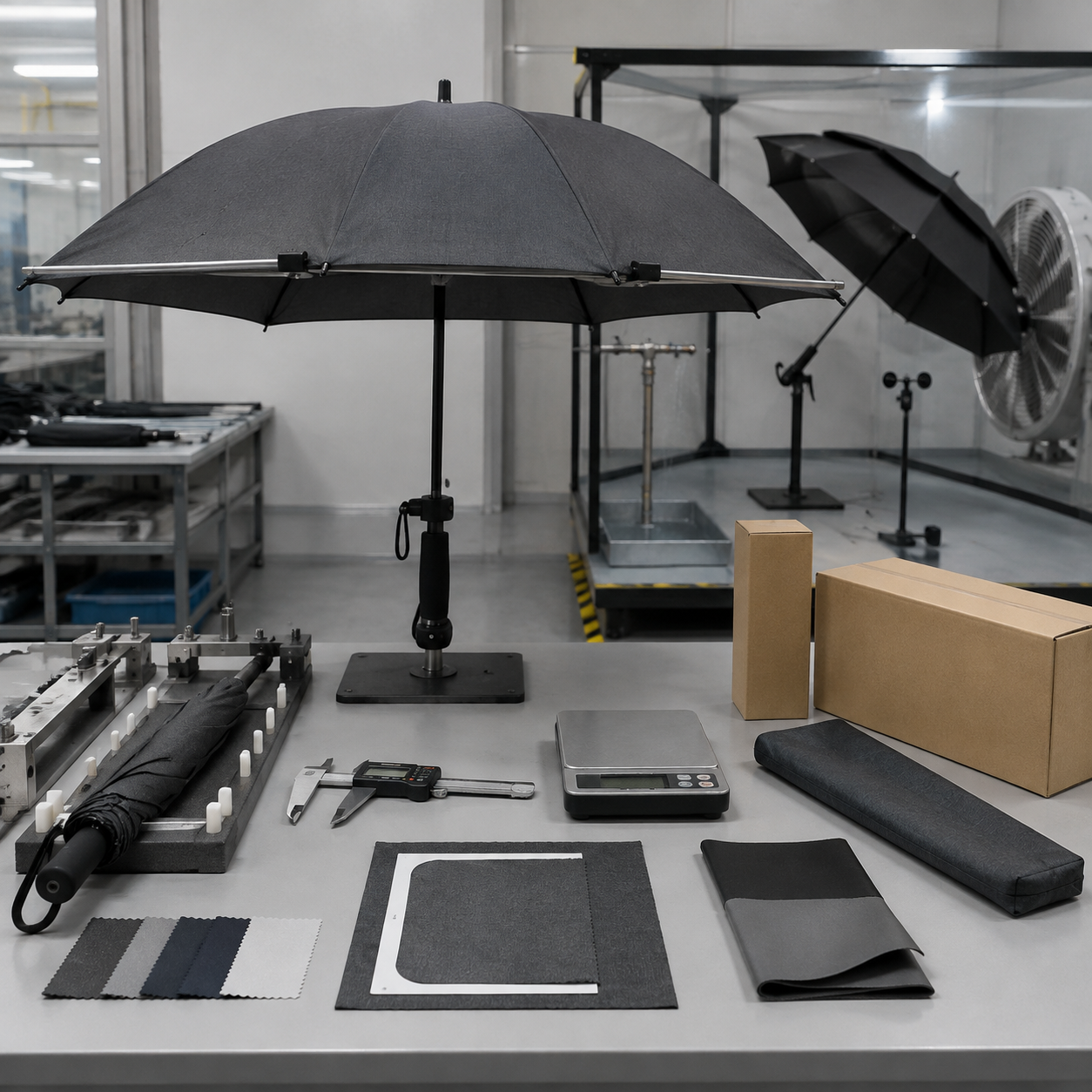
For a New Zealand business buyer, windproof umbrella OEM sample approval is a manufacturing release decision, not a general sign-off on appearance. Approval should apply only to the identified physical sample, specification revision, artwork, packaging proposal, test records and quotation revision. It should not cover later substitutions, unrecorded deviations or performance claims that lack an agreed test method.
Assign a clear decision and record why it was made:
| Decision | RFQ rule |
|---|---|
| Approve | The identified sample and required records match the release revision. Every accepted deviation is listed, and no release-critical hold remains open. |
| Revise | A correctable deviation or missing record prevents release. State the correction, evidence required, owner and resubmission condition. |
| Reject | The submitted configuration is unsuitable, the proposed claim cannot be evaluated or the supplier will not accept the required controls. |
Approval should be linked to a signed record. Require the supplier to acknowledge the same revision before manufacturing begins.
Windproof Umbrella OEM Sample Approval Starts With Identity
The sample must be traceable before its dimensions, materials or operation can be approved. Record the supplier, model, sample identifier, sample stage, specification revision, quotation revision, artwork reference and dispatch date. Disclose stock, temporary and substitute parts rather than allowing a development unit to appear production-equivalent.
Blueprint Umbrella's FAQ says a custom sample can be used to confirm design, material, colour, print effect and presentation. It also notes that fabric batches, coatings, print consistency, lighting and assembly can contribute to differences in bulk production. Treat this as supplier-authored context: it supports recording those attributes and agreed variation, but it does not prove that later production will match an uninspected sample.
Ark Umbrella's manufacturer page describes sample development as a checkpoint for canopy fabric, print layout, structure and the opening mechanism. It also describes physical or photographic samples within its own workflow. That statement does not establish that photographs are sufficient for a buyer's measurements, material comparison or functional checks.
Use a stage label that states what the submitted evidence represents:
| Sample stage | Disclosure required before approval |
|---|---|
| Development sample | Identify temporary, stock, hand-made and substitute materials or processes. State what will change before manufacturing. |
| Pre-production sample | Confirm whether intended materials, components, artwork process, tooling, assembly method and packaging are represented. List every exception. |
| Production-line reference | Identify the manufacturing batch and selection method. Confirm whether approved materials, tooling, process and packaging were used. |
| Photographic or video evidence | Identify the physical unit shown, recording date, setup and revision. List attributes that cannot be verified remotely. |
State in the RFQ when a physical sample is mandatory. Images can support an appearance review, but they should not replace a required physical measurement, mass check, mechanism check or material comparison. Approval of one configuration should not extend automatically to another frame, mechanism, colourway, print process or packaging arrangement.
Build the Sample Approval Release File
Keep the release file focused on the named model and revision:
| Release record | Evidence to capture | Hold approval when |
|---|---|---|
| Control identity | Supplier, model, sample identifier, sample stage and matching document revisions | A document or physical unit cannot be tied to the same revision. |
| Retained control sample | Holder, storage location, condition and confirmation that the unit will remain unaltered | The only control unit has been consumed or changed during testing. |
| Product specification | Umbrella format, measurement datums, canopy construction, declared fabric and coating, shaft, ribs, stretchers, runner, joints, tips, ferrule, handle, strap and mechanism | Generic descriptions prevent comparison with the submitted sample. |
| Material schedule | Declared material for each relevant component and disclosure of substitutions | A sample component is unidentified or differs from the intended manufacturing configuration. |
| Branding record | Production artwork, process, colour reference, panel, orientation, dimensions, position datum and comparison method | Approval relies only on a digital mock-up where a physical print result is required. |
| Acceptance plan | Method, instrument, conditions, test-unit identifier, failure definition, raw-result format and disposition rule | A result can be reported without showing how it was obtained. |
| Packaging reference | Sleeve, individual protection, labels, carton arrangement, carton markings and disclosed differences from proposed bulk packaging | Sample packaging is presented as production-equivalent without confirmation. |
| Deviation log | Every difference among the quotation, specification, sample and intended manufacturing configuration | A difference is accepted implicitly rather than recorded. |
| Change control | Supplier notification and renewed-review triggers for material, component, artwork, tooling, process or subcontractor changes | An approved attribute may be substituted without buyer review. |
| New Zealand order link | Delivery postcode, delivery point, freight basis, packed-data revision, document responsibilities and unresolved external checks | A release-critical freight or document assumption remains undefined. |
Set Measurable Sample Acceptance Criteria
The values below are example RFQ assumptions to verify or replace in the supplier's dated quotation and signed sample plan for the identified model and revision. They are not source findings, standards, test results, product specifications or supplier-capability claims.
| Acceptance field | Explicit example assumption | Scope and release use |
|---|---|---|
| Open canopy span | Example assumption to verify in the supplier quote: target tolerance of +/- 10 mm. | Measure the fully opened submitted sample through the centre between agreed opposite-tip datums. Record the result in millimetres and identify the target used. |
| Closed length | Example assumption to verify in the supplier quote: target tolerance of +/- 5 mm. | Measure the submitted sample from the defined handle datum to the defined ferrule datum. Use the result only for the identified revision and packaging comparison. |
| Complete sample mass | Example assumption to verify in the supplier quote: target tolerance of +/- 5 percent. | Record mass in grams for the submitted umbrella with its normal strap and agreed sleeve, excluding transport packaging. State the signed target mass used for comparison. |
| Branding position | Example assumption to verify in the supplier quote: positional tolerance of +/- 3 mm. | Measure the identified artwork on the named panel from the agreed seam, edge or panel-centre datum. |
| Operating screen | Example assumption to verify in the supplier quote: 50 complete opening-and-closing cycles. | Apply the agreed operating method to a designated test unit. Record jams, locking failures, unintended releases, fractures and permanent loss of function. |
| Water-ingress screen | Example assumption to verify in the supplier quote: 5 min exposure. | Use only after the signed plan defines spray flow, nozzle, distance, orientation and observation method. Report observations for the designated unit without turning the result into a general waterproof claim. |
Keep the retained control sample separate from units used for cycling, spray or wind evaluation. For each check, record the sample identifier, method, instrument identifier, instrument verification or calibration status, operator, conditions, raw result and disposition. A changed target or method should trigger a new plan revision rather than a retrospective edit to an approved result.
Control the Windproof Claim During Sample Approval
None of the supplied sources provides a quantitative threshold for the term windproof. Hold that wording for the submitted model until the buyer and supplier agree on the construction disclosure, test protocol, failure definitions and permitted claim scope.
| Claim-control field | Evidence required | Hold condition |
|---|---|---|
| Construction | Canopy architecture, vent arrangement where applicable, ribs, stretchers, shaft, runner, joints and attachment points tied to the sample identifier | The quotation uses generic frame wording or the submitted unit differs from the declared construction. |
| Test setup | Equipment, airflow unit, measurement location, mounting or handling method, umbrella orientation, exposure duration, test-unit quantity and repeat method | A demonstration lacks a traceable setup, measured airflow condition or sample identifier. |
| Failure definitions | Agreed treatment of inversion, recovery, permanent deformation, breakage, component release, fabric damage and mechanism failure | The outcome is reported only as pass, strong or windproof. |
| Result record | Raw measurements, observations and unedited media linked to the test unit and protocol revision | Promotional footage or selected still images are the only evidence. |
| Manufacturing equivalence | Confirmation of the materials, components, tooling and processes intended for the order, plus renewed-review triggers | The evaluated sample contains an undeclared substitute or lacks a conversion plan. |
| Claim wording | Commercial wording limited to the documented conditions and accepted result | The proposed wording extends beyond the evaluated setup or result. |
A supplier video can supplement the record, but it remains visual evidence unless the equipment, measurements, conditions and sample identity are documented. If a supplier invokes a standard, request its exact title, issuing body, edition, relevant clause, report identifier, issue date, tested model, tested materials and current scope. Keep the standard's published requirement separate from the buyer's contractual acceptance rule and the supplier's internal practice. Do not imply certification without a current document covering the exact model, materials and claim.
Match Branding and Packaging to the Manufacturing Sample
The cited TopUmbrella sourcing page discusses screen printing for simple, limited-colour artwork on standard pongee. Treat that statement as supplier-authored process guidance for the context described on the page. It does not establish that the process, material or result is suitable for the submitted New Zealand order.
Require the sample response to answer these release questions:
- Which fabric, coating, print process, ink or transfer system does the physical sample represent?
- Does it use the intended artwork file, colour reference, dimensions, panel, position and orientation?
- Which appearance attributes will be compared under controlled lighting, and what variation will be accepted?
- Which fabric, coating, colour or artwork changes require another print trial or physical sample?
- Does the packaging sample represent the intended sleeve, protection, labels and carton arrangement?
- Which materials, components, tooling or assembly steps differ from intended manufacturing?
- How will selected production units be compared with the retained control sample before shipment?
Do not approve a required physical print result from a digital mock-up alone. Replace terms such as close, similar or best match with an identified reference, comparison method, tolerance or written deviation.
New Zealand Sample Approval: Freight and Document Holds
The supplied sources include no New Zealand government material, border-agency guidance, carrier quotation, customs determination or broker opinion. They therefore do not establish the named order's classification, tax or duty treatment, destination obligations, restricted-material status, required shipment documents or freight cost. Obtain current, shipment-specific evidence when any of those points affects approval.
Tie these fields to the sample and manufacturing quotation:
| New Zealand decision field | Evidence to record | Hold release when |
|---|---|---|
| Delivery scope | Named delivery location, postcode, service level, payer and excluded destination charges in a dated supplier or carrier quote | The quotation identifies only the country or omits final-delivery scope. |
| Sample courier movement | Courier service, dispatch basis, payer, declared goods description and excluded charges | Responsibility or cost basis is unstated. |
| Bulk freight scenario | Proposed mode, handover point, delivery point, packed-data revision, quote issue date, validity and included or excluded services | A sample courier movement is used as evidence of bulk freight cost or suitability. |
| Trade term | Exact term, named place and allocation of transport, insurance, customs-entry and destination responsibilities | An abbreviation appears without a named place or responsibility allocation. |
| Packed data | Quantity per carton, carton dimensions with units, gross mass, net mass, packing method and pallet proposal where applicable | Provisional packed data are used for a release-critical freight decision. |
| Document matrix | Proposed commercial, packing, transport, origin, insurance, material and test documents, with preparer, checker and order revision | Generic wording replaces a shipment-specific list. |
| Border assumptions | Supplier proposal for classification, origin and goods description, clearly marked for current buyer or adviser review | A supplier proposal is presented as a binding New Zealand determination. |
| Packaging composition | Supplier declaration covering wood, plant-derived and other packaging materials, followed by a current destination check where relevant | Packaging composition is unknown or the necessary external review is incomplete. |
| Compliance evidence | Document holder, issuer, issue date, validity, method, model, materials and relationship to the approved sample | A generic certificate or report cannot be linked to the ordered configuration. |
The cited Ark page is not evidence of a current freight offer, landed cost, responsibility allocation or border outcome for a New Zealand shipment. For each external determination used in the approval file, record its title, issuer, URL or document reference, issue or access date, reviewer and shipment scope.
A freight or document issue should become a manufacturing-release hold only when it affects the approved materials, packaging, labels, order economics, required records or ability to ship the named configuration. Record the issue explicitly rather than hiding it inside a conditional approval.
Practical RFQ Checklist for New Zealand Sample Approval
Send this checklist with the RFQ and require the supplier to mark each line confirmed, deviation or not available. A confirmation should identify the supporting specification, drawing, sample, quotation or record. A deviation should state the proposed alternative and whether it changes price, timing, performance, packaging or the approved claim scope.
- [ ] Identify the supplier, model, umbrella format, mechanism and complete configuration covered by the quotation.
- [ ] Attach the controlled product specification and state its revision and issue date.
- [ ] State the quotation revision, issue date, validity and manufacturing configuration on which pricing is based.
- [ ] Assign a unique sample identifier and declare whether it is a development, pre-production or production-line sample.
- [ ] List every stock, temporary, hand-made or substitute component used in the submitted sample.
- [ ] Provide a component-level material schedule for the canopy, coating, shaft, ribs, stretchers, runner, joints, tips, ferrule, handle, strap and sleeve.
- [ ] Confirm whether a physical sample is included and identify any review that will rely only on photographs or video.
- [ ] State each measurement datum, target, tolerance, unit, method and instrument needed for sample approval.
- [ ] Define operating, water-ingress and wind-claim checks, including conditions, failure definitions, raw-result format and test-unit identity.
- [ ] Attach production artwork and identify the print process, colour reference, dimensions, panel, orientation and position datum.
- [ ] Confirm whether the sample packaging represents the intended sleeve, individual protection, labels, carton arrangement and carton markings.
- [ ] Provide proposed quantity per carton, carton dimensions with units, gross mass, net mass and the revision date of the packed-data estimate.
- [ ] Name the New Zealand delivery point and postcode, freight basis, handover point, payer and services or destination charges excluded from the quote.
- [ ] Supply a shipment-document matrix naming each proposed document, its preparer, checker and relationship to the quoted configuration.
- [ ] Declare packaging composition and flag any wood, plant-derived or otherwise controlled material for current destination review.
- [ ] List all differences among the RFQ, quotation, physical sample and intended manufacturing configuration in a deviation log.
- [ ] Accept written change-control requirements for materials, components, artwork, tooling, processes, packaging and subcontracted work.
- [ ] Confirm that manufacturing will not begin until the buyer records
approve, and thatreviseorrejectdoes not authorize production. - [ ] Name the supplier representative who will acknowledge the approved revision, accepted deviations and unresolved holds.
Do not treat a blank response, an unqualified yes or a generic catalogue sheet as evidence. Hold sample approval when a release-critical checklist item cannot be tied to the identified model, sample and document revisions.
Sign the Decision and Control Changes
Attach the approval record to the purchase order or equivalent manufacturing instruction:
```text Supplier and model: Product revision: Supplier sample identifier: Sample stage: Quotation revision: Specification revision: Approved artwork reference: Control sample holder and location: Declared sample-to-production differences: Accepted deviations: Measurement and test records: Windproof claim status and approved scope: Packaging reference: New Zealand destination and freight basis: Packed-data revision: Document responsibilities: Outstanding carrier, broker or regulatory evidence: Decision: approve / revise / reject Required correction or evidence: Buyer approver name, role and date: Supplier acknowledgement name, role and date: ```
Release manufacturing only against the recorded product revision. Assign every unresolved item an owner, required evidence and disposition. Require renewed review when a proposed change affects materials, components, artwork, tooling, process, packaging, test scope or claim wording.
Evidence Method and Limitations
| Source context | Factual statement retained | How it informs the RFQ | Inference excluded |
|---|---|---|---|
| Blueprint Umbrella FAQ | The page describes custom samples as checks for design, material, colour, print effect and presentation, and notes possible bulk-production variation | Fields for sample attributes, agreed variation and production equivalence | No inference that a sample or production order passed inspection |
| Ark Umbrella manufacturer page | The page describes checks involving canopy fabric, print layout, structure and opening mechanism, and mentions physical or photographic samples in its workflow | Sample-stage disclosure and limits for remote evidence | No inference that photographs satisfy this RFQ or that a service is available for the named shipment |
| TopUmbrella sourcing page | The page discusses screen printing for simple, limited-colour artwork on standard pongee | Questions about print-process and material equivalence | No inference that the process or material suits the submitted model |
| Vincent Xi author profile | The first-party profile identifies Vincent Xi as an Editorial Author | Visible byline and structured-data identity | No inference of product testing, factory visits, credentials or customer outcomes |
Method: Explicit statements from the cited supplier pages were separated from buyer-directed RFQ controls. Supplier statements are attributed at the point of use and limited to what each page describes. The numerical schedule was not derived from those pages; every value is labelled as an example assumption that must be verified or replaced in the supplier's dated quotation and signed sample plan.
Limitations and verification: No laboratory report, production inspection record, actual sample measurement, manufacturing quotation, carrier quote, customs determination, New Zealand government source or broker opinion was supplied. Before release, verify the model-specific specification, tolerances, test conditions, raw results, sample-to-production equivalence, packaging, freight basis, document matrix and current destination requirements. Recheck cited pages against their current versions before using them in a live procurement file.
Author basis: Vincent Xi is identified on ZheBrella's first-party profile as an Editorial Author. That profile is the sole basis for the byline. No first-hand product testing, factory-visit or customer-outcome experience is claimed.
Discuss Your Requirements
Review our manufacturing capabilities, then share your specifications for a supplier-fit review.