Windproof Umbrella Sourcing Communication Workflow Review for Australian Buyers
Editorial author: Vincent Xi, Editorial Author. This procurement briefing is for Australian B2B buyers. Attribution follows the published Editorial Author profile at that URL.
Australian buyers should treat a windproof umbrella sourcing communication workflow review as a gated procurement file, not a salesperson chat. Lock one written tech pack. Confirm a named manufacturer contact can restate frame and canopy construction. Demand a documented wind-test method. Then sample—before any unit price. A price-first thread makes samples incomparable and leaves “windproof” as an adjective instead of a test record.
Use the decision table and RFQ checklist on this page as the working file. The sections below are the gates that feed them. China appears only as manufacturing-origin context from the cited pages, not as a sales-market target.
Why a communication workflow review belongs before any windproof umbrella quote
Decision first: do not request a unit price until one versioned tech pack has been sent to every shortlisted plant and each plant has restated construction and a wind-test method in writing.
Windproof performance is a bundle of materials, joints, vents, and a pass/fail method. If those items never reappear in the dated thread, the quote is not comparable procurement evidence.
A 2026 custom-umbrella sourcing outline states that successful sourcing focuses on spec precision, QC standards, and logistics control; that the process begins with a Tech Pack of 12 must-haves, including a fiberglass frame for wind resistance; and that verifying a real manufacturer is required because trading companies add margin and slow technical communication (scope: custom umbrellas sourced from China manufacturers as described on that page; unit: 12 listed pack items; as-of: 2026 publication year of that workflow) (How to Source Custom Umbrellas from China). This page does not reproduce that full list of 12 items. Send one buyer-controlled pack to every shortlisted plant. Parallel emails with different rib counts, vent sketches, or print placements produce samples that cannot be scored against one another.
A manufacturer-selection guide dated 31 March 2026 likewise starts by defining requirements and sending identical spec sheets to multiple factories (scope: China umbrella manufacturer selection as described in that guide; as-of: 31 March 2026) (Choose the Right Umbrella Manufacturer in China). Put the pack ID in the subject line (for example, TechPack-v2) so a plant cannot quote an old vent drawing.
Risk control: writing construction, colour standard, print-versus-vent clearance, and packing before anyone talks money costs time. Skipping that step costs extra sample loops and a bulk lot that does not match the wind-resistance story in the internal approval file. Do not treat the word windproof as a certification. Unless a current test record is attached, it is a factory claim.
How to verify a manufacturer so technical communication does not stall
Decision first: keep the factory only if a named technical owner can restate this SKU’s frame and canopy build. Hold if sales must “ask the factory.” Drop if every engineering question is routed through a trader who cannot bind the spec.
The same 2026 sourcing outline, already cited above, treats manufacturer verification as required because trading desks add margin and slow technical communication (scope: custom umbrellas from China as described in that workflow; as-of: 2026 article). This page does not classify any named plant as a trader or a factory. Use the first two reply cycles as a document test:
- Ask for the name and role of the person who owns frame engineering, not only sales.
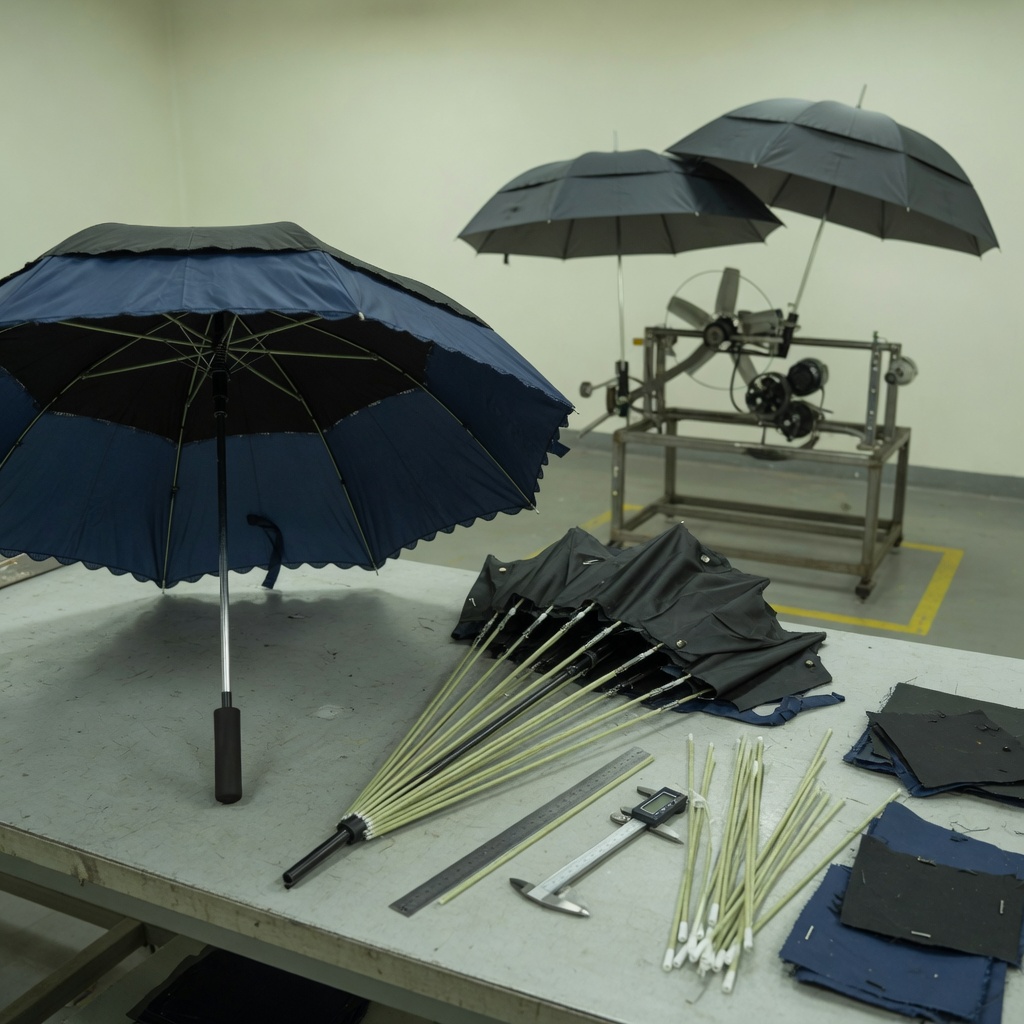
- Request process photos of this construction: fiberglass ribs, vent sewing, joint assembly—not a generic workshop album.
- Send one technical change (rib count or vent geometry) and time how long it takes to get a construction answer rather than a non-specific capability line.
- Ask who writes the wind-test method and who signs the inspection record.
- Require a marked-up spec returned by the factory, not a one-line “confirmed.”
Pass signal: a technical reply that restates rib material, canopy build, vents, joints, and a test method, and that flags conflicts (print sitting on a vent, mixed steel/fiberglass on a folding frame, weight versus wind claim). Fail signal: a price table with no restated construction, or every engineering question routed through a desk that must “check the factory.” This is a file test, not a substitute for a current engineering record. If the file is not current, treat the plant as unverified.
Spec-sheet and wind-test requests to put in writing
Decision first: “windproof” stays off the purchase order until the thread contains a cycle method, inversion/recovery method, joint-pull method, and construction line items. Brochure miles-per-hour copy is not enough to approve bulk.
Published wind-resistance guidance states that documented tests should include cycle wind tests on a motorized rig for 50–100 cycles, inversion/recovery tests, and joint pull tests; that a sourcing spec sheet for wind-resistant models must specify a vented double canopy, fiberglass ribs, and performance such as 40 mph wind for 50 cycles; and that pre-production sampling plus third-party lab reports are non-negotiable before bulk orders (scope: factory-claimed windproof or wind-resistant umbrellas as described on that guidance page; units: cycles and miles per hour; as-of: the published page; these figures are vendor-education targets, not a named national standard and not a certificate for any specific plant) (How to Ensure Your Umbrellas Can Withstand Strong Winds?).
Put those published numbers into RFQ language instead of brochure language:
- Cycle test: motorized rig; confirm a cycle count in the 50–100 range with that factory; record how the rig is driven, canopy size under test, and pass/fail (rib break, permanent set, joint failure).
- Sustained claim: 40 mph for 50 cycles, as written on that guidance page. For Australian internal notes, 40 mph converts to about 64 km/h (40 × 1.60934; example calculation to verify in the supplier quote, not an Australian regulatory wind class). Verify instrument, distance, duration, and pass/fail on the quote.
- Inversion/recovery: number of forced inversions, recovery without rib fracture, and whether a vented double canopy is mandatory on the SKU.
- Joint pull: load, direction, and joint type; record the factory’s unit (N or kgf) so two quotes remain comparable.
- Construction minimums: vented double canopy and fiberglass ribs as spec-sheet line items, not adjectives.
Keep three layers separate in the file:
- Buyer specification — what the purchase order requires.
- Factory practice — what that plant says it does on its line.
- Independent report — a third-party lab document with method, date, sample ID, and result. The guidance page calls third-party lab reports non-negotiable before bulk; that is a sourcing recommendation, not proof that a named factory is certified.
Do not name ISO or other standards unless the current document and test method are attached. This briefing does not assert that 50–100 cycles or 40 mph equal an Australian compliance mark. Write intended use into the tech pack as operating conditions (for example, outdoor events, open car parks, coastal sites, and vehicle storage) so the factory cannot hide behind an unnamed indoor fan test. Those use cases are buyer-specified RFQ conditions, not a legal code cited from the source set.
How to score manufacturer responsiveness in the dated thread
Decision first: score the dated thread, not the sales tone. A precise plant that attaches methods can beat a fast plant that never restates construction.
The 31 March 2026 manufacturer-selection guide lists communication and responsiveness as a critical evaluation factor because technical capability means nothing without replies within 24 hours, clear English for technical details, a problem-solving attitude, and proactive production updates; it also notes that good communication prevents misunderstandings on custom windproof specs such as colours and printing (scope: China umbrella manufacturer selection as described in that guide; unit: 24 hours as a published reply-speed evaluation factor; as-of: 31 March 2026) (Choose the Right Umbrella Manufacturer in China).
The 24-hour figure is an evaluation factor in that March 2026 guide, not a contract SLA unless it is written into purchase terms. Australian buyers should define the clock in the RFQ (for example, a substantive reply by the next Australian business day) rather than arguing about time zones. Run the same pack on at least two factories and keep dates. One SKU, one thread, one pack version. Chat-app changes are void unless copied into the dated pack. The review is the audit trail.
Australian RFQ communication for windproof umbrella procurement
Decision first: sampling, inspection, lead time, and Incoterms stay inside the same communication record as the wind spec. Do not approve bulk from a PDF, and do not let commercial terms drift into a separate unversioned email.
The wind-resistance guidance already cited above states that pre-production sampling plus third-party lab reports are non-negotiable before bulk orders (scope: factory-claimed windproof or wind-resistant umbrellas as described on that page; as-of: the published page). The 2026 sourcing outline places sampling, AQL QC, and FOB/DDP shipping as completing steps, with 6–16 week lead times (scope: custom umbrellas from China manufacturers in that workflow; unit: weeks; as-of: 2026 article) (How to Source Custom Umbrellas from China).
Sampling communication rules
- Freeze construction before colourways. Wind structure first; print second.
- Require the sample to use the same rib material, vent geometry, and joint as bulk—not a showroom frame.
- Keep dated inversion/recovery video and stills of this SKU. Compare them to the written cycle and inversion method.
- If a third-party lab is used, the RFQ must state who pays, which method, how many pieces, and whether a fail holds the purchase order. Do not imply the factory is certified without a current document.
AQL is a buyer-specified practice here, not a claimed certificate. The 2026 outline names AQL QC as part of the process. Write inspection level, AQL for critical (frame/joint/vent seam) versus major (print) versus minor (thread ends), and class wind-related structural defects as critical. Do not describe the plant as “AQL certified.”
Lead-time trade-off: 6–16 weeks is the range given for that custom-from-China workflow, covering sampling through shipment depending on complexity. Australian event or retail windows should be back-planned from the top of that range until the factory confirms a dated capacity slot. Treat any shorter date as an assumption to verify in the supplier quote, not as a promise made by this article.
Incoterms for Australian delivery: the same 2026 outline names FOB/DDP as the completing logistics choices. Ask the factory to restate Incoterm, port pair, and insurance in the same email chain as the wind spec so commercial terms cannot drift from the technical file. FOB can keep ocean freight and onshore Australian costs visible to the buyer only if the quote itemizes those lines; it also leaves the post-loading damage window with the buyer unless the contract says otherwise. DDP can simplify the landed file only if the quote itemizes destination charges and states who owns wet damage or bent shafts in transit. This article does not publish freight rates, duties, or labeling rules. Carton support, shaft protection, and pack tests belong in that same chain because transit damage can fail the SKU before the canopy is opened.
Buyer decision table: keep, hold, or drop the factory
Every row is an action to specify, compare, verify, approve, or order. If the evidence is missing, the order stays off the purchase order.
| Decision | Evidence required in the thread | Keep | Hold | Drop | Order effect |
|---|---|---|---|---|---|
| Start quoting | Identical tech pack restated by the factory | Construction and test method echoed | Price given, spec vague | No tech pack used | Do not issue a purchase order |
| Treat as manufacturer | Technical owner named; process photos of this frame | Engineering answers rib/vent changes | Sales must “ask factory” once | Every technical question routed through a trader | Re-bid if the trader cannot bind specs |
| Accept “windproof” wording | Written method: 50–100 cycle range on a motorized rig; inversion/recovery; joint pull; vented double canopy and fiberglass ribs as line items | Method and sample plan attached | Brochure mph claim only | Refusal to document tests | Do not approve bulk |
| Compare the 40 mph / 50-cycle claim | Instrument, duration, canopy size, pass/fail; 40 mph ≈ 64 km/h as a conversion to verify, not a local code | Traceable test record | Number copied with no rig | Conflicting numbers across emails | Conditional sample only |
| Score communication | Substantive replies on the RFQ clock; technical English; proactive updates (24 hours is a 31 March 2026 evaluation factor, not an automatic SLA) | Dated log meets the stated clock | Fast but non-technical | Missed tests and missed dates | Dual-source if the score is mixed |
| Approve pre-production sample | Sample matches bulk bill of materials; inversion record; optional third-party report | Signed sample with deviations listed | Cosmetic pass, structure unverified | Showroom sample only | No mass production |
| Choose Incoterm | FOB or DDP restated with Australian destination responsibility | Costs and damage ownership clear | DDP lump sum | Incoterm missing | Do not book freight |
| Release bulk | AQL plan with wind defects as critical; dated slot versus the 6–16 week range | Pro forma matches spec, QC, and dates | Capacity verbal only | Lead time unexplained and far outside the range | Split shipment or cancel |
RFQ checklist for windproof umbrella procurement
Use this list to specify, compare, verify, approve, or order. Unchecked items stay off the purchase order. This is the communication workflow review in working form.
- Single tech pack — Send the same pack to every factory: size, rib count and material (fiberglass versus mixed), shaft, runner, tips, vented double canopy yes/no, fabric, colour standard, print-versus-vent clearance, closed length, packing, and any weight target labeled as an example to verify in the quote. These are RFQ fields for this workflow, not a reproduction of the source page’s full list of 12 must-haves.
- Version control — Pack ID and version in the subject line; one thread per SKU; mark older drawings superseded.
- Manufacturer identity — Legal factory name, production address, and the technical owner for frames. Record whether replies read as a trading desk.
- Marked-up spec return — Factory must restate construction and flag conflicts. A one-line “confirmed” is a fail.
- Wind-test method — Cycle test on a motorized rig; confirm cycle count in the 50–100 range with the plant; inversion/recovery count; joint-pull load and units; treat 40 mph for 50 cycles as a stated method to confirm or replace, not as a slogan.
- Construction line items — Vented double canopy and fiberglass ribs as purchase-order lines. State what is not allowed (unvented single canopy sold as windproof).
- Communication clock — Define the reply clock in Australian business days. Use 24 hours as a published evaluation factor to discuss, then write the contractual clock to enforce.
- Language and conflict test — Include one conflict (print over a vent; folding frame versus a fiberglass wind story). File the answer.
- Update cadence — Require unprompted photos of this SKU at frame, canopy, and packing. Name the production stages and the person who sends them.
- Pre-production sample — Quantity, whether it is bulk tooling, who pays, and a rule that structure cannot differ from bulk.
- Third-party lab — Lab name, method, sample IDs, and fail = hold production, if used. The wind-resistance guidance page treats lab reports as non-negotiable before bulk; still do not claim certification without a current document.
- AQL and defect class — Inspection level; critical = broken rib, failed joint, vent-seam failure; major = print; minor = threads. Buyer-specified practice.
- Lead time — Ask the factory to place this SKU inside or outside the 6–16 week range from the 2026 workflow article, with a dated capacity slot. Label any shorter promise as an assumption to verify.
- Incoterms and Australian delivery — FOB or DDP; port pair; who owns transit damage to shafts and canopies; carton spec. No freight amount is stated in this briefing.
- Use conditions — Write intended Australian use (outdoor events, retail, coastal sites) as operating conditions for the test, not as a legal code.
- Change control — One written owner for spec changes; chat-app changes are void unless copied into the dated pack.
- Approval packet — Spec restatement, sample sign-off, test record, QC plan, pro forma invoice. No packet, no order.
Evidence, method, and what Australian buyers should still verify
Source contexts. This briefing uses three publicly available manufacturer-education pages: a 2026 eight-step custom-umbrella sourcing workflow (tech pack of 12 must-haves, manufacturer versus trader, sampling, AQL, FOB/DDP, 6–16 week lead times); a wind-resistance page on documented cycle, inversion, and joint tests plus spec-sheet items (vented double canopy, fiberglass ribs, 40 mph for 50 cycles); and a 31 March 2026 manufacturer-selection guide on 24-hour replies, technical English, proactive updates, and identical spec sheets. Those pages educate buyers on manufacturing-origin sourcing; they are not independent certificates and not tests of any ZheBrella SKU.
How the data was derived. Numbers and process steps are taken from those pages as published guidance to buyers, then arranged into a communication-gated procurement sequence. The 40 mph to about 64 km/h figure is arithmetic for Australian internal notes (40 × 1.60934) and is labeled as a conversion to verify. Research-source evidence supports factual editorial claims only; it is not keyword-demand evidence. The cited pages are not a plant audit.
Limitations / what to verify. Cycle counts, mph claims, and 24-hour replies are not automatically the contract and are not Australian legal limits. Publication year is not proof of current plant capability. Plants use different rigs. AQL, lab reports, and Incoterms apply only if they are written into the purchase order. Lead times move with season and capacity. Labeling, safety, and import entries for Australia must be confirmed against current official requirements and the buyer’s own counsel—this article does not cite an Australian standard because the source set does not. Require current documents. Do not infer certification from a marketing page.
The decision table and RFQ checklist are the working tools: they exist so an Australian procurement file can specify, compare, verify, approve, or order a windproof umbrella without treating “windproof” as a substitute for a communication record.
Discuss Your Requirements
Review our manufacturing capabilities, then share your specifications for a supplier-fit review.