Product Development Capability for Windproof Umbrella Sourcing in Canada
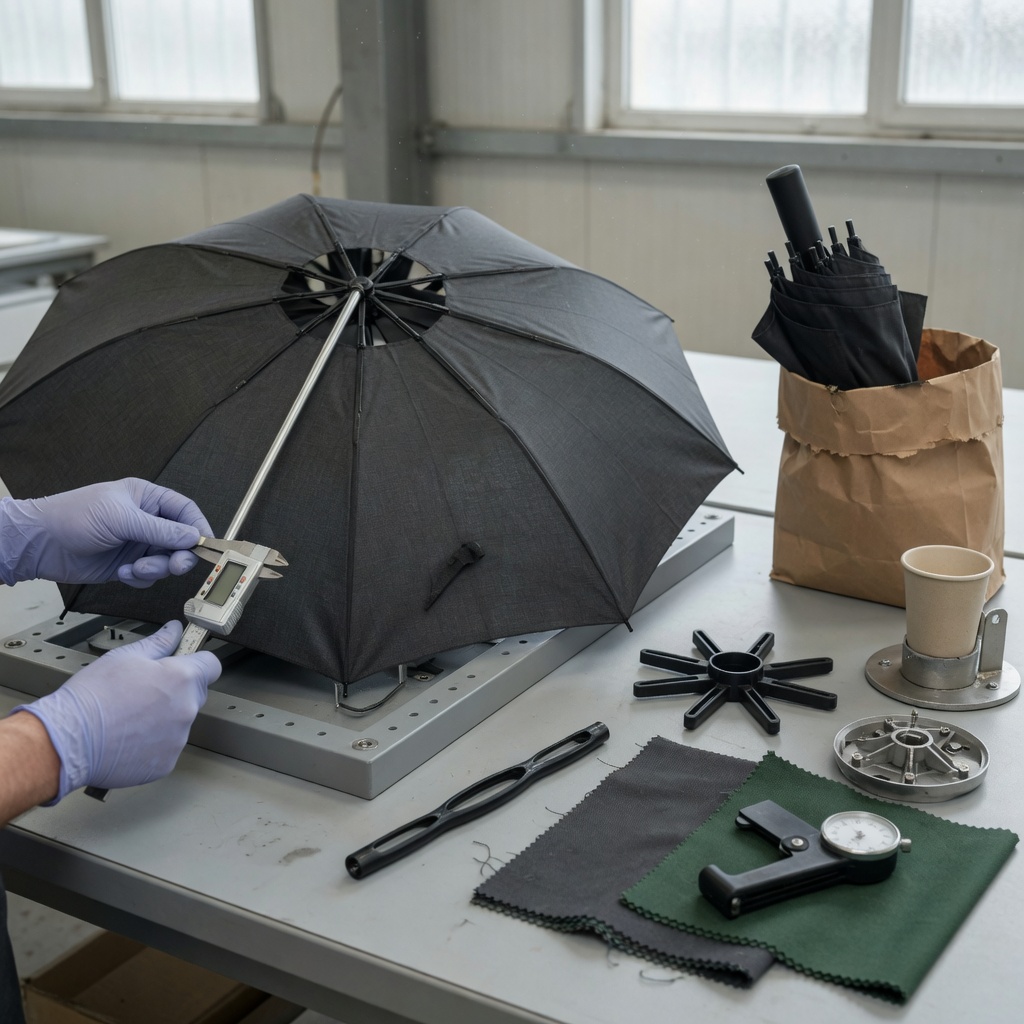
B2B buyers in Canada should treat product development capability as the purchase-order gate in windproof umbrella sourcing. A wind claim is a manufacturable specification only when the factory can convert gust exposure, open/close duty, canopy size, handle hardware, and retail or corporate-gift packaging into four approval records that share one revision ID: a dimensioned frame and canopy construction, a named gold sample, a written wind-test protocol with a failure definition, and a bill of materials (BOM) that quality control can inspect.
Those records are RFQ structure on this page, not a laboratory certificate and not a ZheBrella factory method. Approve when drawing, BOM, gold sample, and protocol carry the same revision ID. Hold when a laboratory exists but this SKU, including print and handle, has not been tested. Refuse a wind-speed claim that omits test setup, wind speed, umbrella orientation, duration, failure criteria, and the exact model tested (Huifeng Umbrella, Sustainable Umbrella Procurement Guide 2026). AceAccessory groups the same buyer problem as a three-part control set: proven frame and canopy materials, design features that manage wind load, and verified wind-resistance tests before shipment (AceAccessory, How to Ensure Your Umbrellas Are Windproof).
The capability question is practical. After a failed sample, can engineering change rib count, ferrule design, runner strength, or canopy cut, then re-test the same SKU?
Author note. This page is written by Vincent Xi, Editorial Author at ZheBrella (author profile). It attributes the third-party supplier and industry pages listed in cited sources. It does not claim laboratory tests, factory visits, client programs, or first-person use by the author.
How this article was derived. Factual claims below are limited to the three source pages in cited sources. Additional lines are buyer-side RFQ and risk-control language. They do not invent prices, lead times, certificates, duty rates, HS codes, labelling statutes, freight rates, or factory capacity. Tempo figures are that manufacturer's published self-description, not a ZheBrella specification and not an industry average. A supplier or manufacturing-origin mention is a source citation, not a sales-market target.
What product development capability means in windproof umbrella procurement
In this category, product development capability is the factory's ability to take a written brief, propose a build that can be tooled and repeated, produce identifiable samples, run or commission a wind test with a failure definition, and freeze a BOM that quality control can inspect. Co-design language is useful only when it names the alignment work: use case, structure, materials, and cost, plus sampling and engineering changes (TEMPO, Outdoor Umbrella Manufacturer).
Keep the SKU family explicit in the RFQ: a windproof umbrella (stick, compact folding, golf, or another handheld construction you name), not an unnamed “similar outdoor” model. If a supplier's published laboratory claims sit on a different outdoor-umbrella construction, treat them as claims to unpack, not as evidence for your SKU.
Buyers should separate three layers that vendors often mix:
- Catalogue windproof SKU. An existing mould and canopy pattern. Weak if you need a different rib count, vent, or logo placement that changes canopy tension.
- OEM copy of a reference sample. Useful when you own a physical gold sample. The copy still has to survive the same wind protocol, not only look the same on a table.
- ODM / co-design. Needed when a Canada program changes shaft length, auto-open hardware, canopy fabric family, or gift-box geometry. Strength equals the engineering change log and the re-test after each change.
A frozen catalogue SKU can fail if your Canada use case, print mass, or handle hardware differs from the tested construction. Every untested change—new runner, shorter rib, heavier coating—resets the wind evidence. Do not accept a wind result from a “similar” model unless the supplier documents what is identical: rib section, joint type, canopy fabric family and stated mass if used, venting, shaft, opening mechanism, print process, and handle hardware.
Data point (supplier-stated, not independently re-tested here): Tempo, as one outdoor umbrella manufacturer, publishes that it holds 100 patents on its outdoor umbrella manufacturer page. Unit: patent count. Scope: company-level claim for that manufacturer, not SKU-level proof that your windproof umbrella passed a test. As-of context: as presented on that page in the supplied source; this article has no patent-office verification and no grant date. Source: TEMPO, Outdoor Umbrella Manufacturer.
Data point (supplier-stated): The same Tempo page states wind resistance up to Level 8 and that it operates professional testing laboratories that include wind-resistance level testing. Unit: manufacturer's “Level” scale as written on that page (the excerpt does not define Beaufort versus an internal scale, and this article does not convert it into metres per second). Scope: that manufacturer's outdoor umbrella production claim, not a default spec for your SKU. As-of context: as presented on that page in the supplied source, with no test date, instrument, duration, or failure mode attached in that excerpt. Source: TEMPO, Outdoor Umbrella Manufacturer. Use both figures only as examples of R&D claims to unpack in an RFQ.
Materials, geometry, and wind-management design to lock before a Canada PO
Windproof performance is a system. Huifeng's procurement guidance is that rib geometry, joint quality, canopy tension, and assembly consistency all affect the result, and that complete frame design matters more than one material name (Huifeng Umbrella, Sustainable Umbrella Procurement Guide 2026). That system view matches AceAccessory's control set: high-performance frame and canopy materials, design features that manage wind forces, and manufacturer-run standardized tests before shipping (AceAccessory, How to Ensure Your Umbrellas Are Windproof).
Specify materials as measurable fields, not adjectives. The millimetre, gram, and count values below are RFQ blanks for the supplier to fill; they are not default specs.
- Ribs. Material (fibreglass, aluminium alloy, steel, hybrid), fibre or wall section, count, length, and whether tips are replaceable. Require rib diameter or section height in millimetres on the drawing.
- Joints and ferrules. Polymer or metal family the factory actually uses; riveted, staked, or screwed; whether the joint is the known failure point in inversion tests.
- Shaft. Diameter and wall thickness in millimetres; steel vs. aluminium vs. fibreglass; auto vs. manual open.
- Canopy. Fabric family (for example polyester pongee or recycled PET, if that is what you are buying), stated grams per square metre if the mill uses mass, coating, seam type, and whether a double canopy or vent is part of the wind path. Treat print coverage as a structural input because it can change stiffness.
- Canopy-to-frame interface. How the canopy is tied or sewn to each rib tip and to the top notch. Loose tips invert earlier even if ribs are strong.
Design features that actually manage wind are inversion-tolerant ribs, controlled vents or double-canopy airflow, and a runner that does not crack when the canopy inverts and recovers. None of those features is windproof unless the factory can assemble them with consistent canopy tension. Dramatic windproof figures are only as strong as the test file that identifies setup, speed, orientation, duration, failure criteria, and the exact model (Huifeng 2026 guide, cited above).
Trade-off to price in the RFQ, not in a later claim. A more flexible fibreglass rib set may survive inversion better than a brittle low-cost metal set, but it can feel less rigid in-hand and may need a different joint design. That comparison is a buyer engineering question to test, not a result measured in the cited sources. Lock these choices on the gold sample and on the inspection checklist together, because a late artwork change is a late structural change.
Do not name a wind-test standard in the purchase order unless the supplier can show the current test-method document and the instrument used. Distinguish a published standard's requirement from a factory's internal practice. This article does not assert that any named factory is certified to a wind standard.
How testing should sit inside the sourcing workflow
Testing is not a certificate attached at loading. For this procurement path it belongs in four buyer gates:
- Brief gate. State the intended wind exposure in operational language (for example, urban pedestrian use with inversion recovery required). State what counts as failure: broken rib, cracked runner, torn canopy, bent shaft, or failure to re-open.
- Engineering gate. The factory returns a drawing, BOM, and a proposed test: wind speed with unit, orientation (canopy facing, side-on, inversion), duration with unit, sample size n, and instrument. If they cannot fill those fields, they do not yet have product development capability for a wind claim (Huifeng 2026 guide, cited above).
- Sample gate. Test the sample that matches production intent, including print and handle. A blank white proto is not evidence for a fully printed production canopy.
- Pre-shipment gate. Repeat the agreed protocol on production units, or on a statistically defined sample from the bulk, with the same failure definition. AceAccessory's third control is explicit: the manufacturer should conduct and verify standardized wind-resistance tests before shipping (AceAccessory page, cited above).
Data point (method requirement, 2026-labelled guide): a wind-tunnel or wind-resistance result is described as having value only when the supplier identifies at least six elements—test setup, wind speed, umbrella orientation, duration, failure criteria, and exact model tested. Unit: count of identification fields. Scope: documentation required for a wind-resistance claim, as stated in that guide, not a measured wind speed. As-of context: Huifeng's Sustainable Umbrella Procurement Guide 2026 (title-year on that source page). Source: Huifeng Umbrella, Sustainable Umbrella Procurement Guide 2026. Treat any missing element as a non-result.
Tempo's page is an example of a manufacturer that says it invests in professional testing laboratories including wind-resistance level testing and automated production (Tempo manufacturer page, cited above). That is a capability claim to audit, not a substitute for your SKU's test file. Ask whether the lab is in-plant or third-party, how the umbrella is fixtured, and whether a written report is retained by lot number.
Example calculation (assumption to verify in the supplier quote, not a market fact): if you require three development samples (proto, printed T1, pre-production) and the factory quotes 10 calendar days per loop, the engineering calendar is 30 calendar days before a production-ready sample, excluding shipping to Canada and excluding a failed re-test. Units: calendar days per loop and calendar days total. Scope: planning placeholder for one SKU's sample map. As-of context: none; this is not a sourced lead time. Verify actual calendar days, which sample is testable, and who pays for a failed loop. Do not use 10 calendar days or 30 calendar days as a benchmark.
How to audit in-house testing and quality control
A Canada-bound program should audit the factory's development and QC path, not only the showroom umbrella.
Incoming materials. Rib lots, shaft tubes, runner mouldings, and canopy rolls should have lot IDs. If fibreglass ribs are specified for flex and recovery, incoming inspection should at least check section size in millimetres and obvious dry fibre or crush damage. Complete frame design and assembly consistency matter more than the material label (Huifeng 2026 guide, cited above).
In-process. Watch rib-to-joint assembly, canopy stretching, and tip attachment. Inconsistent tension is a hidden wind failure. Ask how operators are trained to a tension method (jig, measurement, or undocumented habit).
Lab or test cell. If the factory claims a wind-resistance level, ask to see the fixture, the speed-measurement device, the last report for a comparable model, and the failure photos. Tempo states professional laboratories and wind-resistance level testing, including the published “up to Level 8” figure already scoped above. Your audit question is whether this model will be tested to a defined level with a defined fail/pass rule.
Final QC. Open/close cycles, runner smoothness, canopy weave defects, rust on ferrous parts, and packaging. Windproof construction that is then crushed in a gift box is still a failed delivery.
Document pack for approval. Drawing revision, BOM revision, gold-sample photos, wind-test report for that revision, and a signed deviation log. If the factory cannot produce that pack, you do not have an approvable development record. A patent count is not lot-level QC.
Canada procurement implications for sampling, packing, and order gates
Keep the product and RFQ decision primary. Canada is the sales market this page serves; it is not a substitute for a customs ruling.
Name the commercial path in the RFQ only as it locks the physical SKU: Incoterm, destination, carton construction, inner packing for retail vs. corporate gift, and whether consumer-facing text will appear on hangtags or boxes. If a Canada program uses buyer-supplied artwork files, product development capability must still lock the physical SKU so a late hangtag or box change does not force a new canopy cut. This article does not state labelling statutes, duty rates, or HS codes; those are for your broker and counsel to confirm. The cited sources do not document Canada import rules, so this page does not treat bilingual labelling, duties, or carrier rates as sourced facts.
Sampling questions to require in writing (no default days are claimed here except the labelled example calculation above):
- Calendar days from approved brief to first proto, to printed sample, and to pre-production sample.
- Whether engineering tweaks are included, as some OEM/ODM manufacturers advertise co-design with sampling and engineering tweaks (Tempo manufacturer page, cited above). Treat “fast sampling” copy as a claim to verify, not as a measured calendar.
- Which sample is the wind-test sample, and whether Canada-bound courier time is inside or outside the quoted development window.
- Whether one sealed gold sample stays at the factory and one at the buyer, under the same revision ID.
Pack-weight fields belong in the same RFQ as the wind spec because a heavier fibreglass frame, double canopy, or gift box changes dimensional weight. Ask for carton outer size in millimetres, units per carton, and gross weight in kilograms so a Canada freight quote can be based on the production pack, not a sample envelope.
Buyer decision table: compare product development capability
Use this table to compare factories on the same windproof umbrella development task.
| Decision gate | Weak signal (do not approve yet) | Stronger signal (still verify) | What the Canada buyer should require | Approve / order implication |
|---|---|---|---|---|
| Wind claim | “Windproof” or a speed number with no model ID | Named model, speed with unit, orientation, duration with unit, failure definition | Written protocol attached to the gold sample | No purchase order against an unnamed similar SKU |
| Frame system | One material name only (“fibreglass”) | Rib section (mm), joint type, rib count, canopy tension method | Dimensioned drawing + BOM revision | Freeze drawing before mass print |
| Design for wind load | Decorative vent or “double canopy” copy | Air path and inversion recovery described, then tested | Pass/fail photos of inversion and recovery | Reject lots that pass look-and-feel only |
| Lab reality | Brochure lab photos | Fixture, speed instrument, report template, lot retention | Audit of the actual cell | Condition the purchase order on a production-lot retest |
| R&D depth | Generic OEM listing | Co-design that aligns use case, structure, materials, cost, sampling, and tweaks | Engineering change log after each failed sample | Pay for extra loops only against a written rate |
| Patent / IP talk | Patent count used as a quality claim | SKU still has a test file (Tempo states 100 patents; company-level, not SKU proof) | Freedom-to-operate is counsel's task | Do not trade test evidence for IP marketing |
| Artwork and canopy | Print treated as decoration | Print coverage listed as a mass and stiffness input | Artwork applied only to the tested construction | No untested print-process changes |
| Pack and ship | Sample in a padded envelope | Production carton, inner, and unit protection defined | Carton outer size (mm) and gross kg for a Canada freight quote | Approve packing with the pre-production sample |
| QC release | AQL mentioned with no wind step | Incoming, in-process, final, plus pre-ship wind or inversion sample | Signed inspection plan with lot size | Hold payment terms against that plan |
RFQ checklist for windproof umbrella product development capability
Every item below is something a buyer can put in the RFQ, score, or refuse. Remove any line you cannot verify.
- Specify the SKU job. Named handheld windproof umbrella construction (stick, compact folding, or golf); inversion recovery yes/no; canopy diameter or arc in centimetres on the drawing.
- Specify the wind protocol. Test setup, wind speed with unit, orientation, duration with unit, failure criteria, exact model ID, sample size n, in-house or third-party (Huifeng Umbrella, Sustainable Umbrella Procurement Guide 2026).
- Specify the frame BOM. Rib material and section (mm), rib count, joint polymer or metal, shaft diameter and wall (mm), runner type, tip attachment.
- Specify canopy construction. Fabric type, stated mass if used (g/m²), vent or double canopy, seam type, print process. Artwork is a controlled engineering input.
- Require the three-part control. Materials + wind-management design + manufacturer-verified wind test before shipping (AceAccessory, How to Ensure Your Umbrellas Are Windproof).
- Require co-design evidence if the SKU is not catalogue. Alignment of use case, structure, materials, and cost, plus allowed engineering tweaks (TEMPO, Outdoor Umbrella Manufacturer).
- Require sample map. Proto / printed / pre-production; which one is wind-tested; whether Canada courier time is included; who pays failed loops.
- Require gold-sample control. Same revision ID on drawing, BOM, and sample; one sealed unit at the factory and one at the buyer.
- Require lab audit access. Fixture and speed instrument; last comparable report; retention of reports and test video by lot.
- Unpack R&D claims. If a supplier cites patent counts or a wind level (Tempo publishes 100 patents and up to Level 8, scoped above), demand the method for this SKU (TEMPO, Outdoor Umbrella Manufacturer).
- Require QC plan. Incoming rib/shaft/canopy checks; in-process tension method; final open/close; pre-ship wind or inversion sample size; defect definitions.
- Require document freeze. Drawing rev, BOM rev, gold-sample photos, test report ID, and no silent substitution of rib section, joint polymer, fabric lot, vent geometry, runner tool, or print process.
- Specify Canada delivery fields that lock the SKU. Incoterm, destination, carton outer dimensions (mm) and gross kg, inner packing, hangtag/box files. Confirm duties, HS, and labelling with broker and counsel.
- Specify approval gates. Engineering, sample, pre-production, bulk inspection, then ship. No “approve on photos only” path for a wind claim.
- Specify colourways as test scope. Each colour or print that changes coating or coverage needs a retest rule or documented equivalence.
- Specify commercial consequences. Retest, sort/rework, and rejection if production units fail the gold-sample protocol. Tie payment holds to the signed inspection plan.
Limitations and what to verify before you order
Source context 1. AceAccessory's page is a manufacturer/education article on a three-part windproof control set (materials, design, verified tests). It is not a test report for your SKU (AceAccessory, How to Ensure Your Umbrellas Are Windproof).
Source context 2. Huifeng's Sustainable Umbrella Procurement Guide 2026 is a 2026-labelled procurement guide that stresses frame-system design over single-material names and lists the fields a wind-tunnel claim must include (Huifeng Umbrella, Sustainable Umbrella Procurement Guide 2026).
Source context 3. Tempo's outdoor umbrella manufacturer page is a company self-description of co-design, patents, laboratories, and a Level 8 wind-resistance statement (TEMPO, Outdoor Umbrella Manufacturer). Those numbers are not ZheBrella capabilities, are not third-party audited in this article, and are not automatically transferable to a different windproof umbrella construction.
Verify on the live quote: actual sample calendar days, whether the wind cell can execute your protocol, current test-method documents if a standard is named, carton weights for Canada freight, and that the bulk BOM matches the tested sample. Do not treat any wind level, patent count, or sampling phrase as a substitute for a named sample and a named failure definition.
Discuss Your Requirements
Review our manufacturing capabilities, then share your specifications for a supplier-fit review.