Windproof Umbrella Sourcing Quality Control Inspection for Canada
By Vincent Xi, Editorial Author
For Canadian B2B buyers, the release question is narrow: does the offered or shipped windproof umbrella match the controlled RFQ, approved sample, and agreed test and defect rules? A defensible procurement file links the purchase-order specification, sample record, SKU-specific test evidence, and pre-shipment inspection report to the same construction and revision. For this framework, treat windproof as an unverified commercial description until the RFQ defines the test apparatus, measured conditions, specimen allocation, failure criteria, and required result.
The supplied commercial guidance discusses canopy fabric, frame construction, opening function, dimensions, stitching, decoration, performance checks, and packaging as inspection subjects (Ark Umbrella; HF Umbrella). These subjects can inform buyer-authored RFQ controls. They do not establish conformity for a supplier, sample, production lot, or shipment.
Author scope: The cited ZheBrella profile identifies Vincent Xi as an Editorial Author. It does not provide a basis for first-hand factory, testing, or shipment-inspection claims, and none are made here (author profile).
Canada release gate for windproof umbrella quality control inspection
Keep commercial comparison, sample approval, performance approval, and shipment release as separate decisions. The RFQ or purchase order should identify who can approve each gate and who can authorize a deviation.
| Decision gate | Required evidence | Hold condition | Release condition |
|---|---|---|---|
| Bid review | Completed specification schedule, declared construction, proposed test methods, packaging proposal, charges, exclusions, and substitutions | A controlled field is unanswered or a deviation is concealed | Compare bids only after exceptions and unresolved items are visible |
| Pre-production approval | Sample identifier, specification revision, component declaration, measured dimensions, function record, decoration approval, and pack-out record | The sample identity is unclear or its construction differs from the offered order | Start production after required characteristics and approved deviations are recorded |
| Performance approval | Matching SKU and revision, specimen list, protocol, apparatus, instrument status, conditions, results by specimen, and failure images where applicable | Conditions are missing, specimen results are combined, or the evidence covers another construction | Accept evidence only when it satisfies the buyer-approved method and result rule |
| Pre-shipment inspection | Lot identity, available and packed quantities, carton range, sample-selection record, measurements, test results, defect counts, and packaging audit | The lot is incomplete, inaccessible, changed without approval, or outside written limits | Release shipment only when every buyer-approved acceptance rule is satisfied |
| Corrective-action closure | Affected quantity, segregation or rework record, revised evidence, and reinspection report | Reworked goods cannot be traced or the original failure was not retested | Release only conforming, traceable goods or goods covered by an authorized written deviation |
An approved sample does not approve an unidentified bulk lot. A test report does not support a different canopy size, frame or rib construction, joint design, opening mechanism, or specification revision.
RFQ fields that make inspection enforceable
The following controls are procurement recommendations derived from topics in the supplied commercial guidance. They are not presented as legal requirements, industry standards, or evidence of ZheBrella company practice.
| Controlled field | Buyer instruction | Required supplier return | Inspection decision |
|---|---|---|---|
| Product identity | State the SKU, umbrella type, opening mechanism, specification revision, and approved-sample reference | Offered model, revision, and completed compliance schedule | Documents and inspected specimens must carry matching identities |
| Canopy construction | Define material declaration, supplier weave designation where used, coating, panel construction, seams, color reference, measurement method, and tolerances | Material declaration, swatch or reference, construction details, and exceptions | Compare bulk construction and workmanship with approved requirements |
| Frame and components | Identify the shaft, ribs, stretchers, runner, joints, rivets, tips, spring, handle, cap, finishes, and controlled dimensions | Component declarations, dimensions where controlled, finishes, and proposed substitutions | Record inspected components against the approved construction schedule |
| Finished dimensions and mass | Name each datum, measurement condition, unit, and lower and upper limit | Dimensioned product sheet, nominal mass, and measured sample results | Record actual values by specimen and apply the written tolerances |
| Opening mechanism | Define the operating sequence, test allocation, operating state, and failure criteria | Mechanism declaration and proposed test method | Record completed operation and any jam, unintended release, incomplete lock, or functional failure by specimen |
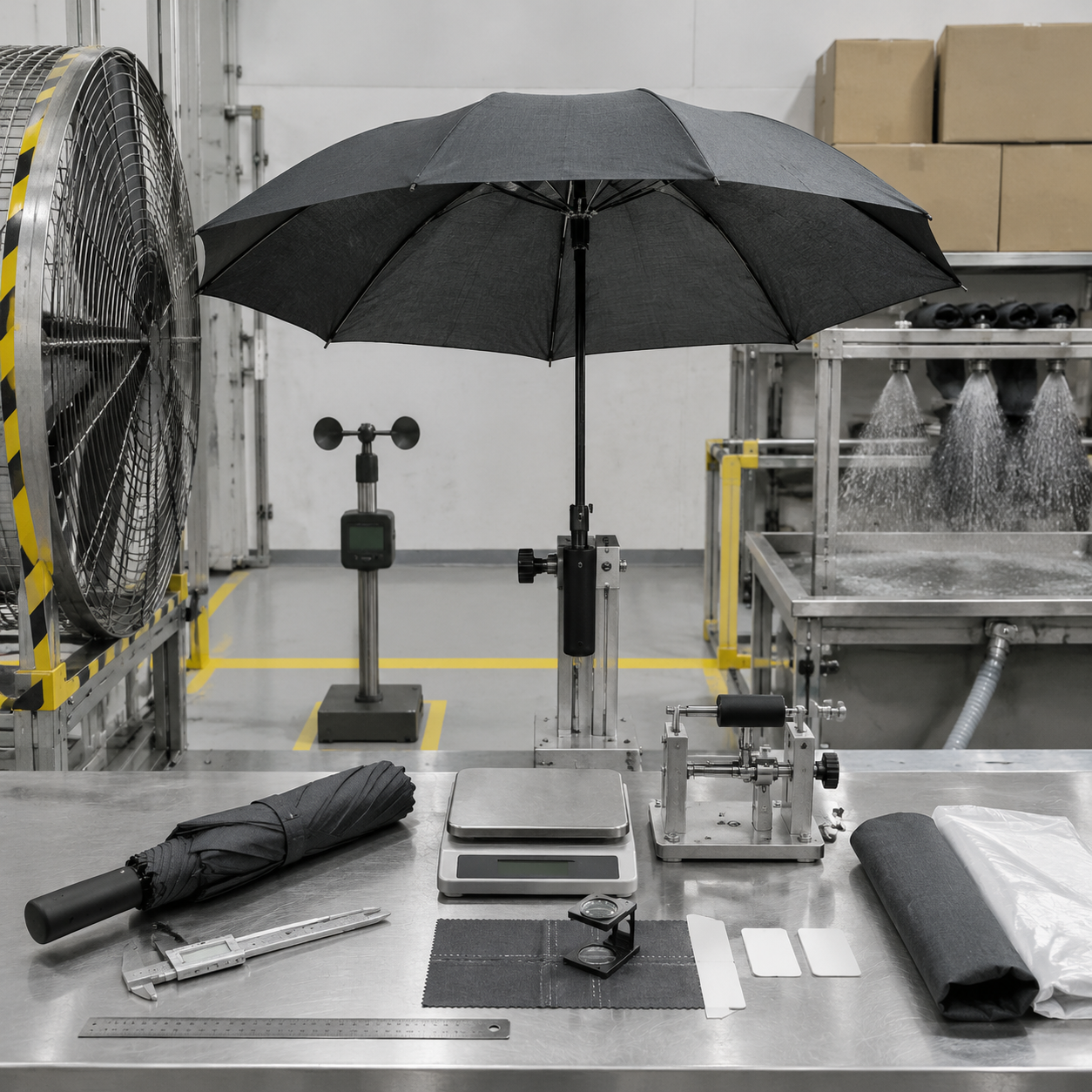
| Wind test | Define apparatus, fixture points, airflow measurement, orientation, exposure, operating state, inversion rule, recovery rule, and structural-failure criteria | Full protocol, apparatus and instrument record, specimen identities, and results by specimen | Accept only results produced under the approved conditions |
| Water check | Define the exposure setup, observation areas, duration, permitted leakage, specimen allocation, and post-test condition | Proposed method and results for the offered canopy, seams, and coating | Compare observations by specimen with buyer-set limits |
| Workmanship and defects | Define acceptable boundaries for seams, threads, panel alignment, tips, edges, joints, runner, handle, attachments, and finishes | Approved sample and defect-reference images | Classify and count departures under purchase-order definitions |
| Decoration | Control artwork revision, process, dimensions, placement datum, orientation, color reference, and appearance limits | Decorated sample, measurements, process declaration, and exceptions | Compare bulk decoration with the approved revision and tolerances |
| Packaging | Define sleeve, inner pack, carton quantity, protection, carton dimensions, carton mass, handling marks, code data, and buyer-approved destination files | Pack-out sample, carton specification, proofs, and scan record where requested | Verify the approved pack-out and files without treating inspection as a legal determination |
| Lot and sampling | Define the lot, sample-selection method, specimen quantity, test allocation, defect classes, acceptance limits, and disposition authority | Inspection access plus production and packing status | Confirm that selection and testing follow the purchase-order instruction |
| Change and document control | Identify changes requiring advance approval and evidence required for laboratory, compliance, or certification claims | Written change requests and current product-scoped supporting documents | Hold affected goods or unsupported claims until the buyer approves adequate evidence |
Avoid stand-alone descriptions such as strong, premium, or heavy duty. Require measurable construction and test proposals, with every exception disclosed before price comparison.
Make the wind result SKU-specific
A report that only says pass does not establish what was tested or under which conditions. Use a controlled test record:
| Test-record field | Required entry |
|---|---|
| Specimen identity | SKU, specification revision, approved-sample reference, and unique specimen identifier |
| Construction identity | Canopy dimensions and material declaration, frame and rib construction, joint design, and opening mechanism |
| Apparatus and fixture | Equipment description, attachment points, umbrella position, and any fixture contact with the handle or frame |
| Airflow measurement | Buyer-set value in m/s, instrument identity, required instrument status, and measurement position in mm relative to the defined datum |
| Orientation | Canopy angle and direction relative to airflow using the buyer's stated datum |
| Exposure | Buyer-set duration in s, repetitions, rest condition where used, and operating state during exposure |
| Specimen allocation | Buyer-set quantity in umbrellas and the required sequence for each specimen |
| Inversion and recovery | Whether inversion is permitted, the permitted recovery method, and the permanent-deformation rule |
| Failure criteria | Breakage, disengagement, bending beyond the buyer-set limit, detached canopy points, runner or lock failure, handle loosening, seam failure, or loss of opening function |
| Result | Measured conditions, observations, disposition for each specimen, and images of damage or deformation where applicable |
Do not transfer a result between SKUs merely because both products are marketed as windproof. The report must connect every specimen to the construction and specification revision used for the order.
Defect classification and sampling
The supplied V-Trust inspection-services page organizes umbrella inspection subjects under function and performance, appearance and workmanship, structure and material, and safety and compliance (V-Trust). Convert relevant subjects into SKU-specific descriptions, reference images, and numerical acceptance limits set by the buyer.
| Buyer-defined class | RFQ example | Required disposition rule |
|---|---|---|
| Potential critical defect | An accessible sharp edge, hazardous unintended release, or another condition the buyer has assessed as a credible safety concern | State the hold, escalation, and release authority; this classification is not itself a legal finding |
| Major defect | Broken rib, sticking mechanism, leakage beyond the written limit, loose handle, out-of-tolerance dimension, incorrect decoration, or another loss of agreed function | State the accepted count and required action when the limit is exceeded |
| Minor defect | Loose thread, finish mark, or alignment departure beyond the approved visual boundary without loss of agreed function | State the accepted count and required action when the limit is exceeded |
A sampling acronym alone is not a complete instruction. State the lot basis, sample-selection method, specimen quantity, test allocation, defect classes, acceptance limits, and deviation authority. Preserve original defect descriptions and counts in the inspection report rather than reclassifying defects solely to obtain a passing disposition.
Canada-bound pre-shipment quality control inspection
The pre-shipment report should identify the SKU, revision, supplier, production location, lot, available quantity, packed quantity, carton range, sampling record, and inspection date. It should separate observed results from the buyer's final release decision.
Verify and record:
- Canopy construction, frame components, mechanism, dimensions, mass, colors, and decoration against the approved revision.
- Wind, water, operation, and workmanship results against approved methods and specimen allocation.
- Actual measurements with units, specimen identifiers, tolerances, and disposition.
- Defect descriptions, classifications, counts, affected quantities, images, and purchase-order limits.
- Sleeve, inner pack, carton quantity, protection, carton dimensions, carton mass, handling marks, and buyer-approved destination files.
- Every deviation with its affected quantity, evidence, proposed action, and approval status.
- Reworked goods through segregation records and a conforming reinspection report.
The supplied pages do not establish Canadian legal, bilingual-labeling, landed-cost, or logistics requirements. Determine any applicable requirement from authoritative Canadian sources before approving destination files or shipment instructions. The inspection should verify the resulting controlled requirements; it should not substitute for that determination.
Place the shipment on hold when product identity does not match, a material or component was substituted without approval, wind-test conditions are missing, the inspected lot cannot be traced, defect limits are exceeded, packaging files use an unapproved revision, or a compliance or certification claim lacks a current product-scoped document.
Evidence method, source data, and limitations
Method. Only the supplied pages were used. The Ark Umbrella and HF Umbrella pages provided commercial sourcing context for product specifications, components, dimensions, function, decoration, performance checks, and packaging. The V-Trust page supplied inspection-category context. The HFBrolly page supplied vendor-scoped quantity and fabric-designation statements. The author profile was used only to identify the named author and role. Source topics were mapped to buyer-controlled RFQ fields; no source statement was treated as proof of a factory, product, production lot, certification, or inspection result.
The source counts below were derived by counting discrete visible table rows, named elements, or category headings. Vendor values were transcribed as stated and were not recalculated. They are source context, not wind-performance thresholds or buyer acceptance criteria.
- 6 checklist rows. Unit: table rows. Scope: the Ark Umbrella checklist entries for canopy fabric, frame and ribs, opening function, logo printing, handle and small parts, and packaging. Date context: page labeled May 18, 2026. Source: Ark Umbrella.
- 11 named product and pack elements. Unit: named elements. Scope: the Ark Umbrella component statement listing fabric, coating, ribs, shaft, runner, spring, handle, tips, sleeve, logo printing, and packaging details. Date context: page labeled May 18, 2026. Source: Ark Umbrella.
- 4 inspection-category headings. Unit: headings. Scope: function and performance, appearance and workmanship, structure and material, and safety and compliance. As-of context: the supplied V-Trust page is undated. Source: V-Trust.
- 500 pieces per custom order. Unit: pieces per order. Scope: the threshold in the vendor's custom-order recommendation, not a universal order requirement. Date context: page labeled January 27, 2026. Source: HFBrolly. Verify quantity, pricing, and commercial terms in the supplier quote.
- 210T-plus supplier designation. Unit: the vendor's T-based weave-density designation. Scope: the fabric recommendation for the custom-order program described on the vendor page, not a universal windproof specification. Date context: page labeled January 27, 2026. Source: HFBrolly. Verify the designation, actual fabric construction, coating, and finished-product result with the supplier.
Limitations and verification. The cited commercial pages do not provide a universal definition of windproof performance, buyer-specific dimensions or tolerances, a complete Canadian legal assessment, or inspection results for the buyer's SKU. They also do not prove that a laboratory, compliance, or certification claim currently covers an ordered product. Before approval, verify the complete construction, specification revision, sample identity, test protocol, apparatus, instrument record, specimen-level results, bulk-lot sampling instruction, defect limits, packaging files, destination requirements, and deviation authority. Rely on a certification or compliance claim only after receiving a current document whose product scope matches the ordered SKU.
Discuss Your Requirements
Review our manufacturing capabilities, then share your specifications for a supplier-fit review.