Windproof Umbrella Sourcing: Sample Approval for Australia
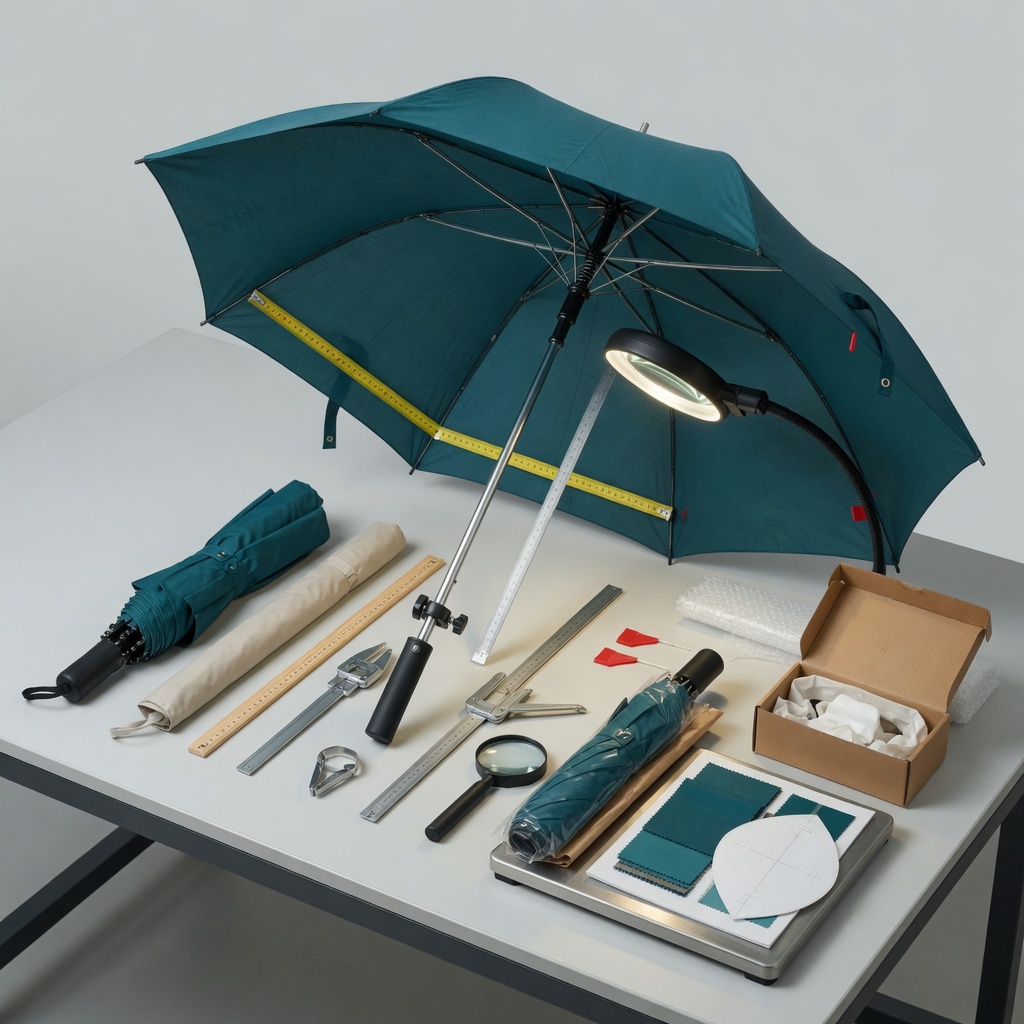
By Vincent Xi, Editorial Author
Australian B2B buyers should use windproof umbrella sourcing sample approval to make a controlled RFQ decision: does an identified physical sample match the configuration the supplier has quoted and proposes to manufacture? The approval record should link the sample identifier to the product specification, quotation, artwork, available test evidence, packing trial, accepted deviations, and proposed bulk-production revision.
Treat windproof as a proposed claim, not a complete acceptance criterion. Claim approval requires evidence that identifies the tested configuration, airflow method, air-speed unit, exposure duration, orientation, operating sequence, failure definition, report date, and result. If that evidence is absent or covers a different configuration, the buyer can still assess construction, artwork, workmanship, or packing while recording the performance claim as outside the approved scope.
Sample Approval Decision for Australian Windproof Umbrella Orders
Use a written disposition that makes the procurement consequence clear.
| Disposition | Required basis | Procurement consequence |
|---|---|---|
| Approved for bulk production | Approval-critical fields match the controlled documents, with accepted deviations listed | The purchase order may reference the approved configuration |
| Hold for evidence or correction | A document, measurement, quotation input, or non-critical detail remains unresolved without changing the physical configuration | Do not release the affected claim or order field until the open item is closed |
| Resample required | An approval-critical material, dimension, component, mechanism, canopy construction, decoration process, or packing configuration must change | Review a revised identified sample before bulk release |
A useful approval gate records both the evidence reviewed and the condition that would stop release.
| Approval control | Record in the file | Hold or resample trigger |
|---|---|---|
| Sample identity | Supplier, model or tooling reference, sample identifier, development stage, specification revision, quotation revision, artwork revision, packing revision, and decision date | The physical unit cannot be matched to the quoted configuration |
| Production representativeness | Prototype materials, substitute components, temporary tooling, hand-finished details, and temporary packing disclosed by the supplier | A temporary attribute affects an approval-critical field and the proposed production version has not been reviewed |
| Construction | Declared canopy, shaft, ribs, stretchers, joints, runner, mechanism, handle, tips, ferrule, fasteners, and sleeve | A material, component, geometry, finish, or source changes without written review |
| Measurements and function | Nominal values, units, measurement definitions, sample condition, tools, tolerances, actual results, and operating procedure | Results exceed agreed tolerances, definitions conflict, or a critical function fails |
| Wind-performance claim | Configuration mapping plus a report stating the method, air-speed unit, duration, orientation, failure definition, date, and result | Evidence is absent, unclear, or based on a materially different configuration |
| Artwork and colour | Controlled artwork, colour reference, decoration process, dimensions, orientation, location, and registration tolerance | Bulk production would use a different file, process, substrate, placement, or colour basis |
| Packing and freight | Packing trial, protective materials, carton arrangement, packed dimensions, net and gross mass, packing quantity, dispatch location, Australian destination, delivery terms, and quotation assumptions | Packing data are estimated, conflict with the trial, or do not match the freight quotation |
| Deviations and bulk transfer | Consolidated deviation record, purchase order, approved-sample identifier, inspection plan, and change-control clause | A difference is undocumented, or the order permits an unreviewed substitution |
A missing wind report should block an unsupported performance claim. It need not block a clearly limited construction or artwork decision when the approval record states that wind-performance evidence remains unresolved.
Evidence Inputs for Windproof Umbrella Sample Approval
The supplied sources are supplier-origin editorial pages. They can support RFQ questions and verification fields, but they do not establish the performance, dimensions, materials, compliance, or commercial terms of a particular sample.
| Concrete data point or recommendation | Source context | Permitted use and limitation |
|---|---|---|
| 500 pieces per custom order | This minimum order quantity applies to the custom-order scope described on the HFBrolly page marked last updated January 2026 (HFBrolly sourcing guide) | Use it only as dated guidance for that source's stated scope. Verify the applicable quantity in the current supplier quotation |
| 210T in the source's T designation | The HFBrolly page marked last updated January 2026 recommends 210T or higher for what it describes as high-density pongee (HFBrolly sourcing guide) | Record the supplier designation as an RFQ field. The source does not define its measurement basis, and the designation is not an independent performance result or universal threshold |
| 3 physical sample units for the specific approval programme: 1 buyer-retained unit, 1 supplier-retained unit, and 1 contingency unit | Explicit example allocation and assumption, not a source-derived requirement | Verify the total sample quantity, configuration, fee, dispatch timing, and retention arrangement in the supplier quotation |
| Pre-production sample checks | HFBrolly recommends checking opening and closing, colour, and stitching before production (HFBrolly sourcing guide) | Convert each recommendation into a written procedure and acceptance criterion rather than recording an undefined pass |
| Frame and decoration questions | HFBrolly recommends fiberglass ribs and choosing the printing process according to the artwork rather than price alone (HFBrolly sourcing guide) | Ask whether those recommendations apply to the quoted sample. Do not describe them as approved construction until documented |
| Specification-led comparison | HFumbrella supports a specification-led inquiry and physical comparison of frame, fabric, mechanism, and artwork (HFumbrella buying guide) | Use this as workflow support; it does not establish a result for the buyer's sample or bulk order |
Practical RFQ Checklist for Windproof Umbrella Sample Approval
Send this checklist with the RFQ and require the supplier to complete each applicable field before dispatching the approval sample. A checked item means that the requested information has been supplied; it does not mean that the buyer has accepted the answer or approved the sample.
- [ ] Identify the supplier, quoted model or tooling reference, product description, and intended Australian delivery destination.
- [ ] State the proposed order quantity, option allocation, quotation currency, delivery terms, dispatch location, and the event that starts the quoted production lead time.
- [ ] Assign a unique sample identifier and state whether the unit is a concept sample, development sample, pre-production sample, or production reference.
- [ ] List the product specification, drawing, quotation, artwork, colour reference, and packing revisions represented by the sample.
- [ ] Declare every prototype material, substitute component, temporary tool, hand-finished detail, and temporary packing element.
- [ ] Provide a component schedule covering the canopy, shaft, ribs, stretchers, joints, runner, mechanism, handle, tips, ferrule, fasteners, and sleeve.
- [ ] State nominal dimensions and mass with units, definitions, measurement points, methods, tools, tolerances, and sample condition.
- [ ] Identify the opening and closing mechanism and provide the proposed functional inspection sequence and acceptance criteria.
- [ ] State the exact windproof or wind-performance claim proposed for the product, packaging, quotation, or sales material.
- [ ] Attach any configuration-specific wind evidence and identify the tested model, report issuer, report date, method, air-speed unit, duration, orientation, failure definition, and result.
- [ ] Provide a mapping of differences between the tested unit, RFQ configuration, physical approval sample, and proposed bulk product.
- [ ] Supply controlled artwork, decoration process, colour reference, placement dimensions, orientation, registration tolerance, and represented substrate.
- [ ] Propose measurable workmanship criteria for sewing, panel alignment, finish, exposed points, component retention, contamination, and visible damage.
- [ ] Complete a packing trial and report the packed configuration, protective materials, packing quantity, carton dimensions, net mass, gross mass, and whether each freight input is measured or estimated.
- [ ] State the sample quantity, sample fee, tooling charge, dispatch timing, courier arrangement, and proposed remedy if the sample does not match the RFQ.
- [ ] List every known deviation from the RFQ and state whether it applies only to the sample or is proposed for bulk production.
- [ ] Confirm that no material, component, finish, decoration, construction, or packing substitution will be made without written buyer review.
- [ ] State which open items can be closed by documents and which changes require a revised physical sample.
- [ ] Confirm the proposed retention arrangement for the approved reference and how the approved-sample identifier will appear in the purchase order and inspection plan.
The buyer should return the checklist with each line marked accepted, open, not applicable, or resample required. Attach document references and deviation decisions rather than relying on an email statement that the sample is generally approved.
What Sample Approval Must Freeze
Identity and production representation
Assign the physical unit a sample identifier and record its development stage. Link it to the supplier's model or tooling reference, product drawing, specification, quotation, artwork, packing proposal, and decision date. Photographs should show the identifier and relevant construction details, but they should supplement the physical reference and measurement record rather than replace them.
Require written disclosure of prototype materials, substitute components, temporary tooling, hand finishing, or temporary packing. If any temporary attribute affects an approval-critical field, record the affected scope and require either documentary closure or a production-representative resample.
Construction declaration
Request component-level declarations for the canopy, shaft, ribs, stretchers, joints, runner, mechanism, handle, tips, ferrule, fasteners, and sleeve. Record material, profile, accessible dimensions, finish, and component reference where they affect the RFQ decision.
Terms such as reinforced frame, premium fabric, and windproof construction are not measurable on their own. If the quotation proposes fiberglass ribs or pongee carrying a supplier designation, tie that declaration to the identified sample and proposed bulk configuration. Do not infer wind performance, water resistance, colourfastness, coating durability, or service life from a material name or fabric designation.
Measurement schedule
Buyer and supplier should agree on definitions before comparing results. Every field should identify its unit, sample condition, measurement location, method, tool, nominal value, permitted tolerance, and actual result.
| Field | Definition to agree | Approval record |
|---|---|---|
| Open canopy span | Endpoints, direction across the canopy, and whether the measurement follows a straight line | Nominal value, tolerance, actual result, unit, tool, and photograph |
| Canopy arc | Start and end tips, path over the crown, and tape tension | Nominal value, tolerance, actual result, unit, and method |
| Folded length | Upper and lower reference points, handle position, strap condition, and whether the sleeve is fitted | Product and sleeved results, units, and tolerances |
| Shaft and frame profiles | Component, accessible measurement point, orientation, and whether coating is included | Supplier declaration, measured result, unit, and tool identity |
| Finished mass | Sample condition and included accessories | Actual result, unit, scale identity, and comparison with the quoted value |
| Packed unit and carton | Packing configuration, included components, carton arrangement, and closure condition | Dimensions, net mass, gross mass, packing quantity, and quotation status |
| Artwork | Reference edges, printed area, placement, orientation, and registration method | Controlled file revision, actual dimensions, colour reference, and deviations |
Preserve actual results rather than reducing the record to a pass or fail mark. Those results provide the comparison baseline for the later bulk inspection plan.
Function, artwork, and workmanship
State whether the sample mechanism is manual, automatic-open, or automatic open-and-close. Define the operating sequence used to assess opening, runner engagement, shaft alignment, closing, button security, fabric clearance, component retention, and rib recovery. The RFQ or test plan should set the repetition method and acceptance criteria.
Approve the controlled artwork file, decoration process, colour reference, dimensions, panel location, orientation in open and folded states, registration tolerance, edge criteria, and represented substrate. A proposed change to the printing process, fabric, colour basis, placement, or artwork revision should reopen the affected approval fields.
Define project-specific workmanship criteria for panel alignment, sewing, loose threads, stains, scratches, exposed points, sharp edges, loose fasteners, pinching behaviour, tip security, handle attachment, odour, contamination, and finish consistency. These are buyer-defined acceptance criteria, not evidence of certification.
Packing and deviations
Conduct the packing trial with the identified sample configuration. Record the folding method, sleeve fit, protective materials, inner packing, carton arrangement, included components, and carton-marking artwork. Mark freight inputs as measured or estimated.
List every difference among the physical sample, drawing, specification, quotation, artwork, and packing proposal. For each deviation, record the affected field, decision owner, acceptance date, required correction, and whether the difference applies only to the sample or also to bulk production.
Windproof Claim Evidence Within Sample Approval
A wind-performance evidence request should cover:
- Tested model and sample identifier
- Canopy dimensions and construction
- Shaft, rib, stretcher, joint, runner, and mechanism configuration
- Canopy fabric and vent construction where applicable
- Test facility or report issuer
- Report date and document identifier
- Airflow-generation method and air-speed unit
- Exposure duration and umbrella orientation
- Operating sequence and sample condition
- Failure definition, observations, and result
- Photographs or diagrams that support configuration comparison
- Deviations between the tested unit, approval sample, and proposed bulk product
Use a configuration-mapping sheet to compare the report with the approval sample. A matching report can proceed to claim review, but it does not by itself establish approved wording, certification, or legal suitability. A material configuration difference should trigger configuration-specific evidence or removal of the affected claim.
The HFBrolly source recommends confirming an AQL level, but the supplied evidence does not identify a sampling standard, inspection level, defect classes, or acceptance and rejection limits. Treat those controls as unresolved RFQ fields until documented. Do not present an AQL reference as certification.
No supplied source identifies a standard that establishes compliance for the proposed sample. If a supplier cites a standard, obtain the current report or relevant document, identify the exact requirement being claimed, and verify that its scope covers the approved configuration. Keep the standard's requirements separate from the buyer's own tolerances, workmanship rules, packing controls, and commercial remedies.
RFQ-to-Sample Approval Workflow
Before dispatch: Obtain the sample specification, quotation revision, product drawing, artwork proof, available test evidence, packing proposal, completed RFQ checklist, and deviation list. The RFQ should also state the proposed order quantity, option allocation, Australian delivery destination, sample fee, tooling charge, dispatch timing, and remedy for a non-conforming sample. Do not classify a prototype as production-representative when different materials, components, tooling, decoration, or packing have been disclosed.
On receipt: Record the parcel condition, packed condition, sample identifier, included components, and visible damage. Separate possible transit damage from manufacturing observations and preserve the identity of each sample during unpacking, measurement, and photography.
During inspection: Apply the agreed measurement points, tools, sample condition, viewing conditions, and functional sequence. Record actual values, observations, tool identity or calibration status where relevant, photographs, and deviations.
| Controlled field | Supplier declaration | Buyer measurement or observation | Agreed tolerance or criterion | Status and deviation decision |
|---|---|---|---|---|
| Sample and revision identity | Exact document match | |||
| Frame and canopy construction | RFQ-defined | |||
| Dimensions and mass | RFQ-defined | |||
| Mechanism and function | Procedure-defined | |||
| Wind evidence | Claim-specific | |||
| Artwork and colour | RFQ-defined | |||
| Workmanship | Defect criteria | |||
| Packing and freight inputs | Quotation-defined |
At decision: Sign and date the disposition, list open items, assign responsibility for each correction, and state whether documentary confirmation is sufficient or a revised physical sample is required. Record the agreed reference-retention arrangement for buyer and supplier.
Sample approval establishes only the recorded decision scope. Bulk conformity requires a separately defined inspection plan tied to the same specification, sample identifier, artwork, tolerances, and accepted deviations.
Australian Purchase Order Release After Sample Approval
For an Australian procurement order, release only the product fields for which the purchase order and approval file identify the same configuration. Confirm the order quantity and option allocation, production revision, accepted deviations, packing configuration, delivery destination, dispatch location, delivery terms, and event that starts the quoted production lead time.
Use packing-trial results from the approved configuration as freight-quotation inputs. Record the carton arrangement, packing quantity, packed dimensions, net mass, gross mass, dispatch window, destination, and supplier or freight assumptions. If the quotation relies on estimated packing data, label it provisional and require confirmation before using it for the release decision.
The supplied evidence does not establish current Australian product-safety, customs, origin-marking, packaging, environmental, or labelling requirements for a particular umbrella order. Submit the proposed claims, labels, packaging files, material declarations, and available reports for appropriate current Australian legal or import review. Record sample approval as a product, artwork, workmanship, and packing decision within its stated scope, not as regulatory approval.
A purchase-order control clause can state:
> Approved for bulk production only against the identified physical sample, controlled product specification, artwork revision, accepted-deviation record, quotation, and packing specification cited in this order. Any undisclosed change requires written buyer review and, when it affects an approval-critical attribute, a revised sample.
Evidence Method, Source Contexts, and Limitations
Methodology. The supplied pages were reviewed only for statements directly relevant to windproof umbrella sample approval, including supplier inquiry, physical sample comparison, frame, fabric, mechanism, decoration, workmanship, packing, and transfer to bulk production. Source figures were transcribed with their stated scope and date context. Recommendations were converted into RFQ questions, measurable fields, evidence requests, checklist items, and decision controls. The sample allocation is explicitly labelled as an assumption to verify in the quotation. Unsupported performance outcomes, commercial savings, superiority claims, customer outcomes, certifications, and company-specific product claims were excluded.
HFBrolly source context. The page supplies the dated minimum-order and fabric-designation statements and recommendations concerning pre-production samples, opening and closing, colour, stitching, fiberglass ribs, printing choices, and AQL discussion. It is supplier-origin editorial material, not a configuration-specific laboratory report or buyer quotation (HFBrolly sourcing guide).
HFumbrella source context. The page supports a specification-led inquiry and physical comparison of frame, fabric, mechanism, and artwork. It is also supplier-origin editorial material and does not establish the result of a particular sample inspection or bulk order (HFumbrella buying guide).
Author basis. The approved profile identifies Vincent Xi as an Editorial Author. It does not document a factory visit, product test, client outcome, certification, or first-hand procurement experience, so no such claim is made.
Limitations and verification. No ZheBrella product specification, supplier quotation, identified physical sample record, wind-test report, material report, freight quotation, current certificate, or Australia-specific legal assessment was supplied as evidence for this article. Before approval, verify the actual sample identity, measurements, materials, test scope, report validity, artwork, proposed claims, packing data, commercial terms, labels, and current destination requirements. Preserve those verified inputs in the purchase order and bulk inspection plan.
Discuss Your Requirements
Review our manufacturing capabilities, then share your specifications for a supplier-fit review.