Windproof Umbrella Wholesale Supplier Communication Workflow Review for United Arab Emirates Buyers
Byline: Vincent Xi, Editorial Author (Author Profile)
For United Arab Emirates corporate procurement teams and commercial distributors, completing a structured windproof umbrella wholesale supplier communication workflow review is a critical gate before releasing a bulk deposit. Wind-resistant canopy systems require precise mechanical coordination across reinforced ribs, stretcher joints, shaft tolerances, and double-canopy venting. A rapid sales acknowledgment that fails to connect technical questions directly to engineering and quality-control personnel creates operational risk once manufacturing starts.
This review evaluates wholesale supply communication frameworks for the windproof-umbrella product family. The assessment synthesizes documented practices from three public sourcing references: the HF Umbrella import guide, the Giant Umbrella production timeline, and a Yiwu umbrella sourcing note. Editorial attribution belongs to Vincent Xi, Editorial Author at ZheBrella (https://www.zhebrella.com/authors/vincent-xi/). No individual factory visits, proprietary laboratory tests, client case histories, or commercial endorsements are claimed.
While manufacturing origins commonly sit overseas, this guide addresses United Arab Emirates B2B buyers managing cross-border commercial transactions. Manufacturing locations are not secondary consumer sales markets. Specific United Arab Emirates import tariffs, port handling fees at Jebel Ali or Khalifa Port, and local commercial labeling mandates do not appear in the referenced sourcing texts; buyers must establish those local parameters directly with licensed freight forwarders and customs brokers.
United Arab Emirates communication workflow review before the purchase order
A disciplined communication workflow review resolves five operational checkpoints before the purchase order is finalized:
- Production escalation: identifying who represents canopy cutting, digital or silkscreen printing, sewing, and final assembly.
- Quality oversight: confirming who establishes quality-control acceptance criteria and administers acceptance sampling.
- Turnaround accountability: establishing the calendar and business-hour clock used to track response times.
- Progress validation: standardizing data fields required on production status photos and milestone tracking logs.
- Revision authority: designating which formal written records may authorize component substitutions or schedule adjustments.
Intermediary trading entities can introduce administrative buffers and delayed feedback cycles, whereas direct manufacturing facilities provide open access to line supervisors and quality managers (HF Umbrella import guide). Key vetting checkpoints include conducting a live video inspection of cutting, printing, sewing, and assembly operations, alongside verifying specific ownership of quality standards and Acceptable Quality Limit (AQL) procedures.
For windproof umbrella wholesale supply contracts, direct technical access is vital. Generic marketing terms such as "storm-proof" or "high-wind resistant" do not define fabric denier, fiberglass rib flex modulus, shaft wall thickness, or thread tensile strength. The communication workflow must secure these engineering parameters in writing before raw materials are cut.
Published timeline analyses show that communication turnaround is a strong operational indicator of delivery reliability (Giant Umbrella production timeline). That analysis highlights a benchmark of responding to inquiries within 4 hours (unit: hours; scope: business-day technical inquiry turnaround indicator for compressed umbrella production schedules; date/as-of context: public website documentation reviewed as of 2024–2025; source: Giant Umbrella Company). It also presents an end-to-end design-to-delivery pathway of 30 days (unit: days; scope: vendor-published example timeline for compressed customized umbrella manufacturing; date/as-of context: published web case timeline; source: Giant Umbrella Company). Milestone transparency includes daily progress reports, in-process quality photos, and logistics tracking.
United Arab Emirates buyers must evaluate these published metrics against their operational context. The 4-hour window represents an indicator from an accelerated production case study rather than a statutory UAE trade rule. Similarly, the 30-day timeline illustrates an expedited single-supplier benchmark rather than an industry-wide delivery guarantee.
Clear communication protocols mitigate technical errors: short phrasing, simplified sentence construction, and numerical confirmations prevent misunderstandings, while bilingual agents provide translation support when language barriers arise (Yiwu umbrella sourcing note). For United Arab Emirates procurement officers communicating in English or Arabic across overseas production hubs, all commercial terms and dimensional tolerances must be logged in explicit Arabic numerals.
Illustrative planning calculation (example assumption to verify in supplier quote): If a buyer tests the 4-hour business-day responsiveness target across a 5-day working week, an unresolved technical question can absorb 1 full business day before formal escalation. Within a 30-day total production calendar, 3 lost business days equal 10 percent (unit: percent; scope: illustrative schedule slippage resulting from 3 unaddressed business days across a 30-day baseline; date/as-of context: example planning calculation to verify in supplier quote; source: illustrative buyer workflow model) of the entire manufacturing window. Buyers must calculate schedule allowances against the supplier's actual working calendar and regional holidays.
Direct factory access versus intermediary feedback layers
Workflow evaluation should measure technical accessibility rather than email signature titles. An intermediary export agency can manage invoicing effectively, but operational friction occurs when that entity cannot bring print technicians, sewing foremen, and assembly inspectors into the communication thread. Documented sourcing evidence indicates that multiple intermediary layers create communication delays, whereas direct factory engagement provides direct access to production lines (HF Umbrella import guide).
Buyers should require a formal four-point contact map prior to deposit release:
- Commercial Lead: Manages proforma invoices, Incoterms, and payment terms.
- Technical Lead: Governs canopy specifications, fiberglass rib diameters, shaft wall thickness, frame hardware, and packaging configurations.
- Quality Lead: Oversees inspection criteria, defines AQL thresholds, and retains operational authority to stop non-conforming assembly runs.
- Logistics Lead: Coordinates export cartoning, palletization, container loading, and ocean or air freight documentation.
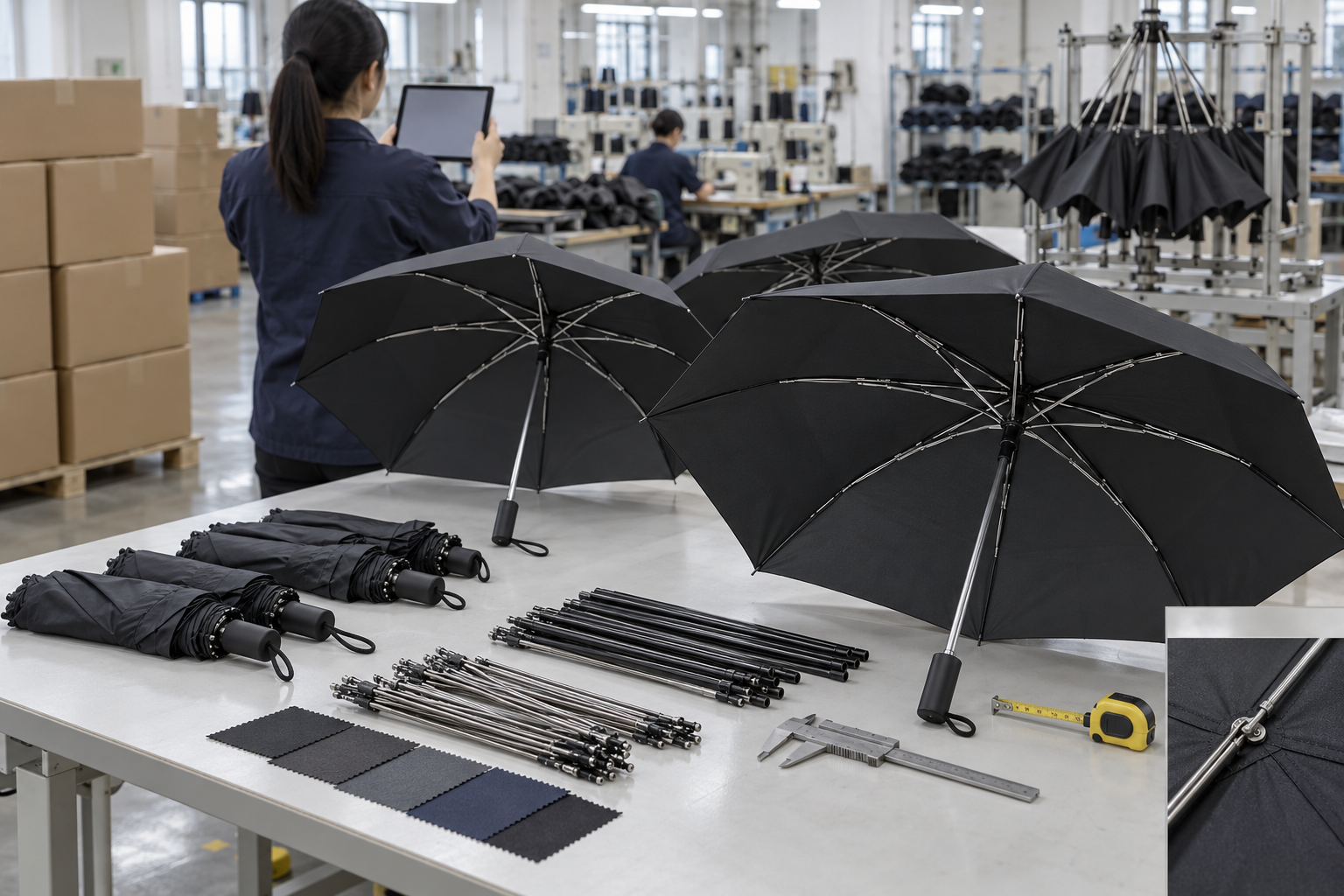
A live video walkthrough of printing, sewing, and assembly stages serves as an operational test of technical access. A refusal or redirection to an unrelated facility signals fragmented factory control. Independent standards such as ISO 9001 quality management or ISO 2859-1 inspection sampling must be distinguished from generalized vendor claims. Certifications require an active, audited document issued directly to the legal contracting entity.
Response timelines, production updates, and change-control trade-offs
Adopting a 4-hour business-day inquiry turnaround requires defining the underlying operational parameters. The contract must state the reference time zone, operating hours, and whether the clock begins at buyer transmission or supplier office opening. Without documented boundaries, response metrics cannot be assessed against United Arab Emirates business days (Monday through Friday) versus manufacturing facilities operating on alternate regional calendars.
Daily production updates and photographic records provide real-time visibility but require standardized reporting formats. Each update should state the purchase order number, production step, completed units, units held for quality review, and time-stamped inspection photos. Photographs submitted without production counts fail to provide sufficient verification.
Illustrative change-control parameter (example assumption to verify in supplier quote): Technical acknowledgment must be distinguished from engineering approval. A supplier may acknowledge an email in 2 hours yet take days to confirm raw material compatibility. Buyers should specify an explicit review window—such as 2 business days (unit: business days; scope: engineering change hold window allowed before halting line operations; date/as-of context: example calculation/assumption to verify in supplier quote; source: editorial planning assumption)—to review material substitutions before line work proceeds.
Simplified phrasing minimizes interpretation errors in cross-border supply chains (Yiwu umbrella sourcing note). However, concise text must not replace detailed technical specifications. Commercial emails should remain brief while referencing attached engineering data sheets that suppliers sign and return without unapproved modifications.
Buyer decision table for communication controls
This decision matrix enables United Arab Emirates procurement officers to evaluate competing wholesale suppliers on structured communication workflows before issuing purchase orders.
| Decision Point | Specification Requirement | Verification Method | Operational Trade-Off | Procurement Rule |
|---|---|---|---|---|
| Production Access | Named liaison covering printing, stitching, and assembly lines | Request live video walkthrough of the designated production line (HF Umbrella import guide) | Trading firms may reply quickly to general queries but slow technical resolutions | Withhold sampling approval if the manufacturing line cannot be shown |
| Quality Oversight | Named lead administering inspection standards and AQL levels | Obtain written confirmation of the quality manager's role | Rigorous sampling can lengthen lead times; unassigned oversight risks defect disputes | Require a named quality owner before contract execution |
| Turnaround SLA | 4-hour business-day response benchmark (Giant Umbrella production timeline), with designated time zone | Transmit a technical specification query and log elapsed hours | Fast acknowledgments may mask delayed technical resolutions | Escalate inquiries when responses lack technical ownership |
| Progress Reporting | Daily or stage updates with photos, completed counts, and hold quantities | Audit incoming update formats against required purchase order fields | Frequent reporting increases supplier administration | Accept progress updates only when verified counts accompany photos |
| Schedule Transparency | Milestone breakdown across sample, bulk, inspection, and dispatch | Cross-reference quoted lead times against published 30-day expedited benchmarks | Compressed schedules leave minimal buffer for raw material delays | Incorporate explicit milestone dates into the purchase order |
| Numerical Record | All quantities, dimensions, and tolerances confirmed in Arabic numerals | Require returned quotation forms to restate all digits (Yiwu umbrella sourcing note) | Verbal summaries save time but introduce costly fabrication errors | Treat unconfirmed numeric counts as unapproved changes |
| Change Control | Formal revision code required for any material, rib, or finish change | Specify that unapproved substitutions halt production immediately | Strict substitution controls can delay production if materials face stockouts | Halt final lot payment upon unauthorized material changes |
| Export Documentation | Designated issuer for commercial invoices, packing lists, and certificates of origin | Match document issuer details against the contracting vendor | Intermediary document issuers can delay United Arab Emirates import clearance | Release balance payment only against verified documentation copies |
Technical specifications that must remain frozen during approval
Windproof umbrella structural integrity depends on mechanical resilience under wind shear. The communication thread must formally freeze structural specifications to prevent unauthorized material shifts:
- Canopy Textile and Coatings: Fabric type (such as 190T or 210T pongee), water-repellent finish, and ultraviolet protection factors, recorded with supplier metric units.
- Frame Architecture: Rib composition (solid fiberglass versus coated spring steel), rib count, double-canopy vent elastic tension, and spreader joint materials.
- Center Shaft Specifications: Shaft diameter, wall thickness, and base metal alloy specifications.
- Handle and Opening Mechanisms: Manual versus automatic open/close mechanical assemblies, grip coatings, and end-tip securement.
- Branding and Graphic Assets: Vector artwork versions, Pantone matching references, print strike-off approvals, and sign-off personnel.
- Packaging and Barcoding: Units per inner box, export master carton burst-strength ratings, and United Arab Emirates retail compliance labeling.
- Inspection Stage Gates: In-process checkpoints, final pre-shipment AQL thresholds, and designated personnel authorized to accept or reject lots.
AQL sampling standards require explicit contractual definitions. While the HF Umbrella import guide notes that buyers must identify who owns the quality standard and AQL process, the text does not define a standard sampling index. Buyers must state their chosen inspection levels (such as AQL 2.5 for major defects and 4.0 for minor defects) in the RFQ and obtain written supplier acceptance.
RFQ Checklist
- Ask the supplier to name commercial, technical specification, quality control, and logistics leads in a single written contact directory before issuing quotes.
- Require the manufacturer to confirm whether production and quality teams will participate in live video verification of canopy cutting, sewing, and frame assembly.
- Specify the exact response-time clock, business-hour calendar, and time-zone baseline if negotiating against the published 4-hour business-day benchmark.
- Require the supplier to submit milestone breakdowns in calendar days for sampling, bulk assembly, pre-shipment inspection, and ex-factory handover rather than relying on generalized 30-day timeline claims.
- Ask the supplier to identify who owns the final quality control standards and who executes the acceptable quality limit (AQL) inspection protocols.
- Specify all canopy fabric weights, frame materials, shaft dimensions, and print specifications in exact numeric digits and units, requiring written confirmation or tracked revisions.
- Require the manufacturer to establish a formal revision protocol that prohibits material or schedule substitutions without prior written buyer approval.
- Require daily or weekly production updates to document the purchase order number, current production stage, completed units, held units, and time-stamped inspection photos.
- Ask the supplier to provide sample inspection logs and carton tracking templates in advance to ensure data fields match procurement tracking standards.
- Specify the exact export documentation package required for United Arab Emirates customs clearance, and confirm required paperwork with your local freight forwarder.
- Ask the supplier to define the primary language of record and state whether intermediary agents have contractual authority to approve engineering changes.
- Require comparative quotations to be evaluated against identical communication response benchmarks so lower pricing without direct technical accountability is rejected.
Evaluating supplier communications before deposit release
Procurement teams should evaluate communication discipline rather than sales tone. An effective response names the question, confirms numeric dimensions, identifies the accountable engineer, and sets a firm delivery date for technical resolutions. Deficient replies provide non-committal assurances, adjust dimensions without formal revision codes, or send generic product catalogs.
Buyers should conduct a controlled pre-deposit communication test:
- Transmit a technical inquiry regarding rib flex properties or shaft wall thickness to the designated specification contact, logging elapsed hours against the agreed business-day SLA.
- Transmit an inquiry to the designated quality lead asking which party holds formal authority to reject lots that exceed agreed defect limits.
If both responses originate from a generic sales inbox without technical confirmation, the intermediary communication layer highlighted in sourcing literature is present (HF Umbrella import guide). While this outcome does not automatically disqualify the vendor, it alerts the buyer to potential coordination bottlenecks.
Furthermore, apply plain-language and numeric verification controls (Yiwu umbrella sourcing note). If a vendor returns an altered order volume or unit price, immediately restate the original numbers and require explicit written resolution. Sampling should not begin while ambiguous quantities remain in correspondence.
Finally, align progress payments with communication and inspection milestones. Bulk deposits should remain on hold until the technical specification sheet, contact directory, and quality-control protocols are signed. Commercial deposit percentages are established through private bilateral negotiation; no standard deposit percentage is defined in the cited sourcing references.
Methodology, source context, and verification limits
Methodology: This review was derived through comparative extraction of communication and timeline protocols published across three umbrella sourcing documents. Extracted data points include trading intermediary feedback delays versus direct factory communication, live video verification methods, quality and AQL ownership principles (HF Umbrella import guide), the 4-hour business-day inquiry turnaround indicator, daily update transparency requirements, and the 30-day design-to-delivery framework (Giant Umbrella production timeline), along with plain-language numerical verification and translator coordination guidelines (Yiwu umbrella sourcing note). The 10 percent schedule variance calculation and the 2-business-day change review period represent explicit planning models for buyer verification rather than empirical survey data.
Source Context: The HF Umbrella guide provides operational advice for buyers importing umbrella products from manufacturing hubs, emphasizing supplier vetting rather than statutory United Arab Emirates customs procedures. The Giant Umbrella Company article outlines that firm's timeline communication practices for fast-track umbrella manufacturing, rather than a multi-factory performance index. The Yiwu umbrella guide addresses marketplace communication nuances and language barrier management. None of these sources constitute a legal customs manual, third-party laboratory test standard, or pricing index.
Limitations and Buyer Verification: Quoted figures such as the 4-hour response indicator and 30-day production timeline reflect published claims from specific supplier websites and should not be treated as mandatory trade standards or broad market averages. Publication dates were not specified in the source documentation; data context reflects the public texts reviewed for this guide. United Arab Emirates import tariffs, shipping line detention terms, port clearance procedures, and product labeling regulations must be confirmed independently with licensed customs brokers and freight forwarders.
Before issuing a purchase order for windproof umbrella wholesale supply, United Arab Emirates procurement teams must verify the signed contact directory, frozen technical specification sheets, quality management owners, and customs paperwork requirements against the final supplier quotation.
Discuss Your Requirements
Review our manufacturing capabilities, then share your specifications for a supplier-fit review.