Windproof Umbrella Wholesale Supplier Production Scalability Planning for Europe
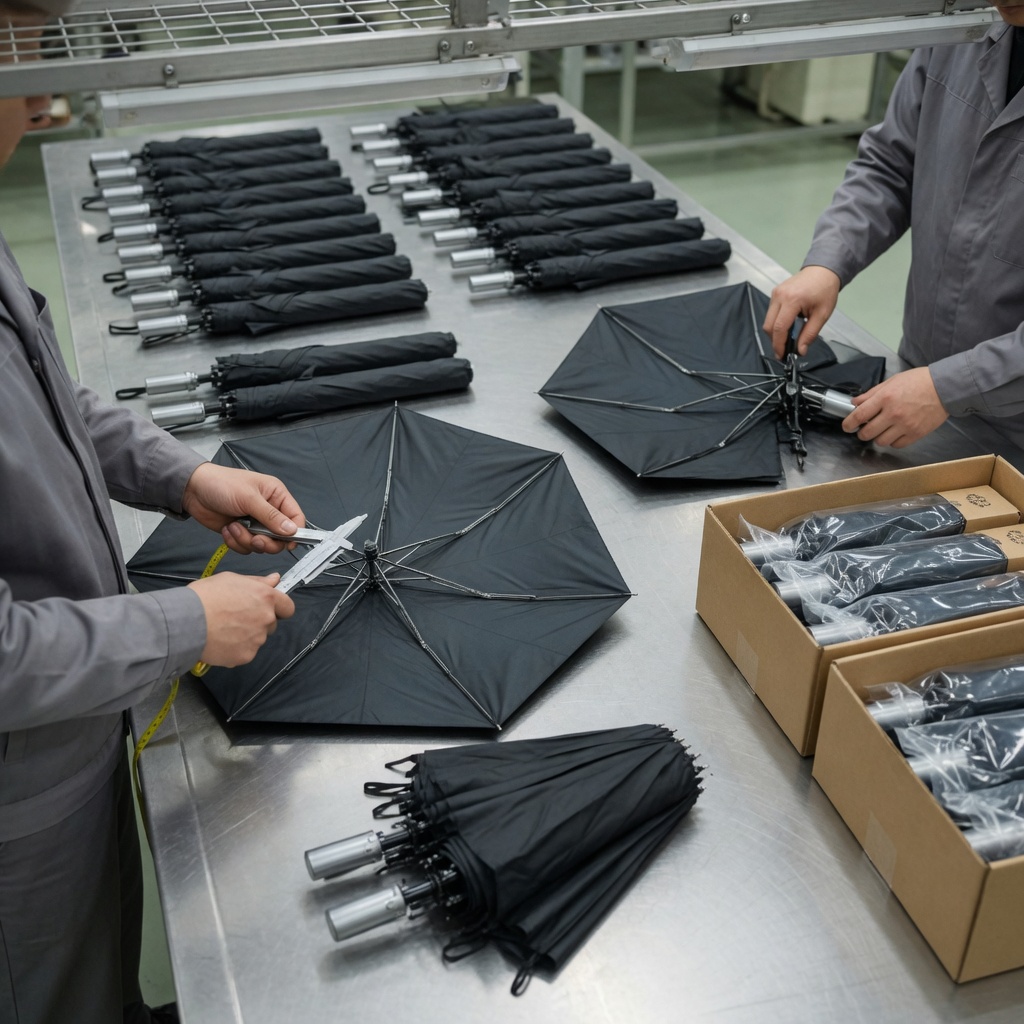
By Vincent Xi, Editorial Author
A European windproof umbrella wholesale program scales only when production scalability planning is a dated, SKU-specific file pack. Catalog adjectives, hall photos, and mixed-range output totals are not that pack. Before a volume purchase order (PO), require written values for factory floor area in the unit the factory prints (m² or sqm), lines assigned to the approved bill of materials (BOM), output in umbrellas per day and per month for that BOM, sample days, mass-production days at the target lot size, stock versus custom minimum order quantity (MOQ), the next peak-season freeze, and the Chinese New Year shutdown for the ship year. Name the country of import in the EU, the EEA, or the UK on the same pack. If any field is missing, hold scale.
Published OEM figures that include windproof umbrellas in range are a screen, not a reserved slot. One Huizhou OEM page states a 5,000 sqm site, 4 production lines, up to 3,000 umbrellas daily, 50,000 folding umbrellas monthly, 500,000 umbrellas annually, sample production in 5–7 days, mass production in 20–30 days depending on quantity, MOQ 100 for stock items, and MOQ 600 for custom orders (World Umbrellas factory page). Scope as published: one named site; area unit is sqm as printed; time unit is umbrellas per day, per month, or per year, and calendar days; MOQ unit is pieces. As-of context: the excerpt used for this article does not state a page date. The same excerpt does not split daily, monthly, or annual output to a windproof-only BOM, so treat those ceilings as site- or mixed-range figures until a quote does. They are not industry averages and not ZheBrella factory claims.
A windproof umbrella wholesaler directory cites manufacturing clusters in Fujian, Guangdong and Zhejiang, a factory-size screening example of 17,000+ m², and on-time delivery of 98.5–100% among “top” listed suppliers (Accio windproof umbrella wholesaler page). As-of context: undated directory copy in the excerpt used here; the on-time range is not a lot-defined audit. Outdoor patio makers stating 45-day bulk cycles, no minimum order quantity, and up to Level 8 wind resistance are a different product system and are not handheld capacity evidence (TEMPO outdoor umbrella manufacturer page).
Production scalability planning for Europe-bound wholesale supply
Production scalability planning for a windproof umbrella wholesale supplier is proving that an approved handheld sample can become repeating, cargo-ready lots at the quantity, construction, and warehouse-in date a named European site requires. Scalability evidence is line time reserved for the contracted rib, canopy, handle, and print BOM; sample days converted to mass-production days at stated lot sizes; a path to add a second lot or colourway without resetting queues; and pack-out plus trade documents the importer of record can use in the destination country.
Usable capacity is packed umbrellas, cartons, and files that can reach a named warehouse in an EU member state, an EEA country, or the UK. A mixed-SKU daily maximum is not usable if printing, QC, or export packing is the constraint.
Measurable trade-off: earlier line reservation can improve on-dock reliability for a named European warehouse-in date and raises inventory and cash risk if sell-through is unproven. Split lots can lower warehouse peaks and add a quality kill-switch after the first inbound; they also add changeovers and extra customs entries. Specify lot size, destination country, Incoterm, and missed-inbound cost in the RFQ before choosing.
Go, hold, or reject before the volume PO
Score RFQ replies against this path. Replace every example figure with quotation figures. Quantity breakpoints used later (1,000 / 5,000 / 20,000 units) are planning assumptions to verify in the supplier quote, not sourced demand.
- Go. Named legal factory; floor area in m² or sqm as the factory prints it; lines for this handheld windproof BOM; umbrellas per day and per month for that BOM; calendar days to ex-works at 1,000 / 5,000 / 20,000 units; packing in cm and kg; documents for the named country of import.
- Hold. Hall-level capacity only; “20–30 days” with no quantity; printing or packing undefined; mixed-SKU output; or “Europe” instead of an EU member state, an EEA country, or the UK.
- Reject for this SKU class. Patio-umbrella cycle times, “no MOQ” language, or Level 8 wind-lab claims copied onto a handheld windproof program (TEMPO outdoor umbrella manufacturer page). Also reject silent substitution after sample sign-off and undated on-time percentages with no lot definition.
How to read factory size, lines, and daily output without mixing product classes
Floor area is a screen, not a certificate. Use it to test volume band, then replace it with line-level evidence for the SKU. Re-verify live page date, legal entity, and SKU fit before any PO.
| Published signal | Figure as stated | Unit | Scope | As-of / dating note | Source | Buyer use |
|---|---|---|---|---|---|---|
| 5,000 sqm factory, 4 lines | Up to 3,000 umbrellas/day; 50,000 folding umbrellas/month; 500,000 umbrellas/year | Area: sqm as printed; output: umbrellas/day, month, year; lines: count | One named Huizhou OEM site; range includes windproof umbrellas; excerpt does not state windproof-only output | Undated in the excerpt used for this article | World Umbrellas factory page | Compare lot size with a stated ceiling; do not treat it as this BOM until the quote splits it |
| Factory-size example 17,000+ m²; clusters in Fujian, Guangdong, Zhejiang | Directory screening plus 98.5–100% on-time for “top” listed suppliers | Area: m²; on-time: percent | Windproof umbrella wholesaler round-up, not a named audit sample | Undated directory copy | Accio windproof umbrella wholesaler page | Larger area may mean more parallel lines; it still does not prove the slot |
| 45-day bulk cycles; Level 8 wind resistance stated | Outdoor/patio umbrella manufacturing | Cycle: calendar days; wind claim: Level 8 as that page states it | Different product class | Undated manufacturer copy | TEMPO outdoor umbrella manufacturer page | Do not copy this cycle or wind claim into a handheld windproof RFQ |
If a Europe program needs 20,000 compact windproof umbrellas in one drop, a site stating 3,000 umbrellas per day has a theoretical 6.7 production days of assembly at that maximum (20,000 units ÷ 3,000 umbrellas/day = 6.7 days, rounded to one decimal place). That is an example calculation to verify in the supplier quote, not a lead time. It excludes fabric, print, QC, packing, shared-line contention, mixed-SKU load, and freight. Do not reconcile the published daily ceiling with the published monthly folding figure or the published annual figure; keep each number inside the scope stated on the page.
Convert size into four written answers: (1) how many lines will run this exact frame, canopy, and handle BOM in the ship week; (2) booked umbrellas/day versus free umbrellas/day for this BOM that week; (3) whether logo or panel printing is in-house or subcontracted, and how many calendar days it adds; (4) packing configuration (units per inner, inners per export carton, carton dimensions in cm, gross weight in kg) and fit to the named European warehouse scan process. Request whether canopy inversion recovery, rib flex, and runner checks are bulk-line standard work or sample-lab only; those names are RFQ specifications, not standards cited on the source pages.
Lead time, MOQ, and customization trade-offs
Wholesale lead time is a stack: material pull, cutting and printing, frame assembly, QC, packing, inland haul to port, main carriage, and destination clearance. The published mass-production window of 20–30 days depending on quantity, taken from the Huizhou OEM page in the table above, covers only the factory portion of that stack (unit = calendar days; scope = that page’s mass-production claim; undated in the excerpt) (World Umbrellas factory page). Sample production stated at 5–7 days on the same page is a development gate, not a replenishment cycle.
MOQ of 100 pieces for stock items and 600 pieces for custom orders on that page shows a common split: repeating an existing construction is easier to slot than a new print, fabric, or handle. Those thresholds are that company’s published numbers, not a market law. A patio-umbrella manufacturer stating no minimum order quantity and 45-day bulk cycles is not a reason to expect zero-MOQ handheld windproof production from an unrelated factory (TEMPO outdoor umbrella manufacturer page).
Put these trade-offs in the RFQ in units a planner can cost:
- Stock versus OEM print. Ask if stock colours can occupy leftover line time; put colour-match and print-position extra days on a separate line.
- One lot versus two. One lot reduces changeovers. Two lots can cut warehouse peak in Europe and stop after the first inbound if inspection fails.
- Quoted days versus reserved capacity. Empty-line 20-day figures are not deposit-locked 20-day figures. Require both.
- Air versus ocean. Price air as a contingency for defined quantity, carton spec, and currency—not as the production scalability planning method.
Require lead time as a function of quantity: calendar days from deposit and artwork freeze to ex-works ready at 1,000 / 5,000 / 20,000 units of the approved SKU, with and without logo print (example quantity breakpoints to verify in the supplier quote). If the supplier will not tabulate that, production scalability planning data is still missing.
Calendar risk for Europe: peak seasons and China production holidays
Treat European sell-through as calendar-sensitive unless the buyer’s own warehouse plan states otherwise. Overlay that plan with China production holidays on one sheet. Scalability planning fails when those calendars are not dated for the ship year.
This article does not have a dated, source-backed table of Chinese New Year shutdown days or European retail peak weeks. Those dates move each year. Obtain in writing for the production year the last cargo-ready date before shutdown; the restart date and any stated weeks of reduced efficiency after restart (ask; do not assume a number); material cut-off dates for fabric and frames; and the required on-dock or warehouse-in date at the specific EU, EEA, or UK location.
Directory copy notes that lead times vary by volume and customization and that larger factories may deliver bulk faster (Accio windproof umbrella wholesaler page). That is a screening remark, not a booking. For Europe-bound ocean freight, add transit, port, and clearance days after ex-works in the logistics quote; do not invent transit times here. Production scalability is not proven until the path from line-off to the named warehouse is dated.
Country distinction, as a procurement control rather than legal advice: an EU member-state import, an EEA import, and a UK import need different documentation packs. Safety marking, chemical information, labelling language, packaging-waste filings, and customs representation can differ by country and are not interchangeable. Do not accept “make it compliant for Europe.” Name the country of import, the importer of record, the Incoterm, and the document list on the PO. Get that list from the importer of record; this article is not the list.
Measurable trade-off: producing six to eight weeks early to beat a holiday shutdown ties up cash and warehouse space in the destination country. The “six to eight weeks” range is a planning assumption to cost in the RFQ (unit: weeks before the named warehouse-in date), not a sourced industry average. Producing through the restart risks missing the same warehouse-in date. Put both costs on one comparison sheet with unit, lot size, and date.
Sample and QC gates before you scale a windproof wholesale lot
Scaling a weak windproof construction multiplies returns and retailer claims in the destination country. Verification belongs before the volume PO. These gates are buyer-specified production scalability planning controls, not factory certifications.
Source-stated methods include wind-tunnel tests, samples, and factory visits as directory verification language (Accio windproof umbrella wholesaler page). An outdoor-umbrella maker cites dedicated labs and a Level 8 wind-resistance claim (TEMPO outdoor umbrella manufacturer page). Those lab claims attach to that company’s outdoor products unless the same protocol is written into the handheld contract.
Do not treat a “windproof” hangtag as a standard. Distinguish a named test method (speed, duration, open/inversion cycles, pass/fail) from marketing language; a standard’s requirement, used only if the standard is named in the contract and a current test report covers the production BOM, from the factory’s own practice; and a passed sample from a bulk lot that uses the same rib count, rib material, joint design, canopy fabric, and stitch pattern. Do not imply certification unless the supplier attaches a current document covering the shipped construction. This article does not assert that any factory is certified.
Gates that protect a European wholesale program, each of which consumes calendar days:
- Golden sample signed for frame geometry, canopy fabric, rib material, and open/close feel.
- Pre-production sample from the actual line tools and print process.
- Written in-process checks for rib-to-joint seating, runner smoothness, canopy alignment, and inversion recovery if that recovery is part of the product claim.
- Finished-unit inspection plan (specify AQL on the PO; this article does not assign an AQL) plus carton and packing checks.
- Retain samples from the first bulk lot held by both parties.
Extra gates add days; skipped gates add claim cost at destination scale.
Decision table: compare wholesale suppliers on production scalability
Use this table to specify, compare, verify, and approve suppliers for a Europe-bound windproof umbrella lot. Replace example figures with quotation figures.
| Decision object | Specify in the RFQ | Compare across suppliers | Verify before PO | Europe-bound implication | Fail-closed if missing |
|---|---|---|---|---|---|
| Daily / monthly output | Lot size and ship week | Umbrellas/day and /month for this BOM | Line list; treat 3,000/day as a quote check only | Can one lot hit warehouse-in | No SKU-specific output |
| Mixed-SKU vs BOM split | Handheld windproof BOM only | 3,000/day or 50,000 folding/month vs a BOM split | Free vs booked output in writing | Mixed gift lines cannot take the slot | Hall total only |
| Factory scale | Handheld class, not patio | 5,000 sqm named site vs 17,000+ m² directory example; line count | Line layout or third-party audit | Peaks may fit a larger site; still confirm the slot | Area without a line |
| Sample vs mass cycle | Artwork freeze; sample and bulk days | 5–7 sample and 20–30 mass days as one published pair; not 45-day outdoor cycles | Print, QC, and pack dependencies | Ocean booking and EU/EEA/UK arrival | “20 days” with no quantity |
| MOQ | Launch vs replenishment qty | Stock 100 vs custom 600 on one page; ignore patio “no MOQ” | Trial lot at stated MOQ | QC test before a season buy | MOQ only in chat |
| On-time | Cargo-ready date | Directory 98.5–100% among “top” suppliers | Lot-defined history and delay terms | Percentages without lots cannot be planned | Percentage only |
| Windproof evidence | Method, speed, cycles, pass/fail | Wind-tunnel or lab language | Report on the production BOM | Lower inbound rejection | “Windproof” with no method |
| Calendar buffers | CNY and peak freeze dates for the ship year | Dated shutdown and restart | Holiday calendar and material cut-off | Arrival windows | On-time slogans |
| Line reservation | Deposit date locking the ship week | Empty-line days vs reserved days | Booked vs free output calendar | Brochure cycle becomes a dated slot | Week not reserved |
| Documents | Country of import, Incoterm, carton marks | Invoice, packing list, origin, chemical/safety files | Importer of record review | EU, EEA, and UK packs differ | Generic “Europe docs” |
RFQ checklist for windproof umbrella wholesale supply
Copy these items into the RFQ. Require dated answers on supplier letterhead for a Europe-bound lot.
- SKU family: Handheld windproof umbrella (folding or stick, rib count, rib material, canopy fabric, size). Exclude patio umbrellas from the same capacity quote.
- Destination: Named country and site in the EU, EEA, or UK—not “Europe.”
- Lot plan: Units per lot, number of lots, cargo-ready date, warehouse-in date.
- Factory identity: Legal name, address, floor area (m² or sqm as stated), line count, and which lines run this BOM.
- Output model: Umbrellas per day and per month for this BOM; booked versus free capacity in the ship week. Reject mixed-SKU hall totals as this SKU’s capacity.
- Lead-time table: Calendar days from deposit plus artwork freeze to ex-works at 1,000 / 5,000 / 20,000 units (example breakpoints), stock versus printed, including QC and packing.
- Line reservation: Deposit amount, currency, and date that locks the ship week; slot treatment if artwork or materials are late.
- Sample path: Days and cost for development and pre-production samples; material differences versus bulk.
- MOQ: Stock versus custom/OEM versus reprint; whether mixed colours share an MOQ.
- Changeover: Extra calendar days to add a second lot or colourway; shared cutting and print queues.
- Holiday and peak calendar: Next Chinese New Year shutdown and restart; extra freezes; last PO date to ship before shutdown.
- Windproof verification: Test method, equipment, parameters, and whether the report covers the bulk BOM. Attach current documents only.
- QC plan: In-process checks; final inspection level (specify AQL); location; internal versus third-party payer; retain-sample policy.
- Packing: Units per inner, inners per carton, outer dimensions (cm), gross weight (kg), label placement, warehouse pallet versus carton-only rule, destination-country care language.
- Materials: Canopy fabric, rib material, coatings, and restricted-substance declarations the importer requires for that jurisdiction.
- Incoterm and logistics: Named term and port; who books main carriage; importer of record; air recovery as a priced contingency, not the default plan.
- Document pack: Commercial invoice, packing list, origin, and extra statements for the named EU member state, EEA country, or UK, listed separately.
- Change control: Approval path for rib, fabric, or print substitution; ban on silent substitution after sample sign-off.
- Failure and delay: Definition of late cargo-ready and inspection fail; remedy (rework, air upgrade, lot rejection).
- Trial order: First lot quantity to approve before the seasonal scale-up PO.
- Production contact: Named planner (not only a salesperson) and response time in the production window.
- Quote validity: Date, currency, unit-price basis, and which capacity figures expire when the booking calendar fills.
Do not issue a volume PO until items 4–13, 17, and 20 have dated, SKU-specific answers.
Source context, methodology, and what to verify
Source contexts. (1) A China OEM factory page publishing site area, line count, daily/monthly/annual umbrella output, sample and mass-production days, and MOQs, with windproof umbrellas in range (https://www.worldumbrellas.com/our-factory). (2) A windproof umbrella wholesaler directory describing Fujian, Guangdong and Zhejiang clusters, factory-size screening (17,000+ m² example), on-time delivery claims, and verification via wind-tunnel tests, samples, and visits (https://www.accio.com/supplier/windproof-umbrella-wholesaler). (3) An outdoor umbrella manufacturer page used only as a contrast on bulk-cycle length, MOQ language, and wind-lab claims for a different product class (https://tempooutdoor.com/outdoor-umbrella-manufacturer/).
How the data was derived. Numbers were taken from the supplied page excerpts, kept inside the named company or directory scope, and not averaged across factories. Daily, monthly, and annual figures from the same OEM page were not combined into a new metric and were not treated as windproof-only output. The 6.7-day theoretical assembly example (20,000 units ÷ 3,000 umbrellas/day = 6.7 days) is an example calculation to verify in the supplier quote, not a promised lead time. Quantity breakpoints of 1,000 / 5,000 / 20,000 units and the six-to-eight-week early-production buffer are planning assumptions to cost in the RFQ. Calendar-risk and EU/EEA/UK document points are procurement-process controls for European buyers; they are not copied from a regulation text in the excerpts.
Limitations / what to verify. Excerpts are undated; capacity, MOQ, and lead time change with bookings, materials, and holidays. Directory on-time percentages are not lot-defined audits, and outdoor-umbrella data must not be applied to handheld windproof umbrellas. Site-level output is not a reserved windproof BOM. This article does not assign factory capabilities, prices, certifications, test results, or customer outcomes to ZheBrella or to any supplier beyond the cited pages. Confirm product, chemical, packaging, and customs rules with the importer of record for the specific country of import; an EU rule is not automatically an EEA or UK rule, and member-state filings can still differ. Re-read live supplier pages, request a dated capacity letter, and inspect sample and bulk units on the actual BOM before approving scale.
Editorial responsibility: Vincent Xi, Editorial Author (author profile). No factory-visit, laboratory, or first-person production experience is claimed.
Discuss Your Requirements
Review our manufacturing capabilities, then share your specifications for a supplier-fit review.