Doorman and Valet Umbrellas: Specifying Large-Format Umbrellas
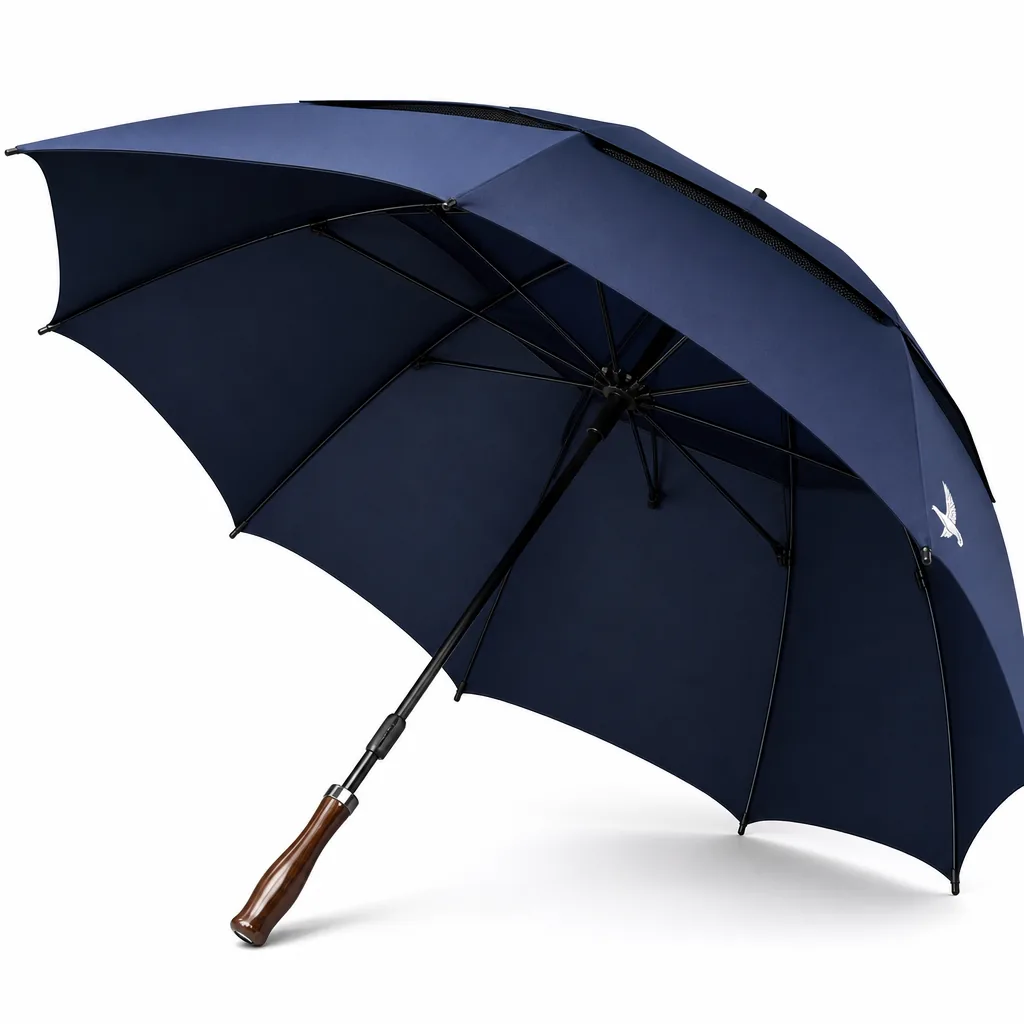
Hotels and venues do not need a generic umbrella; they need a reliable doorman umbrella that can cover guests, luggage, and curbside movement without failing in wind or looking sloppy at the entrance. From the factory floor, the real issues are frame strength, canopy span, seam loading, and how cleanly logos hold up after repeated use. The right spec balances oversized coverage, durable construction, and branding that still looks sharp after heavy service.
Why doorman umbrellas are a distinct product
A doorman umbrella is not just a larger version of a hotel umbrella; it is a different stress case. The canopy has to cover two people, luggage, and the door threshold without turning into a sail the first time a gust hits a curbside entrance. In practice, that means 27-inch and 30-inch sizes, longer shafts, and a wider open arc than a standard promotional umbrella. For a valet umbrella, the balance matters as much as the span. If the frame is too light, it feels flimsy in hand; if it is too heavy, staff stop carrying it. The right build usually pairs fiberglass ribs with a reinforced steel or fiberglass shaft, plus an auto-open or auto-open-close mechanism that survives repeated daily cycling at a hotel entrance.
Durability is the real separator for a large umbrella supplier. A doorman umbrella sees wet hands, constant opening and closing, knocks against door frames, and storage in a rack where the tips and ferrules get abused. Cheap 190T polyester and thin wire frames do not hold up here. For heavy-use programs, I prefer 210T pongee with Teflon water-repellent treatment, stitched with reinforced tip pockets and rib joints designed for high-cycle fatigue. Wind resistance is also not optional; a vented double-canopy layout can help the umbrella dump pressure instead of inverting. On a production line, we look at rib count, ferrule reinforcement, and panel tension, because these details decide whether the umbrella makes it through a season or comes back in a week.
An oversized umbrella manufacturer has to think beyond the canopy diameter and specify the whole system: handle ergonomics, shaft wall thickness, runner quality, and the way the frame transfers load into the tips. A 16K or 8K frame can be appropriate depending on the diameter and wind target, but the point is not the count alone; it is whether the structure stays stable under repeated use at a doorway, parking stand, or event entrance. For hotel and transportation buyers, MOQ, FOB or DDP terms, and lead times matter because these programs are usually reordered in batches and need consistent color and print matching. Our standard practice is to quote AQL 2.5 for inspection and test the finished build for opening force, tip pull, and canopy recovery, because a valet umbrella that cannot survive daily service is just expensive scrap.
Sizing for two-person coverage
For two-person coverage, the first spec I look at is arc size, not just diameter on paper. A 21" or 23" stick umbrella is fine for one person, but a true doorman umbrella usually starts at 27" and often goes to 30" with a full arc around 60 to 68 inches. That extra spread matters when a guest is walking beside staff at the curb, because shoulders and bags take up more room than most buyers estimate. If the canopy is too small, the person holding it ends up dry while the second person gets edge spray. For hotel entrances, valet lanes, and country-club drop-offs, the practical target is enough clearance for two adults at a normal walking pace, with the canopy low enough to block rain yet high enough that taller users do not hit the top edge.
Size alone is not enough if the frame folds under wind or the canopy sags. For this category, I prefer fiberglass ribs, a steel shaft, and 190T or 210T pongee with a water-repellent coating; that combination gives better coverage than a cheap PVC sheet that flaps and drips. A double-canopy vented build helps when the umbrella is opened near revolving doors or in gusty parking areas, and auto-open-close is useful for valet workflow because one hand is usually carrying keys or a ticket sleeve. As a large umbrella supplier, we treat the handle profile and shaft length as part of the coverage spec, because a doorman umbrella that is too short forces awkward posture and reduces usable canopy area. For buyers comparing an oversized umbrella manufacturer, ask for the actual open arc, not just the size label, and verify the sample with two adults under it before approving MOQ or production.
Frame strength for constant use
For a doorman umbrella or valet umbrella that gets opened and closed all day, the frame has to be built around fatigue, not just first-impression stiffness. Fiberglass ribs are the right default because they flex under gust load and return without taking a permanent set, which is exactly what you want when the umbrella is being handled by bell staff, parking attendants, or front-desk teams with no time to baby the product. On larger 21" to 30" formats, I prefer reinforced fiberglass on the main ribs and stretchers, with a thicker steel or alloy shaft only where the torque is highest. A plain steel rib can feel solid on day one and still fail early at the ferrule or joint after repeated cycles. The real test is not static strength; it is whether the frame survives thousands of open-close motions and still tracks straight under wind.
For a large umbrella supplier or oversized umbrella manufacturer, the frame spec should call out more than material names. Ask for rib count, wall thickness, joint design, and corrosion protection, because those details decide whether a canopy lasts through constant lobby use or starts wobbling after a few months. On big golf-style and doorman formats, 8K or 10K ribs are often too light for daily commercial handling; reinforced 16K structures, double-canopy venting, and resin-reinforced hubs are more realistic when the umbrella must survive rough handling and gusts above 50 mph. Our standard practice at ZheBrella is to specify fiberglass at the flex points, extra stitching at the rib tips, and rounded end caps to reduce canopy wear. That approach costs more than a basic frame, but it cuts breakage, returns, and replacement cycles in the field.
Branding for venues
For a doorman umbrella, logo placement matters more than most buyers expect because the canopy is read from several meters away and usually in motion. The cleanest option is one-color print on a single panel facing the curb, sized so the mark stays legible when the umbrella is wet and slightly curved. If the property needs stronger visibility, repeat the logo on two opposite panels, but keep the artwork simple; fine lines and small text disappear on a 30-inch or 32-inch canopy. A valet umbrella for a hotel or restaurant should also consider where staff actually hold it during guest service, because the handle, sleeve, and tie strap are part of the brand presentation. Our standard practice is to confirm print position against an opened canopy mockup before production, especially when the order uses auto-open-close mechanisms or a vented double-canopy frame that changes panel geometry slightly.
Color matching should be treated as a production spec, not a design preference. If a property uses a dark navy, charcoal, burgundy, or forest green identity, the canopy fabric should be matched against a Pantone target under daylight, then checked again under indoor light so the shade does not drift toward blue, brown, or purple. A large umbrella supplier should ask whether the buyer wants the frame to disappear visually or stand out as part of the look; black fiberglass ribs and a matte black shaft are usually safest for upscale venues, while brushed silver can work for modern properties. For an oversized umbrella manufacturer, the bigger risk is dye lot variation across multiple cartons, so we lock the fabric lot before cutting and keep trim, sleeve, and logo ink aligned to the same color standard. That is what keeps a branded doorman umbrella consistent across a full property rollout, not just on the first sample.
Quantity and replacement planning
For a high-turnover doorman umbrella program, I do not treat replacement stock as a nice-to-have; it is part of the working inventory. A practical starting point is to hold 10-15% extra units over live deployment, then raise that to 20% if the umbrellas are being checked in and out daily at a hotel, restaurant, or club. The real loss drivers are not dramatic failures. They are bent tips from car doors, snapped ribs from being shut in a hurry, broken ferrules, and handles that get scarred or separated during storage. A valet umbrella with a 27" or 30" canopy usually sees more abuse than a guest-room model, so the buffer should reflect traffic, not just purchase price. If the front desk issues 50 umbrellas a month, a spare pool of 8-12 units is usually too thin once you include weather spikes and slow returns.
Replacement planning works better when you standardize the build instead of buying mixed lots. Keep the same shaft diameter, ferrule style, handle attachment, and canopy size across the program so you can cannibalize components when needed. In practice, a large umbrella supplier should be asked for repair-friendly construction: fiberglass ribs over thin steel where wind is a concern, reinforced tips, and panels cut in the same 190T or 210T pongee across replenishment orders. That matters because a doorman umbrella that looks identical on the floor but uses a different rib geometry is harder to keep in service. Our standard practice is to separate stock into three buckets: active use, immediate spare, and reserve for seasonal spikes. The reserve lot should be boxed, labeled by PO, and checked every 6-12 months for handle cracking, canopy delamination, or mold from poor storage.
For procurement, the trigger point is usually before failure becomes visible to guests. An oversized umbrella manufacturer should quote not just the production lead time, but the replenishment cycle after approval, because you may need 30-45 days for repeat runs and longer if you are changing print, handle color, or canopy fabric. Keep the reorder point above your monthly breakage rate plus one delivery cycle, and do not rely on a tight MOQ if the umbrellas are used in a public-facing role where appearance matters. I would also insist on AQL 2.5 inspection for replacement lots, since small defects are more noticeable on large canopies and straight shafts. ZheBrella typically advises buyers to lock one spec sheet for the main fleet and one for emergency replacement, so the second batch can move fast without reworking artwork or hardware.
Frequently Asked Questions
What size is a doorman umbrella?
Doorman and valet umbrellas are oversized - often a 30-inch rib length or larger, with a wide arc that covers two people. The goal is to shelter a guest and staff member together at an entrance.
How durable do valet umbrellas need to be?
Very. They are opened and closed constantly in all weather, so specify fiberglass ribs, a reinforced frame, and a reliable mechanism. Plan buffer stock for replacements given the heavy duty cycle.
What canopy size is most practical for hotel doorman and valet use?
For most hotel entrances, a 60 to 68 inch arc works well because it covers one guest plus luggage without crowding the doorway. If the stand area is narrow, a slightly smaller 58 to 62 inch model is easier for staff to maneuver.
What build specs should a B2B buyer request for outdoor valet umbrellas?
Ask for fiberglass or reinforced metal ribs, a vented canopy, and a fiberglass or hardwood shaft if the umbrella will stay at the entrance all day. For high-traffic locations, buyers often specify 8 to 16 panels, a rubberized grip, and canopy fabric such as pongee or polyester with water-repellent coating.
What are typical MOQ and lead times for custom branded large umbrellas?
For OEM or ODM production, MOQ is often 100 to 300 units per color or design, depending on frame and print complexity. Sample lead time is usually 7 to 10 days, and bulk production commonly runs 30 to 45 days after artwork and order confirmation.
Looking to Launch Your Custom Umbrella Line?
ZheBrella is a Zhejiang-based OEM/ODM umbrella manufacturer with 17 years of export experience. Free design, low MOQ from 100 pieces, windproof construction, full-color print.
Get Free Quote Now »People Also Search For
Related Articles
Golf Umbrella Manufacturer in China: 27" vs 30" Canopy Comparison
Detailed comparison of 27-inch and 30-inch custom golf umbrellas from a Chinese OEM factory - canopy coverage, weight, b...
Read More »
Two-Person Oversized Umbrellas: Coverage Without the Bulk
How two-person oversized umbrellas balance wide coverage with manageable weight and wind handling, and how to source the...
Read More »
Wooden Stick Umbrellas for Premium Retail and Hotel Programs
Choose wooden stick umbrellas for hotels and retail with the right shaft, handle, rib material, canopy fabric, logo meth...
Read More »