Branded Umbrellas for Insurance Claims and Agent Teams
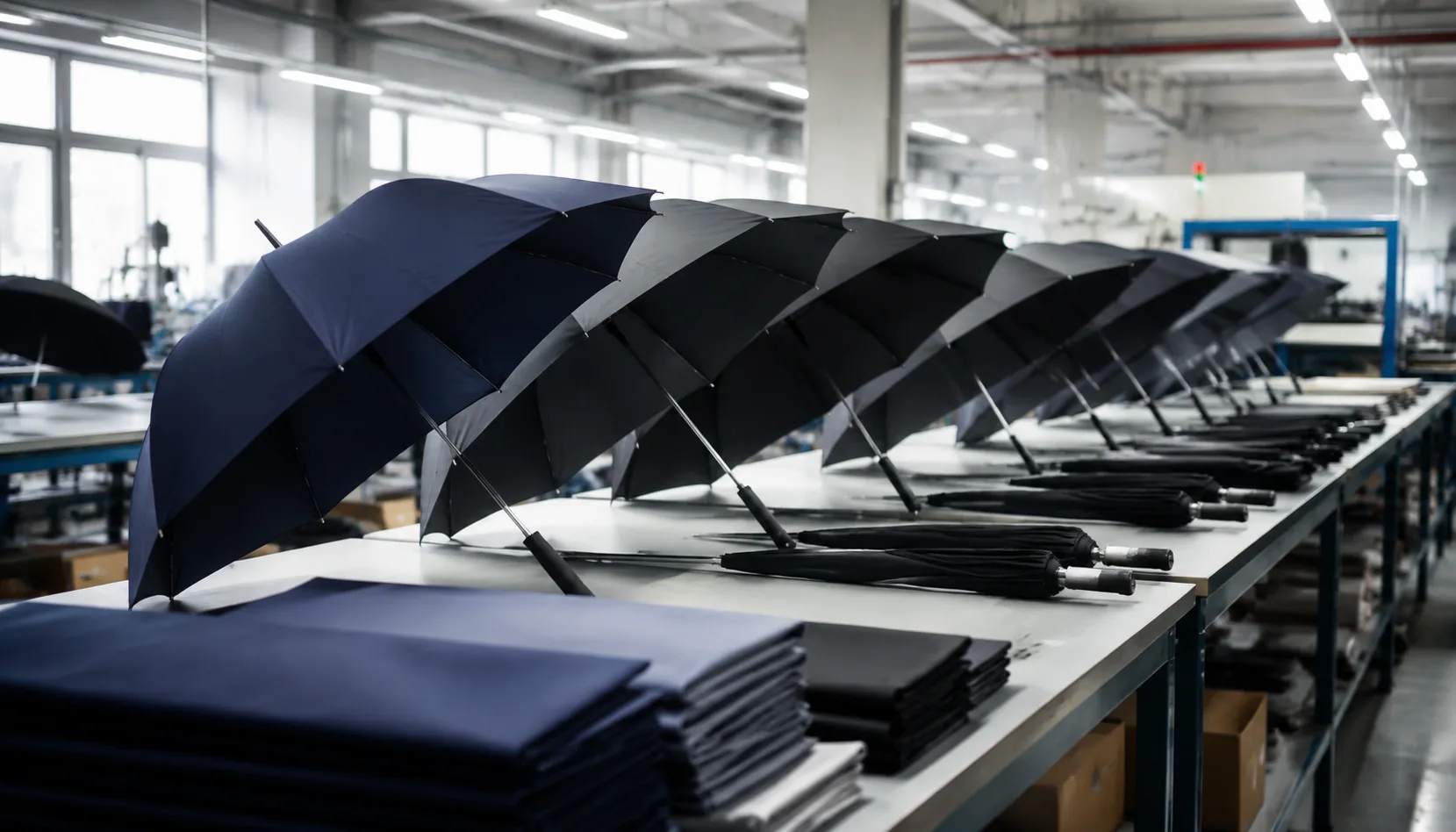
Storm season puts adjusters and agent teams in the field when cheap promo umbrellas fail fastest: bent ribs, leaking seams, late deliveries, and inconsistent logo color all show up in front of policyholders. When sourcing branded umbrellas for insurance programs, the spec needs to be built like a working tool—190T pongee, fiberglass frame choices, print tolerance, carton strength, MOQ planning, AQL inspection points, and realistic DDP timing all decided before production starts.
Why Insurance Teams Use Umbrellas Differently
Insurance teams do not use umbrellas like a hotel or a golf tournament does. A field adjuster needs a tool, not a souvenir: usually a 27" or 30" stick umbrella, 8K or 10K fiberglass ribs, straight EVA or rubberized handle, and 190T or 210T pongee with a water-repellent coating that sheds rain while both hands are busy checking shingles, siding, gutters, or vehicle damage. Claims adjuster umbrellas also need darker canopy colors, because mud, roof grit, and wet ladder contact make white panels look old after one storm week. I would avoid cheap steel ribs for this group unless the use is strictly short-term; in coastal or hail-prone territories, a double-canopy vented windproof build rated around 50+ mph is a more practical specification than a fancy handle or oversized logo.
Agents visiting clients have a different requirement: they need something clean, compact, and brand-correct that can sit in a car door pocket or briefcase. For logo umbrellas for agents, 21" or 23" auto-open-close folding models with fiberglass ribs, black electroplated shafts, and 190T pongee usually balance price and presentation well. Insurance agency promotional umbrellas for client visits often use one or two logo panels, not full-canopy printing, because small type on curved fabric gets distorted and becomes hard to read from across a parking lot. For branded umbrellas for insurance, the better branding decision is usually a high-contrast logo on navy, black, gray, or deep red fabric, with optional reflective piping if agents are working evening appointments after storms.
Volume planning should start with branch count, territory climate, and reorder rhythm, not a random promotional quantity. A small agency with 12 agents may only need 300–500 pieces for client giveaways before rainy season, while a regional carrier with 40 branches and active catastrophe response teams may need 5,000–20,000 pieces split between adjuster-grade stick umbrellas and lower-cost customer gifts. Storm season umbrella sourcing also has a timing problem: if you wait until the first named storm, production slots, fabric dye lots, and FOB vessel space tighten fast. Our standard practice at ZheBrella is to lock artwork and AQL 2.5 inspection criteria before mass production, then plan 25–35 days for standard logo umbrellas and 40–55 days for custom colors, vented canopies, or multi-SKU branch allocations.
Choosing Specs for Field Reliability
For agent teams, the practical spec is usually a 21" or 23" compact auto-open umbrella, not a heavy golf model. Agents keep these in a car door, briefcase, or reception closet, so folded length, one-hand deployment, and clean logo placement matter more than maximum span. I prefer fiberglass ribs over thin painted steel ribs on compact insurance agency promotional umbrellas because fiberglass recovers better after a gust and reduces rib-tip failures after repeated wet-dry cycles. A steel shaft is still acceptable in this category if the wall thickness is honest; the problem is bargain shafts that bend after one storm appointment. For branded umbrellas for insurance, 190T pongee is the minimum I would quote for frequent field use, with 210T pongee preferred when the logo needs sharper screen printing or heat-transfer edges. Avoid cheap polyester that feels papery; it wrinkles badly, leaks sooner at stitch lines, and makes even a good logo look disposable.
Claims adjusters need a different tool because they stand in open driveways, on roofs, beside vehicles, and at loss sites where wind exposure is worse. For claims adjuster umbrellas, I would move to a 27" or 30" stick umbrella with an 8K frame for standard use, or a 16K frame when the buyer expects storm season deployment across multiple branches. The extra rib count spreads canopy tension more evenly, which helps the umbrella hold shape when an adjuster is reviewing hail damage or photographing a roof edge. A straight steel shaft gives better rigidity than many lightweight aluminum shafts, but the ribs should be fiberglass or a fiberglass-steel hybrid to prevent permanent deformation. If the umbrella is intended for storm season umbrella sourcing, specify a double-canopy vented windproof construction; the vent lets pressure escape instead of turning the canopy inside out. A realistic wind-tunnel target is survival at 50+ mph, not a vague “windproof” label.
The canopy fabric is where many promotional orders get underbuilt. For logo umbrellas for agents, 190T pongee with a water-repellent coating is fine for handouts and daily appointments, but adjuster programs should use 210T pongee because it has a tighter hand, better drape, and stronger perceived value when carried in front of policyholders. If sun exposure matters during catastrophe response, add a black inner coating or UPF 50+ UV treatment; if the order is mostly rain use, a Teflon-style water-repellent finish gives faster dry-down before the umbrella goes back into a vehicle. Our standard practice at ZheBrella is to pair compact auto-open models with 8 ribs and stick adjuster models with 8K or 16K frames, then inspect opening force, rib alignment, seam leakage, and print adhesion under AQL 2.5 before packing. That spec split keeps branded umbrellas for insurance useful in the field instead of becoming another forgotten giveaway.
Branding That Supports Trust and Visibility
For branded umbrellas for insurance programs, logo accuracy matters because the umbrella often appears at the exact moment a customer is stressed: after hail, wind, flooding, or a roadside incident. We normally start with Pantone PMS matching on a 190T or 210T pongee strike-off, because navy, red, and gray agency colors can shift badly when printed on wet-look fabric. Screen printing is still the cleanest option for one- to three-color marks on 23" and 27" stick umbrellas, while heat transfer handles gradients, small type, and multicolor carrier logos better. For executive agent kits, a woven label on the closure strap or sleeve gives a more retail feel without overcrowding the canopy. Insurance agency promotional umbrellas should not look like giveaway junk; crooked logos and weak ink coverage reduce trust before anyone reads the policy number.
Claims adjuster umbrellas need visibility first, decoration second. For roadside inspections, CAT response, and storm season umbrella sourcing, I prefer reflective piping along the outer canopy edge, not just a small reflective patch, because drivers see the moving outline from more angles in rain. A 27" or 30" umbrella with fiberglass ribs, a steel shaft, and an auto-open runner gives adjusters one-hand operation while carrying a tablet, ladder hook, or claim folder. If the team works in high-wind zones, use a double-canopy vented windproof frame rated around 50+ mph instead of a cheap 8K straight steel frame. Reflective tape can be sewn into alternate panel seams, but it must be checked after stitching so it does not pucker the canopy or distort the panel shape.
Panel layout decides whether logo umbrellas for agents stay visible once the umbrella is actually in use. A single top-panel logo often disappears when the user tilts the canopy forward, so we usually place the main mark on two opposite outer panels, with a smaller claim hotline, QR code, or agency branch name on a lower-facing panel. On 8K umbrellas, alternating logo panels keep cost controlled; on 16K golf umbrellas, repeated marks can look premium if spacing is disciplined and the artwork does not cross rib seams. For branded umbrellas for insurance, avoid printing too close to the panel edge because rain runoff, seam tension, and folding pressure can wear heavy ink faster. Our standard practice at ZheBrella is to approve a pre-production sample under AQL 2.5 checks for logo position, PMS tolerance, adhesion, seam alignment, and sleeve labeling before bulk production.
Procurement Timing for Storm Seasons
Storm season buying has to be scheduled backward from the first week agents or adjusters will actually carry the umbrellas, not from the date the marketing team approves artwork. For branded umbrellas for insurance, I normally tell buyers to lock specifications 75 to 110 days before hurricane season, monsoon fieldwork, or winter-rain campaigns. A realistic factory clock is 3 to 7 days for artwork layout, 5 to 10 days for a printed sample if the logo placement is new, then 30 to 45 days of bulk production after sample approval. That production window covers frame assembly, canopy cutting, panel printing, sewing, final packing, and AQL 2.5 inspection. If the order uses 190T or 210T pongee with one-position screen printing, timing stays predictable. If it uses full-panel sublimation, reflective strips, UPF 50+ coating, or mixed models such as 23 inch auto-open sticks plus 21 inch auto-open-close folders, add buffer because material batching and print alignment take longer.
Freight is where many insurance agency promotional umbrellas miss the weather window. Ocean freight to the U.S. or Europe commonly adds 25 to 40 days port-to-port, and DDP delivery can stretch the total transit period to 35 to 55 days once customs clearance, domestic trucking, and appointment delivery are included. Air freight can rescue small lots of logo umbrellas for agents, but it is expensive and not ideal for 27 inch or 30 inch golf umbrellas because carton volume is high. For storm season umbrella sourcing, split shipments are often smarter: air ship 5% to 10% for early claims teams, then move the balance by sea. Claims adjuster umbrellas should be ordered before forecasts become headline news, because the same factories are also receiving retail rainwear and emergency-supply orders. Our standard practice at ZheBrella is to confirm carton marks, spare parts, and inspection criteria before production starts, because fixing those details after packing can cost a full week.
Quality Control and Distribution Planning
Quality control matters more on insurance agency promotional umbrellas than on most giveaway items because they are handed out when the weather is already bad. For branded umbrellas for insurance programs, I would not approve shipment without an AQL 2.5 final inspection covering five points: auto-open function, rib strength, print adhesion, seam leakage, and carton drop checks. On auto-open models, inspectors should cycle the button and runner at least 3 times per sampled unit and reject sticky springs, weak lock-up, or handles that separate under pull. For ribs, steel is acceptable for budget 23" straight umbrellas, but fiberglass ribs and stretchers are better for claims adjuster umbrellas because they tolerate gusts and car-door abuse. We normally bend-test sampled 8K or 10K frames, check rivet tightness, and open the canopy fully to catch twisted ribs before packing.
Print and canopy inspection should be stricter when the umbrella carries an agency logo, carrier name, phone number, or claim hotline. Screen prints on 190T or 210T pongee should pass a cross-hatch tape test after curing; heat-transfer logos need edge-lift checks around curved panels, especially on dark fabric where thicker ink layers are common. Seam leakage is tested by spraying the top seam and panel joints, not just the middle of the canopy, because water usually enters at the crown, tips, or poorly tensioned stitching. For storm season umbrella sourcing, I prefer Teflon-coated pongee for daily agent use, while PVC or POE clear umbrellas need extra attention for cold-crack risk and print scuffing. Carton drop checks should include corner, edge, and face drops, then a review of bent shafts, cracked tips, crushed handles, and wet-barcode readability.
Distribution planning should be locked before production, not after cartons are sealed. MOQ usually breaks into practical tiers: 500 pieces for a single logo and stock color, 1,000 to 3,000 pieces for custom panel colors or mixed branches, and 5,000+ pieces when you want private-mold handles, 16K windproof frames, or multi-location kitting. Branch-level carton marking is worth the small admin cost: carton labels should show branch code, agent team, SKU, color, quantity, gross weight, and destination address so a claims office in Florida does not receive stock meant for a Midwest renewal event. FOB Ningbo or Shanghai gives buyers control of freight and insurance, but DDP is cleaner for logo umbrellas for agents shipping to many offices because landed cost, duties, and last-mile delivery are bundled. The tradeoff is simple: FOB is cheaper for experienced importers; DDP reduces surprises for distributed insurance teams.
Frequently Asked Questions
What umbrella size works best for claims adjusters?
A 23-inch or 27-inch 8K stick umbrella gives better coverage for site inspections than a compact model. For wind-prone areas, specify fiberglass ribs and a double-canopy vented design.
Can each regional office receive different logo or address details?
Yes, but each artwork variation may affect MOQ and setup cost. Buyers should consolidate shared canopy colors and vary only one panel imprint when possible.
What umbrella specs work best for insurance adjusters in storm season?
For field use, most buyers choose 190T pongee canopies, fiberglass ribs, and an EVA or rubber grip for wet handling. A 23-inch or 25-inch automatic open model is common because it balances coverage and portability.
What MOQ is typical for logo umbrellas for agents?
For factory OEM orders, MOQ is often 500 to 1,000 pieces per color or design, depending on the umbrella style and print method. Multi-color branding or mixed sizes can raise the MOQ slightly.
How should AQL checks be set for a branded umbrella shipment?
Many importers use AQL 2.5 for major defects and 4.0 for minor defects on a pre-shipment inspection. Focus checks on canopy print alignment, rib tension, opening/closing function, and water resistance.
Looking to Launch Your Custom Umbrella Line?
ZheBrella is a Zhejiang-based OEM/ODM umbrella manufacturer with 17 years of export experience. Free design, low MOQ from 100 pieces, windproof construction, full-color print.
Get Free Quote Now »People Also Search For
Related Articles
Branded Umbrellas for Insurance Agencies and Claims Teams
Plan umbrella programs for insurance agencies, adjusters, and storm-season clients with durable specs, tiered MOQs, and ...
Read More »
Custom Umbrellas for Insurance Agencies and Claims Teams
Source insurance-agency umbrellas for storm claims, branch giveaways, and adjuster kits with durable specs, AQL checks, ...
Read More »
Custom Umbrellas for Insurance Agencies and Broker Networks
Plan umbrella programs for insurance agencies with practical specs, MOQ, branding options, lead times, and reorder model...
Read More »