Branded Umbrellas for Parking Operators and Valet Teams
Parking operators and valet managers need umbrellas that do more than carry a logo: they have to survive constant open-close cycles, stay visible under headlights and rain, and look consistent across shifts and locations. On our Songxia factory floor, the failures usually trace back to rib gauge, runner fit, canopy tension, and weak reflective trims, which is why valet team branded umbrellas have to be specified as working equipment, not giveaway merchandise.
Service Moments Where Valet Umbrellas Matter
The umbrella earns its keep at the guest handoff, where service is judged in seconds and usually in bad weather. At the curb, a weak 21-inch promo model with steel ribs that inverts or sticks under load makes the operation look improvised. For hotel valet umbrellas and parking operator umbrellas, the practical spec is usually a 27-inch or 30-inch straight umbrella with an 8K fiberglass frame, EVA handle, and 190T or 210T pongee canopy finished with a Teflon water-repellent coating. That build gives attendants real coverage during door opening, key exchange, and receipt handoff without the bent-rib failures common in low-cost steel frames. If the property has crosswind between porte-cochere columns or open drive lanes, a vented double-canopy design rated for 50+ mph is a better buy than replacing broken umbrellas mid-season. That is the point of valet team branded umbrellas: not decoration, but durable weather equipment that guests see at the exact moment they decide whether the arrival process feels controlled.
Curbside payment, shuttle loading, and event parking change the requirement from simple coverage to one-handed usability and visibility. Staff need to hold a card terminal, radio, ticket stack, or luggage handle, so auto-open is usually the lowest-risk mechanism; auto-open-close shafts add parts and typically drive more return claims in hard fleet use. For shuttle stops and overflow fields, branded valet umbrellas also work as wayfinding. A clear logo and high-contrast canopy help guests find the queue in rain or low light, when fixed signage disappears behind vehicles. Bright pongee canopies generally stay cleaner and present better in fleet service than translucent POE or PVC, while UPF 50+ coating matters on summer asphalt where attendants stand for hours. Most bulk umbrellas for parking services are ordered in runs of 100 to 500 pieces per colorway so hotel, casino, and event contracts can keep branding separate without overbuying.
The highest ownership cost usually comes after the curb: staff movement between lots, shared shift use, and preventable breakage. When attendants carry umbrellas through doors, lean them against podiums, and pass them between crews, fiberglass ribs recover from flex while cheap steel ribs stay bent, abrade the canopy, and start seam failure at the tip pockets. That is why inspection discipline matters more than premium trim. AQL 2.5 final inspection, repeated open-close cycle checks, print adhesion review, and ferrule alignment checks catch the runner and frame issues that show up fast in high-turn service teams. Custom screen-printed valet team branded umbrellas typically run 25 to 35 days after artwork approval. FOB Ningbo remains standard for importers; DDP is the practical option when cartons need to land directly at a hotel group or parking contractor warehouse. For buyers, the umbrella does two jobs at once: it protects the guest and makes the service team visible, which reduces operational friction and signals control at the curb.
Choosing Frames for Daily Curbside Use
Frame material decides service life for daily curbside use. A valet can open and close the same umbrella 80 to 150 times in one shift, so rib fatigue matters more than handle shape or canopy color. For valet team branded umbrellas used between the porte cochere, garage entrance, and vehicle drop-off, fiberglass ribs outperform plated steel in repeated flex cycles and in crosswinds. Fiberglass bends and rebounds; thin steel ribs on low-cost compact frames are more likely to take a permanent bend at the stretcher joints, then start dragging or fail to close cleanly. The practical spec for guest escorting is a 21-inch or 23-inch auto-open compact with 8K or 10K ribs and either full fiberglass ribs or a fiberglass-steel hybrid frame. That raises unit cost versus a basic steel frame, but it cuts the failures buyers notice first: bent runners, broken tips, and compacts that jam after a week of rain. For parking operator umbrellas, 8K or 10K is the minimum worth quoting for this job; fewer than 8 ribs usually means a less stable canopy in wind and a bulkier, less controlled fit around car doors and tight loading lanes.
Wet storage is where steel frames lose most of the cost argument. Steel can still work if rib wire diameter is consistent, electroplating is even, and staff are not leaving soaked umbrellas in sealed stands or trunks for hours, but standing water at the runner, top notch, and rib joints will eventually produce orange rust and a gritty opening action. Fiberglass does not rust, so branded valet umbrellas and hotel valet umbrellas kept in damp curbside stations usually stay cleaner and open more smoothly after 30 to 60 days of real use. Pair the frame with a 190T or 210T pongee canopy and a Teflon water-repellent finish; that daily-use build is usually a better investment than adding extra mechanisms. Auto-open shafts are the safer choice for high-handoff programs because auto-open-close adds a second spring pack and more failure points. For fixed station coverage in heavy rain, move up to a 16K straight umbrella in 27-inch or 30-inch size. The larger crown gives better rain coverage over the post, and if the site sees gusts above 35 mph, specify a vented double-canopy frame and confirm production inspection to AQL 2.5 before shipping bulk umbrellas for parking services.
Canopy, Safety, and Visibility Specifications
For parking and valet use, canopy spec drives both service life and brand presentation. For routine curbside handoff and shuttle stands, 190T pongee is the cost-efficient baseline. If the umbrellas will ride in trunks, stay in open lots, and open 30 to 50 times per shift, move up to 210T pongee: the tighter weave sheds water faster, resists pinholing after repeated folding, and keeps logo edges cleaner on dark panels. A basic AC water-repellent finish is acceptable for entry-level parking operator umbrellas, but a fluorocarbon or Teflon coating does more to prevent misting back onto jackets and vehicle interiors during steady rain. For airport overflow, resort, and other sun-exposed lots, specify a silver or black UV undercoating with UPF 50+ fabric. That upgrade gives valet team branded umbrellas better dual-use performance in rain and heat and slows early canopy breakdown on asphalt lots where attendants may stand outside for hours.
Night visibility should be written into the purchase spec, not treated as a styling choice. Sew 5 mm to 8 mm reflective piping on alternating panel seams so headlights catch the canopy from multiple angles without making it look like municipal safety gear. Pair that with at least one high-contrast logo treatment, such as white on black, yellow on navy, or silver on red; tonal prints often disappear under LED and sodium lot lighting. Color should still match uniforms, so navy, red, royal blue, and black remain practical for branded valet umbrellas and hotel valet umbrellas, but all-black should be approved only with reflective trim and a bold logo on two opposite panels. For bulk umbrellas for parking services, add one brighter visibility cue such as white edge binding, a reflective strap, or two contrast panels that stay readable from roughly 50 to 100 feet. On reorder programs, stock-dyed pongee is lower risk unless volume exceeds about 1,200 pieces, since custom dye lots can add 7 to 12 days. Final approval should be based on a live sample, with production inspected to AQL 2.5 for panel shade consistency, straight reflective piping, and logo legibility under night lighting.
Branding for Operators, Venues, and Sponsored Programs
For parking operators, office towers, casinos, and event venues, logo placement should be judged from curbside sightlines rather than a flat proof. On a 23 inch or 27 inch straight umbrella with an 8K frame, the clearest layout is usually one large logo panel plus one smaller opposite-panel mark, or a 220 to 260 mm screen print on two alternating panels. That gives valet team branded umbrellas a readable front-drive identity when staff are moving through traffic, opening doors, and standing under porte-cocheres, where a full 360-degree artwork system is rarely visible long enough to matter. Black 190T or 210T pongee remains the safest canopy for white or silver high-opacity ink because contrast stays strong in rain and under night lighting. A handle dome sticker or woven closing-strap label can carry a secondary mark without crowding the canopy. Clear POE guest-loaner umbrellas need a different print map: place the logo higher on the panel to reduce distortion once the canopy is wet and under tension. For most parking operator umbrellas, fewer and larger marks do three jobs at once: they improve visibility, lower print-registration risk across rib sections, and usually reduce unit cost versus multi-panel artwork.
Co-branding works only when the hierarchy is fixed before sampling. If a parking management company shares the umbrella with a property owner or sponsor, the venue should usually own the primary read at the arrival curb, with the operator mark reduced to an opposite panel or the closing strap. On 10K or 16K canopies, the cleanest layout is venue logo on two primary panels, sponsor mark on alternating lower panels, and operator logo kept secondary; that preserves legibility at night and avoids a crowded canopy. PMS control is not optional: navy on black disappears under street lighting, and metallic gold can turn muddy on dark pongee, so coated ink should be matched to Pantone under D65 light and approved from strike-offs on the actual canopy fabric, not paper. Screen printing is usually the more stable high-volume option for solid marks, while heat transfer is better for gradients or more complex artwork. Staff-only and guest-loaner versions should be quoted as separate SKUs. Staff umbrellas should prioritize durability with fiberglass ribs, a black electroplated steel shaft, and a manual or auto-open frame instead of auto-open-close. Guest-loaner and bulk umbrellas for parking services can usually shift to a simpler 21 inch or 23 inch frame with one-color branding and an internal property ID at the panel seam for return tracking. Typical MOQ is 300 to 500 pieces per colorway, sample approval 5 to 7 days, and production 25 to 35 days before FOB Ningbo or DDP terms are finalized.
Ordering, Packaging, and Quality Control
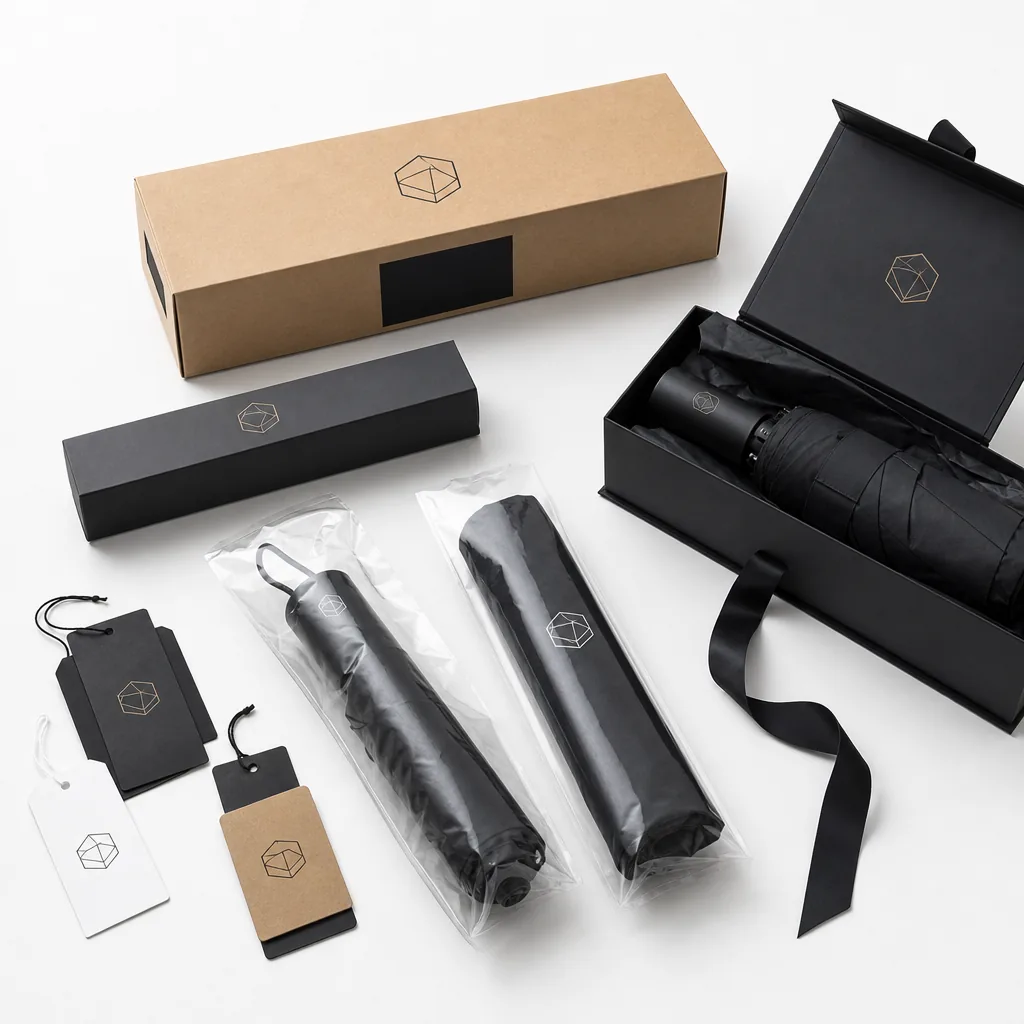
For valet team branded umbrellas, MOQ is set by frame and assembly complexity, not by canopy color alone. A 23-inch straight umbrella with 8K steel ribs, manual open, and 190T pongee usually starts at 300 to 500 pieces per color. A 27-inch golf style with fiberglass ribs, vented double canopy, and auto-open usually starts at 500 pieces. Folding branded valet umbrellas are typically 1,000 pieces minimum because auto-open-close runners, tighter spring tolerances, and matched sleeves increase assembly loss, and spare parts often do not interchange across factories. The same 1,000-piece threshold is practical for hotel valet umbrellas with Pantone-matched handles, woven labels, or upgraded 210T pongee with Teflon or UPF 50+ coating, because lower volumes make unit cost and color consistency less stable across print lots. Build sampling into the PO from the start: 3 to 5 days for a stock-frame sample with a simple one-color screen print, 5 to 7 days for a pre-production sample on a stock frame, and 10 to 12 days if the program needs new screen meshes, transfer layouts, or handle molds.
Lead time is the main scheduling risk for parking operator umbrellas, especially before monsoon and winter peaks. A full counter-sample for bulk umbrellas for parking services usually takes 7 to 10 days, since canopy tension, sleeve fit, and logo position should be checked with the umbrella strapped closed. After sample approval and deposit, production is typically 20 to 25 days for 500 to 1,000 pieces and 30 to 35 days for 2,000 to 5,000 pieces; allow more time for 10K or 16K frames, POE or EVA clear canopies, and auto-open-close mechanisms. FOB Ningbo is usually the most efficient term for buyers using their own forwarder, while DDP suits hotel groups and event buyers that need one landed cost covering customs, duty, and final delivery. Put AQL 2.5 final inspection in the purchase order and name the checks: auto-open function and lock-up, close-and-latch consistency, rib strength over repeated opening cycles, ferrule and top-notch alignment, handle finish without sharp gate marks, print alignment across panels, sleeve fit, crown stitching, panel symmetry, and pull tests on strap snaps or hook-and-loop closures. Before sealing, label every carton by delivery location: valet stand name, property code, city, PO number, carton count, and destination such as front drive, garage office, or overflow lot.
Frequently Asked Questions
What umbrella style works best for valet teams?
A 23 inch auto-open folding umbrella is practical for escorting guests because it deploys quickly and stores near the podium. For fixed curbside stations, a 27-30 inch straight umbrella or 16K windproof model gives better coverage.
Should valet umbrellas include reflective details?
Reflective piping or a small reflective logo area is useful for night shifts, garages, and wet curb lanes. It adds visibility without turning the umbrella into safety equipment, so buyers should still follow local workplace safety rules.
What umbrella specifications work best for valet teams working curbside in wind and traffic?
For daily valet use, buyers typically choose a 27 to 30 inch straight umbrella with fiberglass ribs, a reinforced shaft, and a vented canopy. Reflective piping or edge tape is useful for night visibility, and EVA or rubberized handles hold up better than basic plastic in wet conditions.
How should parking operators split umbrella quantities across locations and reserve stock?
A practical opening order is often 24 to 60 pieces per site, plus 5% to 10% reserve stock for loss and damage. For multi-location programs, many buyers consolidate artwork and specs but pack by site code or property name to simplify distribution.
What quality checks matter most before shipping branded umbrellas for valet or parking use?
Ask for canopy opening and closing tests, logo position approval, frame alignment checks, and carton drop inspection before shipment. For custom orders, a pre-shipment inspection at AQL 2.5 is commonly used, with sample photos confirming reflective trims, handle finish, and print color consistency.
Looking to Launch Your Custom Umbrella Line?
ZheBrella is a Zhejiang-based OEM/ODM umbrella manufacturer with 17 years of export experience. Free design, low MOQ from 100 pieces, windproof construction, full-color print.
Get Free Quote Now »People Also Search For
Related Articles

Branded Umbrellas for Valet Parking and Guest Arrival Teams
Specify valet umbrellas that keep guests dry, protect uniforms, and reinforce brand cues with windproof frames, auto-ope...
Read More »Branded Umbrellas for Parking, Valet, and Security Teams
Specify umbrellas for valet, parking, and security crews with windproof frames, high-visibility details, fast deployment...
Read More »Custom Umbrellas for Insurance Adjusters and Claim Teams
Source durable umbrellas for adjusters and field claim teams with fast-open specs, weather-ready fabrics, QC standards, ...
Read More »