Non-Metal Umbrellas for Stadiums and Security Venues
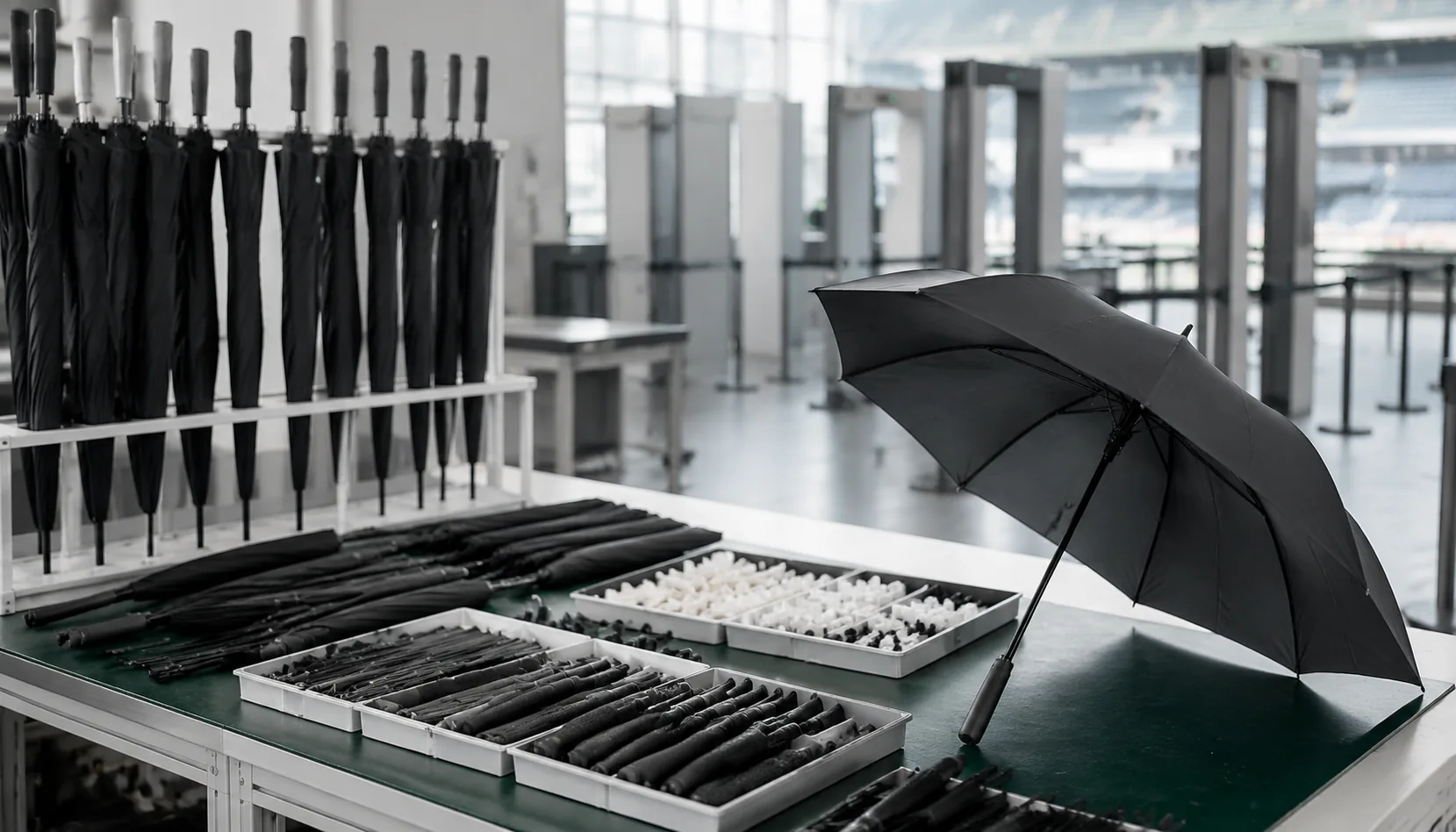
Venue buyers need umbrellas that pass gate security without becoming a headache in rain, wind, or crowd control. When we build non-metal umbrellas for stadiums, the real work is in specifying fiberglass ribs and shafts, plastic tips, controlled opening mechanisms, and logo decoration that survives AQL 2.5 inspection. MOQ, FOB, and DDP pricing only make sense after the frame, fabric, packaging, and security requirements are locked down.
Clarify Venue Rules Before Designing the Umbrella
The first specification for non-metal umbrellas for stadiums is not rib count or print method; it is the venue rulebook. Stadiums, concerts, school districts, airports, courts, and convention centers often write umbrella limits around security screening, not rain performance. I have seen buyers approve a nice 23 inch auto-open sample, then get rejected because the closed length exceeded 21 inches, the ferrule looked like a pointed metal spike, or the open arc blocked sightlines in seated sections. Before sampling, ask the venue for maximum closed length, open diameter, shaft material, tip shape, and whether auto-open mechanisms are allowed. A compact 21 inch model may pass where a 27 inch golf umbrella will not, even if both use safe fiberglass ribs. For security venue umbrellas, the safest starting point is usually a fiberglass shaft, fiberglass ribs, rounded plastic cap, plastic runner, and blunt plastic tips instead of nickel-plated metal hardware.
Material wording matters because security staff do not inspect umbrellas like factory engineers. If the policy says “no metal umbrellas,” a steel shaft with a plastic sleeve is still a problem, and a metal ferrule under a plastic cap may trigger rejection at magnet checks. For true plastic tip umbrellas, specify POE, PVC, EVA, or 190T/210T pongee canopy separately from the frame, then call out non-metal contact points: plastic top cap, plastic tips, plastic handle, and fiberglass or reinforced plastic shaft. Fiberglass ribs are flexible and safer under crowd pressure, but confirm the hub and spring parts if the venue bans exposed metal completely. Manual-open is normally easier to clear than auto-open or auto-open-close because there are fewer internal springs and less suspicion at inspection tables. If wind resistance is still needed, use an 8K or 10K fiberglass frame with a vented canopy rather than upsizing the diameter.
Sampling should copy the final security requirement, not just the buyer’s brand artwork. Our standard practice at ZheBrella is to make a pre-production sample with the exact closed length, open diameter, ferrule shape, runner material, and handle style listed on the venue approval sheet, then photograph those dimensions before bulk cutting. A promotional distributor buying from a fiberglass umbrella OEM should also ask for carton labels that identify the product as “non-metal frame” or “stadium-approved” only when the venue has confirmed that language. Avoid vague claims from an event umbrella supplier such as “security safe” unless the quote includes measurable specs: 21 inch or 23 inch size, open diameter in inches, fiberglass shaft diameter, rounded tip radius, canopy material, MOQ, lead time, and AQL 2.5 inspection points. The best non-metal umbrellas for stadiums are designed backward from the gate check, not forward from a catalog photo.
Build the Frame Around Fiberglass and Plastic Parts
For non-metal umbrellas for stadiums, the frame decision starts with what security staff can see and feel at the gate: no exposed steel ribs, no sharp metal tips, and no long plated shaft that looks like a baton. A proper build uses fiberglass ribs and stretchers, a fiberglass center shaft, a plastic runner, resin tips, and a rounded plastic or resin ferrule at the top. I prefer pultruded fiberglass over hollow plastic ribs because it bends back after gust loading instead of taking a permanent kink. On a 23" or 27" straight umbrella, a 10 mm to 12 mm fiberglass shaft gives enough stiffness without making the guest carry a club. For canopy fabric, 190T pongee is usually the better match than heavier 210T if the buyer wants fast gate throughput and lower carried weight. For transparent security venue umbrellas, POE canopy with fiberglass ribs is common, but the sewing and rib-end reinforcement must be clean because POE tears differently than woven pongee.
The rib count is where buyers often overspec. An 8K fiberglass frame is normally the best balance for stadium entry: lighter, faster to open, lower unit cost, and easier to pack in event cartons. A 23" 8K manual-open model can stay near 360-430 g depending on handle and canopy, while a 16K build may add 80-140 g and push cost up noticeably because every extra rib means more sewing points, more tips, more labor, and more inspection time. A 16K frame does spread canopy tension better and feels more premium, especially on a 27" guest umbrella, but it is not automatically safer or more windproof. If the shaft, runner, and rib joints are poorly molded, 16 weak ribs only create 16 failure points. For plastic tip umbrellas, we specify smooth resin end caps with pull-off resistance checked during AQL 2.5 inspection, because loose tips become the exact small hard parts venues are trying to avoid.
Our standard practice at ZheBrella is to build sample frames before quoting mass production, because fiberglass diameter, runner resin grade, and ferrule shape change both security acceptance and real durability. For a fiberglass umbrella OEM project, I would test manual-open first; auto-open mechanisms can still use springs and small metal parts, which may defeat the purpose for strict venues. If a buyer insists on auto-open, we isolate the mechanism inside the plastic handle and submit a component declaration before production. Wind testing should be realistic: an 8K fiberglass frame with a well-tensioned canopy can survive 35-45 mph handling, while a double-canopy vented 16K design may pass 50+ mph, but that design looks bulkier and costs more. As an event umbrella supplier, I would rather deliver a lighter compliant umbrella with rounded ferrule, molded plastic runner, and resin tips than a heavy “windproof” model that slows screening lines and gets rejected at the gate.
Select Canopy Fabric and Weather Performance
For non-metal umbrellas for stadiums, canopy choice should start with how many times the umbrella must survive use, not just how low the unit price can go. For promotional event quantities, I usually recommend 190T pongee because it prints cleanly, folds neatly, and gives better hand-feel than cheap polyester without pushing the budget too hard. A proper 190T pongee canopy with a water-repellent coating will bead rain well enough for one-season sponsorship programs, giveaways, and queue-line distribution. For retail or reusable venue merchandise, 210T pongee is the better call: denser yarn, smoother surface, stronger tear resistance at the rib tips, and a more premium appearance under stadium lighting. On the cutting table, 210T also holds panel shape better, which matters when logos must line up across 8K or 10K fiberglass frames.
Daytime events need more than rain protection, especially for baseball parks, tennis venues, festivals, and open-air security checkpoints. UPF 50+ coating can be added to 190T or 210T pongee, but buyers should confirm whether they want sun protection only on dark colors or across a full branded palette. Light colors can pass UV testing, but they often need tighter coating control and may show stitch marks more easily. For security venue umbrellas, I avoid overly glossy coatings because they can look cheap and create glare under inspection lights. A matte water-repellent finish is usually safer for venue branding, photography, and sponsor visibility. If the umbrella uses fiberglass ribs, plastic tips, and a non-metal shaft or runner, the fabric should still be tested as part of the complete unit, not approved as a roll sample only.
Color approval is where many event umbrella supplier projects lose time. Stadiums often require exact team colors, sponsor Pantone references, or restricted palettes that match wayfinding, uniforms, and broadcast graphics. Dark navy, black, red, and royal blue are stable on pongee, while neon orange, lime, and bright yellow need closer lab-dip review because coating and sublimation can shift the tone. For a fiberglass umbrella OEM order, our standard practice at ZheBrella is to approve fabric color, coating feel, print method, and finished-panel appearance before bulk cutting, then inspect finished umbrellas under AQL 2.5. If plastic tip umbrellas are being used for strict-entry venues, fabric should not be an afterthought; a weak canopy on a safe frame still creates complaints when rain pools, logos bleed, or seams open during a 30 mph gust at the gate.
Control Opening Mechanism and User Safety
Manual open is usually the safer specification for non-metal umbrellas for stadiums because it slows down deployment in dense foot traffic. A spring-loaded auto-open shaft can snap a canopy outward in less than one second, and that is exactly what security managers dislike near ticket gates, stair aisles, food lines, and covered concourses. For restricted seating areas, I prefer a manual runner with a controlled slide force of roughly 2.5-4.0 kgf, paired with fiberglass ribs and plastic joints instead of steel stretchers. The goal is not only “non-metal” compliance; it is predictable behavior when a guest opens the umbrella shoulder-to-shoulder with others. On 21" and 23" compact models, an 8K fiberglass rib layout is normally enough, while larger 27" golf-style security venue umbrellas need careful review because the canopy arc can interfere with sightlines and neighboring seats.
Auto-open can still be acceptable when the product is sold as retail merchandise outside restricted seating zones, such as fan shops, parking-lot tailgate areas, sponsor booths, or post-event giveaways. In that case, I would keep the mechanism simple: auto-open only, not auto-open-close, because the closing spring adds more stored energy and more pinch risk at the runner and shaft collar. A fiberglass umbrella OEM should also tune the spring so the canopy opens cleanly without a violent kick; cheap stock mechanisms often feel impressive in a showroom but fail crowd-safety reviews. For branded event umbrella supplier programs, we commonly separate SKUs: manual-open compact umbrellas for gate-approved use, and auto-open 23" or 27" merchandise umbrellas for areas where security staff are not screening every item for seating access.
Pinch-point inspection is not optional on plastic tip umbrellas. During pre-production and AQL 2.5 final inspection, I check the runner notch, cap interface, ferrule area, rib-hinge clearance, and sleeve fit, because small gaps can catch children’s fingers or tear a pongee 190T canopy after repeated use. Rounded plastic tips should be molded, not sharp-cut, and the top cap should avoid pointed metal-look decoration even if it is technically ABS or nylon. Compact sleeve design also matters: a tight sleeve makes guests fight the umbrella closed, while an oversized sleeve gets lost at security checkpoints. Our standard practice at ZheBrella is to size the sleeve with enough tolerance for a wet canopy, add a blunt pull tab, and avoid metal snaps; hook-and-loop or elastic retention is usually easier for venue staff to approve.
Plan Compliance, MOQ, and Quality Checks
Venue approval should be treated as a production gate, not a courtesy photo. For non-metal umbrellas for stadiums, writers should specify at least one pre-production sample set using the final shaft, ribs, tips, runner, handle, canopy fabric, print method, and carton label before bulk cutting starts. Security teams often reject an umbrella because of one overlooked detail: a plated ferrule hidden under a plastic cap, a steel spring in the runner, or a sharp ABS tip molded too hard. For security venue umbrellas, the sample should include a simple component declaration, magnet check result, and photos of the shaft end, rib tips, top cap, and closure strap. If the buyer needs branding, submit both the physical sample and a print strike-off on the same 190T or 210T pongee, POE, PVC, or EVA canopy material. Our standard practice at ZheBrella is to freeze the approved sample with a signed tag and keep one matching sample on the sewing floor and one in final QC.
MOQ changes quickly when a buyer asks for custom non-metal parts instead of using stock components. A stock fiberglass shaft with fiberglass ribs, plastic tips, and a molded plastic handle may start around 500 to 1,000 pieces per color, but a new plastic tip mold, custom runner, special EVA canopy color, or private-label handle can push the practical MOQ to 3,000 to 5,000 pieces. Writers should say this clearly because stadium procurement teams often assume a metal-free umbrella is only a material swap. Fiberglass umbrella OEM work needs earlier planning: straight fiberglass shafts are usually easier than custom tapered shafts, while 8K and 10K rib frames are faster than 16K because rib assembly and tension balancing take longer. Normal lead time after sample approval is often 25 to 35 days for stock non-metal frames, and 40 to 55 days if fiberglass shafts or plastic parts need new tooling or color matching. Add another 7 to 15 days for DDP event delivery if cartons must be routed to multiple venues.
Quality checks should be written as a measurable AQL 2.5 process, not a vague “security compliant” claim. For non-metal umbrellas for stadiums, inspection should include metal detection or magnet screening on shaft, ribs, tips, top cap, runner, handle, and wrist strap hardware; any exposed sharp metal should be a critical defect. Tip security needs a pull test because loose plastic tip umbrellas create both safety and litter problems inside a venue. Opening force should be checked on manual and auto-open frames so staff and guests can use them without sudden snap-back; a typical target is smooth opening without runner lock failure after repeated cycling. Seam strength should be tested at canopy panel joints, rib pockets, and closure strap stitching, especially on 23 inch and 27 inch models where wind load is higher. Carton labeling also matters for an event umbrella supplier: master cartons should show SKU, color, quantity, venue name, gate or section allocation, PO number, and barcode if the distributor is sorting by city or stadium.
Frequently Asked Questions
Can an umbrella be completely metal-free?
Yes, but it must be specified from the start with fiberglass or plastic structural parts, including shaft, ribs, runner, tips, and ferrule. Buyers should request a sample teardown or metal-detection check before bulk production.
Are non-metal umbrellas more expensive than standard umbrellas?
They can cost more if fiberglass shafts or custom plastic parts are required. The final price depends on rib count, canopy fabric, logo method, MOQ, and whether the order ships FOB or DDP.
Which umbrella parts should be non-metal for stadium security programs?
Most venue buyers specify fiberglass ribs and shafts, plastic tips, plastic caps, and a controlled manual-open mechanism. Small internal springs may still be present depending on the design, so confirm the venue’s exact screening rules before production.
What MOQ is typical for custom non-metal stadium umbrellas with logos?
A practical OEM MOQ is usually 1,000–3,000 pieces per style for logo printing and custom canopy colors. Lower quantities may be possible with stock fabric colors and one-position printing.
Can non-metal venue umbrellas be shipped FOB or DDP?
Yes. FOB Ningbo or Shanghai is common for importers with their own forwarder, while DDP can be quoted for door delivery to the U.S. or EU after confirming carton size, HS code, duty, and destination ZIP or postal code.
Looking to Launch Your Custom Umbrella Line?
ZheBrella is a Zhejiang-based OEM/ODM umbrella manufacturer with 17 years of export experience. Free design, low MOQ from 100 pieces, windproof construction, full-color print.
Get Free Quote Now »People Also Search For
Related Articles
Wedding Umbrellas: Product Guide for Event and Retail Buyers
Source wedding umbrellas with the right canopy color, frame, print method, packaging, MOQ, and lead time for venues, pla...
Read More »
Wedding Umbrellas for Events: OEM Buyer Spec Guide
Choose wedding umbrellas with the right canopy, frame, print, MOQ, and lead time specs for venues, planners, and event g...
Read More »
Wedding Umbrellas for Venues, Planners, and Retail Brands
Compare wedding umbrella fabrics, frame options, colors, and packaging so planners and retailers can source elegant umbr...
Read More »