Wedding Umbrellas for Events: OEM Buyer Spec Guide
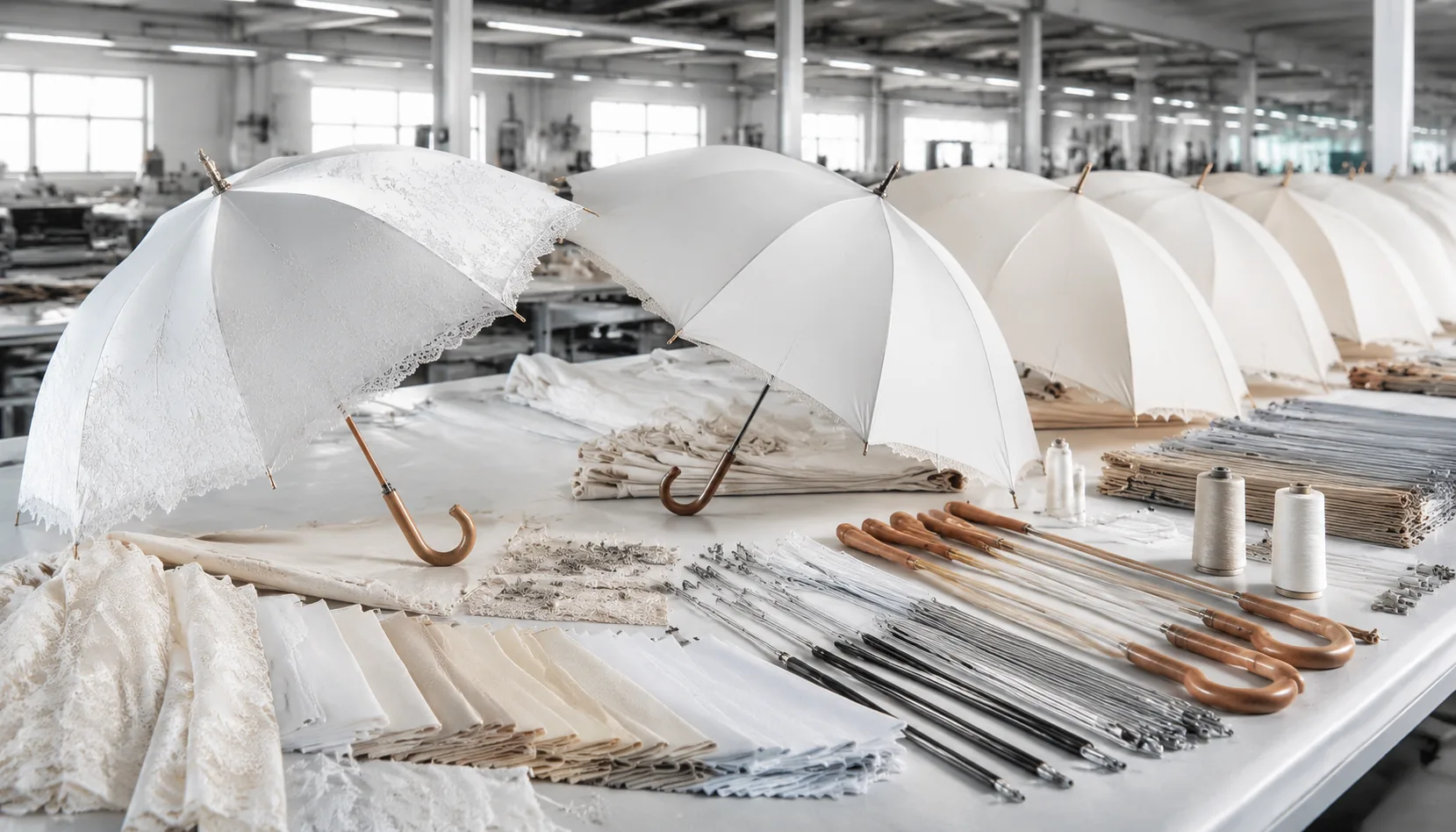
For venues, planners, and event gift buyers, wedding umbrellas for events look simple until the first rain plan exposes weak ribs, color mismatch, late packing, or prints that scuff in transit. On our Songxia factory floor, the orders that run smoothly are the ones specified by canopy fabric, frame strength, handle finish, logo method, carton plan, MOQ, and lead time before sampling starts.
Canopy Styles That Fit Wedding and Venue Use
For wedding umbrellas for events, canopy material decides whether the umbrella looks clean in photos or becomes a maintenance problem after one humid outdoor ceremony. White 190T or 210T pongee is the safest OEM choice: matte, tight-woven, quick-drying, and stable enough for screen printing a small monogram or venue logo without heavy ink bleed. Satin-look polyester gives a brighter sheen under flash photography, but I only recommend it when the buyer accepts more visible creasing from carton compression and slightly slower drying. For white wedding umbrellas, we usually specify color tolerance against a physical swatch, because “white” can shift from blue-white to cream-white between fabric mills, especially after UV or water-repellent coating.
Lace-look overlays are attractive for bridal entrances and chapel exits, but they should be treated as decorative event umbrellas, not high-wind rain tools. The best construction is a 190T pongee base canopy with a polyester lace overlay sewn into the perimeter seam; glue-bonded overlays look neat in samples but can bubble after heat exposure in container transit. Clear POE is a different solution: it keeps faces visible for photography and works well in rain, especially on 23-inch straight umbrellas with steel shafts and fiberglass ribs. Avoid cheap PVC for weddings unless the budget is extremely tight; PVC yellows faster, smells stronger after sealing, and becomes stiff in cold weather.
Size selection should match the actual use scene, not just the catalog photo. A 23-inch straight umbrella, typically 8K with fiberglass ribs or mixed steel-and-fiberglass ribs, is easy for bridesmaids, guests, and ushers to carry, and it packs efficiently for bulk event umbrellas. For couple coverage, a 27-inch golf umbrella is more practical, especially in a double-canopy vented windproof build rated around 40–50 mph in controlled testing. A 30-inch golf model gives better coverage for outdoor venue staff or photo assistants, but it is heavier and less elegant in tight aisle work. As an OEM umbrella supplier, ZheBrella’s standard practice is to confirm handle finish, canopy whiteness, opening force, and packed length before quoting MOQ, because those details affect both the look and the FOB/DDP landed cost.
Frame Specs for One-Day Events vs Reusable Inventory
For wedding umbrellas for events that will be used once for photos, ceremony exits, or guest rain cover between a chapel and reception tent, steel ribs are still acceptable if the buyer controls the environment. A 23" straight umbrella with 8K black-coated steel ribs, steel shaft, J-handle, and 190T or 210T white pongee canopy can pass normal open-close checks and look clean in photography. I would not overspec fiberglass just because the umbrella is white; the real question is whether guests will keep them, reuse them, or fight coastal wind. For bulk event umbrellas under tight budget, specify rust-resistant coating on steel parts, smooth rib tips that will not mark a bridal gown, and an AQL 2.5 inspection focused on frame symmetry, canopy stains, and print alignment. If the event is indoor-outdoor with ushers distributing umbrellas from boxes, manual open is safer and cheaper than auto-open because fewer mechanisms fail under rushed handling.
Reusable inventory changes the frame decision. If a venue, planner, hotel, or rental company wants event umbrellas that survive multiple weekends, fiberglass ribs are worth the added cost because they flex instead of taking a permanent bend. A 23" or 27" straight-shaft model with fiberglass ribs and a steel or fiberglass shaft is a better working spec for lawns, docks, vineyard aisles, and golf-cart transfers. In factory testing, I treat 8K fiberglass as the practical baseline for moderate wind, while 16K is mainly for a rounder canopy shape, stronger visual fullness, and better load distribution when guests hold the umbrella at an angle. A double-canopy vented construction can survive 50+ mph wind-tunnel ratings when the runner, stretchers, and tips are matched correctly, but that is overkill for a calm garden ceremony. For white wedding umbrellas, fiberglass also reduces the chance of visible rib distortion under thin white fabric in photography.
Straight shaft choices should be tied to handling, not only appearance. Wood shafts and curved wood handles look premium for bridal parties but need tighter moisture control and better carton packing; painted metal shafts are cheaper and more consistent for mass guest use; fiberglass shafts make sense when the umbrella is part of reusable venue stock. For wedding umbrellas for events, an OEM umbrella supplier should quote the frame as a full system: 8K or 16K rib count, rib material, stretcher material, shaft diameter, runner type, open method, canopy size, and wind target. Our standard practice at ZheBrella is to separate one-day promotional orders from reusable rental inventory before tooling or sampling, because a low-cost 8K steel frame and a 16K fiberglass windproof frame may look similar in a photo but behave very differently after 200 open-close cycles. For FOB production, frame decisions should be locked before PP sample approval to avoid late balance and carton-size changes.
Print, Color, and Branding Placement Choices
Branding placement should be decided before panel cutting, not after sewing, because a single-panel logo on a 23" or 27" arc umbrella needs different screen positioning than a full-panel monogram that crosses the rib line. For planners ordering wedding umbrellas for events, the safest OEM choice is a one-color or two-color logo printed on one lower canopy panel, usually 120–180 mm wide, so it photographs cleanly without warping around the crown. Hotels and resorts often prefer repeated monograms on alternating panels, but I only recommend that on 190T or 210T pongee with stable tension; loose POE or thin PVC can shift during heat transfer and make the repeat look uneven. For white wedding umbrellas, we normally test both screen print and heat-transfer film, because white fabric reflects light strongly and makes slight ink-density differences more visible in outdoor photography.
Color matching on white canopies has real limits, and buyers should not approve bulk event umbrellas from a Pantone code alone. A Pantone 186C red printed on white 190T pongee will not look identical to the same red on coated polyester, EVA, or transparent POE, especially after Teflon water-repellent treatment or UV coating. Metallic gold and champagne tones are the hardest for destination weddings because they shift under beach sun, ballroom LED lighting, and camera flash. Our standard practice at ZheBrella is to produce a pre-production sample using the final canopy fabric, final coating, and final print method, then check it under daylight and indoor light before opening mass production. For tight brand programs, I suggest approving a tolerance range rather than one theoretical color chip, because fabric absorption, curing temperature, and ink film thickness all affect the finished shade.
Small branding details often matter more to premium event umbrellas than a huge canopy logo. A woven sleeve tag, PU patch, or satin label on the umbrella sleeve gives planners a branded handout without turning ceremony photos into advertisements. Handle branding works well on straight wooden handles, J handles, and EVA foam grips; options include laser engraving, pad printing, hot stamping, or a small metal badge, but each has a different MOQ and durability profile. For hotels and destination weddings, we usually combine a clean white canopy, discreet sleeve tag, and handle mark, then reserve one canopy panel for the couple’s initials, venue crest, or sponsor logo. An experienced OEM umbrella supplier should also check alignment after assembly, because a perfect printed panel can still look wrong if the rib set is rotated during final mounting or if sleeve packing hides the tag.
Packaging, MOQ, and Lead Time Planning
Packaging decisions for wedding umbrellas for events should be made before sampling, not after production, because the packing method changes carton size, freight cost, and venue handling. For economy bulk event umbrellas, the usual setup is one umbrella in a clear polybag, 25 or 50 pieces per export carton, with a master carton around 5-ply K=A or K=K board depending on shaft length and handle type. White wedding umbrellas with curved J handles or 27" golf frames waste more carton space than compact 21" auto-open-close models, so do not compare freight by piece count alone. If the umbrellas will be handed out at a chapel, hotel lobby, outdoor ceremony aisle, or reception entrance, I prefer carton labels that show event name, SKU, color, quantity, carton number, and destination zone such as “Ceremony Gate A” or “Ballroom Backup Stock.” That small label discipline prevents volunteers from opening ten cartons just to find 100 matching white units.
Individual sleeves are worth specifying when the umbrella becomes part of the guest experience rather than a rain backup item. A 190T or 210T pongee umbrella can be packed in a matching fabric sleeve, clear PVC sleeve, frosted EVA pouch, or printed paper belly band; each option affects labor time and rejection risk during final AQL 2.5 inspection. Gift boxes look better for VIP weddings, resort welcome kits, and branded planner packages, but they increase CBM by 20–40% and need stronger corner protection if shipped DDP by courier or truck. For retail-style boxes, provide barcode position, warning text, recycling marks, and logo artwork before pre-production sample approval. Our standard practice at ZheBrella is to photograph one fully packed carton during the pilot run, including inner packing, carton mark, gross weight, and drop-test condition, so the buyer can approve the actual distribution format before mass packing starts.
MOQ depends on frame, fabric, and decoration method more than the word “wedding.” Plain stock white wedding umbrellas may start around 300–500 pieces per model, while custom canopy color, logo screen printing, heat-transfer panels, plated ribs, custom handles, or gift-box packaging usually push MOQ to 1,000–3,000 pieces. Digital sublimation on full-panel artwork often needs more sampling control because white fabric shows color drift, especially under outdoor photography lighting. A realistic sample timeline is 3–5 days for stock with logo, 7–10 days for custom print or sleeve, and 12–15 days when a new box, handle color, or molded part is involved. Mass production for bulk event umbrellas is typically 20–30 days after deposit and approved sample, or 35–45 days during March–June peak season. FOB Ningbo or Shanghai works for buyers with forwarders; DDP needs carton dimensions early so duty, last-mile delivery, and venue deadline buffers can be calculated before the purchase order is locked.
Quality Checks Before Event Delivery
Clean white fabric is the first checkpoint because wedding photography makes small defects look larger than they are. For white wedding umbrellas, we inspect the canopy under both cool white LED and daylight near the loading door, not just at a sewing table. Oil marks from rib assembly, pencil marks from cutting, yellowing from poor storage, and uneven Teflon coating are all rejectable if visible at normal arm’s length. On 190T and 210T pongee, we also check for slubs, needle holes, loose threads at the tips, and seam puckering around the crown. POE and EVA transparent models need separate checks for haze, scratches, and edge cracking. For wedding umbrellas for events, color consistency matters across the full lot, so we compare opened samples from different cartons against the approved pre-production sample, not only the first carton off the line.
Function testing should be done after printing and final assembly, because heat-transfer pressure, screen-print curing, and packing compression can expose problems that early frame inspection misses. Auto-open umbrellas must release cleanly with one button press, without canopy hesitation or shaft bounce-back; auto-open-close models also need controlled closing force so guests are not fighting the mechanism at the venue entrance. We check rib alignment by opening the umbrella on a flat table and viewing the 8K or 10K frame from above: twisted ribs, loose stretchers, uneven tip spacing, and off-center runners are common causes of poor appearance in event umbrellas. Fiberglass ribs should flex evenly without whitening at the joints, while steel ribs need plating checks to prevent rust transfer onto clean fabric. Print registration is measured against the approved artwork position, especially for logos crossing seam lines or repeated monograms across multiple panels.
Bulk event umbrellas should be inspected under AQL 2.5 for major defects, with a tighter internal screen if the order is going straight to a wedding planner, hotel group, or retail event kit without rework time. Major defects include failed auto-open function, broken ribs, dirty canopy, wrong print color, misregistered logos, loose tips, exposed sharp wire, and cartons softened by moisture. Minor defects include small thread ends, slight handle scuffs, or tiny packing creases that recover after opening. Carton moisture control is not optional in Shaoxing’s humid season: we check carton compression strength, polybag ventilation, silica gel placement where specified, and pallet wrapping before FOB Ningbo or DDP dispatch. For bulk event umbrellas, I also recommend opening random packed cartons after 24 hours in the warehouse to catch condensation or ink transfer before delivery pressure removes your recovery window.
Frequently Asked Questions
Are auto-open mechanisms recommended for wedding umbrellas?
Yes, auto-open is useful for guest convenience, especially during outdoor ceremonies. Buyers should test opening force, spring consistency, and closure safety on pre-production samples.
What fabric is best for white wedding umbrellas?
190T or 210T pongee is common because it prints cleanly and feels more premium than basic polyester. For higher opacity, buyers can request thicker fabric or a light-blocking coating sample.
What umbrella size works best for wedding guest coverage?
For guest use, 21-inch to 23-inch straight umbrellas are common because they balance coverage, cost, and carton efficiency. For couple portraits or venue rentals, 27-inch to 30-inch golf umbrellas provide better coverage for two people.
What is a typical MOQ for OEM wedding umbrellas?
For standard white wedding umbrellas with simple logo printing, MOQ is often 500 to 1,000 pieces per design. Custom canopy colors, special handles, or fully custom packaging may require 1,000 to 3,000 pieces.
How long does production take for bulk event umbrellas?
Sampling usually takes 5 to 10 days after artwork approval, and bulk production typically takes 25 to 45 days depending on order quantity and frame availability. Buyers should add ocean or air freight time based on the event date.
Looking to Launch Your Custom Umbrella Line?
ZheBrella is a Zhejiang-based OEM/ODM umbrella manufacturer with 17 years of export experience. Free design, low MOQ from 100 pieces, windproof construction, full-color print.
Get Free Quote Now »People Also Search For
Related Articles
Wedding Umbrellas for Events: OEM Buyer Selection Guide
Compare wedding umbrella specs for planners and brands, including canopy color, UPF 50+ options, frame choice, handle st...
Read More »
Wedding Umbrellas for Events: Buyer Specs and Bulk Orders
Plan bulk wedding umbrella orders with suitable canopy colors, frame strength, print methods, packing, MOQ, and lead tim...
Read More »
Wedding Umbrellas for Events: OEM Specs for Bulk Orders
Plan bulk wedding umbrella orders with canopy color, frame strength, print limits, MOQ, packaging, lead time, and FOB or...
Read More »