Wedding Umbrellas for Events: OEM Buyer Selection Guide
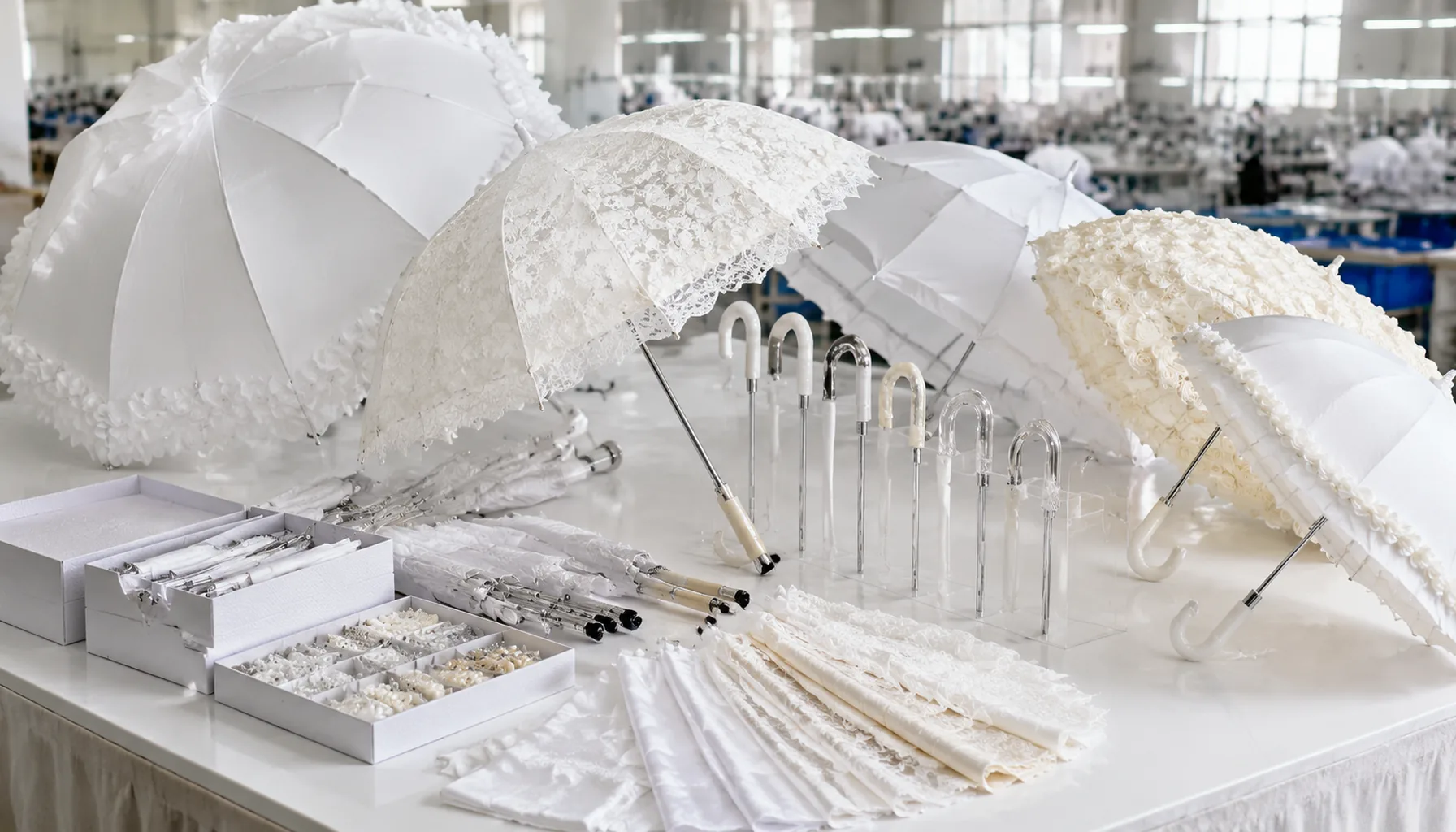
For planners and brands, wedding umbrellas for events look simple until canopy shade, UPF coating, rib strength, handle finish, and packing details start affecting photos, guest comfort, and delivery dates. On our Songxia factory floor, we see most OEM issues come from vague color standards, under-specified frames, and late QC decisions, not from the umbrella shape itself. A clear spec sheet and realistic production calendar make the difference between a smooth event order and costly last-minute sorting.
Identify the Wedding Use Case Before Choosing Specs
The first mistake buyers make is treating wedding umbrellas for events as one product. Ceremony shade umbrellas need clean color control, quiet opening, and enough diameter to cover seated guests without blocking the photographer; I normally start at 27" or 30" straight umbrellas with 8K or 10K fiberglass ribs, white or ivory 190T pongee, and a matte handle. Rainy-day guest use is different: a 23" auto-open umbrella with steel shaft and fiberglass ribs packs easier into cartons, opens fast at the venue entrance, and costs less when you need 300 to 2,000 pieces. If the event is in a windy coastal location, a double-canopy vented structure is worth the extra tooling and sewing time because it can survive 50+ mph gust testing better than a flat single canopy.
Photo props should be specified for lens behavior, not just appearance. Clear POE canopies are popular because faces stay visible under the umbrella, but cheap PVC yellows faster and smells stronger when packed hot, so I push POE or higher-grade EVA for bridal shoots. White ceremony umbrellas look elegant in person, yet under strong sun they can blow out in photos unless the fabric is dense enough or lightly coated; 210T pongee with a soft ivory tone often photographs better than pure optical white. Pastel canopies—blush, sage, champagne, powder blue—need lab dip approval under daylight and warm indoor lighting because small shade differences become obvious when twenty bridesmaids stand together. For custom wedding umbrellas, keep logos small: a tone-on-tone screen print near one panel edge usually looks more premium than a large center print.
Bridal party gifts and retail-style favors need packaging planned from the first quotation, not added after production. Matching sleeves in the same pongee fabric are standard, but drawstring organza bags, kraft tubes, ribbon-tied gift boxes, and individual barcode labels all change carton size, labor time, and DDP freight cost. For OEM wedding umbrellas, our standard practice at ZheBrella is to confirm use case, size, canopy material, rib count, mechanism, color reference, sleeve style, and packing method before sampling; otherwise the approval sample may look correct but fail the event logistics. Typical MOQ is 300 pieces for plain colors and 500 to 1,000 pieces for custom dyeing or full-panel printing, with sampling around 5 to 10 days and bulk lead time around 25 to 40 days depending on season and AQL 2.5 inspection requirements. A serious event umbrella supplier should quote these options separately so procurement can choose where the budget actually matters.
Choose Canopy Fabric, Color, and Sun Protection
For wedding umbrellas for events, canopy fabric is not just a price line; it controls how the umbrella looks in photography, how much light passes through, and how cleanly a logo or monogram prints. 190T pongee is the common baseline for custom wedding umbrellas because it has a smooth hand feel, decent water repellency, and accepts screen print or heat-transfer artwork without heavy ink bleeding. On a 23" or 27" straight umbrella, 190T also keeps weight reasonable, especially with fiberglass ribs and an auto-open shaft. The weakness is opacity: under strong sun, thin white 190T can show rib shadows and may look slightly translucent in close-up ceremony photos.
210T pongee is the better choice when the buyer wants a more premium finish, stronger opacity, and sharper print edges on white ceremony umbrellas. The denser weave gives a cleaner surface for one-color names, dates, venue marks, or full-panel floral graphics, and it hides the frame better when guests hold umbrellas overhead. For OEM wedding umbrellas, I usually recommend 210T for retail gift sets, hotel weddings, and outdoor venue packages where photos matter more than shaving $0.10–$0.25 per unit. If the order uses pale ivory, champagne, blush, or sage green, the denser fabric also reduces the “see-through” problem that can make color look washed out in daylight.
Sun protection should be specified before sampling, not added after the order is approved. A UPF 50+ coating is practical for beach ceremonies, garden weddings, vineyard events, and summer queues where guests may stand 20–40 minutes in direct sun; it can be combined with water-repellent treatment, but the coating hand feel and color tone should be checked on a physical swatch. As an event umbrella supplier, our standard practice is to lock a fabric lot and approve a pre-production sample under D65 light before cutting bulk fabric. Dye-lot variation is especially visible on white, ivory, and pastel canopies, so buyers should request lab dips, keep all panels from the same lot, and define an acceptable shade tolerance before production.
Balance Frame Strength, Weight, and Appearance
For wedding umbrellas for events, the frame choice should start with the site conditions, not the catalog photo. Steel ribs give a clean, traditional profile and keep unit cost down, which works for indoor arrivals, covered walkways, and short outdoor ceremonies where umbrellas are mainly visual props. The tradeoff is weight and corrosion risk if the umbrellas are reused after rain. Fiberglass ribs cost more, but they flex instead of taking a permanent bend, so I prefer them for beach weddings, garden venues, and hotel entrances where gusts hit between buildings. On a 23" or 27" stick umbrella, fiberglass ribs can reduce return damage noticeably compared with painted steel, especially when guests pull umbrellas open quickly without thinking about rib alignment.
Rib count affects both appearance and stress distribution. An 8K frame is the normal choice for custom wedding umbrellas because it is lighter, easier to close, and gives enough canopy shape for white ceremony umbrellas in 190T or 210T pongee. A 16K build looks fuller and more premium in photos, with a rounder canopy edge and more support points, but it adds weight, sewing time, and cost. I use 16K only when the buyer wants a luxury retail feel, a large 27" or 30" golf-style umbrella, or repeated rental use. For most OEM wedding umbrellas, a good 8K fiberglass frame beats a cheap 16K steel frame because the ribs, runner, spring, and tips must work as one system, not just look impressive on a spec sheet.
A double-canopy windproof design is worth paying for when the event is outdoors, coastal, or scheduled in a season with unpredictable weather. The vent lets pressure escape through the top layer, so a 27" fiberglass 8K or 10K frame can survive stronger gusts than a sealed canopy; in our wind checks, properly tensioned vented samples are usually targeted for 50+ mph performance before bulk approval. For guest convenience, manual-open is safer and cheaper for table baskets or ceremony rows because there is less mechanism failure and less chance of accidental popping in a crowd. Auto-open is better for valet stands, hotel entrances, and event staff handing umbrellas out under rain. I would avoid auto-open-close compact mechanisms for formal ceremonies unless the brief demands folding umbrellas, because they are heavier, more complex, and less elegant than a straight stick umbrella in photos.
Specify Handles, Trims, and Branding Details
Handle choice changes the look of wedding umbrellas for events more than buyers expect, especially in photography. Curved wood handles feel correct for premium ceremonies, but the finish must be controlled: natural beech, stained maple, and painted white handles all vary by batch unless the supplier locks a color chip before mass production. For most 23" and 27" straight umbrellas, we specify a 14 mm shaft with a smooth curved wood handle or a molded plastic J handle when the budget is tighter. Plastic J handles are lighter and consistent in color, but cheap molds show parting lines and sink marks, which look bad on close-up shots. Metal tips should be rounded and firmly riveted, not press-fit only, because event crews pack and unpack cartons quickly. For white ceremony umbrellas, I prefer silver or white tips over black, unless the wedding theme uses black hardware intentionally.
Trim details need to be specified in the tech pack, not left to the sewing line. Lace trim can be beautiful on custom wedding umbrellas, but the buyer should define lace width, pattern repeat, attachment method, and whether the lace sits on the canopy edge or below the binding tape. A 25–35 mm lace is common; anything wider may curl after rain unless the sewing tension is balanced. Satin ribbons on the closure strap should be heat-cut to prevent fraying, and the bow position must be fixed so every umbrella photographs the same when closed. Sleeve tags are useful for venue logistics: a woven tag, satin label, or small paper hangtag can identify the couple’s name, event date, or table group without turning the umbrella into a promotional product. Premium event orders usually require clean seams, straight edge binding, and no loose threads at the tips, so we inspect these areas under AQL 2.5 before packing.
Branding should stay discreet unless the buyer is sourcing OEM wedding umbrellas for a sponsor-heavy event. Low-contrast printing, such as warm gray on ivory 190T pongee or matte white on a white canopy, looks better than a large dark logo facing the photographer. For logos, screen printing works well for one-color marks on 190T or 210T pongee, while heat transfer is cleaner for small gradients or fine lettering on the sleeve. I would avoid heavy ink coverage near lace trim because it can stiffen the canopy edge and create folding marks. As an event umbrella supplier, ZheBrella usually asks buyers to approve both a canopy print proof and a handle color swatch before bulk production, especially when matching ribbon, sleeve, and handle tones. For wedding umbrellas for events, the safest branding layout is a small logo on one lower panel, a private sleeve tag, and a handle finish that matches the ceremony palette under daylight, not just office lighting.
Plan MOQ, Samples, QC, and Event Delivery
For fixed wedding dates, sample approval is the part buyers underestimate most. A clean OEM wedding umbrellas timeline starts with artwork and spec lock in 1–2 days, pre-production sample making in 5–7 days for stock frames, and 10–14 days if you need a new handle, special POE dome shape, or nonstandard 16K frame. Add 3–5 days for courier delivery and buyer comments. For custom wedding umbrellas with silk-screen logos, heat-transfer monograms, or sublimated edge patterns, approve both the print position and the fabric shade under daylight; white ceremony umbrellas can shift from warm ivory to blue-white depending on 190T pongee coating and lighting. I do not recommend moving to bulk production from photos only unless the order is repeat production with the same BOM, same Pantone, and same canopy mill lot.
MOQ should be planned from the event quantity backward, not from a catalog number. If a planner needs 380 umbrellas for guest seating, order at least 420–450 pieces to cover venue zoning, VIP spares, photo-team use, transport damage, and last-minute weather changes. Many factories can accept 300 pcs for stock 23" auto-open straight umbrellas, but OEM colors, custom sleeves, wood handles, or 27" golf umbrellas usually push practical MOQ to 500–1,000 pcs because dyeing, printing setup, and carton labeling costs must be spread across the run. As an event umbrella supplier, our standard practice is to confirm the final quantity before sample sign-off so fabric booking, frame purchasing, and logo screens are not revised midstream. For wedding umbrellas for events, that discipline prevents split-lot color differences that become obvious in ceremony photos.
Quality control must be written into the PO, not discussed after packing. Require AQL 2.5 final inspection with checkpoints for canopy stains, oil marks on white fabric, color variance against the approved sample, open-close function, runner lock strength, rib alignment, tip attachment, shaft straightness, and packaging defects such as crushed gift boxes or wrong barcode labels. For manual, auto-open, and auto-open-close mechanisms, inspectors should cycle a statistical sample at least 3–5 times, because weak springs and rough runners often pass a single opening test. Build delivery buffers around the wedding date: 25–35 days for bulk production after sample approval, 7–10 days for QC and carton correction if needed, then 5–7 days by air DDP or 25–35 days by sea freight to many U.S. or EU ports. For outdoor ceremonies, I also prefer double-canopy vented 8K or 10K fiberglass ribs if the venue expects coastal wind above 30 mph.
Frequently Asked Questions
Should wedding umbrellas be manual or auto-open?
Auto-open is convenient for guests during sudden rain, while manual open can feel more elegant for photo props. Buyers should test the mechanism with the selected handle and shaft before confirming production.
Is UPF 50+ necessary for wedding umbrellas?
UPF 50+ is useful for outdoor ceremonies, destination weddings, and summer event rentals. For indoor photo props or short rain-only use, standard water-repellent pongee may be enough.
What MOQ should a buyer expect for OEM wedding umbrellas?
For most OEM wedding umbrella programs, MOQ is typically 300-500 pieces per style and color, with mixed canopy colors usually requiring separate MOQs. If you need custom printing or a special handle, plan for a higher minimum on the first order.
Which umbrella specs matter most for wedding and event use?
Planners usually prioritize canopy size, white or ivory color consistency, frame wind resistance, and a clean handle finish. If the umbrellas are for outdoor ceremonies, UPF 50+ fabric and reinforced ribs are worth specifying in the RFQ.
How should a buyer plan lead time for a custom wedding umbrella order?
Sampling often takes 7-15 days, while mass production is commonly 30-45 days after sample approval, depending on order size and customization. Add extra time for peak wedding season, logo approvals, and ocean freight if shipping internationally.
Looking to Launch Your Custom Umbrella Line?
ZheBrella is a Zhejiang-based OEM/ODM umbrella manufacturer with 17 years of export experience. Free design, low MOQ from 100 pieces, windproof construction, full-color print.
Get Free Quote Now »People Also Search For
Related Articles
Wedding Umbrellas for Events: OEM Buyer Spec Guide
Choose wedding umbrellas with the right canopy, frame, print, MOQ, and lead time specs for venues, planners, and event g...
Read More »
Wedding and Event Umbrellas: Specs for Bulk Custom Orders
Plan wedding and event umbrella orders with the right canopy color, frame, print method, wind resistance, MOQ, lead time...
Read More »
Wedding Umbrellas for Events: Buyer Specs and Bulk Orders
Plan bulk wedding umbrella orders with suitable canopy colors, frame strength, print methods, packing, MOQ, and lead tim...
Read More »