Step-and-Repeat Logo Patterns for Branded Umbrella Canopies
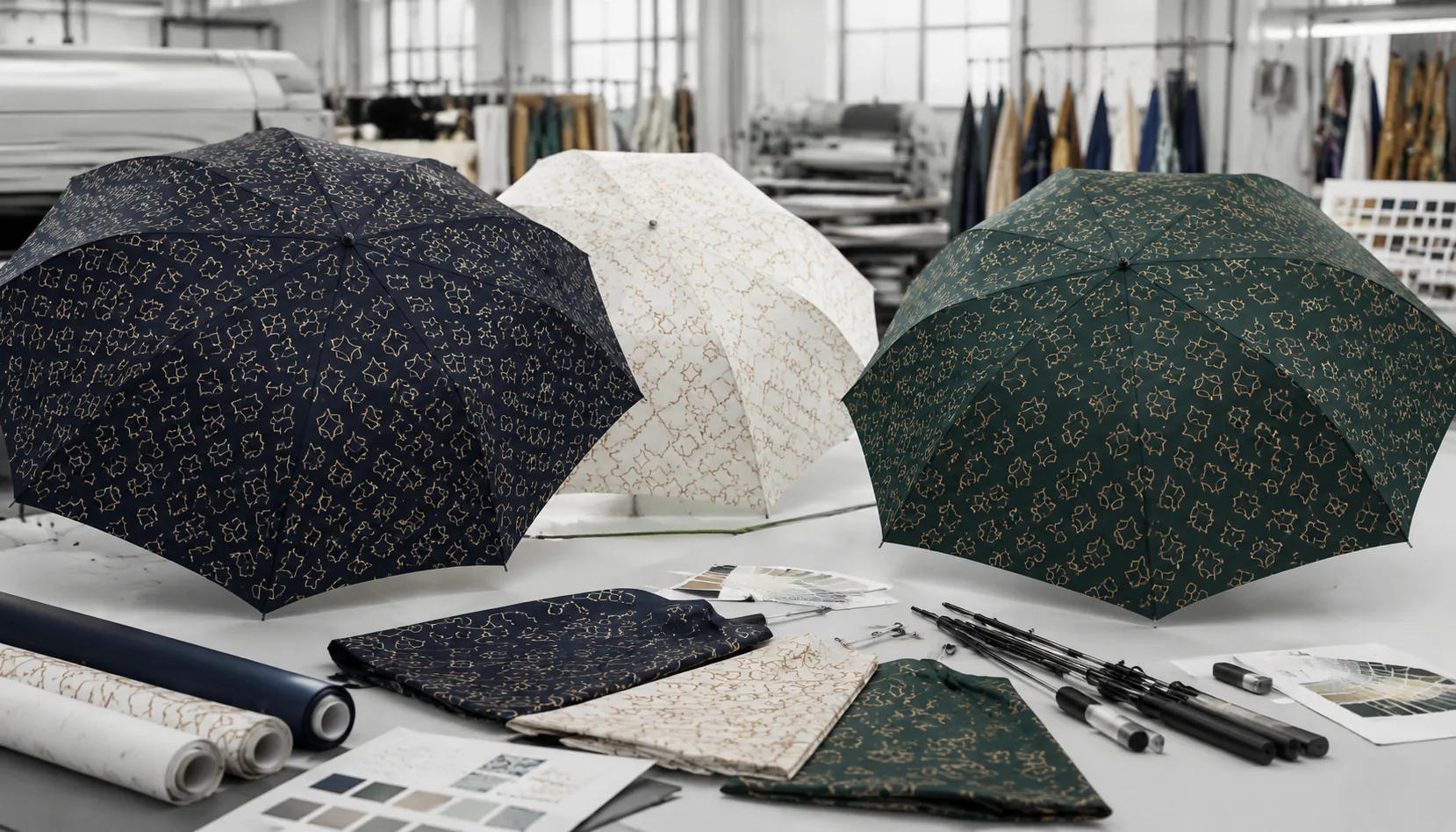
Repeated logo canopies look simple on a mockup, but in production every panel seam, fabric stretch, and print tolerance can shift the pattern enough to make a brand order feel uneven. On our Songxia cutting tables, step and repeat umbrella printing starts with panel-by-panel artwork layout, controlled logo spacing, and sample checks under real canopy tension before bulk fabric moves to sewing. Buyers need a plan that protects visual consistency while still passing practical AQL inspection.
Why Repeated Logo Patterns Work for B2B Branding
Repeated logos work best when the umbrella needs to be recognized from three distances: in the hand, across a lobby, and in event photos. For corporate gifts, a repeated logo canopy avoids the “one big billboard” look that many executives dislike, especially on 23" and 27" straight umbrellas with 8K or 10K frames. Sports sponsors use the same logic around stadium entrances and golf tournaments, where dozens of umbrellas appear together and the brand impression comes from volume, not one oversized mark. Hotels usually prefer quieter branded umbrella patterns because guests actually carry them in public; a 20-40 mm logo repeat on navy, black, or beige 190T pongee looks more like a uniform accessory than a giveaway. Retail private label lines can go bolder, but I still push buyers to test the layout at full canopy scale before approving mass production.
For step and repeat umbrella printing, logo size is usually the detail that decides whether the canopy looks premium or cheap. A 20-60 mm mark is the practical range for most repeated logo canopy designs: small enough to follow the panel curvature, large enough to read on 210T pongee, POE, or coated polyester after cutting and sewing. Oversized repeats often cross seam lines, distort near the rib tips, and become hard to align when panels are sewn around the crown. Small repeats hide normal production tolerance better, especially on 8-panel umbrellas where each triangular panel is cut separately. Our standard practice at ZheBrella is to mark the umbrella artwork layout with panel boundaries, seam allowance, print direction, and crown dead zone before sampling, because a pattern that looks perfect as a flat square file can fail once it wraps over a dome.
Repeated patterns are also safer for procurement because they reduce approval risk across mixed users. A hotel general manager, a sponsor’s brand team, and a distributor’s end client may disagree on handle type or canopy color, but they usually accept a clean micro-repeat faster than a giant centered logo. In promotional umbrella printing, that matters because sampling and artwork revisions can add 3-7 days before production even starts. For screen printing, simple one- or two-color repeats keep registration stable; for heat-transfer or sublimation, tighter repeats allow gradients and multi-color marks but need careful color control under wet-look coatings, Teflon finish, or UPF 50+ treatments. I would rather see a disciplined 30 mm repeat covering all panels evenly than a 120 mm logo fighting the ribs, seams, and vent layer on a double-canopy windproof umbrella.
Planning Pattern Scale Across 8K and 16K Panels
Rib count changes the math before it changes the look. On a 27" or 30" 8K golf umbrella, each panel has enough visual width for a 90–140 mm logo repeat without making the canopy look crowded from 10 feet away. The seam interruption is also predictable: eight seams mean fewer breaks, so a repeated logo canopy can run with larger spacing and still feel continuous when viewed from the front or side. For step and repeat umbrella printing, I usually ask buyers to approve the pattern on a flattened panel drawing, not only on a round canopy mockup, because the logo closest to the rib line may lose 3–5 mm into sewing allowance and fabric fold.
A 16K fashion umbrella behaves differently even if the finished diameter is similar. The narrower panels create a faster repeat rhythm, so a 60–90 mm logo often works better than a large mark that gets chopped at every seam. On 16K steel or fiberglass frames, the branded umbrella patterns should be centered per panel or built as a staggered half-drop layout; otherwise the artwork looks tilted once the canopy is tensioned. For retail umbrellas using 190T or 210T pongee, we also check whether printing is screen, heat transfer, or sublimation, because fine repeated marks hold differently near stitched seams and top-cap stress points.
Double-canopy windproof styles add one more decision: whether the inner vent panels stay plain, carry a secondary repeat, or use a contrasting brand color. On vented 8K golf umbrellas rated around 50+ mph, the outer canopy may show the main promotional umbrella printing while the lower inner layer flashes only when wind lifts the vent. On 16K fashion models, inner-panel artwork can make the umbrella feel premium, but it also doubles layout checking because every visible overlap needs alignment. Our standard practice at ZheBrella is to mark seam allowance, rib position, runner direction, and top notch on the umbrella artwork layout before sampling, then review one open sample under daylight rather than approving from a flat digital file alone.
Choosing Fabric and Print Method for Sharp Repeats
For sharp branded umbrella patterns, 210T pongee is the safer fabric when the logo has small type, thin outlines, or a tight registration box. The higher yarn density gives better ink holdout, so a repeated logo canopy looks cleaner after coating and water-repellent finishing. On 190T pongee, the weave is still acceptable for most promotional umbrella printing, especially on 21" and 23" folding models, but fine serifs and 1–2 mm gaps can soften because the fabric has slightly more texture and movement during curing. Plain polyester is the budget choice; it works for bold marks and event giveaways, but it usually shows more edge feathering and less premium hand feel than pongee. If the buyer is ordering 5,000 pieces for outdoor retail, I would pay for 210T. If it is a 500–1,000 piece campaign with a large one-color logo repeat, 190T often gives the best cost-to-result balance.
Screen printing is still the most stable method for one-color repeats because the ink layer is even, opaque, and predictable across 8K, 10K, and 16K canopies. For step and repeat umbrella printing, we normally lock the umbrella artwork layout to the panel cutting template first, then set repeat spacing so logos do not land awkwardly on seams or rib tips. Screen works especially well for white, black, navy, red, or PMS spot colors on 190T/210T pongee, with typical tolerance around ±2 mm after sewing. Digital printing is better when the artwork includes gradients, photo effects, shadowed logos, or many colors that would make screen setup expensive. The tradeoff is that digital ink can look slightly less dense on dark fabric unless a white base or lighter canopy color is selected.
Heat transfer is useful for tight multi-color marks where the buyer cares more about logo precision than all-over fabric hand feel. It gives crisp edges on badges, sponsor blocks, and complicated brand lockups, but I do not like it for dense all-over repeats because large transfer areas can feel heavier and may crease near fold lines on compact auto-open-close umbrellas. Sublimation is another option, but only on white or very light polyester; it is excellent for gradients and full-panel repeats, yet it cannot print true white and will shift color if the base fabric is tinted. Our standard practice at ZheBrella is to check artwork at actual panel scale, then run a strike-off before bulk cutting, because a repeat that looks balanced on a flat PDF can look crowded once wrapped around a 23" or 27" canopy.
Sampling, Approval, and Bulk Quality Control
Approval should start with a strike-off, not a full umbrella, because most artwork problems show up on fabric before the frame matters. For step and repeat umbrella printing, we print one or two actual canopy panels in the selected fabric, usually 190T or 210T pongee, POE, PVC, or EVA depending on the order. The strike-off checks logo scale, repeat spacing, registration, ink density, and whether the repeated logo canopy looks balanced after the triangular panel is cut and sewn. Flat artwork can deceive buyers; a 23" umbrella has eight curved panels, so a logo that looks centered on a rectangle may drift toward the rib seam after assembly. Our standard tolerance for panel-to-panel alignment is normally within 2-3 mm at the seam for screen printing and heat transfer, tighter when the artwork has straight borders or geometric branded umbrella patterns.
After the strike-off is approved, the pre-production sample confirms the full umbrella artwork layout on the actual frame, handle, runner, tips, binding, and storage sleeve. Sample lead time is usually 7-10 days after final AI/PDF artwork, Pantone references, and product specs are locked. Color should be judged under a light box, not only office lighting; for fabric printing, a practical tolerance is about Delta E 2-3 or a close visual match to the approved Pantone swatch, because pongee absorbs ink differently than coated PVC or transparent POE. We also run dry and wet rub testing on printed panels, especially for dark logos on light canopies and white ink on navy or black fabric. A simple factory check is 20 cycles dry and 10 cycles wet with no serious smearing, peeling, or transfer that would stain adjacent panels when folded damp.
Bulk production should not begin until the signed pre-production sample is sealed and kept at the sewing line as the comparison standard. For promotional umbrella printing, we inspect incoming fabric, print position, curing temperature, cutting direction, panel sequence, seam matching, and final canopy tension after assembly. Bulk lead time is typically 30-45 days after sample approval, depending on quantity, rib count, and whether the order uses manual, auto-open, or auto-open-close frames. Final inspection should follow AQL 2.5 for major defects and a tighter internal screen for visible logo faults: misaligned repeats over 3 mm, wrong Pantone, ink pinholes, ghosting, scratched transfers, crooked sleeve printing, loose tips, and canopy stains are not acceptable for retail or event use. For export orders, we also check carton marks, polybag warnings, moisture control, and packed quantity before FOB Ningbo/Shanghai or DDP shipment is released.
Cost Drivers, MOQ, and Shipping Terms
The biggest cost swing in step and repeat umbrella printing is not the logo repeat itself; it is how many canopy panels carry ink and how many screens or transfer films are needed. A 23" 8K umbrella with a repeated logo canopy on two panels is very different from full 8-panel coverage, especially if the artwork uses 3 or 4 spot colors that need tight registration across seams. For promotional umbrella printing, we usually price screen printing by panel and color, while heat transfer is driven more by transfer size, film quality, and press time. Sublimation works well for full-surface branded umbrella patterns on white 190T or 210T pongee, but it requires panel-level printing before sewing, so cutting alignment and shade consistency must be controlled from the start.
Umbrella construction adds another layer to the quotation. A 21" manual folding umbrella with steel ribs is the lowest-cost platform, but a 23" auto-open stick umbrella, 27" golf umbrella, or 30" double-canopy vented model uses more fabric, heavier shafts, larger tips, and stronger spring parts. Fiberglass ribs cost more than steel, but they reduce warranty risk when buyers want windproof claims around 40–50 mph. Auto-open-close mechanisms also add cost because the runner, spring, and shaft tolerances are less forgiving than manual frames. Sleeve printing is often forgotten in early umbrella artwork layout discussions, yet a printed sleeve can add a separate screen setup, handling step, and packing check, especially when the sleeve logo must match the canopy repeat direction.
For most custom step-and-repeat orders, realistic MOQ is 500–1,000 pieces per design, colorway, and frame type; lower quantities are possible only when using stock frames and simple 1-color panel printing. Our standard practice at ZheBrella is to confirm MOQ after checking artwork size, panel count, fabric color, and whether the buyer needs AQL 2.5 inspection or retail barcode packing. FOB Ningbo or Shanghai keeps the unit price cleaner because the buyer controls ocean freight, duties, and final delivery. DDP is better for landed-cost planning when the buyer wants one door-delivered number, but it must include carton volume, destination ZIP code, import duty classification, and peak-season freight buffers, otherwise the quote looks cheap and fails later.
Frequently Asked Questions
Can every panel carry the same repeated logo pattern?
Yes, but the artwork must be tiled per panel with seam allowances. For best consistency, approve a printed panel strike-off before full assembly.
Are step-and-repeat patterns more expensive than one large logo?
Usually yes, because more print area and registration checks are involved. Costs rise further with multi-color logos, 16K panels, or printing on both canopy layers.
What spacing works best for a repeated logo on an umbrella canopy?
For most 8-panel or 10-panel umbrellas, logo repeats are usually spaced to fit one clear repeat per panel or every other panel, depending on logo size. A safe margin of 5-10 mm from seams is typical, and the final layout should be adjusted after confirming the canopy diameter and panel width.
How should artwork be prepared for step-and-repeat umbrella printing?
Vector files in AI, PDF, or EPS are preferred so the repeat stays sharp across every panel. Keep text outlined, colors specified in Pantone or CMYK, and include bleed of about 3-5 mm if the design crosses seam lines.
What sampling and inspection steps are common before bulk production?
A pre-production sample usually takes 5-7 days after artwork approval, then bulk production often starts only after sign-off. For shipment inspection, many buyers request AQL 2.5 for major defects and AQL 4.0 for minor defects to check print position, color consistency, and seam registration.
Looking to Launch Your Custom Umbrella Line?
ZheBrella is a Zhejiang-based OEM/ODM umbrella manufacturer with 17 years of export experience. Free design, low MOQ from 100 pieces, windproof construction, full-color print.
Get Free Quote Now »People Also Search For
Related Articles
Step-and-Repeat Logo Patterns for Promotional Umbrellas
Plan repeat-logo umbrella artwork with correct scale, panel breaks, 190T/210T fabric choices, proofs, MOQ, lead times, a...
Read More »
Step-and-Repeat Umbrella Logo Patterns for Campaigns
Plan repeat-logo umbrella layouts across 8K or 16K panels with cleaner seams, better spacing, accurate samples, and smoo...
Read More »
Step-and-Repeat Umbrella Printing for Sponsor Campaigns
Plan sponsor-ready step-and-repeat umbrella prints with logo spacing, panel seams, 190T/210T fabric choices, MOQ, sample...
Read More »