Step-and-Repeat Umbrella Printing for Sponsor Campaigns
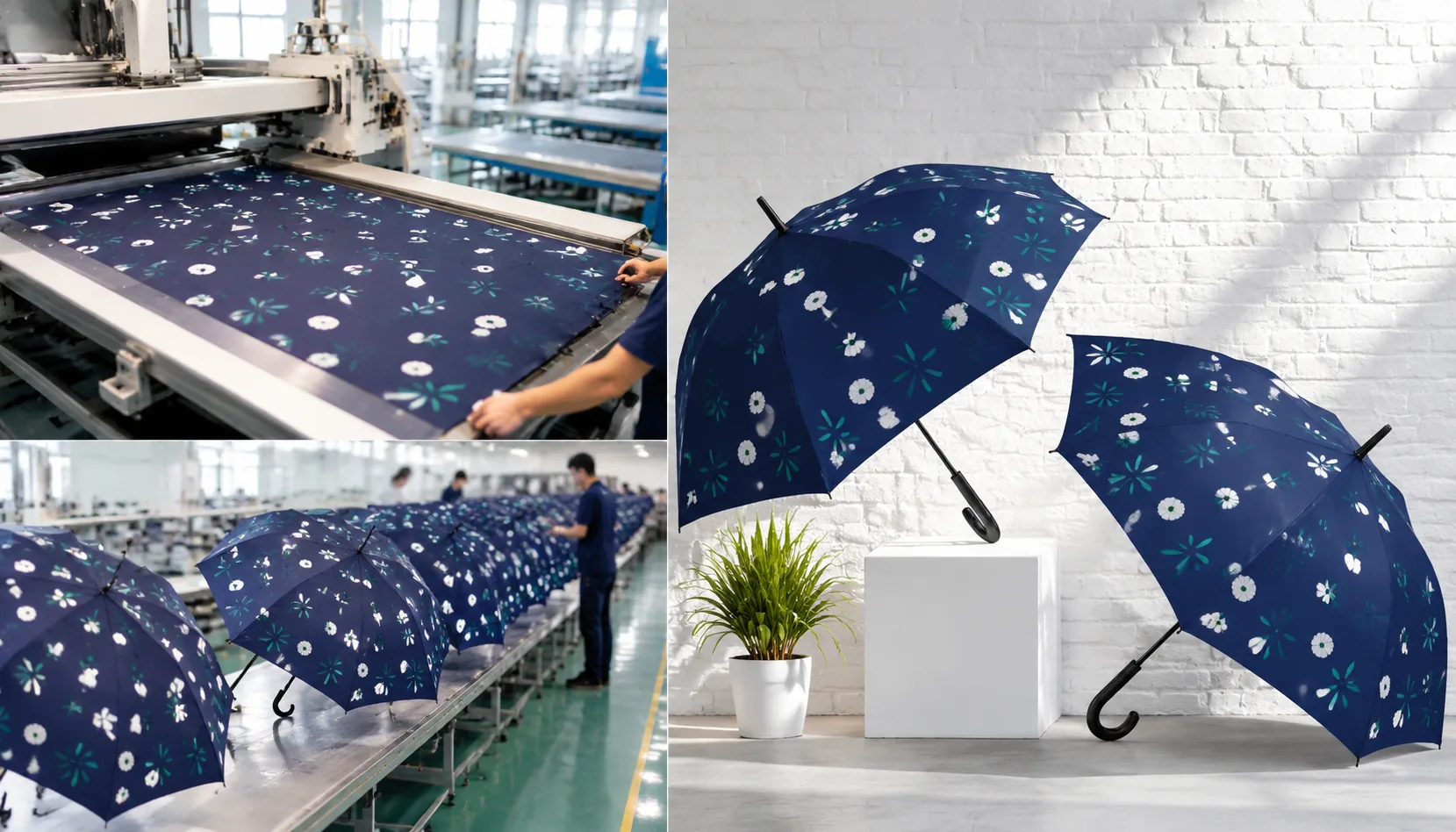
Sponsor campaigns look simple on a mockup, but repeated logos can drift across panel seams, crowd the cap area, or lose sharpness when the fabric and print method are mismatched. On our Songxia production floor, we plan step and repeat umbrellas by checking logo pitch against rib positions, choosing 190T or 210T fabric based on opacity and hand feel, and confirming samples before MOQ production moves into AQL inspection.
Why Step-and-Repeat Works for Sponsor Visibility
Repeat-logo layouts beat one oversized logo whenever the umbrella is moving, tilted, or partly blocked by people. At golf tournaments, outdoor festivals, hotel driveway activations, and sponsor-wall photo zones, cameras rarely see a perfectly flat canopy from straight above. They catch a 30-degree side angle, a cropped half-panel, or a guest holding the shaft low while walking. One large center logo can disappear into a fold or sit outside the frame. Step and repeat umbrellas solve that by placing sponsor marks across multiple ribs and panels, so at least two or three logos remain visible in most candid photos. For sponsor logo umbrellas, I usually tell buyers to think like a photographer, not like a catalog designer: the winning print is the one still readable in a shoulder-level shot from 10 to 25 feet away.
Viewing distance decides the logo size and spacing more than personal taste. For a 23-inch straight umbrella used near a hotel entrance, a 3.5- to 5-inch logo repeated across 8K panels is usually enough because guests and cameras are close. For a 27-inch or 30-inch golf umbrella on a tee box or festival field, sponsor marks often need to be 5 to 7 inches wide with stronger contrast, especially on 190T or 210T pongee where dark dye absorbs fine detail. Event umbrella printing also has to account for canopy curvature: a mark that looks centered on the cutting table may bend over the rib line after sewing. Good promotional umbrella patterns leave breathing room around each logo, avoid tiny registration marks, and keep repeat spacing consistent across seams so the canopy does not look like leftover fabric patched together.
Rib count changes the rhythm of the repeat logo canopy print. An 8K umbrella gives eight larger triangular panels, so the pattern feels bold and slower; it works well for one or two sponsors, especially with alternating panel colors or a diagonal repeat. A 16K frame creates narrower slices, which lets the print wrap in a denser, more premium rhythm, but it also increases sewing alignment risk because every panel edge becomes a visual checkpoint. On vented double-canopy windproof models, I avoid placing critical logo text too close to the vent overlap because the top layer can hide part of the repeat from low camera angles. Step and repeat umbrellas are strongest when the artwork is built panel-by-panel, not simply tiled across a circle, with enough tolerance for cutting, hemming, and the 2 to 3 mm movement that happens during canopy stitching.
Setting Logo Size, Spacing, and Panel Breaks
Logo height should be set from the real canopy panel, not from a flat circle mockup. On a 23" straight umbrella, one triangular panel usually gives about 430–470 mm of usable vertical print length after hemming; for step and repeat umbrellas, I normally keep sponsor marks at 45–70 mm high for readable photo distance without turning the canopy into one oversized billboard. For a 27" golf umbrella, 70–95 mm works better, especially with 8K or 10K frames where the panels are wider. Keep at least 18–25 mm clear from rib seams and 30–35 mm from the outer hem because sewing pull, bias stretch, and final tensioning can move the fabric a few millimeters. If the canopy is 190T or 210T pongee with Teflon coating, print gain is modest; on POE/PVC clear panels, small text below 8 pt often looks dirty after heat transfer or screen printing.
Repeat spacing has to follow the triangular geometry of the panels. A clean repeat logo canopy print usually uses staggered rows: the upper row centered near the panel spine, the next row shifted left or right so the layout does not form a stiff vertical stripe. For sponsor logo umbrellas, I prefer 1.2–1.6 times the logo width as horizontal spacing and 1.0–1.4 times logo height as vertical spacing, then adjust by panel count. On 8K umbrellas, each panel is broad enough for two medium logos across the lower third; on 16K frames, one centered logo per row is safer because the panel narrows quickly toward the top cap. Avoid placing logos where the runner stretch will distort the fabric when the umbrella opens; the worst zone is often the lower side of each panel near the seam, where tension is uneven after rib assembly.
Partial logos at panel edges are the mistake buyers notice first in event photos. For event umbrella printing, every repeat should either sit fully inside one panel or be intentionally split with a controlled match mark across the seam; accidental cropping looks cheap and is hard to repair after sewing. Our standard practice at ZheBrella is to add a seam-safe boundary on the print file, then nest the promotional umbrella patterns panel by panel before cutting, not after. Alternating panels also need a direction rule: either all logos face outward from the shaft, or opposite panels mirror the same reading direction for camera visibility. If artwork crosses panel breaks, we allow 3–5 mm bleed into the seam allowance and run a first-article canopy check before bulk production. For sponsor campaigns under AQL 2.5 inspection, I would reject inconsistent alignment over 5 mm because it becomes visible once eight panels meet at the top notch.
Choosing Fabric and Print Method for Clean Repeats
Clean repeats start with fabric choice, not the artwork file. For most step and repeat umbrellas, 190T pongee is the safest cost-performance base: tight enough for sharp sponsor marks, light enough for 21" and 23" folding umbrellas, and stable under normal screen-print curing. On white or light gray 190T, a repeat logo canopy print stays crisp if the logo stroke is above 0.3 mm and the gap between repeats is not too tight. Dark 190T needs an underbase for sponsor logo umbrellas, otherwise red, yellow, and light blue inks lose brightness after drying. I do not recommend cheap polyester taffeta for sponsor campaigns; it saves a few cents but shows more bleeding at panel seams and looks thin under venue lighting.
210T pongee gives better opacity and a smoother hand, especially on 27" and 30" golf umbrellas where the larger canopy exposes every registration mistake. The denser weave holds screen ink on the surface better, so black, navy, and metallic sponsor logos look cleaner after rub testing. For coated UPF 50+ fabrics, usually silver, black-out, or UV-coated pongee, opacity is excellent but ink adhesion becomes the risk. The coating can reject ink if the factory uses the wrong binder or skips surface testing. Our standard practice at ZheBrella is to run a tape test and wet-rub test before bulk event umbrella printing, especially when the canopy has Teflon water-repellent finish plus UV coating.
Screen printing is still the best method for limited-color promotional umbrella patterns: one to four solid Pantone colors, repeated across 8 panels, with tight control of logo size and spacing. It is faster, cheaper, and more durable than digital when the artwork is flat color, but every color needs its own screen and registration setup. Digital printing makes more sense for multi-logo sponsor sets, gradients, photo backgrounds, or sponsor walls where each panel carries different artwork. For step and repeat umbrellas with 10 or 20 sponsor names, digital avoids excessive screen charges and handles small type better, but buyers should approve a strike-off because sublimation and pigment digital prints can shift 5–10% in color depending on fabric coating and curing temperature.
Frame Specs That Support Event Use
For sponsor campaigns, the frame is what decides whether the umbrella survives the first windy parking-lot activation or becomes trash before the photo wall opens. I prefer fiberglass ribs for event use because they flex and recover; steel ribs are cheaper and feel solid, but they deform when a guest turns the canopy into a sail. A 23" 8K straight umbrella with fiberglass ribs and a steel shaft is the practical baseline for sponsor logo umbrellas: enough canopy area for a repeat logo canopy print, still easy for staff to hand out and collect. For golf formats, 27" or 30" frames give much better brand visibility, especially when the layout uses alternating logos across 190T or 210T pongee panels. If the brief calls for step and repeat umbrellas near entrances, VIP lines, or outdoor media zones, do not underspec the frame just to save a few cents; broken ribs are more visible than imperfect ink registration.
Auto-open mechanisms matter because event umbrellas are usually opened one-handed while holding a badge, phone, tote bag, or drink. A good automatic runner should lock cleanly without scraping the shaft, and the spring tension must be matched to canopy size; too weak feels cheap, too aggressive can shock the stitching at the top cap after repeated use. For event umbrella printing, I normally pair auto-open with a steel shaft on 23" straight models, or a stronger fiberglass shaft on larger golf umbrellas if wind exposure is expected. A 16K frame spreads load more evenly than 8K and gives a rounder canopy, which helps promotional umbrella patterns look more continuous across panel seams. The tradeoff is weight and cost: 16K is better for premium sponsor kits, outdoor festivals, and hospitality terraces; 8K is usually enough for indoor-outdoor conferences, hotel drop-offs, or short-duration street teams.
Double-canopy windproof golf frames are the safest choice when the umbrella will be photographed outdoors, because the vent lets gusts escape instead of flipping the ribs backward. A properly built 27" double-canopy frame with fiberglass ribs can be tested to survive 50+ mph gusts in a wind tunnel, but only if the vent overlap, rib tips, and runner lock are built correctly. Our standard practice at ZheBrella is to confirm frame performance before approving bulk print, because a perfect repeat pattern means little if the canopy inverts on-site. Compact folding umbrellas are better when the campaign goal is mass giveaway rather than staffed event coverage: 21" 3-fold auto-open-close models fit gift bags, reduce carton volume for DDP delivery, and work well for commuter audiences. They offer less print continuity than golf frames, so use simpler step and repeat umbrellas artwork with fewer small sponsor marks and stronger contrast.
Sampling, MOQ, and Quality Control Before Launch
Approve the artwork before talking about mass production dates, because sponsor layouts fail most often at the proofing stage, not on the sewing line. For step and repeat umbrellas, we normally ask for a vector file in AI, PDF, or EPS, with each sponsor logo converted to outlines and placed on the panel template at actual size. A digital proof should show logo spacing across all 8 panels, seam allowance, top cap position, and whether the pattern rotates continuously or resets on each panel. For event umbrella printing, I do not trust screen-view colors alone; Pantone references should be confirmed, especially for red, navy, orange, and metallic-looking sponsor marks that shift badly on 190T or 210T pongee.
A strike-off sample is the real checkpoint: one printed fabric panel, or one fully assembled umbrella if registration across seams is critical. For sponsor logo umbrellas, the buyer should check print sharpness at small logo sizes, repeat spacing near panel edges, and color consistency after the fabric is stretched over the frame. Typical MOQ bands are 300–500 pieces for digital heat-transfer or sublimation repeat logo canopy print, 1,000 pieces and up for economical screen printing, and 2,000–3,000 pieces when custom dyed fabric or special handles are involved. Practical lead time is 5–7 days for proofing, 7–10 days for strike-off or pre-production sample approval, then 25–35 days for bulk production after deposit and artwork lock.
Quality control has to be written into the order, not negotiated after cartons are packed. Under AQL 2.5, inspection should cover print registration from panel to panel, color consistency against the approved strike-off, rib alignment so logos do not twist when the umbrella opens, and packaging labels matching the PO, SKU, carton mark, and destination requirements. For promotional umbrella patterns, inspectors should open samples from multiple cartons, check 21-inch or 23-inch folding frames and 27-inch or 30-inch golf frames under normal tension, and confirm no ink transfer, ghosting, skipped print, or seam distortion. FOB orders need export carton marks and packing lists checked before vessel cutoff; DDP orders also need barcode, Amazon/FBA or retail label accuracy, and carton dimensions verified early enough to avoid relabeling at the warehouse.
Frequently Asked Questions
Can different sponsor logos be printed on each umbrella panel?
Yes, each panel can carry a different logo if the artwork is separated by panel and approved before cutting. Digital printing is usually better for many logos, while screen printing works best for fewer spot colors.
What is the safest MOQ for a step-and-repeat event umbrella order?
MOQ depends on size, frame, and print method, but custom printed event umbrellas often start around 500–1,000 pieces. Allow extra units for AQL inspection, sponsor approvals, and replacements.
How much spacing should there be between repeated sponsor logos on an umbrella canopy?
For most event umbrellas, buyers ask for logo repeats every 1–2 panels so the design reads clearly when open. The exact spacing depends on canopy size, logo width, and whether the print needs to stay visible across seams and ribs.
Should sponsor logo umbrellas use 190T or 210T fabric for step-and-repeat printing?
190T is common for cost-sensitive promotional orders, while 210T is preferred when you want a denser weave and better print sharpness. If the artwork has fine text or tight logo repeats, 210T usually gives a cleaner result.
What is a typical MOQ and sample process for repeat logo canopy print orders?
Many factories set MOQ around 500–1,000 pieces per design, but it can vary by umbrella style and print method. A pre-production sample is usually made after artwork approval, and sample lead time is often 5–10 days before bulk production.
Looking to Launch Your Custom Umbrella Line?
ZheBrella is a Zhejiang-based OEM/ODM umbrella manufacturer with 17 years of export experience. Free design, low MOQ from 100 pieces, windproof construction, full-color print.
Get Free Quote Now »People Also Search For
Related Articles
Step-and-Repeat Umbrella Patterns for Brand Campaigns
Plan repeating logo umbrella patterns with panel layout, print sizing, color control, MOQ, sampling, and QC checks for r...
Read More »
Step-and-Repeat Logo Patterns for Promotional Umbrellas
Plan repeat-logo umbrella artwork with correct scale, panel breaks, 190T/210T fabric choices, proofs, MOQ, lead times, a...
Read More »
Step-and-Repeat Umbrella Logo Patterns for Campaigns
Plan repeat-logo umbrella layouts across 8K or 16K panels with cleaner seams, better spacing, accurate samples, and smoo...
Read More »