Step-and-Repeat Logo Patterns for Promotional Umbrellas
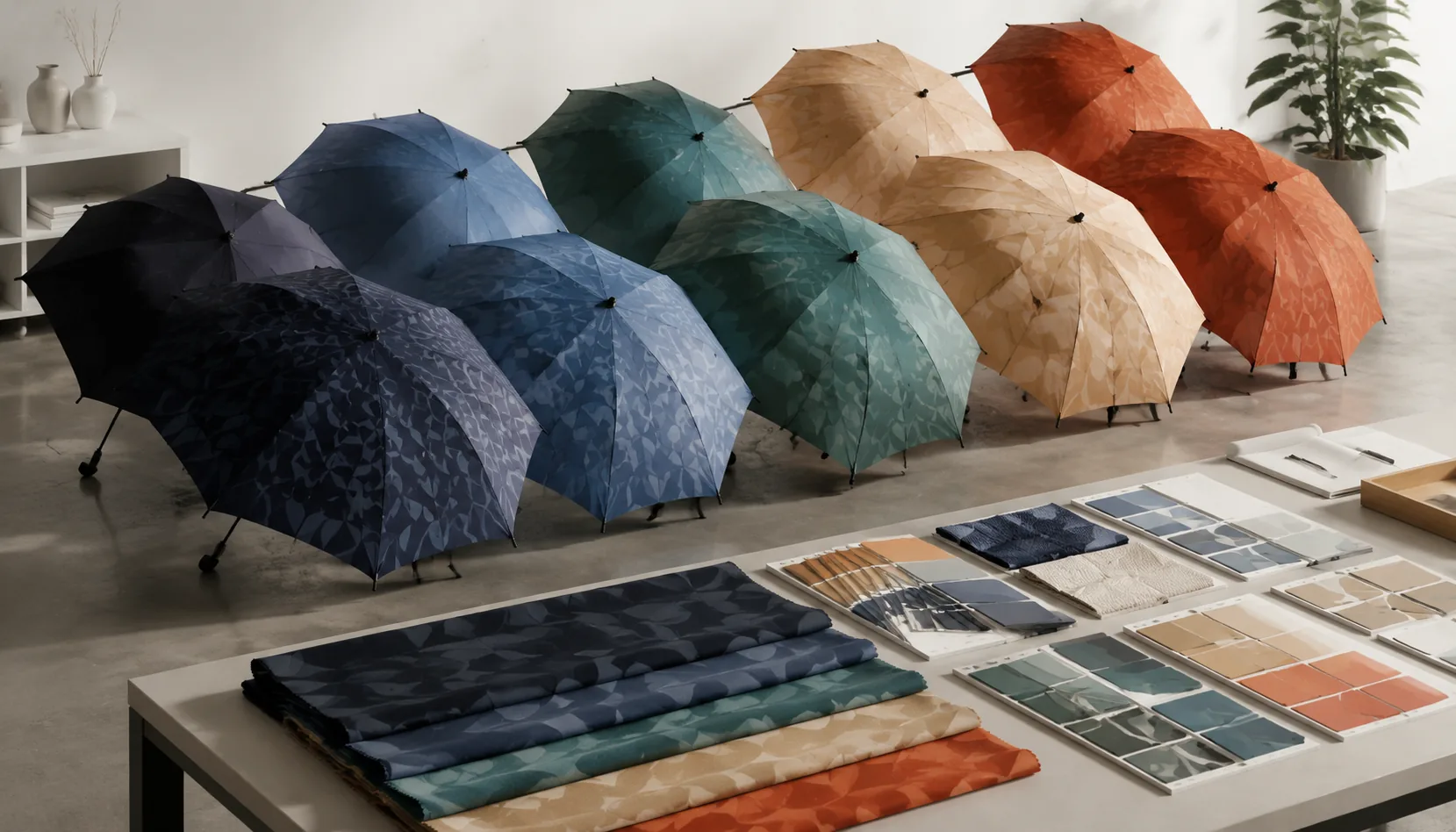
A repeat-logo umbrella looks simple on a mockup, but on the cutting table every panel break, seam allowance, fabric stretch, and color hit can shift the pattern. For step and repeat umbrella printing, buyers need to lock scale, fabric choice, proofing, MOQ, lead time, and AQL checkpoints before bulk cutting starts, or a clean brand pattern can turn into mismatched panels and costly rework.
Why Repeat Logos Work for B2B Umbrella Branding
Repeat logos work because an umbrella is a moving, curved billboard, not a flat poster. A single oversized mark can look good in a PDF mockup but distort across 8K panels, seam allowances, and canopy tension, especially on 23" and 27" pongee umbrellas. With step and repeat umbrella printing, the brand mark is scaled smaller and tiled across each panel, so visibility survives from multiple viewing angles: opened above a trade show queue, carried through a stadium concourse, parked in a hotel lobby stand, or photographed at a golf event. For banks and insurance companies, the pattern also feels more conservative than a huge chest-thumping logo, which matters when the umbrella is handed to employees, VIP clients, or branch visitors.
A good repeat logo umbrella layout uses spacing discipline. On 190T or 210T pongee, I usually prefer a 35–70 mm logo width for corporate marks, with enough negative space that the canopy does not become visual noise. Dense patterns suit retail drops and fashion collaborations; wider grids fit hotels, universities, and financial clients. For promotional umbrella printing, the method also helps when the buyer wants brand recognition but does not want every panel to shout. You can place a full-size logo on one or two panels and use a branded canopy pattern on the remaining panels, which gives both close-range identity and long-range readability without making the product look cheap.
Production method affects how clean the pattern looks. Screen printing is cost-effective for 1–3 spot colors and larger MOQs, but registration must be controlled carefully when the repeat crosses panel edges. Heat transfer handles sharper multicolor logos on smaller runs, while sublimation works best on white polyester when the buyer wants full-panel logo pattern umbrellas with gradients or all-over coverage. Our standard practice at ZheBrella is to approve the repeat on a cut-panel template, not only on a round top-view mockup, because ribs, tips, Velcro straps, and sewn seams all interrupt the artwork. For B2B orders, that prepress check prevents the most common mistake: a neat digital pattern that becomes crooked once the canopy is stitched and tensioned.
Artwork Scale, Spacing, and Panel Break Rules
The safest scale for a repeated umbrella logo is smaller than most brand teams first request. On a 23" straight umbrella with 8K panels, I usually keep each mark 45–70 mm wide for a dense step-and-repeat field, or 80–120 mm if the buyer wants the logo readable in event photos from 3–5 meters. For compact 21" folding umbrellas, reduce that by roughly 15%; for 27" and 30" golf umbrellas, 100–150 mm marks can still look balanced. Spacing should be measured between the visual edges of the logos, not the artboard boxes: 35–60 mm works for tight promotional umbrella printing, while 70–110 mm gives a more premium branded canopy pattern. If the logo has long text, test it on a panel-shaped template, because a rectangle layout on screen will distort once the pongee 190T/210T canopy is tensioned over ribs.
Panel count changes the artwork logic. An 8K umbrella gives wider triangular panels, so a repeat logo umbrella can carry two or three staggered marks per panel without looking chopped up. A 16K frame has narrower slices and twice as many rib paths, which makes full-pattern alignment harder but creates a finer, more tailored look when the logo is small, usually 35–55 mm. For step and repeat umbrella printing, the repeat should be built from the centerline of each panel outward, not as one continuous flat fabric pattern, unless the factory is sublimating before cutting and has very accurate cutting registration. Screen printing after sewing is simpler for single-position logos, but for all-over logo pattern umbrellas, sublimation on white pongee gives cleaner coverage and fewer placement fights around seams.
Seam allowance is where many nice mockups fail. Each panel normally loses 7–10 mm per side into sewing, and the rib path visually hides another narrow strip once the canopy is assembled, so keep complete logos at least 15–20 mm away from cut lines and rib seams. Add 10–15 mm bleed beyond the cut shape for sublimation or heat-transfer layouts, but do not place important letters, QR codes, or fine taglines in that bleed. Our standard practice at ZheBrella is to mark a no-logo zone along every panel edge and then shift the repeat so partial marks fall only where they look intentional, not randomly sliced through a brand name. Before bulk production, request a 1:1 panel proof and one sewn pre-production sample, especially on double-canopy vented windproof umbrellas where upper and lower canopy layers can expose different alignment tolerances.
Fabric and Print Method Choices for Pattern Clarity
Fabric choice decides whether a small repeat mark looks intentional or turns into a fuzzy stain. For step and repeat umbrella printing, 190T pongee is usually the safest commercial baseline: tight enough for clean edges, light enough for folding umbrellas, and stable under normal screen-print curing. 210T pongee gives a smoother hand and slightly better line definition, especially on 23" and 27" canopies where the logo tile repeats across wider panels. Plain polyester can work for budget promotional umbrella printing, but lower-density cloth often drinks ink unevenly and shows more feathering around 1 mm strokes. I tell buyers not to approve a dense branded canopy pattern on cheap shiny polyester unless they have seen a strike-off under daylight and rain-spray testing.
Coated fabrics need more caution because the coating that adds function can fight the ink. UPF 50+ silver or black coating is usually on the underside, so outside printing on pongee remains practical, but heavy water-repellent or Teflon-style finishing can reduce ink grip if the surface energy is too low. PVC, POE, and EVA clear umbrellas are a different category: they can hold sharp logo pattern umbrellas visually, but ink selection must match the film or the print can crack at rib folds after opening cycles. Our standard practice at ZheBrella is to test adhesion with cross-hatch tape, wet rub, and 24-hour drying before bulk cutting, because a repeat logo umbrella has many small logos and one weak ink batch makes defects obvious across every panel.
Screen printing is efficient when the repeat uses 1–2 solid colors, especially white, black, navy, or a matched Pantone on 190T/210T pongee. The setup cost is spread well once MOQ reaches roughly 500–1,000 pieces, and it gives strong opacity on dark canopy cloth. Digital printing is the better choice for gradients, fine outlines, multicolor icons, photographic motifs, or irregular step and repeat umbrella printing where each panel needs precise scaling. Sublimation works best on white polyester or white pongee because the dye enters the fiber and keeps a soft hand, while direct digital pigment gives more flexibility on colored fabric but needs proper pretreatment and curing. For complex branded canopy pattern work, I prefer digital sampling first, then lock the tile size, panel orientation, and seam allowance before mass cutting.
Sampling, Color Control, and Bulk Inspection
A pre-production strike-off is where most repeat logo umbrella problems should be caught, not after 3,000 canopies are sewn. For step and repeat umbrella printing, we normally approve one printed fabric swatch and one assembled umbrella sample because flat-panel registration can look acceptable before the canopy is tensioned over 8K or 16K ribs. The buyer should provide Pantone Solid Coated references for spot colors, or LAB values if the brand has strict retail standards. On 190T or 210T pongee, I like to hold most corporate colors within Delta E 2.0–3.0; on darker substrates or Teflon-coated fabric, Delta E 4.0 may be more realistic unless we print a white underbase. For heat-transfer logos, the strike-off must also confirm edge sharpness after pressing, because excess temperature can make small text spread by 0.2–0.5 mm.
Pattern registration needs a written tolerance band before bulk cutting starts. For a repeat logo umbrella, we check whether the branded canopy pattern crosses panel seams cleanly, whether the logo axis stays consistent from panel to panel, and whether the main visible logo falls too close to the rib seam or hem. On a 23" or 27" umbrella, a 3–5 mm registration shift may be acceptable for small repeat marks, but it is not acceptable for a large centered logo that should align with the front viewing panel. Our standard practice at ZheBrella is to mark one approved canopy as the golden sample, then compare bulk output against it under D65 light, not under random workshop lighting. For promotional umbrella printing, we also rub-test wet ink areas and inspect for smearing, ghosting, pinholes, and transfer-film residue before sewing.
Bulk inspection under AQL 2.5 should include both printed panels and finished umbrellas, because logo pattern umbrellas can fail after assembly even when the fabric looked clean on the inspection table. During final inspection, we open the umbrella fully and check for off-center panels, skewed repeats, distorted circles or squares, and logos stretched by uneven sewing tension. Double-canopy vented windproof models need extra attention because the top vent layer can hide a misaligned lower pattern until the umbrella is opened. I also check the runner action, rib tips, cap, tie wrap position, and panel symmetry because a crooked frame makes a good print look defective. Serious defects include wrong Pantone shade, obvious ghosting, missing logos, upside-down panel placement, or a front logo rotated more than 5 degrees from the approved sample.
MOQ, Lead Time, and Cost Drivers to Quote Early
Price moves fastest when the artwork changes from a simple one-color repeat logo umbrella to a full branded canopy pattern with tight registration. For screen printing, each spot color needs its own film, screen, setup, and wash-down time; a 2-color pattern across 8 panels is not priced like a small chest logo. Heat transfer handles gradients better, but large coverage raises transfer paper cost and pressing labor. Sublimation is the cleanest route for all-over logo pattern umbrellas on white 190T or 210T pongee, but it requires panel printing before sewing and tighter shade control between panels. Coverage matters as much as color count: a 15 cm corner repeat is cheap, while edge-to-edge step and repeat umbrella printing can add 20–45% depending on ink load, reject risk, and whether the pattern must match across seams.
The umbrella specification should be quoted together with the print, not after it. A 21 inch compact with steel ribs and manual open is a different cost base from a 23 inch auto-open stick umbrella or a 30 inch golf umbrella with 8K fiberglass ribs and a double-canopy vent. Steel ribs keep cost down for indoor events and short campaigns, while fiberglass ribs are worth it when the buyer wants a windproof claim, often tested around 40–50+ mph depending on frame design. Auto-open and auto-open-close mechanisms add spring, runner, shaft, and QC cost, especially on compact models where tolerances are less forgiving. Packaging also matters: bulk polybag is basic, but individual color boxes, kraft sleeves, retail hangtags, silica gel, barcode labels, and carton drop-test requirements all affect unit price and packing labor.
For planning, most promotional umbrella printing projects start at 300–500 pieces per design for standard screen or heat-transfer work, while full-panel sublimation or custom-dyed canopy programs are usually cleaner at 500–1,000 pieces. Sampling normally takes 5–7 days for a plain frame with printed strike-off, or 10–15 days if we need a full canopy prototype with repeat alignment checked after sewing. Bulk lead time is typically 25–35 days after sample approval for standard logo pattern umbrellas, and 35–50 days in peak season or when custom packaging is involved. Our standard practice at ZheBrella is to quote both FOB Ningbo/Shanghai and DDP when the buyer gives destination ZIP code, carton mark rules, and target delivery date; DDP is useful for event deadlines, but FOB gives procurement teams cleaner control over freight and import handling.
Frequently Asked Questions
Can a repeat logo pattern align perfectly across every umbrella panel?
Exact cross-seam alignment is difficult because each canopy panel is cut and sewn separately. A factory should design the repeat with safe spacing and inspect panel registration during AQL 2.5 checks.
Is screen printing or digital printing better for repeat-logo umbrellas?
Screen printing is usually more cost-effective for simple 1–2 color repeats at volume. Digital printing is better for gradients, many colors, or dense all-over logo patterns.
What logo size works best for a step-and-repeat umbrella canopy?
For most 8-panel promotional umbrellas, a repeat logo width of 3 to 6 inches works well because it stays visible without looking crowded. Larger golf umbrellas can usually handle 5 to 8 inch repeats, depending on the panel width and seam allowance.
Should a repeat logo pattern cross umbrella panel seams?
It can, but it is usually safer to design the repeat inside each panel to avoid misalignment at stitched seams. If the pattern must cross seams, request a full canopy proof and allow a tolerance of about 3 to 5 mm in bulk production.
What MOQ and lead time should buyers expect for repeat logo umbrellas?
Typical OEM orders start around 500 to 1,000 pieces per design, depending on fabric, frame, and print method. Sampling usually takes 5 to 10 days, while bulk production often takes 25 to 40 days after artwork approval and deposit.
Looking to Launch Your Custom Umbrella Line?
ZheBrella is a Zhejiang-based OEM/ODM umbrella manufacturer with 17 years of export experience. Free design, low MOQ from 100 pieces, windproof construction, full-color print.
Get Free Quote Now »People Also Search For
Related Articles
Step-and-Repeat Logo Patterns for Branded Umbrella Canopies
Plan repeated logo umbrella canopies with clean spacing, panel registration, fabric choices, sampling steps, and AQL che...
Read More »
Step-and-Repeat Umbrella Printing for Sponsor Campaigns
Plan sponsor-ready step-and-repeat umbrella prints with logo spacing, panel seams, 190T/210T fabric choices, MOQ, sample...
Read More »
Step-and-Repeat Umbrella Logo Patterns for Campaigns
Plan repeat-logo umbrella layouts across 8K or 16K panels with cleaner seams, better spacing, accurate samples, and smoo...
Read More »