Step-and-Repeat Umbrella Logo Patterns for Campaigns
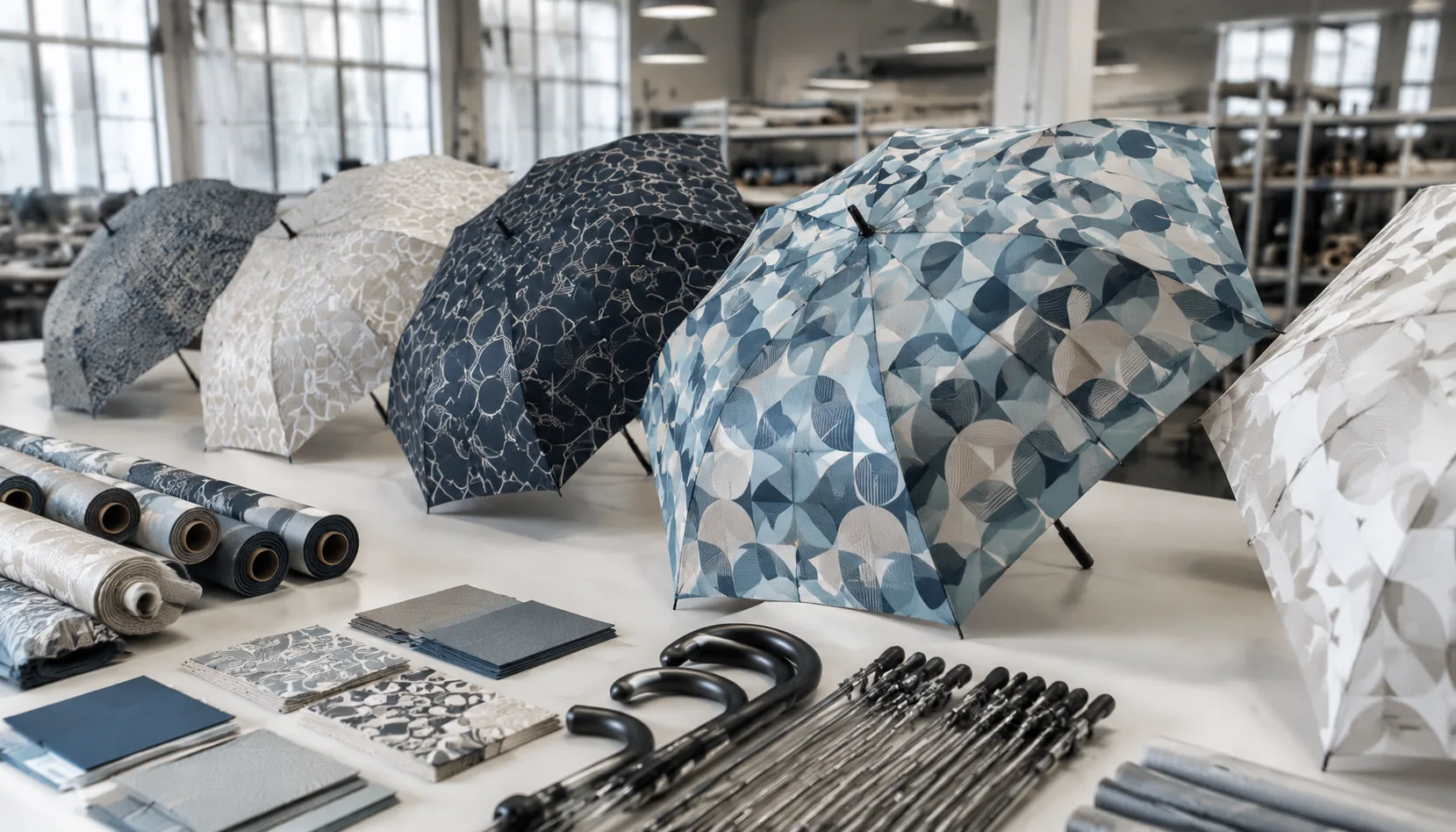
Repeat-logo umbrellas look simple on a mockup, but panel count, rib position, fabric stretch, and seam allowance can make a campaign pattern drift badly in production. On our Songxia factory floor, step and repeat umbrella printing starts with locking the logo grid to each 8K or 16K panel, then checking how the artwork meets at the cut edges before screens, digital print files, or strike-off samples move forward.
Why Repeat Patterns Work for Promotional Umbrellas
Repeat layouts work because umbrellas are moving, rotating media, not flat posters. At a sports event or outdoor trade show, a single logo on one panel disappears every time the user turns the shaft or tilts the canopy against rain. With repeat logo umbrellas, the brand stays visible from more angles because the mark is distributed across 8K or 16K panel positions instead of relying on one “hero” panel. For most campaign orders, I prefer a controlled repeat at 80–120 mm logo width on 23" or 27" pongee canopies; it reads cleanly at 10–20 meters without turning the umbrella into a messy wallpaper sample.
Step and repeat umbrella printing is especially useful for hotel programs, golf tournaments, stadium giveaways, and retail collaborations where many umbrellas appear together in photos. Ten guests entering a hotel lobby with matching branded umbrella patterns create a stronger visual block than ten umbrellas with small, isolated panel marks. On dark 190T or 210T pongee, white or metallic ink repeats pop well, while sublimation on light panels allows tighter color matching for retail artwork. The panel logo layout must account for seam loss, rib shadows, and the natural curve of the canopy; we normally keep critical logo elements at least 15–20 mm away from stitched seams.
Promotional umbrella printing needs discipline, because more logos also means more chances for distortion and registration issues. Screen printing is cost-effective for one- or two-color repeats, but each panel must be jigged consistently before sewing or the pattern will crawl around the canopy. Heat transfer works for sharper multicolor marks, while full sublimation is better for all-over branded umbrella patterns on white polyester. For campaign quality control, AQL 2.5 inspection should include logo spacing, color tolerance, panel orientation, and open-canopy viewing at normal standing distance—not just flat-panel checks before assembly.
Mapping Logo Repeats Across 8K and 16K Panels
Panel count decides whether a repeat looks intentional or chopped up. On a standard 23" 8K umbrella, each canopy panel gives a wider triangular print field, so a 70–90 mm logo can breathe without fighting the ribs. The same artwork on a 16K frame is split into narrower wedges; spacing must tighten, logo height often drops to 45–60 mm, and the pattern needs more offset planning so it does not create a heavy visual band near the crown. For step and repeat umbrella printing, I usually start from the finished panel shape, not a flat circle, because the usable area changes after sewing tension pulls the pongee. A clean panel logo layout keeps the repeat aligned to the rib direction and avoids placing full logos across panel joins unless the buyer accepts small registration breaks.
Seams are the enemy of small text, thin icon strokes, and registered trademarks. The safe rule is simple: keep critical logo details at least 10–15 mm away from stitched seams, including the two long radial seams and the reinforced tip area. On 190T or 210T pongee, even good sewing can shift 2–4 mm from panel to panel, and heat-transfer film can thicken slightly near folded seam allowances. With repeat logo umbrellas, I prefer using partial logo crops only as background texture, never for legal marks or sponsor names. If the campaign requires many sponsors, an 8K canopy usually gives better readability; if the goal is a luxury all-over texture, 16K branded umbrella patterns can look more refined because the ribs create a tighter rhythm.
Print method also affects repeat spacing. Screen printing is efficient for one- or two-color promotional umbrella printing, but each panel is printed separately, so the artwork should tolerate minor left-right variance. Sublimation handles dense step repeats better on white polyester because the pattern can cover edge-to-edge before cutting, but exact seam matching still needs tolerance. At ZheBrella, our standard artwork check marks the live logo zone, seam allowance, tip cap, runner shadow area, and the visible arc after the umbrella is open. For step and repeat umbrella printing, I ask buyers to approve both a flat panel proof and an open-canopy mockup, because a repeat that looks balanced on a PDF can crowd badly once the 8K or 16K frame stretches the fabric into a dome.
Fabric and Print Method Choices for Pattern Clarity
For step and repeat umbrella printing, fabric choice affects edge definition more than most buyers expect. 190T pongee is the common promotional grade: light, smooth enough for clean ink transfer, and cost-efficient for 21" and 23" folding umbrellas or event giveaways. It works well when the logo repeat has moderate spacing, solid shapes, and no tiny legal text. 210T pongee has a tighter weave and slightly heavier hand feel, so the canopy feels more retail-grade and the printed edge usually holds better after water-repellent finishing. On a dense panel logo layout, especially across 8K or 10K panels, 210T reduces the fuzzy edge you sometimes see when ink bridges yarn gaps on lower-density fabric. If the order is for executive gifts, retail shelves, or brand campaigns where people will photograph the umbrella close-up, I push buyers toward 210T pongee with a clean Teflon-type water-repellent finish instead of chasing the lowest FOB price.
Screen printing is still the right method for simple repeat logo umbrellas when the artwork uses 1 to 3 solid colors, consistent spacing, and logos large enough to register cleanly on curved panels. It gives strong opacity on dark navy, black, red, or bottle-green pongee, and the unit cost is sensible once the MOQ reaches 500 to 1,000 pieces per design. The limitation is registration: every color needs a separate screen, and small misalignment becomes obvious when branded umbrella patterns repeat across all 8 panels. Our standard practice at ZheBrella is to keep screen-printed repeat marks away from rib seams by at least 12 to 18 mm, because stitching, panel stretch, and heat setting can distort a logo that sits too close to the seam line.
Digital printing is better when promotional umbrella printing needs gradients, full-color logos, camouflage-style repeats, small icons, or dense all-over patterns. Sublimation on white 190T or 210T pongee gives the cleanest color transitions because the dye bonds into the yarn surface instead of sitting as a thicker ink layer. For dark canopies, heat-transfer or digital film methods can work, but they add hand feel and may not fold as softly after 500 open-close cycles, especially on compact auto-open-close frames. For step and repeat umbrella printing with tight repeats, I recommend a printed strike-off before bulk cutting, not just a PDF approval, because the panel curve changes visual spacing after sewing. AQL 2.5 inspection should include logo position tolerance, color ΔE target, rubbing check, and water-drop testing after print curing.
Sampling, Tolerance, and Bulk Quality Checks
Strike-off sampling is where step and repeat umbrella printing either becomes controllable or turns into a bulk argument. For repeat logo umbrellas, I do not trust a flat artwork proof by itself because the logo grid changes once it is cut into 8 panels and sewn onto a curved canopy. A proper sample package should include a digital layout proof with panel logo layout dimensions, Pantone or LAB color targets, logo repeat spacing, seam allowance, and confirmed print method: screen print for solid spot colors, heat transfer for sharper small marks, or sublimation for all-over polyester graphics. For a 23" manual or auto-open umbrella in 190T pongee, we normally check whether the logo repeat crosses seams cleanly, whether center cap and rib tips interrupt key marks, and whether each panel is printed in the same grain direction. If the campaign involves 16K golf umbrellas or a double-canopy vented windproof frame, sampling must include both canopy layers because the lower vent can hide or distort part of the branded umbrella patterns.
Color drift needs to be measured before bulk fabric is cut, not after 5,000 canopies are sewn. On production runs, ink behavior changes between 190T pongee, 210T pongee, POE, PVC, and EVA because surface energy and coating differ; Teflon water-repellent finishing and UV UPF 50+ coatings can also reduce ink adhesion if pretreatment is skipped. For promotional umbrella printing, I like to approve one strike-off under D65 light and one assembled umbrella under normal indoor light, because buyers judge campaign photos more than lab cards. Acceptable tolerance should be written into the purchase order: print position within ±3 mm on standard 21"/23" folding and straight umbrellas, ±5 mm on 27"/30" golf umbrellas, and color drift within Delta E 2.0–3.0 depending on brand strictness. Ink adhesion should pass a cross-hatch tape test after 24 hours of curing, plus a wet rub check if the umbrellas will be used at outdoor events.
Bulk inspection should follow AQL 2.5 for major defects, with print defects separated from frame and sewing defects so nobody hides bad artwork under a general pass result. During final inspection, pull cartons across the run, not just from the top pallet, and open umbrellas fully to check print position, color consistency, ink cracking at rib folds, panel-to-panel registration, skipped logos, ghosting, pinholes, and contamination. For step and repeat umbrella printing, the most common failure is not one ugly panel; it is gradual screen stretch or transfer placement creep that makes the first 500 pieces look approved and the last 2,000 pieces look shifted. Our standard practice at ZheBrella is to keep the approved strike-off, signed layout proof, and first-piece sample at the printing table, then record in-line checks every 300–500 pieces before sewing. Final cartons should also be checked for SKU mix, handle color, manual or auto-open mechanism, rib count such as 8K/10K/16K, and export marks before FOB Ningbo or Shanghai, or DDP shipment release.
MOQ, Lead Time, and Shipping Planning
All-over repeat designs usually need a higher MOQ than a single-panel logo because the risk is in fabric control, not just printing setup. For a standard single-logo umbrella, many factories can run 300–500 pcs per color on 190T or 210T pongee with screen printing or heat transfer. For repeat logo umbrellas, I normally advise 1,000 pcs as a practical starting MOQ, and 2,000–3,000 pcs if the artwork needs exact registration across 8K or 16K panels. Step and repeat umbrella printing also wastes more fabric during cutting because the panel logo layout must stay consistent after sewing; if the logo is too close to the seam allowance, you will see drift from panel to panel. For retail or political campaigns, lock the umbrella size first—21" folding, 23" stick, 27" golf, or 30" oversized—because the same branded umbrella patterns do not scale cleanly across different panel shapes.
Sampling should be treated as part of the schedule, not an optional preview. A digital mockup can be done in 1–2 days, but a real printed canopy sample usually takes 7–10 days for heat transfer, 10–14 days for screen printing, and 12–18 days for sublimation if strike-off approval is required. Bulk production for promotional umbrella printing is typically 20–30 days after sample approval for 1,000–5,000 pcs, assuming standard steel or fiberglass ribs, manual or auto-open frames, and available pongee stock. Add 5–7 days if you need Teflon water-repellent coating, UPF 50+ treatment, custom EVA/POE/PVC packaging, or mixed frame colors. Our standard practice at ZheBrella is to check repeat alignment during pre-production and again under AQL 2.5 inspection, because a beautiful repeat pattern on flat fabric can still look uneven after rib tips, top notch, and runner tension pull the canopy into shape.
For campaign deadlines, plan backward from the event date and decide early whether FOB or DDP makes more sense. FOB Ningbo or Shanghai is cleaner when the buyer already has a freight forwarder; allow 3–5 days for factory packing, customs documents, and port delivery after final inspection. DDP is easier for distributors shipping to offices, campaign warehouses, or event venues, but the quote must include carton dimensions, HS code, duties, last-mile delivery, and whether the destination needs liftgate service or appointment booking. Sea freight to the U.S. commonly needs 25–35 days port-to-port plus clearance and domestic trucking, while air freight is usually 5–9 days but can cost more than the umbrella on low-value 21" folders. For step and repeat umbrella printing tied to a launch date, approve samples at least 60 days before use for ocean freight and 35–40 days before use if you are willing to pay for air or split shipment.
Frequently Asked Questions
Can a repeat logo pattern continue perfectly across umbrella seams?
Not perfectly. Umbrella panels are cut and sewn individually, so buyers should allow small seam breaks and keep important logo details away from stitch lines.
Is screen printing or digital printing better for repeat-logo umbrellas?
Screen printing is cost-effective for simple one- or two-color repeats. Digital printing is better for full-color patterns, gradients, or smaller logo repeats across multiple panels.
Should repeat-logo artwork be prepared differently for 8K and 16K umbrellas?
Yes. An 8K umbrella has larger panels, so logos can be bigger with fewer seam breaks, while a 16K layout needs smaller repeats and tighter spacing control. For bulk orders, artwork should be reviewed on the exact panel template before sampling.
How do factories control logo alignment across umbrella seams?
Factories usually add seam allowances and position the repeat pattern so critical logo elements do not sit directly on stitch lines. A pre-production sample is recommended to confirm spacing, panel matching, and visual balance before mass production.
What is a typical approval process for step-and-repeat umbrella printing?
The usual process is digital mockup, artwork template confirmation, sample printing, buyer approval, then bulk production. Sampling often takes 7–10 days, and bulk lead time is commonly 25–40 days depending on order quantity and print complexity.
Looking to Launch Your Custom Umbrella Line?
ZheBrella is a Zhejiang-based OEM/ODM umbrella manufacturer with 17 years of export experience. Free design, low MOQ from 100 pieces, windproof construction, full-color print.
Get Free Quote Now »People Also Search For
Related Articles
Step-and-Repeat Umbrella Patterns for Brand Campaigns
Plan repeating logo umbrella patterns with panel layout, print sizing, color control, MOQ, sampling, and QC checks for r...
Read More »
Step-and-Repeat Logo Patterns for Branded Umbrella Canopies
Plan repeated logo umbrella canopies with clean spacing, panel registration, fabric choices, sampling steps, and AQL che...
Read More »
Step-and-Repeat Umbrella Printing for Sponsor Campaigns
Plan sponsor-ready step-and-repeat umbrella prints with logo spacing, panel seams, 190T/210T fabric choices, MOQ, sample...
Read More »