Property Management Umbrellas for Leasing and Residents

For apartments and mixed-use properties, umbrellas fail in very visible places: leasing tours, resident loaner bins, lobby exits, and shuttle stops. Specifying property management umbrellas means balancing low unit cost with frames that survive repeated borrowing, branding that reads clearly at a distance, and replenishment plans that do not leave empty stands after the first storm. On our factory floor in Songxia, we see the difference in QC details: rib strength, runner fit, fabric tension, and logo placement all decide whether the program feels managed or disposable.
Identify Where Umbrellas Add Value in Multifamily Properties
The first place property management umbrellas earn their keep is the leasing path: curb to lobby, model unit to amenity deck, and parking garage back to the office. A leasing associate walking a prospect through rain with a sturdy 23" or 27" auto-open umbrella looks prepared; handing them a flimsy giveaway umbrella with 6 steel ribs looks cheap when it flips at the first gust. For leasing office umbrellas, I would specify 190T or 210T pongee, fiberglass ribs, a straight EVA or rubberized handle, and a vented double-canopy if the property has open courtyards or waterfront wind. Keep the logo clean and small—this is an operational tool, not a walking billboard. In our factory inspections, the common failures on shared-use umbrellas are loose tips, weak runner springs, and cracked plastic handles, so these details matter more than adding another print color.
Resident loaner programs need a different mindset from promotional giveaways. Branded loaner umbrellas should be durable, easy to track, and consistent in appearance at the concierge desk, package room, valet stand, shuttle stop, and garage elevator lobby. A 27" golf umbrella with 8K fiberglass ribs works well for two adults walking from a parking garage, while compact 21" auto-open-close units fit better for apartment resident umbrellas kept behind the front desk. If the property is in a high-wind market, I would move to 10K ribs or a double-canopy vented design rated around 50+ mph in wind-tunnel testing, not because residents will read the spec sheet, but because maintenance staff will notice fewer broken returns. Dark navy, charcoal, or black hides wear better than white, and a name/room log or simple tag system reduces disappearance.
Move-in welcome kits and premium resident gifts belong in a separate sourcing bucket from daily-use operational stock. A welcome-kit umbrella can use a nicer sleeve, color-matched canopy, UPF 50+ coating, or Teflon water-repellent finish because it is part of the resident experience, not a tool being opened 20 times a day. For multifamily amenity sourcing, I usually recommend three tiers: low-cost promotional compact umbrellas for events, mid-duty property management umbrellas for leasing and loaner use, and premium 23" or 27" gifts for lease renewals, VIP residents, or furnished units. The MOQ and lead time change with that choice: stock-color pongee with one-position screen print can often move faster, while custom canopy colors, sublimation panels, or special handles add sampling time and usually push production toward 25–35 days after artwork approval.
Specify Durable Models for Repeated Daily Handling
For property management umbrellas that will be touched by residents every day, I would not start with a cheap 3-fold pocket model. Front-desk loaners need 23" or 25" stick umbrellas with 8K or 10K ribs, auto-open shafts, 190T or 210T pongee canopy fabric, and a straight EVA or rubberized handle that still feels clean after repeated use. The auto-open mechanism matters because residents often grab the umbrella with one hand while holding packages, a dog leash, or a phone. In factory testing, the weak points are usually the runner, spring, and rib tip stitching, not the logo panel, so we specify reinforced runner notches and bar-tacked canopy joints for loaner programs.
For leasing tours, concierge escorts, and rainy move-in days, 16K golf umbrellas are the safer choice. A 27" or 30" arc gives enough coverage for two people walking from the leasing office to a model unit or parking garage, and the extra ribs keep the canopy round instead of sagging at the edges. These leasing office umbrellas should use fiberglass ribs and stretchers if the property is in a windy market, especially coastal, lakefront, or high-rise locations. A vented double-canopy design can survive 50+ mph wind-tunnel testing when built correctly, while a single-canopy steel frame may invert sooner and stay bent afterward.
Fiberglass costs more than steel, but it reduces replacement frequency in branded loaner umbrellas because it flexes and returns instead of permanently deforming. Steel ribs are acceptable for low-wind indoor-to-garage use and tighter multifamily amenity sourcing budgets, but they add weight and show rust faster if wet umbrellas are returned without drying. Our standard practice at ZheBrella is to quote both options with the same canopy and print method so buyers can compare real unit cost against expected service life. For apartment resident umbrellas, I would rather buy fewer fiberglass 10K sticks than a larger batch of steel frames that start failing before the first rainy season is over.
Choose Branding That Fits the Property Experience
Branding should match how the umbrella is actually used on the property, not just how it looks in a mockup. For Class A or luxury apartments, I usually recommend a restrained approach: one-color logo on one or two panels, tone-on-tone ink on black or navy 190T/210T pongee, or a small woven label sewn into the canopy edge. A 23" auto-open stick umbrella with a fiberglass shaft and ribs feels more resident-friendly than a cheap 21" steel compact, and it photographs better in lobby storage. Matte black EVA handles, rubberized straight handles, or wood-look crook handles all change the perceived value before the canopy is even opened. For leasing office umbrellas used during tours, keep the logo visible but not loud; prospects notice quality details like smooth runners, clean stitching, and a sleeve that does not split after five uses.
High-visibility branding makes more sense at shuttle stops, parking lots, dog parks, and guest pickup zones, where staff need the umbrella to be recognized from 30 to 50 feet away. In those cases, larger panel printing, alternating brand-color panels, reflective piping, or a white logo on a dark double-canopy vented windproof frame can be practical, not just decorative. A 27" or 30" golf umbrella with 8K or 10K fiberglass ribs is better for concierge escort use because it covers two people and survives wind gusts around 50 mph when built correctly. Sleeve printing is often overlooked, but for branded loaner umbrellas it matters: a printed sleeve with “Please return to leasing office” reduces loss, and a sewn woven label with unit name or QR code looks cleaner than a sticker that peels in humidity.
For management groups, artwork can be handled at either the unit level or the portfolio level, and the choice affects MOQ, cost, and inventory control. Unit-level art works well when each property has its own leasing identity, but it creates more screens, more Pantone matching, and more cartons to track. Portfolio-level artwork is better for multifamily amenity sourcing when a regional team wants one approved umbrella spec across 5, 20, or 100 communities, with only a small woven label or sleeve print changing by property. Our standard practice at ZheBrella is to lock the frame, canopy fabric, coating, and handle first, then vary the decoration layer so production remains stable. For property management umbrellas, that usually means one umbrella construction, one AQL 2.5 inspection plan, and controlled artwork versions for apartment resident umbrellas without creating a procurement mess.
Plan Inventory, MOQ, and Replenishment by Property Size
Plan property management umbrellas from the door count first, not just the unit count. For a 100–200 unit building with one leasing office and one main resident entrance, I usually recommend 36–48 pieces: 12–18 leasing office umbrellas for tours, 12 resident loaners at the front desk or package room, and 12–18 pieces held back as reserve stock. A 300–500 unit community with two entrances should start closer to 72–120 pieces, especially if leasing traffic runs 20+ tours per week. Garden-style properties need more because umbrellas disappear between scattered buildings; 150–200 pieces is not excessive for 600+ units with multiple clubhouses, mailbox stations, and parking areas. Separate the pool of apartment resident umbrellas from the leasing team’s supply, or the leasing office will be empty after the first wet weekend.
MOQ depends heavily on the umbrella type and decoration method. For a basic 23 inch auto-open stick umbrella with 190T or 210T pongee canopy and one-color screen print, 300 pieces is a practical factory MOQ; 500 pieces gives better unit cost and more stable material purchasing. If you want multiple canopy colors, 8K fiberglass ribs, a vented double canopy, or PMS-matched handles, expect MOQ to move toward 500–1,000 pieces. Branded loaner umbrellas should use darker canopy colors, fiberglass ribs instead of thin steel, and simple one-panel logos because these are handled roughly and left in cars, elevators, and laundry rooms. For multifamily amenity sourcing across a portfolio, combine properties under one purchase order, then split the carton markings and delivery addresses by site.
Do not wait until the forecast turns bad to reorder. Sample approval normally takes 5–7 days for a digital proof and 7–12 days for a physical pre-production sample if PMS color, logo placement, and handle tag need confirmation. Bulk production is typically 30–45 days after deposit and sample sign-off, with longer timing before spring rain season and Q4 promotional peaks. For DDP delivery to multiple properties, build a replenishment calendar with one reserve shipment arriving 30 days before the local rainy season, then smaller top-ups every quarter based on loss rate. Leasing office umbrellas should be counted like keys or access fobs: track issue location, damaged returns, and missing pieces monthly. AQL 2.5 inspection before shipment is worth specifying, especially when one container or LCL shipment is being divided among 10, 20, or 50 apartment communities.
Protect the Program With QC and Usage Controls
The fastest way to ruin property management umbrellas is to treat them like disposable promo goods. For leasing office umbrellas and resident loaners, I would specify AQL 2.5 final inspection with separate checkpoints for function, structure, appearance, and packing. Auto-open units need repeated open/close testing, not just one press at the table; a weak spring, sticky runner, or loose button will show up after several cycles. Canopy tension should be checked on fully opened samples so loose panels, twisted seams, and off-center tips are caught before shipment. Ribs and stretchers need visual and hand-check inspection for bent steel, cracked fiberglass, loose rivets, and sharp burrs near the runner. Tips should be pull-tested because missing tips turn into safety complaints at the front desk.
Logo quality deserves its own QC line because apartment resident umbrellas are often photographed during tours and events. For screen printing, check registration, ink coverage, edge sharpness, and rub resistance after drying. For heat-transfer logos, inspect adhesion around fine lettering and curved panels; lifting corners usually mean the press temperature, dwell time, or pressure was wrong. Packaging inspection should confirm each umbrella has the correct sleeve, barcode or unit label, carton mark, and master carton count. Our standard practice at ZheBrella is to inspect packed cartons against the approved pre-production sample, not just against a spec sheet, because small changes in handle finish, sleeve fabric, or logo position are easy to miss on paper.
Usage controls matter as much as factory QC. Numbered sleeves are simple and effective: mark each sleeve and umbrella handle with the same ID so staff can see what is missing after rain days. A front-desk checkout bin should separate clean returns from wet returns, with a small drip tray or mesh basket so mildew does not build up inside 190T pongee sleeves. For branded loaner umbrellas, set a reorder trigger before the rack looks empty; if the property wants 40 units in circulation, reorder when stock drops below 15, not when only three broken umbrellas remain. Multifamily amenity sourcing works best when the first PO includes extra sleeves, spare cartons, and a written replacement rule for bent ribs, torn canopies, failed auto-open buttons, and unreadable logos.
Frequently Asked Questions
What umbrella style works best for apartment loaner programs?
An auto-open stick umbrella with fiberglass ribs is usually the best balance of durability, ease of use, and cost. A 23-25 inch canopy is practical for residents walking between entrances, parking, and shuttle points.
Can a property group ship the same umbrella to multiple buildings?
Yes. Orders can be packed by property, with separate carton labels, delivery addresses, and replenishment quantities. DDP shipping is often preferred when management teams want landed costs by location.
What umbrella size works best for leasing offices versus resident loaner racks?
For leasing offices, a 23-inch straight umbrella usually gives the cleanest branding area and a more professional handoff during tours. For resident loaners, many buyers choose a 27-inch or 30-inch golf-style umbrella for better rain coverage at entry points and shuttle pickup areas.
How should a multifamily property plan replenishment for shared umbrellas?
A practical starting plan is to reorder 15% to 25% of the original quantity per year, depending on climate, resident traffic, and whether umbrellas are tracked. Communities with open-access lobby racks or heavy commuter use often schedule replenishment every 6 months rather than annually.
What QC checkpoints matter most for umbrellas used at apartment entrances and shuttle points?
B2B buyers usually ask suppliers to inspect opening and closing function, rib alignment, logo print position, fabric color consistency, and carton count accuracy. For higher-use programs, it is also smart to require a wind test standard, rust-resistance check on metal parts, and AQL inspection before shipment.
Looking to Launch Your Custom Umbrella Line?
ZheBrella is a Zhejiang-based OEM/ODM umbrella manufacturer with 17 years of export experience. Free design, low MOQ from 100 pieces, windproof construction, full-color print.
Get Free Quote Now »People Also Search For
Related Articles

Branded Umbrellas for Luxury Apartment and Condo Amenities
Plan lobby loaner and resident-gift umbrellas with durable frames, premium canopies, MOQ targets, and reorder timing for...
Read More »Custom Umbrellas for Property Managers and Leasing Teams
Plan umbrellas for apartment tours, resident loaners, and leasing gifts with specs for wind, print durability, MOQ, lead...
Read More »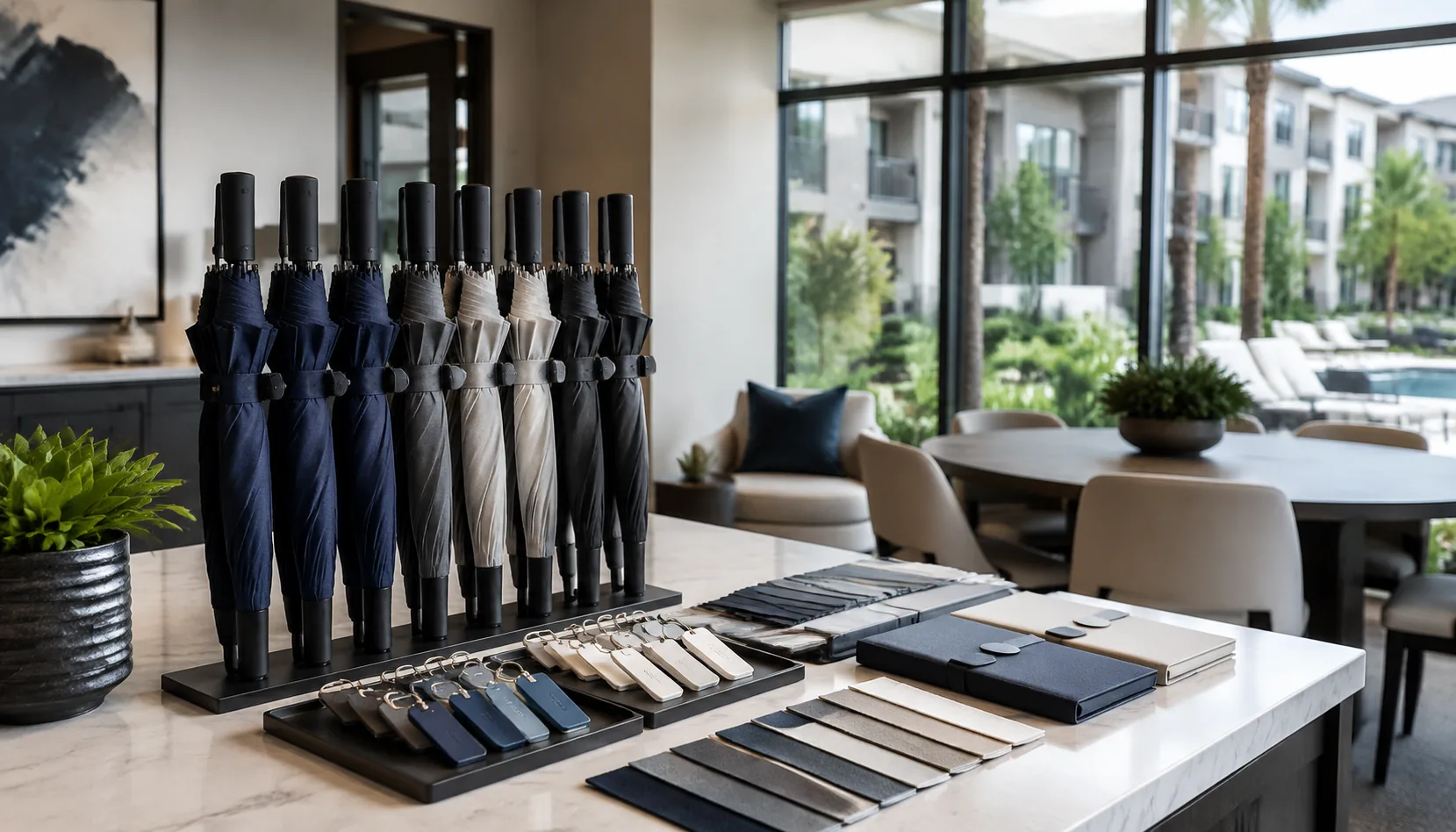
Branded Umbrellas for Apartment Communities and Leasing Teams
Build umbrella programs for leasing offices, resident gifts, and property tours with durable specs, smart order quantiti...
Read More »