Rain Test Standards for OEM Umbrellas: What Buyers Should Ask
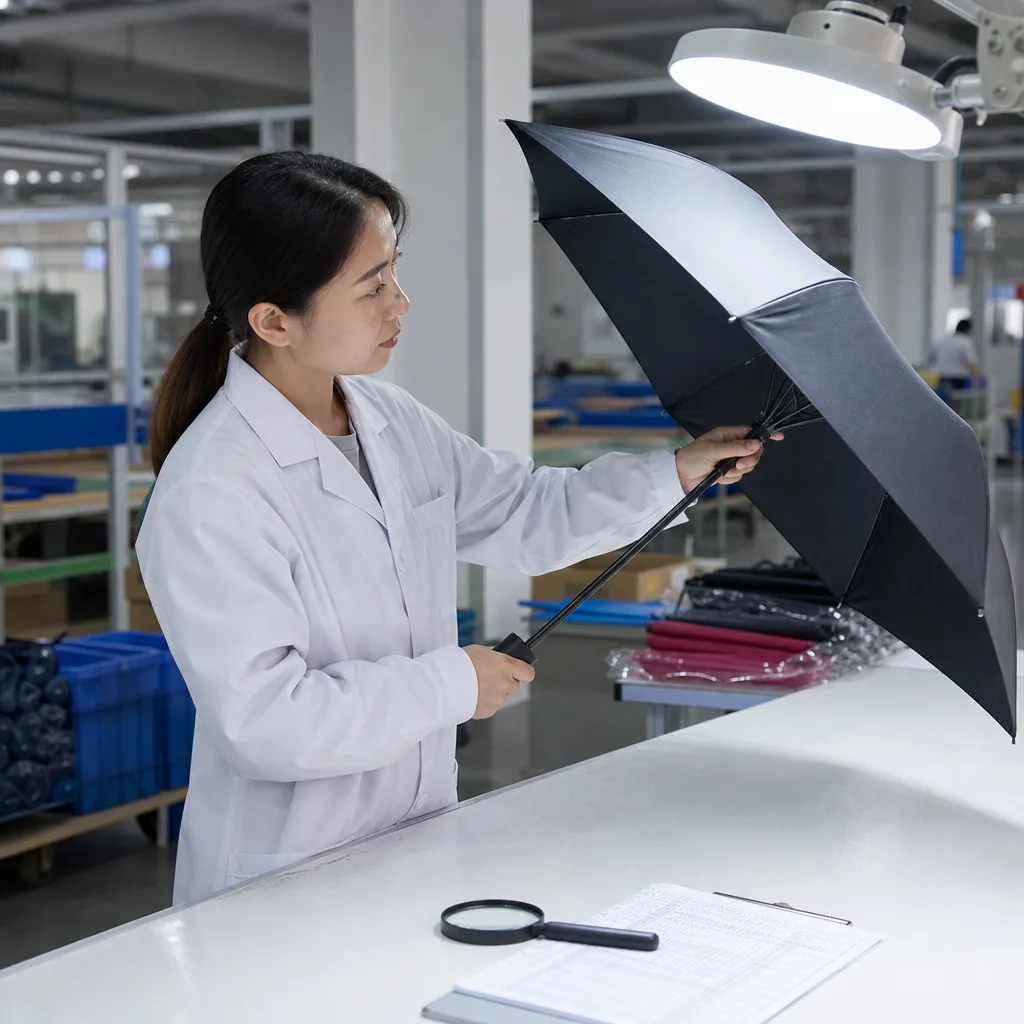
When an umbrella sample looks fine in a showroom but starts leaking at the seam, wetting through the canopy, or loosening after a few open-close cycles, the real cost lands on the buyer. In Songxia production, we judge performance by what happens under spray racks, cycle rigs, and final AQL inspection, so buyers asking about umbrella rain test standards should focus on measurable test conditions, failure points, and batch consistency rather than generic pass claims.
What a Basic Rain Test Should Actually Measure
A basic rain protocol for OEM umbrellas should score four separate results, not one vague pass/fail. Visual wet-out is face-fabric darkening after the yarn surface saturates. Beading is whether droplets stay rounded on the canopy or flatten into a film. Runoff speed is how fast water clears a fully opened 21 inch or 23 inch canopy at a fixed tilt, because slow runoff leaves standing water at panel seams and fold lines. Leakage is different again: water penetrating stitch lines, tip patches, or the top notch after frame tension opens needle holes. Under practical umbrella rain test standards, these are distinct failure modes and should be recorded separately. A 190T pongee canopy with a fresh DWR finish can bead well in the first minute and still show seam leakage umbrella defects during longer exposure. The writer should tell buyers to inspect samples fully opened, at more than one angle, immediately after spray and again after sustained rainfall, with attention to sewn joints rather than surface appearance alone.
DWR needs a two-step check because a simple spray test only captures the condition of a new coating. Start with a controlled water repellency test on the canopy face to confirm even finish application across 190T or 210T pongee, recycled polyester, or POE clear panels. Then run continuous wetting for 10 to 15 minutes to see whether beading collapses, printed zones or fold creases retain water, runoff slows, or moisture transfers to the inside after shaking and reclosing. The approval sheet should state both the initial spray result and the sustained-exposure pass/fail rule, including stitch-line leakage criteria, test duration, spray intensity, and sample quantity. For auto-open or auto-open-close models, run rain exposure before and after the auto-open cycle test so spring action and repeated tension do not create new leaks. For vented styles, add double-canopy testing to check water tracking between layers. Final judgment should sit beside AQL 2.5 inspection across multiple cartons, not a single photo of one dry-looking sample.
Check Seams, Canopy Tension, and Top Ferrule Sealing
Under practical umbrella rain test standards, the first leaks usually appear at four points: panel seams, tip pockets, the top ferrule or cap area, and any canopy with uneven tension across the ribs. Ask the factory to run a static spray or shower exposure with the umbrella fully opened, then keep it open for at least 30 minutes before inspection so saturation can expose hidden needle-hole leakage. Check panel seams from the inside first; on many failures, the face side still looks clean while the seam line is already wicking. A seam leakage umbrella problem typically comes back to sewing control, not fabric failure: stitch density set too low, the wrong needle size for pongee, or seam tape and seam alignment drifting during sewing. Tip pockets need a separate check because rib-end load is concentrated at that point. If the pocket is cut too narrow or the bartack sits too close to the edge, leakage often shows up earlier after repeated opening and closing, even when the canopy passes a basic water repellency test.
The crown deserves its own inspection because several layers converge around the top ferrule, creating an easy path for water if the cap washer, reinforcement patch, or sealing part is off-center. On straight umbrellas, loose canopy tension is the second common cause of water entry: uneven pull between ribs lets water pond, increases local load on stitch holes, and drives moisture through seams that would stay dry on a properly tensioned frame. For vented styles, double-canopy testing should confirm that the upper-to-lower canopy overlap stays consistent and that vent stitching lies flat; otherwise splashback often starts around the cap area. Fabric selection also changes wet-test results. 190T pongee is cheaper, but it shows stitch grin, puckering, and enlarged needle holes sooner when thread tension is poorly controlled. 210T pongee usually keeps a cleaner surface and better appearance after soak-and-dry cycles, especially on dark shades and large printed panels. Pair wet testing with AQL 2.5 inspection and an auto-open cycle test, and require post-test photos or video of seams, tip pockets, and crown sealing instead of accepting a generic waterproof claim.
Combine Rain Testing With Opening and Closing Cycle Tests
Treat water exposure and mechanism durability as one test sequence. A 190T pongee canopy may pass a basic water repellency test when new, yet the umbrella still fails after repeated wet use on an auto-open or auto-open-close frame. Under practical umbrella rain test standards, buyers should ask suppliers to test the same sample after static spray exposure and then run 500, 1,000, or 3,000 opening and closing cycles under load. For 21 inch and 23 inch folding umbrellas, 500 cycles is a workable floor for low-cost promotional models, around 1,000 cycles suits mainstream retail, and 3,000 to 5,000 cycles is the range to request for better auto-open-close programs. Straight stick auto-open umbrellas usually survive higher counts because the shaft and spring path are simpler. Compact telescopic frames are the higher-risk format; weak springs, runner wear, and top-notch deformation show up there first, which directly affects returns, warranty risk, and replacement cost.
Wet-condition cycling is more useful than a dry bench test because the canopy gains weight, fabric tension shifts, and water reaches the runner track, spring cavity, and stitched joints. That is where partial opening, slow rebound, sticky release buttons, incomplete lock-up, and seam leakage umbrella defects start to appear earlier. A practical buyer protocol is to spray 8K or 10K samples for 10 to 15 minutes, drain for 2 to 5 minutes, then run 200 to 500 immediate cycles before checking to AQL 2.5 inspection criteria for non-opening, shaft hang-up, button failure, loose ferrules, and visible seam ingress. For vented styles, double-canopy testing should include wet reopening after spray or rain simulation, because trapped moisture between the upper and lower canopy can raise reopening force, extend drying time, and distort panel tension. On higher-spec programs, add a dry-down period and a second cycle block to see whether steel springs begin to corrode or whether fiberglass ribs remain aligned after repeated wet loading.
Adapt the Test Plan to the Umbrella Structure
Match the test plan to the frame architecture instead of running one generic spray check across all SKUs. For a 23-inch straight umbrella with an 8K fiberglass frame, umbrella rain test standards should weight wind-load retention, rib recovery, and canopy tension after soaking more heavily than hinge leakage, because the long shaft and low joint count make overall frame stability the main failure risk. A 21-inch or 23-inch 3-fold umbrella fails differently: prioritize hinge wear, runner tracking, and fabric stress at the notch and rib pockets after repeated opening and closing. For auto-open or auto-open-close folding styles, pair the rain exposure with an auto-open cycle test of 500 to 1,000 cycles, then repeat wet-opening checks to confirm the spring still clears when the canopy, seam lines, and tapes are holding moisture. That sequence exposes looseness and alignment drift early, especially on plated steel linkages; fiberglass-and-aluminum frame sets generally maintain tolerance longer under the same wet-cycle load.
Frame material changes both the durability risk and the inspection method. Fiberglass ribs flex and recover better under gusts, so the rain-related focus shifts to stitch stability, tip fixation, and canopy stretch points under wet loading; poor sewing tension usually shows up as local distortion before the frame fails. Steel ribs are lower cost and stiffer, but thin tube walls or weak plating raise the risk of corrosion at joints and deformation at the rib elbow after repeated wet-dry exposure. A 190T pongee water repellency test only proves initial beading. It does not rule out seam leakage umbrella failures under sustained spray, so buyers should add seam-focused checks for stitch density, needle size, and tape consistency, then verify workmanship during pilot production and again under AQL 2.5 inspection on bulk goods.
Double-canopy testing needs separate pass-fail criteria because vented construction creates two distinct risks: static ingress and wind-driven ingress. Start with a walking-angle spray check to see whether water passes through vent gaps, overlap geometry, or stitch lines. Then run a separate wind-driven rain test with fans or wind-tunnel exposure, because a vented 27-inch golf umbrella can remain structurally intact above 50 mph yet still mist the user if canopy spacing, overlap depth, or edge binding is off. That is the practical difference between double-canopy testing and a basic single-canopy POE or 190T pongee straight umbrella. Straight golf umbrellas and 30-inch stick umbrellas often pass a simple shower test but fail in crosswind, when rain is forced upward through the vent and carried inward. Buyers comparing suppliers should ask for both water-ingress data and wind-driven rain results, not one combined claim.
Write Pass-Fail Criteria Into the PO and Inspection Plan
Put pass-fail terms into the PO and inspection plan before deposit payment, not after production starts. For OEM orders, replace broad claims like "water resistant" with a named test, sample size, and acceptance rule tied to umbrella rain test standards. Specify final inspection to ANSI/ASQ Z1.4, General Level II, at AQL 2.5, and state the lot size and total carton count in the PO so both the factory and any third-party inspector pull the same number of samples. On a 5,000-piece lot, that means agreeing in advance how many units are checked for appearance, open-close function, and wet testing before packing begins. If you require a water repellency test, define the method and threshold clearly, such as a target spray rating after fixed exposure or no unacceptable surface wet-out on 190T or 210T pongee beyond the agreed grade. Buyers should lock these terms before paying the deposit and before booking freight under FOB or DDP, because once cargo timing is fixed, disputes over test scope usually become cost and delay claims.
Set numeric defect limits for leakage and function so the inspection result is binary. State whether any seam leakage umbrella defect is rejectable, or whether limited bead-through at stitched panel joins is allowed after 15 to 30 minutes under controlled spray. Keep defect categories separate: canopy leakage, broken ribs, loose top cap, failed spring action, printing bleed, and packaging defects should not be rolled into one subjective judgment. For auto-open styles, require an auto-open cycle test with the cycle count written into the PO, then check runner lock, canopy alignment, and tip tension after cycling. For vented models, include double-canopy testing at the vent overlap and vent stitching, not only a basic shower test. After drying, inspect re-closure, strap fastening, sleeve fit, care-label bleed, carton moisture, barcode legibility, and shipping marks. Require dated photo and video records before shipment covering lot overview, random sample selection, opening and closing, rain exposure, leakage close-ups, and sealed cartons, so the pre-shipment file supports the AQL 2.5 inspection result instead of relying on email arguments later.
Frequently Asked Questions
Can a double-canopy umbrella leak more easily than a single-canopy model?
It can if the vent construction, stitching, or overlap design is weak. Buyers should ask for rain testing on the final production structure, not just frame testing, because vent geometry changes water behavior.
Should rain testing be done only on pre-production samples?
No. Pre-production approval is useful, but final random inspection matters because stitching quality, coating consistency, and mechanism assembly can vary in mass production. AQL 2.5 checks should confirm the approved standard before shipment.
Should buyers ask for rain-test results by umbrella type or just one factory report?
Ask for results by construction type, not one generic report. A straight umbrella, 3-fold auto-open model, and double-canopy golf umbrella can fail in different places, so test data should match the frame, canopy fabric, and opening mechanism of your SKU.
When is the best time to run seam leakage and water repellency tests during production?
Run them twice: once on pre-production or pilot samples to confirm fabric and stitching settings, and again on finished goods before packing. For bulk orders, many buyers also require an inline check during sewing if the order uses coated fabric or taped seams.
What sample size is practical for umbrella rain testing on a bulk OEM order?
For routine production, buyers often ask the factory to test 3-5 units per color or per lot, then confirm final acceptance through an AQL 2.5 inspection. For higher-risk programs like auto-open folding umbrellas, importers may increase functional test samples to 8-10 units per shipment.
Looking to Launch Your Custom Umbrella Line?
ZheBrella is a Zhejiang-based OEM/ODM umbrella manufacturer with 17 years of export experience. Free design, low MOQ from 100 pieces, windproof construction, full-color print.
Get Free Quote Now »People Also Search For
Related Articles
How Umbrella Frame Prototypes Are Tested Before Mass Production
See how frame prototypes are checked for cycle life, corrosion, wind resistance, and assembly accuracy before production...
Read More »
Umbrella Frame Assembly QC: From Ribs to Final Opening
Learn how factory line QC controls rib riveting, runner fit, frame tension, and opening cycles before AQL 2.5 final insp...
Read More »Umbrella Assembly Line QC Gates for OEM Manufacturing
Map the key QC gates in umbrella assembly, from frame prep to final packing, to cut defects, speed approvals, and protec...
Read More »