Umbrella Packaging Cost Breakdown for Brand Buyers

For brand buyers, packaging can quietly turn a good umbrella program into a margin problem once MOQ, handwork, carton size, and freight all move together. On our Songxia factory floor, we see the same issue every season: a low unit pack price can still raise total landed cost if it slows packing or wastes cube. A clear umbrella packaging cost breakdown has to connect polybags, kraft boxes, rigid cartons, and inserts to production speed and retail requirements.
Map the Main Packaging Formats and Use Cases
Start packaging from landed cost and damage risk, not shelf aesthetics. In any umbrella packaging cost breakdown, a plain PE or CPP polybag is the lowest-cost baseline because it adds almost no assembly labor and very little carton cube while protecting the canopy from dust, moisture, and carton rub. A printed paper sleeve is the next step when the buyer needs SKU ID, EAN/UPC barcode placement, QR code, or country-of-origin and compliance marking without taking on full custom umbrella box cost. Both formats work best for 21 inch and 23 inch compact umbrellas, including manual, auto-open, and auto-open-close 3-fold frames, because these units collapse tightly and hold carton counts efficiently. The packaging decision should follow the umbrella spec, not precede it: folded length, handle profile, frame material such as steel or fiberglass ribs, rib count, and canopy fabric such as 190T or 210T pongee all change pack-out, labor time, and master-carton yield. A straight-handle umbrella and a 3-fold auto-open-close umbrella can share the same canopy size but still require different inner packing, carton dimensions, and freight assumptions.
A folding kraft box is the practical move up when the program needs better transit protection or a cleaner retail presentation. It is commonly used for compact 8K umbrellas with steel or fiberglass frames when handles, ferrules, or painted tips are vulnerable to scuffing in bulk export cartons. For buyers comparing umbrella polybag vs box, the box usually makes sense for e-commerce, gift-with-purchase, and licensed retail because the added board, die-cutting, and hand-fold assembly can be offset by fewer damage claims and more consistent presentation. Rigid gift boxes sit at the premium end and fit executive gifting, hotel amenities, or higher-ticket styles such as wood crook-handle umbrellas, UV-coated canopies, and specialty frames, but they are usually a poor match for low MOQ packaging options because tooling setup and manual packing cost rise quickly on short runs. PDQ trays and carton-ready formats solve shelf-replenishment speed, not gifting. They are more common for 27 inch and 30 inch straight golf umbrellas, especially double-canopy windproof frames in 8K or 16K constructions, because these larger folded bodies do not pack efficiently in small folding cartons. Lock the format early against FOB DDP packaging assumptions: polybags improve container density, while boxes and PDQ packs increase cubic volume before master cartons leave China.
Break Down Unit Cost Drivers by Material and Pack Structure
Do not treat packaging as a flat surcharge; start your umbrella packaging cost breakdown with the pack structure and board specification. At 3,000 units, a basic individual carton in 300-350 gsm white card with 1-color black print usually adds $0.18-$0.32 per unit. Moving to an E-flute carton or rigid presentation box with 4-color process print lifts that to about $0.55-$1.20. Lamination typically adds $0.03-$0.08 per unit, while spot UV, foil stamping, and embossing add both setup charges and higher run cost. Quote inserts as separate lines: a die-cut paper insert is often $0.05-$0.12, while EVA or foam inserts run about $0.18-$0.45 depending on cavity depth and tooling allocation. Small items also move cost. Barcode labels, suffocation-warning stickers, and carton marks usually add $0.01-$0.04 per piece, with extra labor if they are hand-applied. For any custom umbrella box cost review, require a line-item quote covering board grade, print colors, finish, insert type, labels, MOQ, and whether pricing is FOB or DDP so you can see exactly which spec change moves unit cost.
Pack-out often changes landed cost more than the primary pack itself. In an umbrella polybag vs box comparison, a standard OPP or PE polybag usually costs $0.02-$0.05 and keeps packing density high; an individual box reduces pieces per master carton and increases freight cube under either FOB DDP packaging model. A 21-inch folding umbrella in a slim carton may still load 24 or 36 pieces per export carton, while a 23-inch auto-open or auto-open-close style with a thicker handle often has to stay at 24 pieces to avoid carton bulge. A 27-inch golf umbrella commonly packs 12 or 24 pieces depending on box width and canopy bulk. Product construction changes carton dimensions as well: 210T pongee folds thicker than 190T, double-canopy and POE or EVA clear canopies compress less than woven polyester, and fiberglass ribs or shafts usually take more section space than economy steel. That is why MOQ packaging options should be quoted against the exact size, rib count, fabric, and frame build. An 8K steel-frame compact in 190T pongee will usually pack denser than a 10K or 16K fiberglass model with a rubberized handle and 210T canopy, affecting carton size, load quantity, freight cost, and carton performance during AQL 2.5 inspection.
Show How MOQ and Sampling Affect Packaging Decisions
MOQ sets the packaging route before artwork matters. For stock packing—an OPP polybag, plain inner carton, and standard export master carton—most umbrella orders can start at 300 to 500 pieces per model or color because there is no die-cut tooling, print plate setup, or excess board inventory. Shift to a custom printed sleeve, mailer, or rigid carton and the MOQ typically moves to 1,000 to 3,000 pieces per design; it can climb further if the box is offset printed on coated board and the converter needs a full paper run. That is the point of an umbrella packaging cost breakdown: unit cost only makes sense against forecast volume. A custom pack that adds $0.28 to $0.65 per unit at 3,000 pieces often loses value at 500 pieces once tooling, setup, and waste are absorbed by too few units. When buyers compare umbrella polybag vs box, the custom umbrella box cost also includes slower packing output, more warehouse cube, and higher freight per shipped unit.
Sampling is where lead time and cost usually widen. A stock polybag with a suffocation warning and barcode label can often be approved from a digital mockup plus one pre-production sample. A custom box usually needs four gates before mass production: dieline approval, artwork position check, a white dummy for fit, and a color sample. Add EVA window patches, spot UV, foil stamping, or an insert sized for a 21 inch or 23 inch folding umbrella, and expect extra sample rounds plus another 5 to 10 days. This is why MOQ packaging options should match the sales channel: promo programs usually stay with polybags or paper sleeves, while retail packs can justify printed cartons if margin covers labor and cube. Under FOB DDP packaging terms, that cube directly affects carton dimensions and chargeable volume. At final inspection, AQL 2.5 should cover packaging as well as umbrellas: check print rub, glue strength at box corners, clean folds without board cracking, scannable EAN or UPC labels, and transit protection under drop and compression so packaging defects do not stop shipment.
Compare Freight Impact Under FOB and DDP Terms
For any umbrella packaging cost breakdown, separate unit packaging cost from packed volume. A rigid gift box may add only $0.18 to $0.45 per piece, but it can increase master-carton CBM by 20% to 60%, which usually has a bigger effect on landed cost than the packaging line itself. Under FOB terms, that penalty sits outside the factory quote: the umbrella may still look price-competitive, while the buyer absorbs higher ocean freight, destination charges, and final-mile delivery. Under DDP, the same volume increase is built into the supplier’s delivered rate, so bulky packaging shows up immediately in the all-in price. That is why custom umbrella box cost cannot be judged by paperboard grade or print alone. Buyers need packed CBM per 1,000 pieces, master-carton pack count, and pallet or container loading data using the same 21 inch, 23 inch, or 27 inch umbrella, the same export carton spec, and the same Incoterm. Without that, an FOB DDP packaging comparison is incomplete and freight risk stays hidden.
The practical tradeoff in umbrella polybag vs box is carton density. A straight umbrella in a sleeve or polybag can often ship 24 or 36 pieces per export carton, while the same SKU in a rigid presentation box may require a lower pack count and leave dead space around the handle, ferrule, or tip. For example, a 23 inch auto-open umbrella with 190T pongee and fiberglass ribs may ship efficiently in a sleeve plus polybag, but a magnetic-close box with an EVA insert can raise freight per unit more than the visible packaging upgrade. The lowest-risk savings usually come from structural changes, not from stripping out graphics. Flat-packed boxes cut storage and outbound volume on 500 to 3,000 piece runs; nested paper inserts can replace bulky molded trays; and simpler decoration such as a one-color logo, label seal, or spot UV panel can preserve shelf presentation without increasing box depth. For MOQ packaging options, FOB buyers should request ex-factory pack cost plus packed CBM, while DDP buyers should compare delivered pricing to the same ZIP code or postal code before approval.
Build a Packaging Matrix for Promo, Retail, and Gift Programs
Start with channel economics, not aesthetics. In an umbrella packaging cost breakdown, promotional giveaways usually work best with a 21 inch or 23 inch umbrella in an individual OPP or polybag plus carton marks only, because that keeps the FOB target in the stated $3.50 to $6.50 range and preserves budget for the product: a 190T pongee canopy, steel shaft, and a practical manual or auto-open frame. A plain white tuck-end box can still fit conference kits or client handouts, but buyers should compare umbrella polybag vs box on total landed impact: added box material, hand-packing time, lower pieces per master carton, and higher freight cube. MOQ packaging options matter here. Factories can often mix canopy colors in one export carton, but custom printed inner boxes typically require a separate 1,000 to 3,000 piece MOQ, which reduces flexibility and raises inventory risk. If the program is a basic promo umbrella, polybag packing usually offers the lowest unit cost, the fastest pack-out, and the least chance of delays or packing errors.
Retail shelves, e-commerce, and executive gifting need different packaging standards because presentation and damage risk directly affect margin. For retail, start with a 23 inch auto-open or auto-open-close umbrella in 190T or 210T pongee with a hangtag, belly band, and printed carton; if the item is sold on sun protection, the pack should state UPF 50+ and name the canopy treatment instead of making generic UV claims. For e-commerce, a fit-to-product mailer or protective box is usually safer than a thin display carton, especially for 10K or 16K umbrellas with fiberglass ribs, where parcel handling can crush weak packs and trigger repacking or returns. In any custom umbrella box cost review, include box cost, pack labor, carton utilization, dimensional weight, and damage exposure. Executive gifting is the clearest case for premium packaging, but only when the umbrella spec supports it: 27 inch or 30 inch canopy, double-canopy vented construction, premium fiberglass frame, rubberized handle, or auto-open-close. Use landed cost, lead time, and unboxing standard as the final matrix. Plain FOB promo orders can move in 25 to 35 days; custom retail cartons, gift tubes, and FOB DDP packaging programs more often run 35 to 50 days after artwork approval, sampling, and drop-test review.
Frequently Asked Questions
Does premium packaging usually increase umbrella shipping costs more than product costs?
Often yes, especially for rigid gift boxes that increase carton volume and reduce packing density. For DDP projects, the freight uplift can outweigh the packaging material delta, so buyers should compare landed cost per set, not only ex-factory cost.
What should be checked during packaging approval before mass production?
Confirm dieline size, fit around the folded umbrella, barcode readability, and drop-test protection. The final approval should also verify carton marks, pack quantity, and that packaging passes the agreed AQL 2.5 inspection points.
At what order volume does a custom kraft box usually make sense versus a standard polybag?
For most B2B umbrella programs, custom kraft boxes become more cost-efficient at roughly 1,000 to 3,000 units per style, depending on print coverage and box size. Below that level, tooling setup and higher per-unit print costs usually make polybags or stock cartons the safer option.
How much can boxed umbrella packaging increase freight cost compared with polybag packing?
Boxed packing often increases outer carton volume by about 15% to 35% versus polybag packing for the same umbrella size. That can materially raise ocean freight and especially DDP costs, so buyers should compare packaging cost and cubic meter impact together before approving artwork.
Can branded inserts be added without changing the master carton specification?
Usually yes, if the insert is a light paper card or thin folded leaflet and does not change the folded umbrella dimensions. If the insert adds thickness or requires a retail box, the supplier may need to revise carton pack quantity, carton size, and final gross weight.
Looking to Launch Your Custom Umbrella Line?
ZheBrella is a Zhejiang-based OEM/ODM umbrella manufacturer with 17 years of export experience. Free design, low MOQ from 100 pieces, windproof construction, full-color print.
Get Free Quote Now »People Also Search For
Related Articles
Umbrella Packaging Cost Breakdown for Brand Programs
Compare sleeves, cartons, inserts, and gift packs by MOQ, freight impact, and lead time so brand teams can choose packag...
Read More »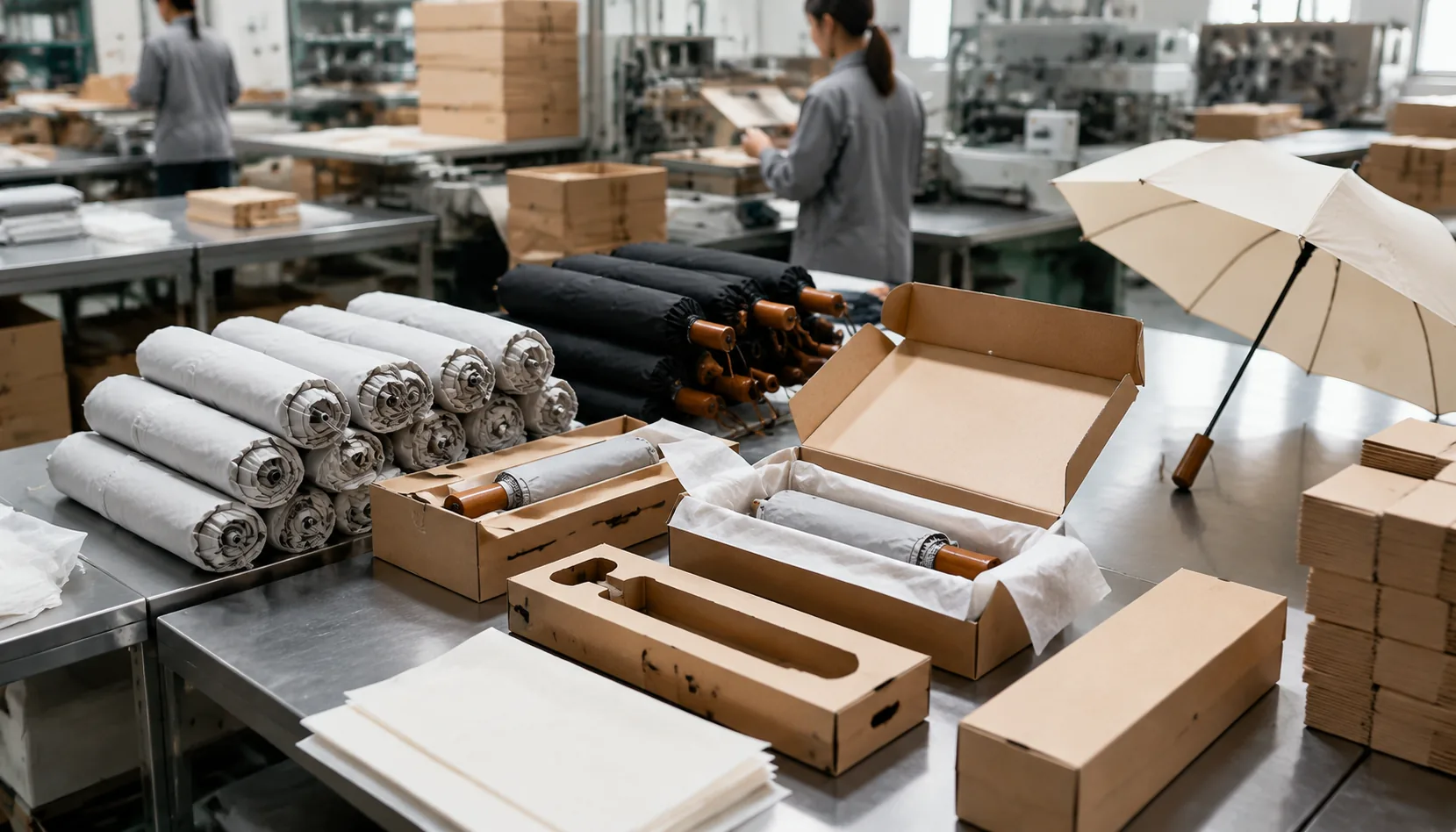
Umbrella Packaging Cost Breakdown for OEM Brand Programs
Compare sleeves, cartons, inserts, and gift upgrades by MOQ, lead time, and FOB/DDP impact so buyers can budget branded ...
Read More »
Umbrella Packaging Cost Breakdown for Brand Buyer Decisions
Compare sleeves, cartons, inserts, and premium packouts by MOQ, FOB/DDP impact, and lead time so brand buyers can choose...
Read More »