Umbrella Packaging Cost Breakdown for OEM Brand Programs
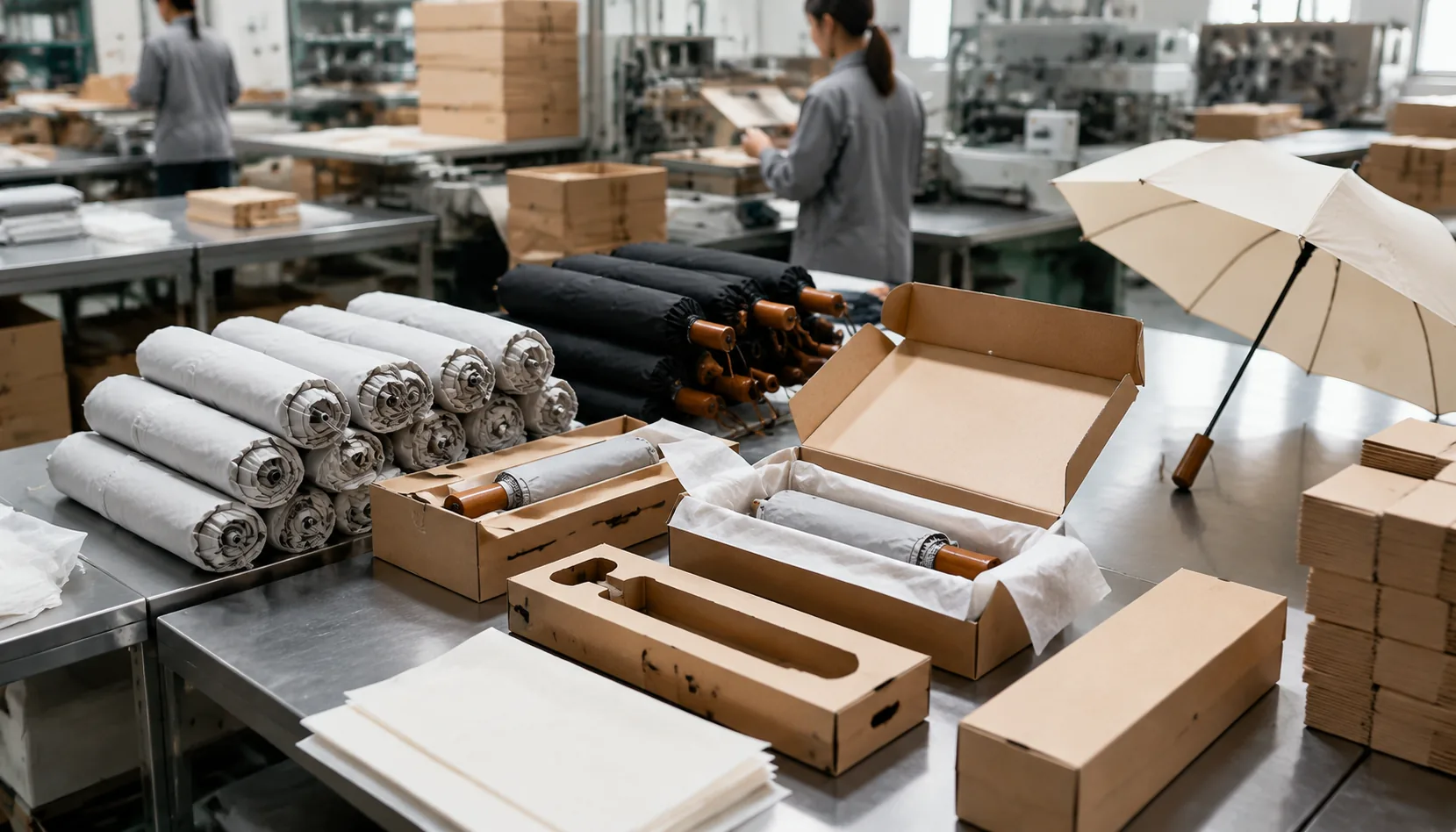
For OEM buyers, the umbrella packaging cost breakdown is rarely just a line item; it changes with sleeve material, carton spec, insert printing, and whether the program is priced FOB or DDP. On the factory floor, we see small packaging choices drive MOQ, lead time, labor, and freight in different ways, which is why a clean budget has to separate protection, branding, and presentation before the order is locked.
What Packaging Components Add Cost in an Umbrella Program
The real umbrella packaging cost breakdown starts with the parts that touch the product, because they set both unit cost and carton geometry. A plain polybag is the lowest-cost option, but once you add paper bands, belly wraps, tissue, stickers, custom insert cards, or a printed carton, the price rises because you pay for printing setup, die cutting, and manual packing time. In OEM umbrella packaging, the paper itself is usually not the problem; labor and setup are. Custom insert cards often cost more than buyers expect because they slow the pack line and need tighter print control to avoid color variation. That is why retail presentation costs can exceed the cost of the box alone. MOQ packaging options also matter: unprinted bags and labels can work at lower MOQ, while matched cartons, inserts, and multi-part retail packs generally need higher volume to reach workable unit economics.
Umbrella size changes the pack more than most buyers expect. A 21" folding umbrella usually fits a smaller polybag and inner carton than a 27" or 30" stick umbrella, so the larger formats increase carton length, master carton cube, and freight density. Straight umbrellas typically need longer cartons and more void fill, while folding umbrellas pack tighter but may still need molded inserts or tissue to keep the canopy, shaft, and handle from rubbing. Auto-open and auto-open-close mechanisms also affect packaging: the button housing and thicker handle can widen the pack, and the closed length is often slightly longer, which pushes up both box size and shipping weight. Those changes matter whether you buy FOB or DDP packaging, because carton dimensions feed directly into freight cost and destination handling charges.
The higher-cost items are usually the ones that control shape and retail readiness: custom cartons, molded inserts, tissue, stickers, and master cartons. A simple master carton can be cheap per unit, but if the inner pack is oversized by even a few millimeters, you lose case count per pallet, reduce container efficiency, and raise shipping cost per umbrella. Stickers and belly wraps are inexpensive on paper, but they add application labor and can slow the line when artwork changes across SKUs. The practical umbrella packaging cost breakdown is not just material cost; it includes pack speed, carton cube, shipping weight, and damage risk. For most programs, a clean polybag plus paper band is the lowest-cost structure, while a printed carton with insert card, tissue, and label system is the highest-cost option because it combines material, setup, and retail presentation costs in one pack.
How MOQ Changes Your Packaging Economics
At low MOQ, the umbrella packaging cost breakdown is driven by setup, not board weight. In the 300-500 unit range, a stock corrugated mailer or 1-color kraft sleeve usually beats offset-printed boxes, custom insert cards, and laminated retail cartons because plate making, die cutting, proofing, and short-run changeovers are spread across too few pieces. For OEM umbrella packaging, 500-1,000 units is usually the practical floor for one carton size, one print color, and no spot finish. Below that, keep MOQ packaging options simple: plain board, direct print, and standard inserts. Factory setup charges matter here because a small run can carry the same prepress and tooling cost as a larger order, which pushes the landed unit price up faster than the paper spec does.
At mid MOQ, roughly 2,000-5,000 units, offset printing starts to become cost-efficient, especially when retail presentation costs affect shelf performance. This is the range where custom insert cards can replace loose tissue, a separate instruction sheet, or hand-packed branding, and the labor savings can offset the extra print step. Spot UV, foil, soft-touch lamination, and window patches still need enough volume to justify their setup charges, so they make more sense when the same packaging stays in production for multiple umbrella colorways or repeat reorders. For FOB DDP packaging quotes, freight, destination labeling, and outer-carton strength often move landed cost more than the print spec itself. Carton quantity rounding also matters: if the pack spec is 24 units per carton and the order is 2,300 units, the partial carton creates overage, more void fill, and another handling touch.
At high MOQ, usually 10,000 units and up, packaging becomes a production plan rather than a decoration choice. At that level, multiple SKUs, dedicated insert cards, and heavier board grades become cost-efficient because press setup, knife tooling, and color matching stop dominating the bill. Mixed SKUs raise packaging waste quickly: different canopy colors, handle styles, or 21-inch and 23-inch size mixes force separate label runs, more packing sequences, and more half-full cartons. That means more corrugate, more dunnage, and a higher damage risk during consolidation. The most efficient approach is to standardize packaging around the production schedule, then add exceptions only where the brand program truly needs them. That keeps the umbrella packaging cost breakdown aligned with real output instead of a sample approval sheet that ignores factory and freight costs.
Material Choices That Affect Protection and Presentation
SBS paperboard is the lowest-cost option when the goal is shelf appeal, not freight protection. For 190T and 210T pongee umbrellas with steel ribs, a tuck box, paper sleeve, or carton wrap can hold a printed panel or custom insert card and keep the canopy clean, but SBS adds little crush resistance in export cartons. In an umbrella packaging cost breakdown, SBS usually sits at the low end of retail presentation costs because the board is thin, the structure is simple, and print setup is straightforward. Add spot UV, a die-cut window, or heavier stock, and the unit price rises quickly. For OEM umbrella packaging, SBS works best when the umbrella already ships compact and the buyer is paying for presentation rather than impact protection.
Corrugated board becomes the better choice as soon as the frame gets heavier or more delicate. Fiberglass-rib umbrellas, auto-open-close models, and double-canopy windproof designs need stronger pack protection than lighter steel-rib promotional umbrellas because the frame can flex under carton pressure and damage the canopy, tips, or runner. Single-wall corrugate is usually the minimum for these builds; molded pulp adds shaft and handle support without the tooling cost of an EVA tray. EVA gives the most precise fit for the canopy head, handle, and ferrule, so it is the better option when scuff control and retail presentation must match protection. That tradeoff shows up directly in retail presentation costs, because tighter inserts reduce damage claims but raise unit price and tooling spend.
The right spec depends on the shipping program and MOQ packaging options, not on one universal carton. A basic inner sleeve with tissue or a polybag is often enough for low-cost promotional umbrellas when the buyer mainly needs carton efficiency, barcode labeling, and a clean retail face. For FOB DDP packaging programs, the risk shifts to sea freight compression, so the pack has to keep the canopy finish clean, prevent handle punch-through, and hold the umbrella stable through palletizing and carton stacking. Simple inner protection works for steel-rib promotional umbrellas; fiberglass-rib and double-canopy units usually need corrugated reinforcement or an EVA tray to avoid transit damage that wipes out the savings from a cheaper box. That is the practical umbrella packaging cost breakdown: the lowest packaging price is not the lowest landed cost if the pack fails in transit.
Freight, Incoterms, and Carton Optimization
In any umbrella packaging cost breakdown, carton dimensions are the largest hidden variable in freight. A 21-inch manual umbrella packed 40 units per layer in a 24×12×10-inch carton on a 120×100 cm Euro pallet; switching to a 27-inch auto-open-close model with a clamshell blister pack drops that to just 12 units. Cubic volume per unit can double, and under FOB terms, ocean freight is entirely the buyer's cost. A $0.80 gift box that adds 2 inches in height cuts pallet tiers from 8 to 7, adding $0.35 per unit in container freight—a 44% increase in landed cost for a package that cost pennies more. At ZheBrella, we run a cube utilization calculator before quoting OEM umbrella packaging, because the real cost is in the air the carton ships, not the paper.
Under DDP terms, the freight and packaging cost breakdown becomes more granular because you absorb every leg: factory to Ningbo port, ocean to Long Beach, rail to Chicago, and final truck to a Kansas City distribution center. A 30-inch golf umbrella in a double-wall corrugated carton with a 6×6×6-inch void fill survives a 4-foot drop test (ISTA 1A) without a dent, but a single-wall carton with a decorative sleeve may fail at 2 feet, triggering chargebacks of $2–$5 per damaged unit. Export marks—'Made in China' in 1/4-inch font, country of origin, and handling symbols—are often overlooked; a missing CE mark on a DDP shipment to Germany can cause a customs hold adding $200 in demurrage per container. Best practice is to specify a 32 ECT carton for any umbrella over 27 inches, and keep the outer carton footprint close to 40×30×20 cm to maximize pallet density without exceeding 22 kg per carton—the typical weight limit for manual handling in US warehouses.
Oversized gift packaging—like a hexagonal tube with a magnetic closure for a 21-inch compact umbrella—can add $0.60 in material cost but $1.20 in freight because it wastes space. A promotional distributor once ordered 10,000 units with a custom insert card that added 0.5 cm to carton width, reducing pallet count from 60 to 48 cartons and eroding margin entirely. For MOQ packaging options, start with a standard polybag plus header card for FOB shipments under 5,000 units, then upgrade to a retail box only when order volume justifies a dedicated container. Test the carton stack with a 10-pallet load in our warehouse before committing to the design; a 2% compression loss in the bottom tier can mean 50 damaged units per container. That's not a packaging issue—it's a freight optimization failure that a proper umbrella packaging cost breakdown would have caught.
Approval Workflow to Control Packaging Quality at Scale
The umbrella packaging cost breakdown starts with dieline approval, because the flat file controls box size, insert-card folds, glue tabs, and the clearance needed for a folded canopy. For OEM umbrella packaging, freeze the dieline within 3 working days after artwork submission, then check a 1:1 paper mockup on the final stock before any plates are made. That step matters more as formats get tighter: a 21-inch three-fold auto-open umbrella typically packs to about 28 x 6 x 4 cm, and insert-card slots usually need 3 mm tolerance to avoid binding during hand insertion. After the dieline is signed off, run a calibrated digital proof on the specified substrate, such as 157 gsm or 200 gsm coated duplex board, and lock color within 48 hours. For retail presentation costs, this is where procurement teams catch substrate changes, fit issues, and artwork drift before they turn into scrap or delayed launch dates.
Barcode checks should run in the same proof window, not after production starts. Scan every UPC or EAN on custom insert cards, hang tags, and master cartons, and verify the print at 10 points across the sheet to confirm ANSI/ISO 15416 grade B or better. Carton markings also need a separate review: shipping mark, item number, quantity per carton, gross weight, and country of origin must match the packing list before loading. That review is especially important for FOB DDP packaging, where a bad carton code or missing origin mark can stop warehouse intake and create rework fees. Final inspection should use AQL 2.5 Level II, plus a focused sample for card fit, barcode readability, and carton integrity, so low-MOQ packaging options do not become a hidden risk once the order scales.
Plan packaging lead times against umbrella production, not in isolation. A standard OEM umbrella packaging program with custom insert cards usually needs 18 to 22 calendar days from dieline approval to mass production readiness: 3 days for dieline sign-off, 5 days for proofs and barcode verification, and 10 to 14 days for offset printing and die-cutting. Sampling is usually faster, often 5 to 7 days for a printed mockup and 7 to 10 days for a press proof, depending on substrate and finish. For FOB shipments, that schedule can run alongside umbrella assembly; for DDP programs, add about 4 buffer days for carton marking verification, consolidation, and final loading across multiple SKUs. That keeps the umbrella packaging cost breakdown tied to real procurement timing, so packaging and umbrellas reach readiness together instead of forcing split shipments or demurrage.
Frequently Asked Questions
When does a custom printed umbrella box usually become cost-effective?
It often makes more sense at mid to higher volumes, because tooling, print setup, and minimum board orders are spread across more units. Buyers should compare the box upcharge against the freight increase from larger carton size.
Should packaging be inspected separately from the umbrella itself?
Yes. Packaging artwork, barcode accuracy, carton strength, and packing method should be checked during pre-production and again at final inspection under AQL 2.5, especially for retail or gifting programs.
What is the usual MOQ for custom umbrella sleeves and insert cards?
For printed sleeves and insert cards, many factories set MOQ at 500 to 1,000 pieces per design, depending on print method and paper stock. If you need multiple SKUs or seasonal artwork, the effective MOQ can rise because each version needs its own setup.
How much can packaging add to the FOB price of an umbrella order?
Basic sleeves may add only a small amount per unit, while printed cartons, hang tags, and gift boxes can increase FOB by roughly 0.10 to 1.50 USD per umbrella. The final impact depends on paper grade, color count, finishing, and whether the packaging is assembled or flat-packed.
Does DDP pricing usually include packaging upgrades in the landed cost?
Yes, if the quote is structured correctly, DDP should include the umbrella, packaging materials, inland freight, export handling, and destination delivery charges. Buyers should confirm whether the DDP rate covers special packaging labor, repacking, or carton reinforcement because those items can change the final landed cost.
Looking to Launch Your Custom Umbrella Line?
ZheBrella is a Zhejiang-based OEM/ODM umbrella manufacturer with 17 years of export experience. Free design, low MOQ from 100 pieces, windproof construction, full-color print.
Get Free Quote Now »People Also Search For
Related Articles

Umbrella Packaging Cost Breakdown for Brand Programs
Compare sleeves, cartons, inserts, and gift packs by MOQ, freight impact, and lead time so brand teams can choose packag...
Read More »
Umbrella Packaging Cost Breakdown for Brand Buyer Decisions
Compare sleeves, cartons, inserts, and premium packouts by MOQ, FOB/DDP impact, and lead time so brand buyers can choose...
Read More »Umbrella Packaging Cost Breakdown for Brand Buyers
Compare polybags, kraft boxes, rigid cartons, and inserts for branded umbrellas with MOQ, lead time, freight, and retail...
Read More »