How Windproof Umbrellas Are Wind-Tunnel Tested and Rated
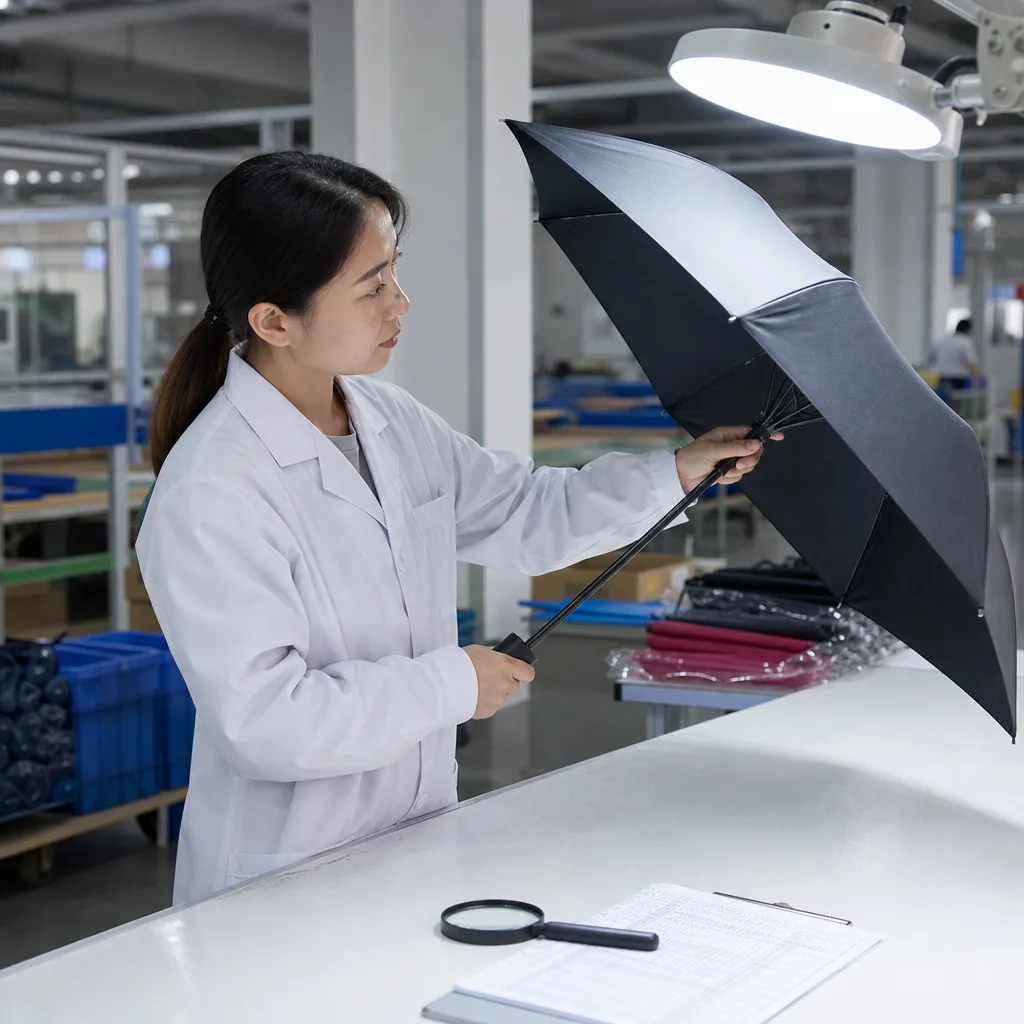
Buyers hear a lot of wind-resistance claims, but the real issue is whether a frame survives repeated gust loads without ribs twisting, joints loosening, or the canopy turning inside out. At the factory level, windproof umbrella testing is about controlled speed, angle, and cycle count, then comparing failure points across frame designs, materials, and build quality so procurement teams can judge ratings against actual performance instead of marketing language.
What 'windproof' actually claims
In the factory, “windproof” is not a claim that the umbrella will never invert. It means the frame is built to flex under load and then recover without breaking, which is the real point of windproof umbrella testing. A proper umbrella wind tunnel measures how the canopy behaves when gusts hit from different angles: ribs should bend, the crown should flatten briefly, and the structure should spring back instead of snapping. That is why fiberglass ribs are preferred over rigid steel in many designs. The storm proof umbrella rating you see in sales sheets usually reflects survival at a stated wind speed, not perfect shape retention. A canopy with venting or a double-canopy vented windproof design will usually shed pressure better than a sealed top, but it still has limits. In practical terms, “windproof” means less likely to invert, tear, or lose its frame when the umbrella wind resistance test gets ugly, not invincible in a typhoon.
The numbers matter because the label alone tells you very little. A 21-inch compact with 6K ribs is a different animal from a 30-inch golf umbrella with 8K or 10K fiberglass ribs, and both behave differently in an umbrella wind tunnel. Our standard practice at ZheBrella is to define the expected failure mode before testing: canopy inversion first, rib deformation second, and joint breakage last. That is the only way the result is useful to a buyer. A decent storm proof umbrella rating should be tied to a specific test setup, angle of attack, and pass/fail criteria, ideally with video and post-test inspection. Otherwise, “windproof” is just sales language. Good windproof umbrella testing looks for self-recovery after a gust, not a fantasy of zero damage. If a sample survives repeated load and still opens and closes normally, that is a meaningful result; if it only looks good once, it is not a reliable umbrella wind resistance test.
Wind-tunnel and repeated-inversion testing
Windproof umbrella testing is not a showroom demo with a fan; it is a controlled umbrella wind tunnel run where speed, angle, and cycle count are measured. We fixture the umbrella by the handle or shaft, open it fully, and expose it to rated wind speeds in steps, usually starting around 20 mph and moving up to 35, 45, and 50+ mph depending on the storm proof umbrella rating being claimed. The real variables are frame geometry and joint quality: fiberglass ribs flex and return better than plain steel, but ferrules, stretchers, and the runner all have to stay locked under load. A proper umbrella wind resistance test checks whether the canopy sheds pressure without seam burst, rib twist, or pole bend. If a supplier is only talking about canopy fabric, they are skipping the part that actually fails in the field.
After the speed run, repeated inversion cycles matter more than one dramatic gust. In our standard practice at ZheBrella, the canopy is deliberately flipped inside out and then reset open for a set number of cycles, because a frame that survives one gust but loses alignment after three inversions is not dependable. This is where 8K, 10K, 16K rib counts, fiberglass vs. steel construction, and hub design show their limits. A 23-inch or 27-inch automatic-open frame with a reinforced vented double canopy can recover cleanly if the stretchers are sized correctly, while a cheap 21-inch compact model often fails at the runner or tip sockets. The test is not just whether it inverts; it is whether the umbrella returns to full tension, keeps the canopy centered, and still opens and closes smoothly after repeated stress.
A meaningful windproof umbrella testing report should record both the failure mode and the recovery condition, not just a pass/fail stamp. Good samples are inspected for bent ribs, cracked tips, seam tearing, loose thread at the canopy edge, and deformation at the top notch and lower ferrule. For buyers, the useful number is the speed and cycle threshold at which the umbrella first inverts, plus whether it remains functional afterward; that tells you more than a vague “wind resistant” claim. If the spec sheet cites pongee 190T or 210T, Teflon coating, UPF 50+, or auto-open-close mechanics, those features are secondary unless the frame survives the umbrella wind tunnel first. That is why a credible storm proof umbrella rating should always be tied to the exact test method, sample size, and acceptance criteria, usually with AQL 2.5 inspection on production lots before shipment.
Design features that earn the rating
A real windproof umbrella testing result starts with the canopy shape, not the frame slogan. The best umbrellas use a double-canopy vented top so air can pass through instead of loading the fabric like a sail. In an umbrella wind tunnel, that vent keeps the canopy from inverting as pressure rises, which is why a vented 23" or 27" golf umbrella usually outperforms a flat single-canopy model with the same rib count. The storm proof umbrella rating is not just about surviving one gust; it is about how cleanly the canopy recovers after repeated pressure cycles. For windproof umbrella testing, I look first at how the vent is cut, how much overlap remains under tension, and whether the panels stitch evenly around the peak so the airflow does not create a weak point at the seams.
Fiberglass ribs are the next part that earns the rating because they flex and return instead of bending permanently like low-grade steel. In an umbrella wind resistance test, a 16K frame with fiberglass ribs, steel shaft reinforcement, and a properly sized runner usually holds its shape better than a heavier but brittle build. The runner and joint hardware matter as much as the ribs: reinforced knuckles, rivets that do not loosen, and end tips that keep the canopy tension balanced decide whether the umbrella folds back or stays stable. At ZheBrella, the factory-side check is simple: if the joints chatter, the ribs twist, or the runner binds under load, the design has not passed windproof umbrella testing, no matter what the marketing copy says.
Comparing claims between suppliers
When suppliers quote a windproof umbrella testing result like “survives 40 mph” or “50+ mph,” the first question is not the number, it is the method. Ask whether that figure came from an actual umbrella wind tunnel, an open-field gust test, or a simple hand-held fan setup, because those are not equivalent. A real umbrella wind tunnel should define canopy size, frame spec, opening state, test angle, exposure time, and failure criteria. For example, a 23" auto-open model with fiberglass ribs can behave very differently from a 30" golf umbrella with a vented double canopy and steel shaft. If the supplier cannot tell you the exact umbrella wind resistance test conditions, the mph claim is marketing, not data. In windproof umbrella testing, I also want to know whether the stated speed is a sustained wind, a peak gust, or the point at which permanent deformation starts, because those are three different thresholds.
The storm proof umbrella rating should also be tied to sample count and acceptance rules, not one lucky sample. Ask how many pieces were tested, whether the result was AQL 2.5 screening or a one-off prototype, and whether failure means inversion, rib crack, canopy tear, or only minor frame twist. A good supplier should state the speed in mph or m/s, the duration at that speed, and whether the umbrella was fully open, partially loaded, or cycled through open-close actions before testing. For windproof umbrella testing, I prefer suppliers to show a short test report with photos or video, because a real umbrella wind tunnel result is easy to verify and hard to fake. If they only say “our umbrella passed 60 mph,” ask for the test standard, the tunnel calibration, and the exact model used. That is the fastest way to separate engineered performance from loose claims.
Spec'ing for genuinely stormy markets
For coastal and high-wind regions, start with the frame, not the canopy. A genuine storm-ready build uses fiberglass ribs and stretcher arms, not cheap steel that kinks after the first hard gust. For a compact model, I would not go below 8K ribs with reinforced shaft joints; for a stick umbrella aimed at daily commuter abuse, 10K or 16K with a vented double canopy is the safer spec. Pair that with 210T pongee and a Teflon water-repellent finish so the fabric sheds rain instead of loading up with water and becoming a sail. In windproof umbrella testing, the canopy shape matters as much as the metal: a deep dome with controlled venting usually survives a better umbrella wind resistance test than a flat, oversized panel that flaps itself apart.
A practical storm proof umbrella rating should be based on more than a marketing number. Our standard practice at ZheBrella is to set a target wind range first, then build the sample around it, usually with fiberglass ribs, anti-inversion tips, and a reinforced top notch that keeps the canopy from flipping inside out. For markets that see typhoons, monsoon bursts, or open waterfront exposure, a 23-inch or 27-inch stick umbrella with auto-open-close is usually more reliable than a lightweight travel model, because the shaft wall and hub geometry can take more stress. In the umbrella wind tunnel, I care about deformation, rib memory, and recovery after the gust, not just whether the umbrella stayed technically intact for a few seconds.
If the customer needs a spec for procurement, ask for the test conditions in writing: wind speed, duration, angle of attack, number of cycles, and pass/fail criteria. A serious umbrella wind tunnel program should record whether the frame returned to shape, whether the canopy seam tore, and whether the runner slipped under repeated load, because that is what determines field failure. For coastal retail or promotional programs, I would specify UV coating with UPF 50+ only if the market values sun protection, but I would never let that replace structural testing. For bulk orders, keep MOQ aligned with colorway complexity, insist on AQL 2.5 for inspection, and match the promised storm proof umbrella rating to a real umbrella wind resistance test, not a copied catalog claim.
Frequently Asked Questions
What does a windproof umbrella rating mean?
It indicates the wind speed a frame can withstand, and recover from inversion, without breaking - verified by wind-tunnel and repeated-inversion testing. It does not mean the umbrella is indestructible; it means it flexes and springs back instead of snapping.
How can I compare windproof claims between suppliers?
Ask each supplier for the test method and the wind speed the rating is based on, plus the inversion-cycle count. A number with no test behind it is marketing; a number tied to a defined test is meaningful.
What wind speed should a factory report in an umbrella test?
Ask for the exact test speed in mph or m/s, plus the duration at each step. Many OEM labs record performance at staged speeds such as 20, 30, and 40 mph, but the key is whether the canopy stays usable and the frame returns to shape after the test.
How many samples should be tested before I trust a wind rating?
For a commercial order, ask for at least 5 to 10 samples from the same production lot. A single sample can hide variation in ribs, stretch fabric, or stitching, so multiple samples give a more reliable view of batch consistency.
What should be included in an umbrella wind-test report for importers?
A useful report should list the sample size, wind speed steps, test angle, failure criteria, and photos or video of the test. If the supplier can also show frame material, rib count, and recovery after deformation, it is much easier to compare offers honestly.
Looking to Launch Your Custom Umbrella Line?
ZheBrella is a Zhejiang-based OEM/ODM umbrella manufacturer with 17 years of export experience. Free design, low MOQ from 100 pieces, windproof construction, full-color print.
Get Free Quote Now »People Also Search For
Related Articles
How Umbrella Frame Prototypes Are Tested Before Mass Production
See how frame prototypes are checked for cycle life, corrosion, wind resistance, and assembly accuracy before production...
Read More »How Umbrella Salt Spray Testing Supports Coastal Use Programs
Learn how salt spray testing helps buyers specify corrosion-resistant umbrellas for resorts, marine retail, and humid ma...
Read More »How Umbrella Frame Salt Spray Testing Reduces Rust Claims
Learn how salt spray testing, coatings, and frame-material choices cut rust complaints on custom umbrellas shipped throu...
Read More »