Best Umbrellas for Outdoor Retail Queues and Curbside Pickup
Retail buyers choosing umbrellas for curbside pickup need more than a windproof label: queue coverage, one-handed handling, wet-canopy recovery, and repeatable frame QC all affect daily use. For a quote-stage comparison, treat 8 fiberglass ribs per umbrella, a 23-inch rib length per unit, and a 500-finished-unit MOQ per order as example assumptions to verify in the dated supplier quote. Vincent Xi, Editorial Author (https://www.zhebrella.com/authors/vincent-xi/), compares that quote with preproduction sample-inspection records; verify wind-test protocols, fabric construction, dimensional tolerances, and current compliance documents.
Where Umbrellas Fit in Retail Service Operations
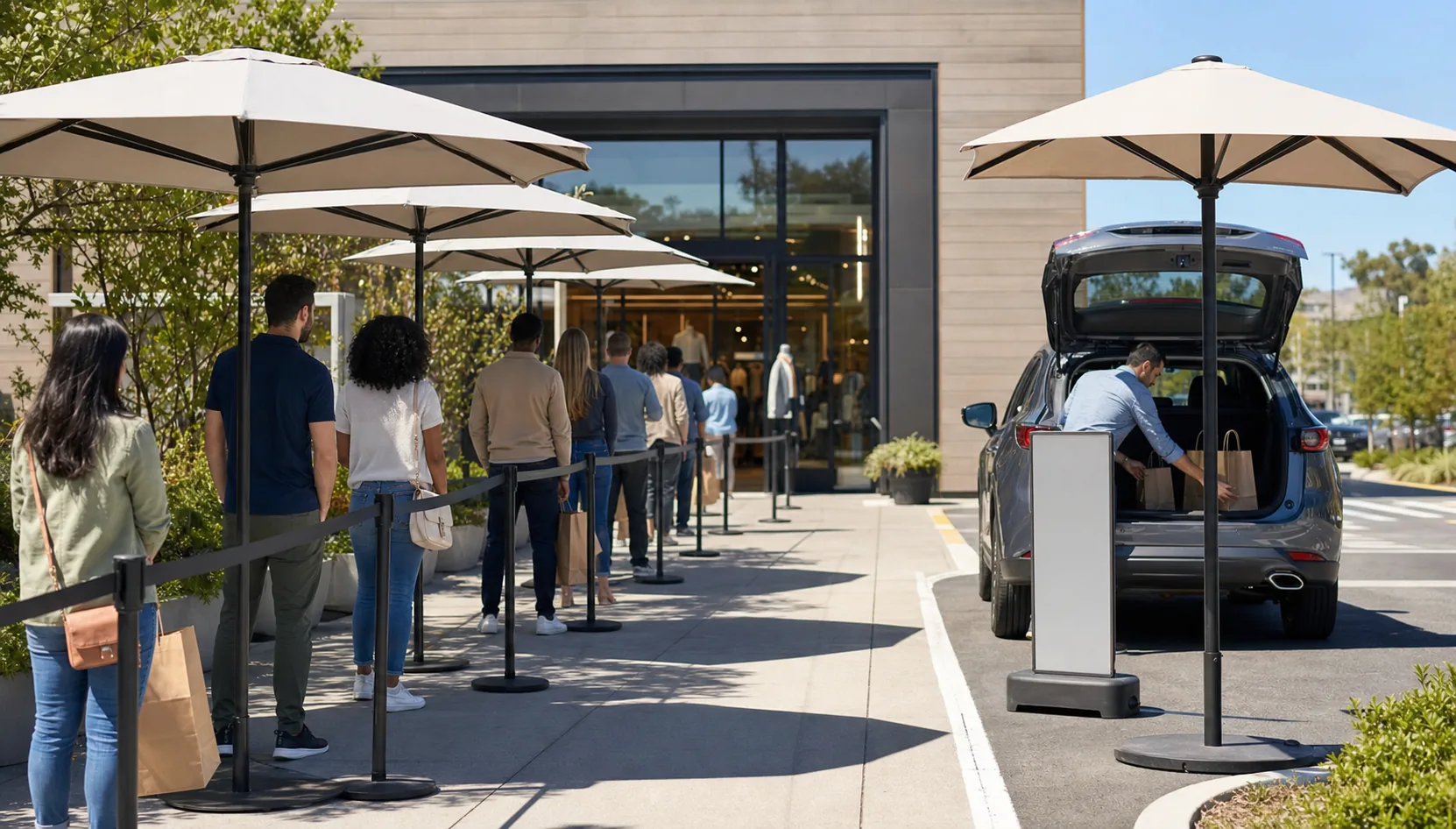
Use umbrellas for curbside pickup wherever associates or shoppers leave fixed cover: pickup lanes, seasonal sale queues, mall entrances, garden centers, and parking-lot handoff routes. Select by movement and exposure, not by a single chainwide specification. Outdoor retail queue umbrellas must cover a stationary shopper without narrowing walkways or obscuring staff sightlines; mobile branded retail service umbrellas should reduce swing weight and remain controllable while an associate carries an order. The January 2025 procurement worksheet lists example assumptions to verify in the current supplier quote: a 27-inch canopy, an 8-rib fiberglass frame, and 190T pongee for mobile associates, plus a 30-inch vented canopy for entrance greeters who stay near cover. Those dimensions do not establish wind resistance or service life. Auto-open supports one-handed order handling; manual opening reduces accidental deployment beside vehicles. Specify auto-open-close only where staff can collapse the shaft clear of customers, vehicles, and merchandise. Assign retail operations umbrellas by deployment point so each canopy, frame, and mechanism balances unit cost against handling risk and expected exposure.
Build inventory from peak concurrent exposure, then aggregate demand across locations. For the January 2025 worksheet, treat every figure as an example assumption to verify against the retailer's labor roster and a dated supplier quotation: 12 store locations, 4 simultaneously exposed associates per store, 1 assigned umbrella per associate per shift, a 20 percent spare allowance, and a 35-calendar-day rainy-season replenishment lead time. Method: multiply 12 locations by 4 exposed associates to obtain 48 base units; calculate 9.6 spare units at 20 percent, round up to 10 spare units, and place a 58-unit example opening order. This is neither a recommended MOQ nor a factory lead-time claim. Recalculate from peak outdoor headcount in shift schedules, deployment points on queue and curbside maps, and documented breakage or wet-storage losses. For weather context, compare NOAA climate normals applicable when the order is planned with store-level precipitation records; for supply context, use the supplier's dated production schedule plus quoted FOB or DDP transit time. Annual rainfall cannot predict simultaneous replacement demand, so update spares whenever location count, rainy-season staffing, or quoted reorder lead time changes.
Before purchase release, verify MOQ pricing, mechanism-cycle expectations, wet colorfastness, rib-replacement terms, carton quantity, Incoterm, vehicle clearance, drainage, and wet-storage controls. For custom windproof umbrellas, require a physical double-canopy vent and the laboratory report behind any performance claim. The January 2025 example bid sheet sets assumptions to verify in current documents: a submitted-sample wind-tunnel result above 50 miles per hour, with test duration, canopy orientation, and failure criteria stated by the laboratory; and lot inspection at General Inspection Level II with AQL 2.5 for major defects under the ISO 2859-1 edition cited on that sheet. ISO 2859-1 defines sampling; it does not certify an umbrella or prove wind resistance, and neither threshold establishes product performance. Confirm local gusts, employee handling, and the quoted FOB or DDP route before approval. Publication must use a visible byline and an Article or BlogPosting JSON-LD author object with type Person, name Vincent Xi, jobTitle Editorial Author, and URL https://www.zhebrella.com/authors/vincent-xi/. His approved profile supports editorial attribution only, not a first-hand test claim. Visual brief: depict the January 2025 worksheet's example 27-inch navy 190T pongee canopy with black fiberglass ribs during a tote handoff beside a vehicle, paired with a QC bench checking frame alignment and auto-open function; show realistic rain, drainage, safe vehicle spacing, and unidentifiable staff, with no text, logos, watermarks, or impossible machinery.
Top 5 Buyer Criteria for Store-Associate Umbrellas
Start with task fit, then confirm the sample. Rib length does not equal usable coverage, so record open canopy diameter in inches, folded length in inches, shaft angle, rib curve, canopy tension, and handle clearance on the approved sample. As an example assumption to verify on the pre-production sample and supplier quote, a 23 in to 27 in folding umbrella, measured by rib length for one associate-use SKU, often fits curbside runners because it clears a POS tablet, receipt printer, radio, or cart handle without blocking sight lines. Larger stick umbrellas usually suit queue management, bag check, and door teams because those associates are more stationary and need a wider dry zone. Two 23 in frames can cover differently, so outdoor retail queue umbrellas should be approved by measured open diameter, not catalog size alone. Source context: this framework uses retail operating inputs, including associate mobility, cart clearance, and queue spacing, plus umbrella production terminology attributed to Vincent Xi, Editorial Author at ZheBrella, from the approved author profile as of 2026.
One-hand operation is the next filter for umbrellas for curbside pickup. Auto-open is usually enough for associates carrying orders, scanners, keys, or radios; auto-open-close may help parking-lot runners, but closing resistance, spring force, and grip security should be checked with wet hands and gloves on the sample. For custom windproof umbrellas, specify fiberglass ribs, steel ribs, or a mixed frame, then inspect the runner, stretchers, tip joints, and shaft after inversion. A double-canopy vent can improve recovery at exposed storefronts, but it adds weight and carton volume. Treat any 50 mph wind-tunnel target as an example lab-style claim to verify for the stated sample size, test duration, test date, test lab, and tested SKU. It is not a certification unless current documents name the applicable standard and confirm that the exact retail operations umbrellas being ordered were tested.
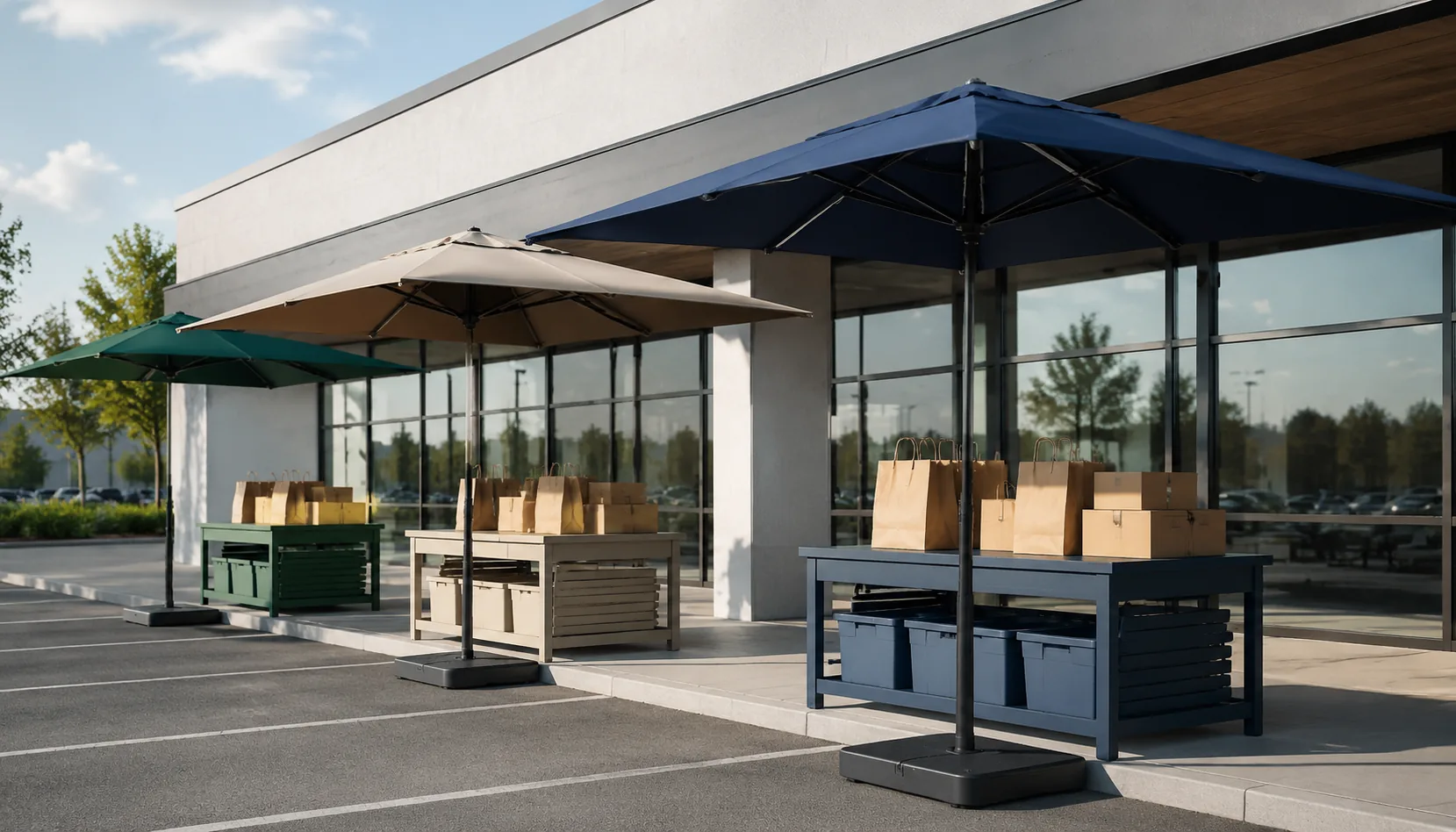
Brand visibility and carton handling decide whether branded retail service umbrellas stay in daily use. For car-lane or sidewalk recognition, confirm panel count, logo print area in inches, PMS color tolerance, and canopy material: 190T or 210T pongee for fabric models, or POE, PVC, or EVA where clear sight lines matter. Stick umbrellas usually give cleaner panel visibility; folding umbrellas are easier to stage at service desks, curbside racks, and carts. Methodology note: these criteria come from sample-based buying checks, carton handling constraints, and standard umbrella BOM terminology, not a universal retail standard. Verify final open diameter, folded length, carton quantity, gross weight per carton in kg, MOQ in units, FOB or DDP terms, lead time in days, and whether an AQL 2.5 inspection plan applies to the actual order. Visual brief: show a retail curbside pickup station with sampled 23 in to 27 in folding umbrellas beside larger stick umbrellas, open canopies measured for diameter, visible ribs, handles, cartons, and a QC checklist; no text, logos, watermarks, or identifiable people.
Fabric, Frame, and Weather-Resistance Specifications
By Vincent Xi, Editorial Author; profile: https://www.zhebrella.com/authors/vincent-xi/. For umbrellas for curbside pickup, compare 190T and 210T pongee using the supplier’s dated 2026 fabric sheet, swatch card, and approved production swatch. Within that order scope, both figures are supplier-declared thread-count grades for one canopy layer, not complete fabric specifications. Require the quotation and pro forma invoice to state denier, yarn density, coating weight, water-repellent finish, color, and print process. Select 210T for canopies kept open through extended shifts near glazing, carts, and traffic: it generally provides a firmer hand, lower show-through, steadier heat-transfer logo registration, and better shape retention after wet/dry cycling. Use lower-cost 190T for shorter promotional deployments when those characteristics carry less value. Specify UPF 50+ only for sun-heavy outdoor retail queue umbrellas. For the 2026 order, accept that claim only with a current laboratory report identifying the tested fabric color, coating, test method, report date, and production lot; a catalog statement does not substantiate performance.
Prioritize frame material and joint quality before rib count. Steel ribs reduce purchase cost and feel rigid when opened, but fiberglass ribs recover more effectively after gust loading and are less prone to permanent bending at exposed storefront corners. For a nominal 23-inch retail operations umbrella identified in the supplier’s dated 2026 quotation, confirm whether the measurement describes rib length, canopy arc, or open diameter against the approved pre-production sample. In that quotation, 8K must mean 8 canopy-supporting ribs and 16K must mean 16 ribs; verify each configuration by physical count. A well-assembled 8K fiberglass frame with secure rivets, a sound runner, and a reliable spring can outlast a decorative 16K steel frame. Choose 16K branded retail service umbrellas only when the rounder canopy profile and distributed loading justify the additional material, weight, and cost. Auto-open mechanisms suit staff service with fewer inspection points than auto-open-close systems. If the 2026 purchase order specifies AQL 2.5 for final inspection, it must also define defect classes and the sampling plan; AQL 2.5 is an acceptance threshold for that inspection scope, not a durability rating or certification.
For exposed storefronts, specify double-canopy venting for custom windproof umbrellas: an overlapping upper vent releases pressure that can otherwise invert a canopy in doorway or curb-lane crosswinds. Approve the vent overlap, stitching, and tie points on the pre-production sample. Treat “survives 50 mph wind” only as an example supplier claim for a 2026 order until a dated test report identifies the umbrella size, open angle, airflow method, exposure duration, and pass/fail definition; wind-tunnel and field results are not interchangeable. Methodology: compare the dated quotation, fabric sheet, swatch card, current laboratory reports, and pro forma invoice, then inspect the sample for rib count and construction. Limitations: before release, verify fabric and coating documents, rib material by magnet and controlled bend checks, shaft diameter, runner strength, MOQ, FOB or DDP scope, and lead time in calendar days. Vincent Xi’s approved profile supports Editorial Author attribution only, not first-hand production or testing claims. Visual brief/imagePrompt: realistic exposed glass-storefront pickup lane with wet pavement; quote-matched nominal 23-inch vented umbrella, 190T and 210T swatches, 8-rib fiberglass and 16-rib steel frames, plus a QC bench with a magnet and bend-check fixture; no people, text, logos, watermarks, or impossible machinery.
Ordering Model: MOQ, FOB/DDP, Lead Time, and QC
Set MOQ from construction first, then decoration risk. For umbrellas for curbside pickup, use the supplier's current quotation sheet as the quote-date source context: an example calculation to verify is 300 units per artwork for a 23-inch, 8-rib manual frame with one-color screen printing. A 27-inch double-canopy vented frame with fiberglass ribs, custom panels, and tight PMS registration may move the quoted MOQ assumption to 600 to 1,200 units per artwork because cutting loss, panel matching, and print alignment checks raise waste. Keep the initial retail operations umbrellas order simple unless the service workflow needs premium hardware: manual and auto-open frames reduce spring, runner, shaft, and cycle-test variables compared with auto-open-close. Match materials to duty cycle, not catalog defaults: specify 190T or 210T pongee from the supplier's current specification sheet for repeated outdoor handling, POE or EVA when store teams need transparent sightlines, and UPF 50+ only when that sheet or a current test report supports the claim as of the purchase order date.
Pick FOB or DDP from the rollout map. FOB Shanghai or FOB Ningbo, as example Incoterms to confirm in the supplier quote, fits a consolidated shipment into a buyer-controlled distribution center; DDP fits multi-store delivery only when the quote names the destination country, delivery-point count, duty responsibility, carton count, and liftgate or appointment-delivery terms. For branded retail service umbrellas, treat 35 to 50 calendar days after approved artwork and approved pre-production sample as a planning assumption to verify in the supplier quote, with scope tied to order date, style, print method, and factory load. Custom windproof umbrellas with supplier-quoted 10K or 16K frame specifications, double-canopy vents, heat-transfer logos, sublimated panels, or bulk fabric dyeing can exceed that window when sample revisions or fabric lead times change. Methodology: these ranges use the buyer's store rollout plan and the supplier's current quotation/specification sheet as source contexts, with publication attribution to Vincent Xi, Editorial Author, https://www.zhebrella.com/authors/vincent-xi/.
Put final inspection language in the purchase order, not in email notes. For outdoor retail queue umbrellas, state AQL 2.5 as the buyer-specified final inspection sampling plan as of the purchase order date; if ISO 2859-1 general inspection sampling is used, cite it as the sampling context, not as ZheBrella product certification. The PO should define lot size, inspection level, critical defects at 0 accepted defects under the buyer's sampling plan, and checks for canopy stitching, seam symmetry, print registration, rib function, runner lock, handle fixing, ferrule alignment, and auto-open cycling. The same limitation applies to wind claims: a 50 mph wind rating should be accepted only if backed by a current test report; otherwise treat it as a design target to verify. Before deposit, verify fabric availability, MOQ by artwork, carton dimensions, DDP destination fees, inspection-agency scope, and whether the approved sample matches the packed production lot.
Evidence, Author Basis, and What to Verify
Byline: Vincent Xi, Editorial Author, https://www.zhebrella.com/authors/vincent-xi/. Author basis is limited to that approved ZheBrella profile; no factory-test, certification, client-result, or first-person claim is made here. Evidence for umbrellas for curbside pickup should come from two source contexts: ZheBrella product-spec context for retail operations umbrellas and the buyer’s current dated supplier quotation plus physical sample review before purchase order release. Methodology: map queue length, staff handoff point, service-cart height, logo area, and wind exposure to the quoted bill of materials, then confirm the pre-production sample against the same details. Quote-level assumptions to verify for a named rollout include a 23 in staff stick umbrella, an 8-rib fiberglass frame per umbrella, and 210T pongee canopy fabric compared with 190T pongee when hand-feel or print definition matters. Treat each item as an example assumption to verify in the supplier quote, not a guaranteed specification, until the SKU, sample date, and bulk terms match.
For outdoor retail queue umbrellas, reject “windproof” unless the quote names the frame: fiberglass ribs, steel ribs, or mixed construction. If a custom windproof umbrella is sold with a 50 mph wind rating, verify whether that figure applies to the exact SKU and whether the source is an internal test or a dated lab report. For branded retail service umbrellas, confirm Pantone tolerance on the actual print method because screen print, heat transfer, and sublimation behave differently on pongee, POE, PVC, and EVA. Limitations to verify before rollout: AQL 2.5 inspection scope for the order, carton drop-test needs by carton size and destination, local labeling rules, current UPF 50+ reports if sun protection is claimed, and exact FOB or DDP transit time in calendar days for the named port or warehouse. Image prompt: realistic retail operations scene with several solid-color umbrellas in a curbside pickup area, one folded compact auto-open model on a service cart, one open double-canopy umbrella with visible fiberglass ribs and 210T pongee texture, rain on pavement, store entrance and pickup signage shapes without readable text, QC checklist clipboard and packed cartons nearby; no text, logos, watermarks, fake people, or impossible machinery.
Frequently Asked Questions
Are auto-open umbrellas worth the cost for curbside pickup teams?
Usually, yes for associates carrying bags, scanners, or receipts, because one-hand opening reduces friction during vehicle handoffs. The mechanism should be checked during sampling for smooth opening, secure lockup, and repeated-cycle reliability.
What color works best for retail queue umbrellas?
High-contrast brand colors or neutral canopies with bright trim are easier for customers to identify in rain or sun. Exact Pantone matching, print opacity, and stain visibility should be reviewed on a physical sample before mass production.
What umbrella size works best for curbside pickup associates?
For one associate handling orders, a 46- to 54-inch arc umbrella is usually practical because it gives body and package coverage without being hard to manage near vehicles. For queue greeters or two-person coverage, buyers often specify 58- to 62-inch golf umbrellas, but samples should be checked against store entrance width and parking-lane workflow.
What specs should be requested for windproof retail service umbrellas?
A typical B2B spec should include a fiberglass shaft or ribs, vented canopy, 190T or 210T pongee fabric, reinforced tips, and a wind-resistance test requirement stated in the quote. Ask the supplier to confirm the tested wind speed, test method, sample size, and whether the claim applies to production goods or only a pre-production sample.
What MOQ and lead time should retailers expect for branded queue umbrellas?
For custom logo umbrellas, many factories quote MOQs around 500 to 1,000 units per style/color, with sample lead time commonly 5 to 10 business days and bulk production around 25 to 45 days after artwork and sample approval. Exact MOQ, fabric color matching, packaging, and shipping terms should be confirmed on the supplier's proforma invoice before ordering.
Looking to Launch Your Custom Umbrella Line?
ZheBrella is a Zhejiang-based OEM/ODM umbrella manufacturer with 17 years of export experience. Free design, low MOQ from 100 pieces, windproof construction, full-color print.
Get Free Quote Now »People Also Search For
Related Articles
Branded Umbrellas for Outdoor Retail and Curbside Pickup
Specify staff and customer umbrellas for curbside pickup, garden centers, and outdoor retail teams with durable frames, ...
Read More »
Custom Umbrellas for Security Teams and Venue Operations
Equip security and venue staff with umbrellas built for patrols, entry lines, and guest support using durable frames, cl...
Read More »Umbrella Programs for Luxury Retail Concierge and Valet
Build a premium umbrella program for luxury retail concierge and valet teams with upscale materials, branding, QC, and d...
Read More »