Blackout Coated Rain Umbrellas: Retail Buyer Spec Guide
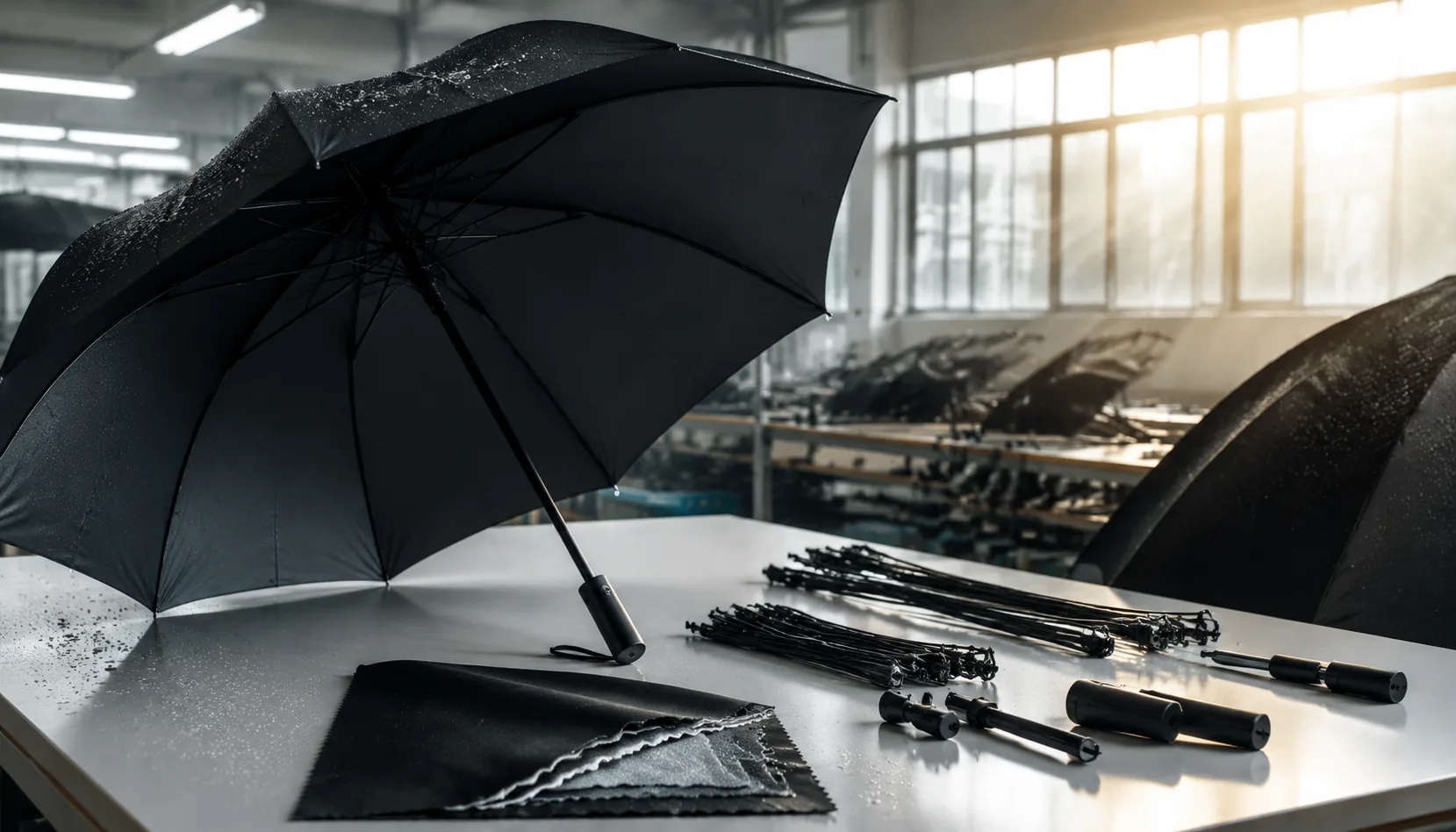
Retail buyers often approve blackout coated umbrellas from a nice sample, then run into shade variation, pinholes, print cracking, or weak rib choices once bulk production starts. On our Songxia factory floor, the key is locking the coating standard, UPF 50+ fabric construction, frame spec, logo method, MOQ, and AQL checks before cutting fabric, because small spec gaps become carton-level problems at inspection.
Clarify Sun-and-Rain Performance Goals
The first decision is whether the umbrella is primarily a rain product with sun claims, or a shade product that must also pass wet-weather retail standards. Blackout coated umbrellas use an inner black or dark silver coating on 190T or 210T pongee to block visible light, reduce heat under the canopy, and support UPF 50+ positioning when the fabric and coating are tested as a finished panel. For retail packaging, I prefer wording such as “UPF 50+ sun and rain umbrella” only after lab confirmation, because a pretty black lining does not automatically equal compliant UV protection. The outside face can stay brand-colored, while the inside coating does the sun-control work; that is why a navy, beige, or red canopy can still perform like a black coated pongee umbrella.
Rain performance still comes from the canopy fabric, seam quality, frame geometry, and water-repellent finish, not from the blackout layer alone. A commuter 23" auto-open stick umbrella may use 8K fiberglass ribs, a steel shaft, 210T pongee, and a Teflon-style water-repellent finish for quick shake-off at subway entrances. Travel programs usually move to 21" or 23" auto-open-close folding frames with fiberglass-and-steel mixed ribs, where weight matters more than a 50+ mph wind-tunnel claim. Outdoor events often need 27" or 30" golf styles with double-canopy venting, 8K or 10K fiberglass ribs, and stronger runner parts because guests use them in open wind, not just light city rain.
Buyer use case should drive the spec before artwork or price negotiation. School stores and campus bookstores usually need safe, mid-priced UPF rain umbrellas with manual or auto-open mechanisms, conservative colors, and carton labeling that makes replenishment simple. Promotional outdoor events may accept higher MOQ, larger logo panels, and heat-transfer printing, while retail umbrella sourcing for chains needs barcode placement, AQL 2.5 inspection, salt-spray expectations for metal parts, and consistent FOB or DDP lead times, commonly 35–55 days after sample approval. For a sun rain umbrella OEM project, our standard practice at ZheBrella is to approve coating handfeel, light-blocking effect, and wet-rub risk before bulk cutting, because coating defects are expensive to fix after sewing.
Specify Fabric Weight and Coating Type
Water repellency should be specified separately from blackout performance. The outside face still needs durable water repellent treatment, usually tested by spray rating before sewing, because the inner blackout coating does not stop face wetting or slow drying. For sun rain umbrella OEM programs, I prefer 210T pongee with outer water-repellent finish and inner black PU coating when the buyer wants UPF 50+ positioning plus reliable rain use. The tradeoff is folding thickness: coated 210T can add 8% to 15% bulk compared with uncoated 190T, and that affects sleeve fit, carton cube, and how neatly a 3-fold auto-open-close umbrella closes. On compact umbrellas, ask the factory to confirm finished closed diameter, not just panel fabric GSM. If the product must fit a slim retail sleeve, a lighter 190T with controlled black coating may be more practical than a heavy coated 210T canopy.
Match Frame Strength to Canopy Weight
A blackout coating changes the frame calculation because the canopy is heavier and less forgiving than plain 190T pongee. A standard 23" black coated pongee umbrella may add 8–15% canopy weight after coating, and that load sits on the rib tips every time the umbrella snaps open, dries unevenly, or catches wind. For low-cost retail programs, an 8K steel shaft with steel ribs is acceptable when the size stays at 21" or 23", the mechanism is manual or basic auto-open, and the target is everyday rain rather than beach-level sun exposure. Steel gives good compression strength and keeps FOB cost down, but it bends permanently after side gusts. Aluminum shafts reduce weight, especially on compact UPF rain umbrellas, but they need thicker wall tubing and better notch control; cheap thin aluminum shafts wobble badly under coated canopies.
Fiberglass ribs are the safer choice once the canopy reaches 27" golf size, double-canopy vented construction, or a true sun rain umbrella OEM spec with UPF 50+ coating. Fiberglass does not make the umbrella indestructible, but it flexes and recovers instead of kinking like low-carbon steel. For most retail umbrella sourcing, I prefer a steel center shaft with fiberglass ribs and stretchers on 23" and 27" models because the shaft stays rigid while the rib system absorbs wind load. An 8K fiberglass frame is enough for normal walking umbrellas; 10K gives a rounder canopy and better print appearance; 16K is mainly useful for premium stick umbrellas where buyers want a fuller dome, heavier fabric support, and a higher perceived retail price. More ribs also mean more sewing points, more runner friction, and more parts to inspect.
The weak point on blackout coated umbrellas is often not the rib itself but the runner, spring, and rivet stack. Coated pongee has more memory, so if the runner is loose, rough, or made from brittle recycled plastic, the umbrella opens with uneven tension and the coating starts showing stress lines near the rib pockets. Our standard practice at ZheBrella is to test coated canopy samples with repeated open-close cycling before confirming bulk frame tooling, especially on auto-open and auto-open-close models where spring force is higher. For AQL 2.5 inspection, buyers should ask factories to check runner travel, rib symmetry, rivet tightness, tip stitching, and wind recovery after inversion. If a supplier claims a 50+ mph wind-tunnel rating, make sure the test was done on the final coated canopy, not on an uncoated sample with a lighter fabric.
Plan Printing Around Coated Panels
Color accuracy also changes once the canopy is coated, especially when the outside fabric is dark or the inner black layer reduces light transmission through the textile. A PMS 186C red printed on white POE is not the same red printed on 210T black-backed pongee, so the factory should run strike-offs using the actual bulk fabric roll, not leftover sample cloth. For sun rain umbrella OEM programs, our standard practice at ZheBrella is to test print at least one production-size panel before bulk cutting, then check it after drying, sewing tension, frame mounting, and a 24-hour rest. This catches problems that flat swatches hide: ink cracking near rib tips, heat-transfer edge lifting at folded creases, and logo shade shift under daylight versus store lighting. Test prints add a few days, but they prevent 3,000 pieces from failing AQL 2.5 inspection because the logo looks dull, crooked, or damaged after opening cycles.
Set Testing, MOQ, and Delivery Terms
Set commercial terms early because coating, testing, and packaging all affect lead time. A realistic sample lead time for blackout coated umbrellas is 7–10 days for existing frame and fabric, or 12–18 days if you need custom handle tooling, Pantone-matched pongee, or printed retail packaging. Bulk lead time is usually 30–45 days after sample approval and deposit, but add 5–7 days if you require third-party UPF reports, pre-shipment lab checks, or complex heat-transfer logos. MOQ depends on the frame and fabric: 500–1,000 pieces is common for stock black coated pongee, while custom canopy color, private mold handles, or retail gift boxes often push MOQ to 1,200–3,000 pieces per SKU. FOB Ningbo or Shanghai is cleaner when your forwarder controls consolidation and compliance paperwork. DDP works better for smaller retail launches or promotional distributors that need landed cost certainty, but confirm duties, Amazon carton rules, palletization, and delivery appointment fees before comparing prices. A cheap DDP quote can hide weak insurance or slow customs handling.
Frequently Asked Questions
Does a blackout coating automatically mean UPF 50+?
Not automatically. Buyers should request UPF 50+ testing for the final fabric color, coating, and construction because coating quality and fabric density both affect the result.
Can logos be printed on the inside blackout coating?
It is possible in some cases, but outer-panel printing is usually more stable. Inner coating print tests are recommended because ink adhesion, cracking, and color shift can occur after folding.
What blackout coating specification should retail buyers request for UPF rain umbrellas?
Ask for UPF 50+ test results on the finished canopy fabric, not only the raw pongee. For retail programs, 190T or 210T pongee with a black PU blackout coating is common, with coating adhesion checked after wet rubbing and folding tests.
What are practical print limits on black coated pongee umbrellas?
Most logo printing is placed on the outer pongee surface, while the black coated underside is usually left unprinted to protect UV performance and coating integrity. For large retail graphics, confirm panel-by-panel artwork, maximum print area, and color tolerance before sampling.
What MOQ and lead time should buyers expect for OEM blackout coated umbrellas?
A typical MOQ is 1,200 to 3,000 pieces per style, depending on frame, fabric color, and print method. Sampling usually takes 7 to 12 days, while bulk production often takes 30 to 45 days after sample approval and deposit.
Looking to Launch Your Custom Umbrella Line?
ZheBrella is a Zhejiang-based OEM/ODM umbrella manufacturer with 17 years of export experience. Free design, low MOQ from 100 pieces, windproof construction, full-color print.
Get Free Quote Now »People Also Search For
Related Articles
Blackout Coated Umbrellas: Buyer Specs for Rain and Sun
Source blackout coated umbrellas with the right pongee, UPF 50+ layer, frame, print method, and QC tests for rain-and-su...
Read More »
Walking Cane Umbrellas for Retail: OEM Buyer Spec Guide
Source walking cane umbrellas with the right shaft, crook handle, ribs, canopy fabric, tip design, MOQ, and QC standards...
Read More »
Flat Mini Umbrellas: Retail Buyer Spec and Sourcing Guide
Source flat mini umbrellas for retail with clear specs for folding structure, rib strength, pongee fabric, coating, pack...
Read More »