Blackout Coated Umbrellas: Buyer Specs for Rain and Sun
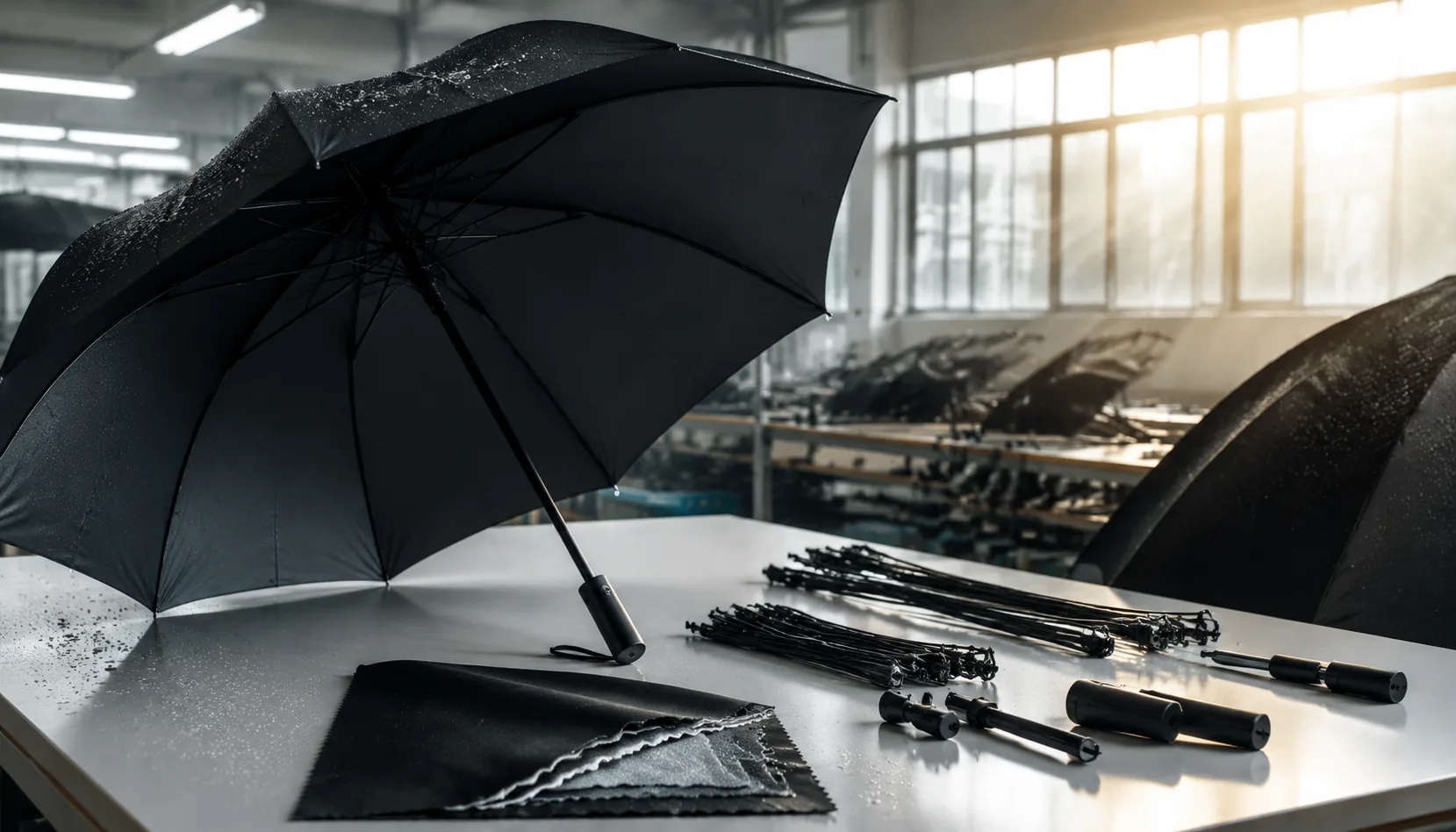
For rain-and-sun retail programs, the risk is not just a weak quote—it is a canopy that passes sampling but fails under heat, wet storage, or repeat opening on the shelf. On our Songxia production floor, blackout coated umbrellas require the pongee denier, coating adhesion, UPF 50+ performance, rib strength, print curing, and final water tests to be specified together, because one shortcut can turn into returns across the whole shipment.
Clarify Rain-and-Sun Performance Goals
Start by deciding whether the product is a sun umbrella that can handle rain, a rain umbrella with UV value, or a true all-season retail SKU. Those three briefs use different specs even if the outside looks similar. For UV protection, I would set UPF 50+ as the minimum claim and require test data on finished canopy fabric, not just raw coating film. For heat reduction, ask for measured surface temperature difference under midday sun, because a black underside can block light well but still feel warm if the outer fabric is dark. For rain-first use, hydrostatic pressure and seam leakage matter more than the UV label; 190T pongee with a dense blackout layer behaves differently from standard 190T polyester with basic PA coating. In our factory quotations, blackout coated umbrellas are usually separated by purpose before price, because a promotional giveaway, golf umbrella, and retail compact umbrella should not share the same coating target.
Light blocking should be written as a performance expectation, not a vague color request. A good UV blackout umbrella OEM brief should state whether buyers expect near-zero visible light transmission, reduced glare for outdoor dining, or just UPF 50+ sun protection. Black coated pongee umbrellas usually give the strongest visual blackout and are common on 21 inch auto-open-close compacts, 23 inch stick umbrellas, and 30 inch golf models. Silver coating reflects more heat but can look cheaper if the layer is too thin or patchy after rib rubbing. Vinyl-look blackout layers feel heavier and more rubberized; they can be useful for fashion or beach umbrellas but need flex testing, because thick coating may crack around folded creases after 500 to 1,000 open-close cycles. For custom blackout umbrellas, I always recommend approving both fabric swatches and a full finished sample under sunlight before locking bulk production.
Coating color also affects branding and inspection standards. A black underside makes logo placement on the outer canopy cleaner, especially with 190T or 210T pongee in navy, beige, forest green, or corporate PMS colors. A silver underside can fight with heat-transfer logos if the buyer wants inside printing, and vinyl-look layers often require stronger needle control because punctures show as pinholes when held against light. Practical sun rain umbrella specs should include canopy fabric, coating type, UPF target, water repellency, frame material, and intended wind rating: for example, 210T pongee, black UV coating, UPF 50+, Teflon water-repellent finish, 8K fiberglass ribs, auto-open frame, and 50+ mph wind-tunnel target for a vented 23 inch model. Bulk inspection should include AQL 2.5 checks for coating scratches, light leaks, seam wet-out, handle function, and color consistency between panels, because blackout defects are much easier for retail customers to notice than ordinary rainwear flaws.
Select Canopy Fabric and Coating Construction
For blackout coated umbrellas, the canopy decision usually starts with 190T versus 210T pongee, not with the coating color. 190T pongee is lighter, folds smaller, and works well for 21" and 23" compact auto-open-close models where packed diameter matters. The tradeoff is a looser weave, so heavy ink coverage or a thick black backing can show more fabric grain and slightly more panel distortion after heat setting. 210T pongee has a denser hand, cleaner panel tension, and better print registration for logos, especially on 27" golf umbrellas or retail-grade straight umbrellas. It also carries PU, silver, or black UV coatings more evenly because the yarn gaps are tighter. For black coated pongee umbrellas, I prefer 210T when the buyer wants a UPF 50+ claim, dark exterior colors, or large heat-transfer logos; 190T is acceptable for promotional runs when target FOB price is the main driver.
Single-side coating is the most common construction: dyed pongee outside, black or silver blackout coating inside. It keeps weight reasonable and lets the exterior print with screen, heat-transfer, or digital methods before final cutting. For a UV blackout umbrella OEM project, the coating must be tested for rub-off, pinholes, and cracking at fold lines, because cheap coating paste can look fine on the roll but fail after 300 open-close cycles. Double-layer construction is different: one outer decorative canopy plus an inner black canopy, usually stitched together at the tips and cap. It gives a softer luxury hand and hides the coating completely, but adds labor, weight, and bulk. Our standard practice at ZheBrella is to quote both builds separately when buyers request custom blackout umbrellas, because a double-layer 23" umbrella can pack closer to a normal 27" shaft umbrella in thickness.
Seam leakage is the weak point buyers often miss in sun rain umbrella specs. The fabric panel may pass water pressure testing, but every stitch hole along the 8K or 10K canopy seams breaks the coating film. On single-side coated canopies, we control this with correct needle size, tight stitch balance, and seam orientation; for heavier rain claims, seam tape or a waterproof top cap washer should be specified. Coating also changes folding behavior. A thick black PU layer increases panel memory, so the umbrella resists a tight roll and may crease white on sharp folds if the recipe is too brittle. On compact auto-open-close models, that extra thickness can stress the runner spring and make closing feel harsh. For retail programs, I would rather use stable 210T with medium coating weight than chase maximum blackout with a heavy coating that causes bulky packing, noisy folding, and early cracking.
Match the Frame to Added Canopy Weight
The first mistake I see in blackout coated umbrellas is treating the canopy like ordinary 190T pongee. A black PU, silver, or vinyl blackout layer can add noticeable mass and stiffness, especially on 23" and 27" golf models where the panel area is large. That extra load shows up at the ribs, stretchers, runner, and notch when the umbrella snaps open or catches side wind. For compact 21" manual models, 8K steel ribs may pass basic rain use, but I prefer fiberglass ribs or at least reinforced fiberglass end ribs when the buyer expects daily sun-rain use. Steel gives low cost and good shape memory in light rain, but it bends permanently after inversion; fiberglass flexes back better and is safer for windproof double-canopy builds.
Rib count should match the duty cycle, not just the catalog photo. An 8K frame is acceptable for promotional custom blackout umbrellas when the diameter is 21" or 23", the canopy is 190T/210T pongee with moderate coating, and the buyer is controlling cost. For retail, resort, golf, or event rental programs, 10K or 16K frames distribute the coated canopy load more evenly and reduce panel flutter. A 16K frame looks premium, but it also adds assembly points, weight, and inspection risk, so the stretchers must be riveted cleanly and the runner must slide without scraping the shaft. Our standard practice at ZheBrella is to test coated samples through repeated open-close cycles before confirming sun rain umbrella specs, because a canopy that looks fine on the sewing table can feel sluggish once mounted.
Auto-open and auto-open-close mechanisms need special attention because blackout coating changes opening force. If the spring is too weak, the canopy stalls halfway; if it is too aggressive, it shocks the ribs, cracks plastic runners, or tears stitching at the tips. For UV blackout umbrella OEM orders, I normally ask engineering to calibrate the spring after the final fabric is approved, not from an uncoated sample. Black coated pongee umbrellas with Teflon water repellency and UPF 50+ backing should also be checked after humidity conditioning, because coated fabric can stick slightly at folds. Buyers should specify cycle testing, runner pull force, rib material, and AQL 2.5 checks for open/close function, not just canopy diameter and logo method.
Plan Printing and Color Accuracy
Printing plans for blackout coated umbrellas should start with a hard rule: treat the inner canopy as a functional coating surface, not a decoration zone. Most black UV layers are PU, silver, or black glue coatings applied to 190T or 210T pongee, and they do not tolerate the same ink adhesion, screen pressure, or heat exposure as the outer face. For custom blackout umbrellas, I normally push logo work to the outer canopy panels, sleeve, closing strap, and handle end cap or grip insert. A 23" auto-open straight umbrella may allow 8 panel logos, but a cleaner retail spec is usually 1 or 2 panels plus a sleeve print. On compact 21" auto-open-close models, keep artwork away from rib tips and fold lines because repeated creasing will crack thick ink films faster than rain exposure will.
Color accuracy needs to be written into the purchase spec, not argued after bulk production. PMS matching should be confirmed on the actual canopy fabric, not on paper, because black coated pongee umbrellas often make outer colors look slightly duller due to the heavier backing and reduced light transmission. White underbase is required for yellow, orange, red, and other bright logos on navy, black, forest green, or burgundy pongee; otherwise the ink will sink and fail the buyer’s brand standard. For promotional orders, our standard practice at ZheBrella is to approve a strike-off under D65 light before mass printing, with tolerance agreed as Delta E if the brand has strict retail controls. Sleeve and strap prints often look sharper than canopy prints because the fabric is flatter and carries less panel tension during curing.
Writers should call out curing limits because blackout coatings are heat-sensitive, especially when buyers request heat-transfer logos or large solid screen prints. A typical PU black coating can bubble, gloss, or soften if the press temperature is pushed too high or the dwell time is too long; that damage may not show until the umbrella is opened under tension. For UV blackout umbrella OEM work, low-temperature transfer film, controlled flash curing, and slower conveyor settings are safer than forcing speed. Good sun rain umbrella specs should include print method, logo size in inches or centimeters, PMS codes, ink opacity requirement, placement diagram, and pre-production sample approval before fabric cutting. For AQL 2.5 inspection, add checks for ink rub resistance, coating bleed-through, panel-to-panel color variation, and registration drift near seams, especially on 8K and 10K frames where panel geometry is visibly exposed.
Confirm Testing, MOQ, and Delivery Details
Do not approve blackout coated umbrellas on a shade-card promise; approve them on test reports and retained samples. For sun claims, ask for UPF 50+ testing to AS/NZS 4399 or AATCC 183, with the finished coated canopy tested after sewing if the construction has many needle holes or vent panels. For rain, we normally check spray rating to AATCC 22, basic hydrostatic pressure on 190T or 210T pongee, and a 24-hour wet hanging check because some black coatings look fine dry but show streaking after soaking. Coating adhesion should be checked by cross-hatch tape pull and repeated fold rubbing at rib contact points, especially on compact 21" and 23" auto-open-close models where the canopy is compressed tightly.
Inspection has to include the umbrella mechanism, not only the fabric. AQL 2.5 for major defects is a reasonable export standard, with critical defects set to zero tolerance for broken tips, sharp burrs, failed runner locks, loose top caps, and coating transfer onto hands or packaging. For custom blackout umbrellas, I like to see at least 300 manual open-close cycles on straight umbrellas and 500 cycles on auto-open or auto-open-close samples before bulk approval; coating stiffness can change closing force and stress the ribs. On frames, confirm whether the buyer wants steel ribs for cost, fiberglass ribs for wind recovery, or mixed steel shaft plus fiberglass ribs for a practical retail balance. Double-canopy vented designs should be checked separately because vent overlap can reduce UV coverage if the lower panel is not also black coated.
For planning, sample lead time is usually 5–7 days for stock black coated pongee umbrellas with logo printing, and 10–15 days for a UV blackout umbrella OEM build involving new panel color, handle mold, custom sleeve, or lab testing. Bulk lead time is typically 25–35 days after deposit and sample approval, but heat-transfer logos, full-panel sublimation on the outer face, or Teflon water-repellent finishing can add 3–7 days. MOQ depends on fabric color, rib count, and handle: 500–1,000 pieces for common 23" 8K styles, 1,200–3,000 pieces for custom dyed 210T pongee, and higher if private packaging is required. FOB Ningbo or Shanghai is cleaner for coated goods when the buyer controls freight; DDP is convenient, but cartons need stronger moisture control and accurate HS classification because black coated pongee umbrellas may be inspected differently from basic rain umbrellas.
Frequently Asked Questions
Does a blackout coating automatically mean UPF 50+?
Not automatically. Buyers should request UPF 50+ test documentation for the selected fabric and coating combination, especially if the umbrella will be sold as sun protection.
Can blackout coated umbrellas be made as compact folding models?
Yes, but the coating adds thickness and can make folding less smooth. For compact models, specify 190T or carefully selected 210T pongee, tighter folding samples, and sleeve-fit checks before approval.
What fabric and coating specs should buyers request for blackout coated umbrellas?
For retail rain-and-sun umbrellas, request 190T or 210T pongee with a black PU or vinyl blackout coating and a target UPF 50+ rating. Ask the factory to confirm coating side, fabric weight, colorfastness, and whether the canopy passes water repellency testing after coating.
Can logos be printed on black coated pongee umbrellas?
Yes, but printing is usually done on the outer pongee side, not directly on the blackout coating. Screen printing is common for 1-4 color logos, while heat transfer or digital print may be used for gradients, small details, or retail artwork.
What QC tests are important for UV blackout umbrella OEM orders?
Buyers should request UPF testing, water repellency testing, coating adhesion checks, colorfastness to rubbing, frame open-close cycle testing, and wind resistance checks. For larger OEM orders, pre-production samples and final AQL inspection are recommended before shipment.
Looking to Launch Your Custom Umbrella Line?
ZheBrella is a Zhejiang-based OEM/ODM umbrella manufacturer with 17 years of export experience. Free design, low MOQ from 100 pieces, windproof construction, full-color print.
Get Free Quote Now »People Also Search For
Related Articles
Blackout Coated Rain Umbrellas: Retail Buyer Spec Guide
Specify blackout coated rain umbrellas with UPF 50+, pongee fabric, frame choices, print limits, MOQ, and AQL checks for...
Read More »
Cane Handle Stick Umbrellas: Buyer Specs for Retail Brands
Specify cane handle stick umbrellas with 8K frames, 190T/210T pongee, auto-open options, and QC checks for retail and gi...
Read More »
Private Label Rain Umbrellas: Good-Better-Best Specs
Build a good-better-best umbrella line with fabric, rib, mechanism, QC, MOQ, and packaging specs that fit retail price t...
Read More »