Private Label Rain Umbrellas: Good-Better-Best Specs
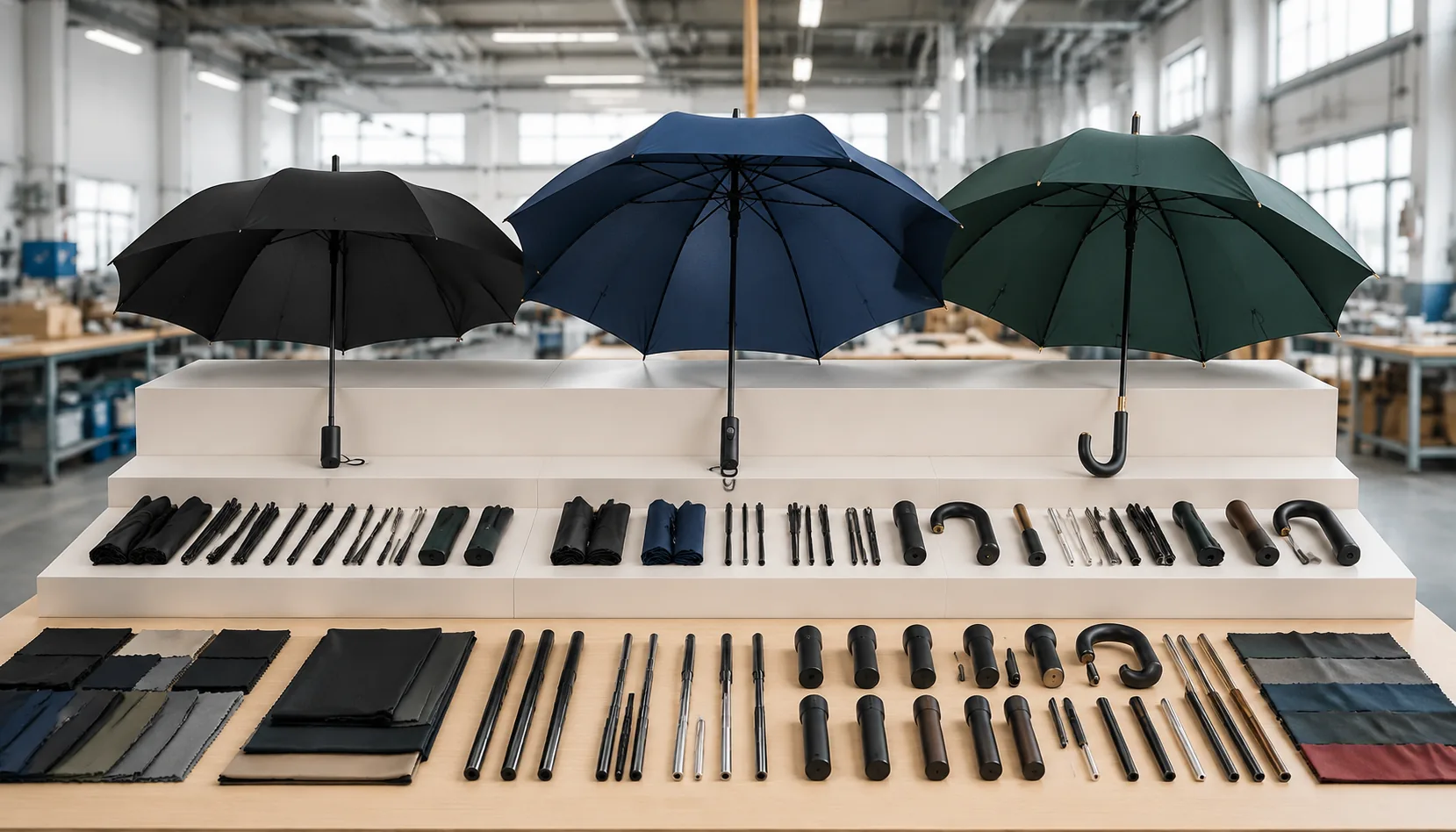
When buyers build good-better-best tiers for private label rain umbrellas, the hard part is not naming the levels; it is matching fabric, frame, opening system, QC limits, MOQ, and packaging to a retail price that still survives production. On our Songxia factory floor, small choices like 190T versus pongee, fiberglass versus metal ribs, or auto-open spring strength can decide whether a line feels coherent or becomes a return problem.
Define the Retail Tier Before Choosing Components
Define the retail tier before you touch the rib drawing, because the same 23" umbrella can land at very different costs depending on the buyer’s margin model. For entry private label rain umbrellas, I usually see FOB targets around $2.20–$3.80 for a manual 8K steel frame, 190T pongee umbrella fabric, straight plastic handle, and basic sleeve; these fit convenience retail, campus stores, and one-season promotional bins where the retail price may be $8–$15. Mid-tier programs often sit at $4.20–$7.50 FOB with auto-open or auto-open-close mechanisms, 8K or 10K fiberglass ribs, 210T pongee, better water-repellent coating, and a more stable retail price of $18–$35. Premium department-store or gift lines can run $8.00–$15.00+ FOB, especially with 16K frames, double-canopy vented windproof construction, UPF 50+ coating, EVA or rubberized handles, gift boxes, and 50+ mph wind-tunnel claims that actually need test backing.
Margins work backward from the shelf, not forward from a component wish list. A distributor selling into a retail umbrella program may need 40%–55% gross margin after freight, duty, warehousing, and markdown allowance, while a brand selling direct can tolerate higher FOB if the story is strong: compact commuter umbrella, executive gift umbrella, golf-size 30" storm umbrella, or fashion capsule for department stores. OEM umbrella specs should be locked by use case first. Commuter models normally prioritize 21" or 23" compact auto-open-close frames, corrosion-resistant shafts, and fast-drying 210T pongee. Gift umbrellas need cleaner branding, color consistency, custom woven labels, and better packaging. Department-store lines need tighter cosmetic control, smoother runner action, and fewer sharp cost cuts because customers will compare hand feel on the rack. Our standard practice at ZheBrella is to quote Good-Better-Best using the same canopy size and artwork first, then isolate cost changes from frame, fabric, handle, coating, and packaging.
MOQ and color assortment are where many buyers accidentally add cost. A factory may accept 500–1,000 pieces per style for a stock-color canopy, but custom-dyed pongee, matched handles, plated shafts, or printed retail cartons can push practical MOQ to 2,000–3,000 pieces per color. If a buyer wants six colors at 500 pieces each, the total order looks large, but each SKU still carries separate fabric setup, cutting-room sorting, print alignment, carton labeling, and inventory risk. That raises per-SKU cost and makes AQL 2.5 inspection more important because small color lots leave less room to replace defects before shipping. For entry tiers, keep colorways tight: black, navy, red, and one seasonal color. For mid and premium tiers, use fewer frame platforms across more canopy designs so spare parts, production jigs, and QC criteria stay consistent. Private label rain umbrellas sell better when the assortment is disciplined, not when every buyer meeting adds another color.
Match Canopy Fabric to Price and Performance
Fabric choice is where a retail umbrella program quietly wins or loses margin. For value-tier private label rain umbrellas, 190T pongee is usually the right starting point: it is lighter, cuts cleanly, dries faster than cheap polyester taffeta, and holds basic one- or two-color logo printing without looking flimsy on a 21-inch folding umbrella or 23-inch stick umbrella. I would pair 190T with steel ribs on entry models and fiberglass ribs only if the buyer needs a wind story, because spending on both premium fabric and premium frame can push the umbrella out of its intended price band. For OEM umbrella specs, define not just “190T pongee umbrella fabric” but also yarn density tolerance, water-repellent treatment, colorfastness, and whether the canopy must pass spray testing after folding abrasion. A good factory will check shade consistency roll by roll before cutting, because navy, black, and red show batch variation fast under retail lighting.
210T pongee is the better choice when the umbrella needs a smoother handfeel, tighter weave, and sharper print registration. The difference is obvious on full-panel heat transfer, edge-to-edge sublimation, and retail patterns where a loose weave makes fine lines look fuzzy. On 27-inch golf umbrellas, 30-inch doorman umbrellas, or 8K/10K premium stick umbrellas, 210T also hangs better over the rib tips and gives the canopy a cleaner dome after sewing. It costs more, but it supports higher retail pricing because the customer feels the upgrade immediately when opening the umbrella. For private label rain umbrellas sold through department stores, corporate gifting, or brand boutiques, I would rather reduce packaging cost than downgrade from 210T to 190T if print quality is part of the offer. Our standard practice at ZheBrella is to approve a pre-production canopy under both daylight and 6500K light before bulk fabric cutting.
Coatings should be specified by claim, not by habit. A normal water-repellent finish is enough for everyday rain resistance, but PU coating adds a softer backside and improves water holdout on dense rain days; black coating is the common choice for UPF 50+ sun-block umbrellas because it blocks visible light and heat better than a clear finish. Silver coating is cheaper and familiar in promotional umbrellas, but it can scratch during folding and looks less premium on retail shelves. If the packaging says UV protection, ask for UPF 50+ test data from the fabric lot, not just a catalog promise. Coating also affects sewing: thick PU or black glue layers can make needle holes more visible, especially near the top cap and rib pockets. Build this into the AQL 2.5 inspection checklist with checks for coating pinholes, print adhesion, seam leakage, and canopy shade match, because fabric defects are expensive to discover after final assembly.
Select Frame, Rib Count, and Mechanism by Tier
For economy private label rain umbrellas, I normally start with an 8K steel frame because it is predictable, easy to source, and keeps the FOB price under control. A 23" straight umbrella or 21" 3-fold compact with 8 steel ribs, a chrome-plated shaft, and 190T pongee umbrella fabric is the common opening tier for supermarkets, hotel giveaways, and basic promotional programs. Steel gives good shape retention, but it does not forgive side gusts; once a rib bends past its elastic limit, the umbrella may still open but the canopy tension becomes uneven. For this tier, keep the mechanism simple: manual open for the lowest failure rate, or auto-open only if the retail umbrella program needs one-hand operation. In our incoming and final checks, economy OEM umbrella specs should still include rib pull tests, runner locking tests, and open-close cycling, not just visual inspection, because cheap frames fail first at the notch, stretcher rivet, and runner spring.
The better tier is where fiberglass ribs start earning their cost. A 23" or 27" 8K frame with fiberglass ribs and a steel or aluminum shaft flexes instead of permanently deforming, which is why it performs better in 35–45 mph gust simulations than all-steel economy builds. For compact models, I like a steel center shaft with fiberglass end ribs rather than an all-lightweight structure, because buyers often underestimate how rough consumers are with auto-open folding umbrellas. Auto-open mechanisms need stronger springs, cleaner button travel, and tighter QC on the runner lock; if the button sticks after 300–500 cycles in testing, returns will follow. At this level, 190T is acceptable, but 210T pongee with water-repellent coating gives a noticeably cleaner canopy surface and better print registration for logos. AQL 2.5 inspection should include functional sampling after packed-carton compression, since a frame that passes loose on the table may bind after shipping pressure.
Premium windproof lines should not just add more ribs for appearance; they need a frame system designed around load distribution. A 16K straight umbrella looks strong and gives a dense, luxury canopy profile, but it adds weight and more rivet points, so poor assembly can create more failure locations. For true storm positioning, I prefer a 27" or 30" double-canopy vented construction with fiberglass ribs, reinforced stretchers, and a vent gap that releases uplift instead of fighting it. Good builds can survive 50+ mph wind-tunnel testing, but only when the canopy pattern, rib arc, and runner travel are matched. Auto-open-close is useful for premium compact private label rain umbrellas, yet it is the hardest mechanism to keep durable because the spring, cable, shaft sections, and safety lock all age together. For that reason, premium OEM umbrella specs should call for 500–1,000 open-close cycles, inversion recovery checks, and separate testing after UV, Teflon, or UPF 50+ coating treatments.
Plan Branding, Packaging, and Carton Specs
Branding decisions should be locked before bulk fabric cutting, not after the first sample, because panel artwork changes the whole production flow. For private label rain umbrellas, specify whether the logo is screen printed, heat transferred, or sublimated, and state the print position by panel count: one-panel outside print, alternating 2-panel print, full 8K wrap, or inside canopy artwork. Screen print is still the cleanest choice for solid corporate logos on 190T or 210T pongee umbrella fabric, but gradients and photo graphics usually need heat transfer or digital sublimation. Call out Pantone codes, logo size in millimeters, distance from seam, and whether printing must avoid the strap fold line. Woven labels should list exact dimensions, fold type, placement on strap or seam, and thread colors. Hangtags need paper weight, string type, hole reinforcement, and language versions if the same retail umbrella program ships to the U.S., EU, and Canada.
Retail packaging is where many OEM umbrella specs become vague, so make it measurable. A polybag is cheap and compact, but a printed retail sleeve or color box changes both shelf presentation and export volume. Define sleeve material, box flute or card stock, window cutouts, matte or gloss lamination, and whether the handle must remain visible for store merchandising. Barcode placement should be confirmed on the color box, hangtag, and master carton before mass printing; retailers often reject cartons when UPC/EAN labels sit across a seam, corner, or tape line. Our standard practice at ZheBrella is to place item barcode, PO number, color code, and carton number on two adjacent carton sides so warehouse scanners can read them on a pallet. If FNSKU, Amazon carton labels, or retailer routing labels are required, reserve a blank label zone instead of covering printed shipping marks later.
Packaging also affects freight math, not just appearance. A 23-inch auto-open umbrella in a tight sleeve may pack 48 pieces per master carton, while the same umbrella in individual color boxes may drop to 24 or 36 pieces and raise CBM by 20–45%. That difference directly changes DDP landed cost because ocean LCL, truck delivery, and warehouse handling are often billed by volume, not unit price. Carton design should be checked against a realistic drop test: five faces, three edges, and one corner from 60–80 cm depending on gross weight. Use 5-ply export cartons for heavy 27-inch or 30-inch models, and add inner dividers if metal tips or hook handles can rub through retail boxes. Tie packaging approval to AQL 2.5 inspection, including barcode scanability, carton compression, print rub resistance, and packed-weight verification before shipment release.
Lock QC, Lead Time, and Reorder Rules
Lock the golden sample before you argue about price breaks, because private label rain umbrellas fail most often from drifting details, not from the headline specification. For a retail umbrella program, I want one signed pre-production sample for each construction: 21" compact auto-open-close, 23" straight auto-open, 27" golf, or whatever the line includes. That sample should freeze the frame material, rib count, shaft diameter, handle finish, logo position, fabric weight, seam allowance, tie-wrap length, sleeve label, barcode, carton mark, and hangtag wording. OEM umbrella specs also need measurable tolerances: logo registration within 2 mm, canopy panel color within an agreed Lab dip range, rib tip pull strength, open/close cycle test, and water repellency after spray testing. If the buyer approves only a photo, the factory floor will interpret gray areas differently across cutting, sewing, printing, and assembly shifts.
A realistic production lead time is about 30–45 days after written sample approval, deposit, confirmed artwork, and packaging files; quoting from PO date is how schedules get padded and then missed. Plain 190T pongee umbrella fabric in black, navy, red, or royal blue can usually move faster because greige fabric and common dye lots are stocked in Songxia, but custom PMS dyeing, sublimation panels, rubber-coated handles, UPF 50+ coatings, or double-canopy vented windproof frames add days. Our standard practice at ZheBrella is to separate the timeline into material booking, fabric cutting, printing, sewing, frame assembly, packing, and final inspection rather than giving one vague ship week. For FOB Ningbo or Shanghai, build in 3–5 days for inland trucking, booking, and customs paperwork; for DDP, add the ocean or air freight reality instead of pretending the factory lead time is the delivery date.
Final inspection should be written into the PO as AQL 2.5 inspection for major defects, with critical defects at zero tolerance when safety or brand risk is involved. Major defects include broken ribs, weak runners, loose tips, crooked logos, stained canopy panels, failed auto-open-close mechanisms, exposed sharp wire, wrong barcode, and carton shortages. Minor defects might be small thread ends, slight sleeve wrinkles, or acceptable shade variation within the approved standard, but define them before production starts. Reorder rules matter just as much: reserve repeat colors by dye-lot when possible, keep the same mold numbers for handles and end caps, and confirm replacement parts such as ribs, runners, ferrules, tips, sleeves, and wrist straps. Seasonal launches should place repeat orders 60–90 days ahead of the sales window, especially before April–June rain promotions or Q4 gift sets, because small custom parts are what delay otherwise simple private label rain umbrellas.
Frequently Asked Questions
What is a practical MOQ for a private label rain umbrella line?
Many OEM factories quote from 500-1,000 pieces per style/color, but lower MOQs may limit fabric colors, handle molds, and packaging options. Multi-color assortments usually work best when total order volume supports shared components.
Which spec upgrade gives the best retail value?
For most mid-tier retail umbrellas, upgrading from steel to fiberglass ribs improves wind resilience more visibly than minor fabric changes. Pairing 190T or 210T pongee with AQL 2.5 inspection helps control returns.
What specs should separate good, better, and best retail umbrellas?
A typical good tier uses 190T polyester, steel ribs, manual open, and basic sleeve packaging. Better often upgrades to 190T or 210T pongee, fiberglass ribs, auto open, and retail hangtag; best may include full fiberglass frames, auto open-close, windproof construction, branded case, and stricter QC.
What MOQ is realistic for a private label rain umbrella program?
For OEM retail umbrellas, a practical MOQ is usually 500–1,000 pieces per color or style, depending on fabric, frame, and printing method. Custom packaging or Pantone-dyed fabric may require higher minimums, often 1,200–3,000 pieces.
How should AQL 2.5 inspection be applied to umbrella orders?
AQL 2.5 is commonly used for major defects such as broken ribs, faulty open-close mechanisms, fabric leakage, incorrect logo placement, or poor stitching. Buyers usually define critical, major, and minor defect limits in the purchase order before production starts.
Looking to Launch Your Custom Umbrella Line?
ZheBrella is a Zhejiang-based OEM/ODM umbrella manufacturer with 17 years of export experience. Free design, low MOQ from 100 pieces, windproof construction, full-color print.
Get Free Quote Now »People Also Search For
Related Articles
Private Label Umbrella Specs That Reduce Retail Returns
Define retail-ready umbrella specs that reduce returns: canopy fabric, ribs, auto-open cycles, labeling, AQL checks, MOQ...
Read More »
Private Label Rain Umbrellas: Retail Specs and Carton Planning
Plan retail-ready private label umbrellas with fabric, frame, packaging, barcode, carton, MOQ, and inspection specs buye...
Read More »
Luxury Wooden Handle Umbrellas for Retail Private Label
Build retail-ready wooden handle umbrellas with 16K frames, 210T pongee, branded details, packaging specs, FOB/DDP terms...
Read More »