Cane Handle Stick Umbrellas: Buyer Specs for Retail Brands
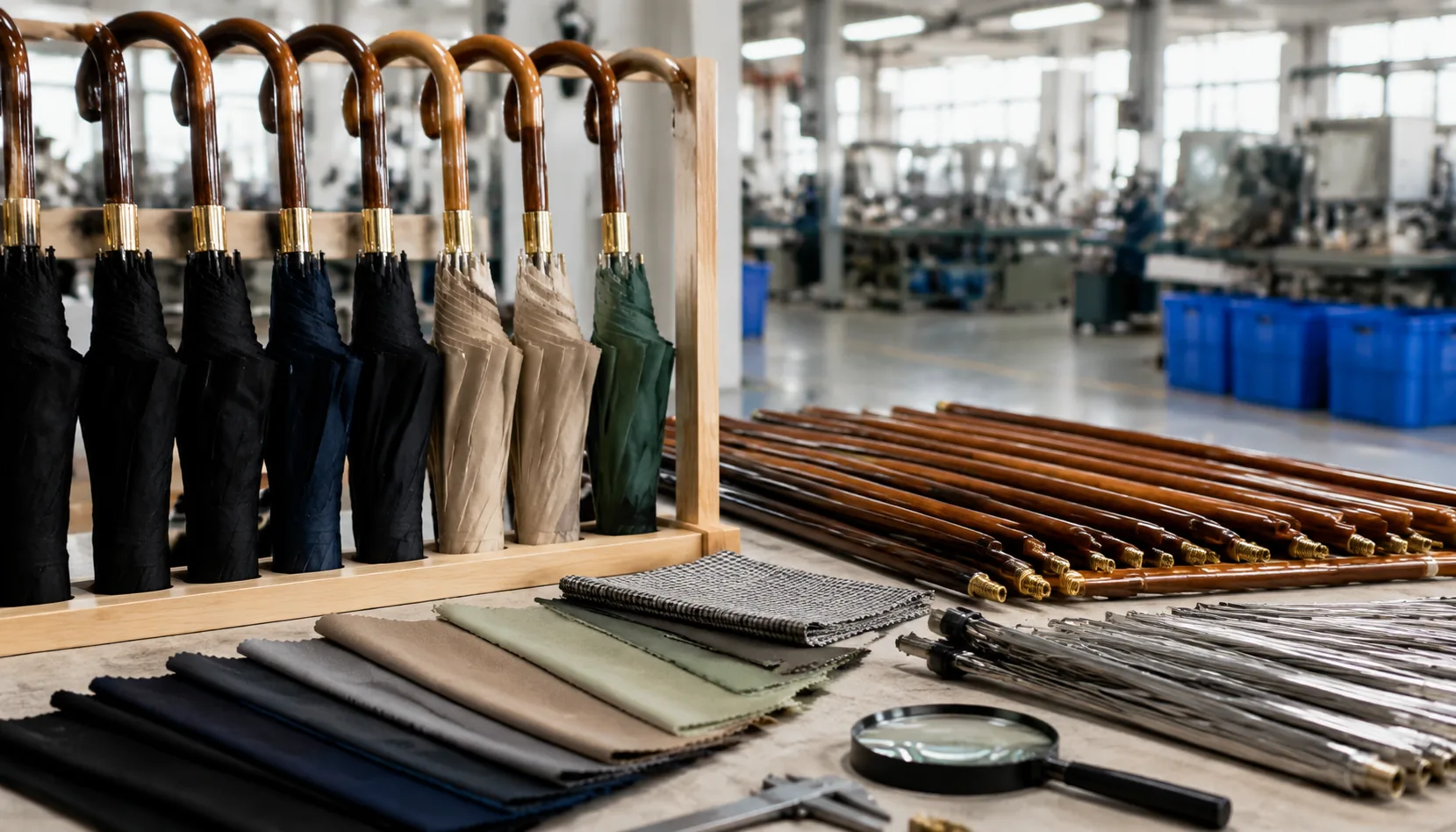
For retail and gift buyers, cane handle stick umbrellas look simple until frame balance, fabric handfeel, handle fit, and carton specs start affecting returns and shelf presentation. On our Songxia factory floor, the decisions that matter are practical: 8K rib strength, 190T or 210T pongee coating, reliable auto-open action, clean tip alignment, and QC checks that catch loose ferrules, warped shafts, and color variance before packing.
Frame and Rib Specs for Stick Umbrellas
For retail stick umbrellas, the rib length usually starts at 23 inches and moves to 25 inches when the buyer wants more shoulder coverage without turning the product into a golf umbrella. A 23-inch 8K frame gives roughly 102–105 cm open arc depending on rib curvature, which fits department-store wooden handle umbrellas and most promotional retail rain umbrella specs. A 25-inch frame pushes closer to 110–115 cm arc and feels more premium, but it also increases canopy fabric consumption, carton length, and shipping cube. I am cautious with “oversized” claims on cane handle stick umbrellas because a heavier canopy on a long shaft can make the umbrella nose-heavy unless the shaft diameter, runner, and handle weight are balanced correctly.
The 8K frame is the commercial workhorse: eight ribs, clean canopy panels, fast sewing, lower rejection risk, and good pricing for straight umbrella OEM programs. A 16K frame looks richer because the canopy is divided into narrower panels, giving a rounder dome and a more tailored retail presentation, especially with 190T or 210T pongee. But 16K is not automatically stronger. It doubles the number of ribs, tips, pockets, and stitch points, so tolerance control matters more. If the rib ends are uneven by even 3–5 mm, the canopy can twist after opening. For crook handle umbrellas sold through retail shelves, I normally recommend 8K for value lines and 16K only when the brand is willing to pay for tighter frame inspection and slower assembly.
Fiberglass ribs outperform steel when wind recovery and weight control matter more than the lowest frame cost. Steel ribs are stiff and cheap, but once bent past their elastic range they stay bent, which is why low-cost stick umbrellas often fail after one gust. Fiberglass ribs flex and rebound, especially when paired with a steel or fiberglass shaft and proper stretchers, so a 23-inch or 25-inch umbrella can survive repeated inversion better. Our standard practice at ZheBrella is to test fiberglass 8K stick frames through opening cycles, rib deflection checks, and wind exposure around 40–50 mph for windproof claims. For cane handle stick umbrellas aimed at daily retail use, fiberglass ribs add cost, but they reduce warranty complaints and keep the umbrella lighter in hand.
Canopy Fabric, Coatings, and Color Matching
For cane handle stick umbrellas sold at retail, canopy fabric is where the customer first feels the difference between a giveaway item and a product worth hanging near the front door. 190T pongee is the normal baseline for crook handle umbrellas because it gives a smooth hand feel, decent drape, and reliable water beading after a standard water-repellent finish. It is also easier to control cost on 23" and 27" straight umbrella OEM orders. 210T pongee is tighter, slightly heavier, and noticeably cleaner under store lighting; the surface takes heat-transfer logos and edge-to-edge sublimation with better line definition, especially on dark navy, forest green, burgundy, and custom Pantone panels. In production, 210T also shows fewer needle puckers after sewing if the factory uses the correct needle size and thread tension. My advice: use 190T for value retail and promotional runs, but specify 210T when the umbrella will sit in a branded gift box or sell above the basic price tier.
Water repellency depends more on finishing control than fabric label alone. A good 190T pongee canopy with a clean WR finish can pass normal shake-dry expectations, but a poor coating line will leave wet patches around the panel seams no matter what the buyer paid for the yarn count. For retail rain umbrella specs, I would request a spray rating sample before mass production, then confirm bulk fabric after dyeing because darker colors sometimes behave differently from light panels. Teflon coating is an option when the buyer wants stronger beading and a more premium hand, but it adds cost and should be confirmed against the target FOB price. For wooden handle umbrellas, I also check whether canopy color bleeds onto the curved cane handle during wet folding; cheap black or red dye lots can stain varnished beech or maple handles if the fabric was not properly fixed.
Sun-rain SKUs need a different specification from ordinary rain umbrellas. A black inner coating can give strong shade, reduce visible light transmission, and support UPF 50+ claims when tested properly, but it changes the canopy hand feel and makes stitching flaws easier to see from inside. Silver coating is cheaper, though it often looks less refined on cane handle stick umbrellas aimed at department stores or lifestyle brands. If the product needs both rain performance and sun protection, I usually recommend 210T pongee with black coating, fiberglass ribs for better wind recovery, and a 23" or 27" manual-open frame depending on the retail channel. Color matching should be done on bulk fabric, not only lab dips, because coated pongee shifts visually after lamination. Our standard practice at ZheBrella is to approve Pantone under D65 light, then recheck finished panels after cutting, printing, and sewing before AQL 2.5 inspection.
Cane Handle Materials and Brand Positioning
Handle material sets the price signal before a customer opens the canopy, so I never treat it as a decoration choice. ABS crook handles are the most stable option for mass retail: low cost, good impact resistance, easy Pantone color matching, and consistent surface gloss across 5,000 or 50,000 pieces. Rubberized ABS improves wet-hand grip and feels better in cold weather, but buyers should specify coating thickness and abrasion testing because cheap soft-touch paint can turn sticky after warehouse heat cycles. Faux wood gives cane handle stick umbrellas a warmer shelf look without the moisture movement of real timber; the best versions use hydrographic grain over ABS, then a clear coat that survives carton rubbing. For promotional or fashion programs, faux wood also keeps color variation under control, which matters when stores display 12 units face-out in one tray.
Real wood crook handles belong in a different positioning tier. Beech, maple, ash, and bamboo all work, but each behaves differently during sanding, staining, and clear coating. Beech gives a smooth, uniform finish for classic wooden handle umbrellas; bamboo reads more eco-oriented but has node variation that must be approved in pre-production samples. Real wood feels warmer and heavier than plastic, which helps premium crook handle umbrellas justify a higher retail price, but it also needs tighter moisture control before assembly. If the wood is too wet, the handle may shrink after export and loosen around the metal shaft. Our standard practice at ZheBrella is to check handle fit after aging samples for 24 hours, then torque-test the shaft joint before mass production. For retail rain umbrella specs, I would also define acceptable grain variation, stain tolerance, and whether minor natural knots are allowed.
Logo placement is more limited on crook handles than many brand teams expect. The outside curve is comfortable in the hand but poor for sharp printing because the radius distorts pad-print artwork, especially small serif text under 6 pt. The best branding zones are the flat end cap, the upper neck near the shaft, or a metal badge inset on the outer face. ABS handles can take pad print, heat transfer, or molded-in logos; rubberized handles usually need one-color pad print with primer, and durability should be verified by 3M tape and 500-cycle rub tests. Faux wood and real wood are better with laser engraving, hot stamping, or a small metal plate, but color-filled engraving on dark stain can lose contrast. For straight umbrella OEM orders, I advise locking the handle first, then matching canopy binding, runner, tips, and sleeve trim around it so the umbrella looks intentionally designed rather than assembled from available parts. Cane handle stick umbrellas sell best when grip comfort, finish consistency, and branding method are specified together.
Mechanism, Tip, and Runner Choices
For cane handle stick umbrellas, the mechanism decision should come before handle material or logo placement because it controls the shaft diameter, runner design, spring load, and final packing length. A manual 23" or 27" stick umbrella is the most stable retail build: fewer moving parts, lower warranty risk, and easier AQL 2.5 inspection because the open-close force is visible by hand. Auto-open is convenient for department-store and travel retail programs, but it needs a stronger spring, cleaner shaft slot punching, and tighter runner tolerance; cheap auto-open parts are where I see ribs jumping out after 300–500 cycles. For straight umbrella OEM orders, we usually test 500 open-close cycles for manual and 800 cycles for auto-open before approving bulk components. Auto-open typically adds about $0.18–$0.45 FOB depending on shaft gauge, runner grade, and whether the frame is 8K steel, 8K fiberglass, or a mixed steel/fiberglass windproof structure.
The runner is a small part that causes big claims if the buyer ignores it. Crook handle umbrellas for retail should use a pinch-proof safety runner, especially in the U.S. and EU promotional channels where end users include families and event guests. A basic metal runner is cheap and strong, but it can pinch fingers and scratch plated shafts if the edge is not rolled cleanly. Plastic safety runners feel smoother and reduce injury complaints, but low-grade PP runners crack in cold weather; I prefer nylon-reinforced runners on 27" and 30" stick frames. For wooden handle umbrellas, check that the runner stop, notch spring, and top cap are aligned, because wood handles make the umbrella feel premium while a rough runner makes it feel like a market-stall item. Our standard practice at ZheBrella is to inspect runner lock engagement, release pressure, and shaft scratching during inline QC, not only at final AQL.
Tip choice affects both appearance and durability more than many retail rain umbrella specs admit. Metal tips, usually nickel-plated or powder-coated steel, look sharper on cane handle stick umbrellas and balance well with a wood crook handle, but they add weight, can dent floors, and may rust if plating is thin or salt-spray control is skipped. Plastic tips are lighter, cheaper, and safer for event giveaways, but they look weak on a premium 190T or 210T pongee canopy unless the mold is clean and the color matches the ferrule, runner, and end cap. A metal tip may add only $0.03–$0.08 FOB, but combined with a thicker shaft, fiberglass ribs, UV coating, and color-matched hardware, the total frame upgrade can move cost by $0.40–$1.20. My recommendation: use metal tips for retail wooden handle umbrellas above mid-tier price points, and use reinforced plastic tips for budget auto-open programs where carton weight and safety matter more than shelf presence.
Order Specs, Testing, and Lead Time Planning
Testing and lead time planning should be practical. Specify AQL 2.5 for major defects and AQL 4.0 for minor defects unless the retailer has its own manual, then define checks for open-close smoothness, rib alignment, canopy tension, seam slippage, print adhesion, water repellency, and carton drop resistance. For retail rain umbrella specs, carton packing usually runs 24 pcs or 36 pcs per export carton, with each umbrella in a sleeve, master carton under 18–22 kg, and shipping marks matching the PO. Production lead time is typically 30–45 days after artwork and PP sample approval, not after deposit, because fabric dyeing, frame assembly, printing, sewing, packing, and final inspection all depend on locked artwork. Add 7–10 days for sample making and 3–5 days for buyer review, and longer before Canton Fair, Christmas, or spring promotion seasons when capacity tightens.
Frequently Asked Questions
Are cane handle stick umbrellas better for retail than folding umbrellas?
They offer a more premium in-store presentation and stronger frame options, but they require larger cartons and higher freight volume. They work best for department stores, hotels, and gift programs where perceived value matters.
Can a cane handle umbrella use an auto-open mechanism?
Yes, many stick umbrellas can be built with auto-open runners. Buyers should confirm spring strength, button placement, and cycle testing before approving bulk production.
What specifications should a retail buyer confirm for cane handle stick umbrellas?
Confirm rib count, frame material, shaft diameter, fabric weight such as 190T or 210T pongee, handle material, opening mechanism, canopy size, logo method, and packaging. For retail programs, buyers usually request pre-production samples before mass production.
What MOQ is typical for custom crook handle umbrellas?
A common MOQ is 500 to 1,000 pieces per design, depending on handle material, fabric color, and logo requirements. Custom molded handles or special wood finishes may require a higher MOQ.
What QC checks are important for wooden handle stick umbrellas?
QC should include auto-open function testing, rib strength checks, shaft straightness, fabric waterproof testing, seam inspection, logo placement, and handle finish inspection. Retail buyers often require AQL inspection before shipment.
Looking to Launch Your Custom Umbrella Line?
ZheBrella is a Zhejiang-based OEM/ODM umbrella manufacturer with 17 years of export experience. Free design, low MOQ from 100 pieces, windproof construction, full-color print.
Get Free Quote Now »People Also Search For
Related Articles
Walking Cane Umbrellas for Retail: OEM Buyer Spec Guide
Source walking cane umbrellas with the right shaft, crook handle, ribs, canopy fabric, tip design, MOQ, and QC standards...
Read More »
Executive Stick Umbrellas: Buyer Specs for Retail Brands
Compare executive stick umbrella specs, from 8K/16K frames and pongee fabrics to handles, QC, MOQs, and shipping terms f...
Read More »
Wooden Stick Umbrellas: OEM Specs for Retail Brands
Compare wooden stick umbrella specs for retail orders, including shafts, 8K/16K ribs, 190T/210T pongee, handles, QC, MOQ...
Read More »