Wooden Handle Umbrellas: Specs for Premium Retail Programs
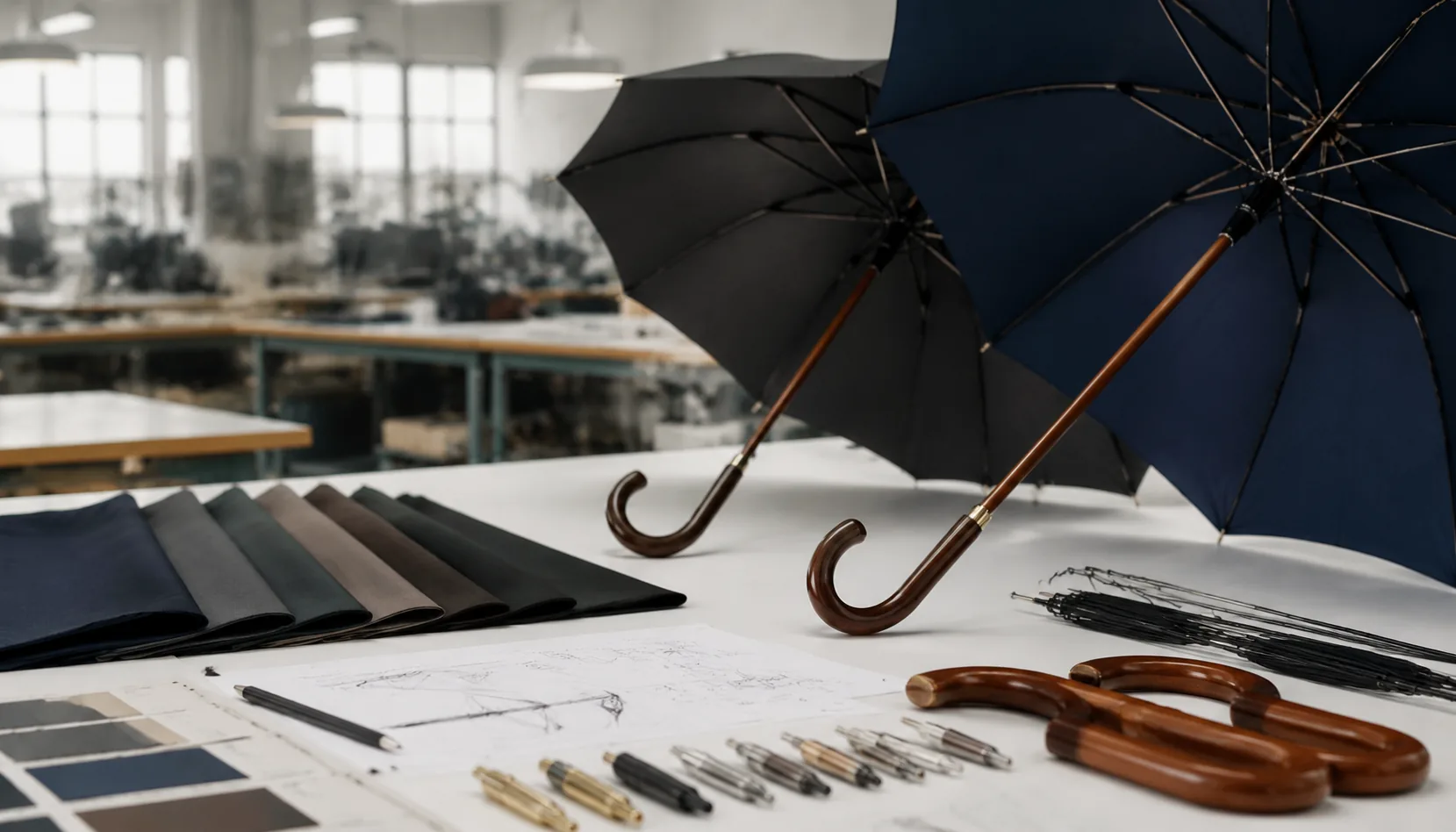
Premium retail buyers do not struggle with the idea of wooden handle umbrellas; they struggle with keeping the hand feel, canopy tension, frame strength, logo finish, and carton presentation consistent across thousands of units. On our Songxia production floor, the difference between a solid program and a costly claim often comes down to shaft tolerance, rib selection, pongee density, handle coating cure time, and pre-shipment QC that matches the retail price point.
Where Wooden Handle Umbrellas Fit
Wooden handle umbrellas fit where the buyer is selling touch, not just rain coverage: department stores, museum shops, hotel boutiques, fashion retail, and executive gift programs. A maple, ash, bamboo, or beech crook handle immediately separates the product from a $2 plastic J-handle promotional umbrella because the shopper feels weight, grain, and finish before opening the canopy. For premium retail umbrellas, I usually recommend a 23" or 27" stick frame with 8K or 10K fiberglass ribs, a steel shaft for a clean formal profile, and 190T or 210T pongee with Teflon water-repellent coating. That combination gives enough structure for daily use without turning the umbrella into a heavy golf model. A wooden crook handle umbrella also photographs better on shelves and online because the handle creates a recognizable silhouette, especially when paired with a matte black, navy, forest green, or cream canopy.
The premium signal comes from controlled details: handle sanding, varnish depth, ferrule alignment, tip color, runner smoothness, and canopy tension. Basic plastic-handle umbrellas can hide rough assembly because they are treated as disposable giveaway items; wooden handle umbrellas cannot. If the crook has visible glue marks, uneven lacquer, or a sharp inside radius, the whole program feels cheap. For museum shops and hotel boutiques, I prefer manual-open construction because it feels quieter and more intentional, while corporate executive gifts often use auto-open for convenience. In both cases, the frame should pass open-close cycling checks and rib joint pull tests before final packing. At ZheBrella, our standard practice for this category is AQL 2.5 final inspection with extra attention on handle finish, canopy centering, and seam puckering, because retail returns usually start with visible defects rather than technical failure.
For OEM umbrella specs, the handle choice should be locked early because it affects packaging length, carton cube, MOQ, and FOB/DDP costing. A 23" stick umbrella with a wooden crook handle may need a longer sleeve, reinforced inner carton, and scratch protection between handles, especially for glossy varnish or engraved logos. Fashion retailers often ask for tone-on-tone woven labels, metal nameplates, or heat-transfer canopy branding; museum shops lean toward subtle inside-panel prints or artwork on 210T pongee; hotels usually choose restrained logo placement on the tie wrap or sleeve. A serious luxury umbrella supplier should also clarify whether the wood is natural, stained, painted, or laminated bamboo, because color variation becomes a QC issue when stores expect consistent shelf presentation. Typical production lead time is 30–45 days after sample approval, longer if custom handle tooling, FSC documentation, or multi-color sublimation artwork is required.
Handle Materials, Shapes, and Finish Quality
Handle choice changes the retail feel more than buyers expect, especially on wooden handle umbrellas where the customer touches the value before opening the canopy. A wooden crook handle umbrella is still the safest shape for premium retail umbrellas because it hangs cleanly on a display rail, feels balanced on a 23" or 27" stick umbrella, and gives enough surface area for a polished grain or stained finish. Straight wooden handles work better on golf styles, usually 27" to 30", where the buyer wants a firmer grip and less old-world styling. Carved handles are attractive but risky if the pattern has sharp valleys; those areas catch varnish, show sanding marks, and crack faster during dry-season export storage. For OEM umbrella specs, I ask buyers to define handle diameter, curve radius, wood species, finish type, and logo method before sampling, not after the first salesman sample looks “almost right.”
Finish quality must be judged under consistent light, not just from phone photos. Varnished handles should have an even gloss with no orange peel, pinholes, dust points, or thick buildup around the ferrule joint. Matte finishes look more modern, but they expose sanding defects, so the wood needs to be worked through fine grit before coating. Stained handles require grain sorting because mixed light and dark pieces in one carton make a retail program look like leftover stock. Painted handles solve color matching, especially for black, navy, ivory, or Pantone brand colors, but paint must pass cross-cut adhesion and rub testing before mass production. Our standard practice at ZheBrella is to approve a sealed color master and compare bulk handles against it at incoming inspection, then again after assembly, because coating tone can shift once the handle is bonded to a black steel or fiberglass shaft.
The failure points are simple: bad wood, rushed sanding, weak bonding, and careless packing. Inspectors should reject handles with open cracks, worm holes, raised grain, rough edges at the crook end, visible glue squeeze-out, or color patches that cannot be hidden by normal retail lighting. The shaft-to-handle joint needs a mechanical fit plus adhesive, not glue filling a loose hole; otherwise the handle twists after several open-close cycles or during carton vibration on a 30-day ocean shipment. On premium programs, I prefer torque checks on finished units, pull checks by sample lot, and AQL 2.5 visual inspection for scratches, chips, coating bubbles, and inconsistent grain. A luxury umbrella supplier should also separate wooden handles with sleeves or tissue before final packing, because varnished and painted finishes can transfer marks when 24 or 36 pieces are packed tightly for FOB or DDP shipment.
Frame and Canopy Specifications
For premium retail umbrellas, the shaft choice decides the hand feel before the customer ever opens the canopy. A 23" wooden crook handle umbrella with a black electroplated steel shaft has the classic weight buyers expect in department-store programs: usually 14 mm center pole diameter, smooth manual-open runner, and enough mass to balance a beech or maple J-handle. Aluminum shafts cut weight by roughly 15–25%, useful for travel-oriented retail sets, but they do not give the same solid “walking umbrella” feel. For wooden handle umbrellas, I normally recommend steel shafts unless the target retail price or freight weight forces a lighter build.
Rib material is where many OEM umbrella specs get oversimplified. Steel ribs are inexpensive, straight, and clean-looking, but they can deform after repeated inversion. Fiberglass ribs cost more, yet they flex back better in gusts, especially on 8K and 16K frames. An 8K frame is the standard retail choice: lower bulk, cleaner silhouette, and easier packing in 12 or 24 pcs/carton. A 16K frame looks more architectural and premium, but it adds labor at rib assembly and sewing alignment; if the canopy panels are not cut accurately, the umbrella will twist when opened. For wind claims above 40–50 mph, fiberglass ribs or at least fiberglass end ribs are safer than full steel.
Canopy fabric should match the price tier, not just the catalog photo. 190T pongee is acceptable for mid-range wooden handle umbrellas, promotional retail, and private-label gift sets, while 210T pongee has a tighter hand, better drape, and more convincing premium shelf presence. For dual rain and sun use, add a silver, black, or invisible UV coating to reach UPF 50+, but confirm whether the buyer wants a soft luxury look or a technical sunshade finish. As a luxury umbrella supplier, ZheBrella’s standard practice is to pair 210T pongee, fiberglass ribs, and AQL 2.5 inspection for premium programs where returns hurt more than a small increase in FOB cost.
Branding and Retail Packaging Options
Branding on wooden handle umbrellas should stay quiet, because the handle, frame finish, and canopy cloth already carry the premium signal. For retail programs, I usually recommend a small one-panel print near the lower edge, tone-on-tone if the canopy is black, navy, forest green, or burgundy 190T/210T pongee. A loud full-panel logo can make a $18–$35 retail umbrella look like a giveaway item. Better options include a brushed metal badge on the tie wrap, a debossed or laser-engraved mark on the wooden crook handle umbrella, or a woven label sewn into the inside seam. If the canopy uses Teflon coating or UPF 50+ treatment, print position and ink system need to be confirmed before bulk cutting, because adhesion and color density change after finishing.
Premium retail umbrellas also need packaging engineered as carefully as the umbrella itself. A simple matching sleeve works for department-store pegs, but gift channels often need a rigid paper box, magnetic box, kraft tube, or color sleeve with hang tag. The hang tag should specify key OEM umbrella specs clearly: 23 inch or 27 inch arc, 8K or 16K frame, fiberglass or steel ribs, auto-open or manual mechanism, canopy fabric, coating, country of origin, and care instructions. For higher-end lines, a satin-finish sleeve, cotton drawstring bag, or molded insert can protect the wooden handle from rubbing during sea freight. Our standard practice at ZheBrella is to test packaging by packing full export cartons, not just one showroom sample, because handle varnish scratches often appear only after vibration.
Retail buyers should lock logo placement, barcode labels, carton marks, and retail-ready packaging during sampling, not after the purchase order is released. I have seen good samples delayed 10 days because the EAN sticker covered the brand story on the back tag, or because the outer carton mark did not match the buyer’s warehouse routing rules. A luxury umbrella supplier should provide a packaging dieline, print proof, barcode scan check, and carton layout before mass production. For AQL 2.5 inspection, packaging defects are counted alongside umbrella defects, so unclear UPC labels, crushed gift boxes, wrong hang tags, or missing polybag warnings can fail a shipment even when the umbrellas themselves pass. Confirm inner box quantity, master carton size, gross weight, FOB/DDP label requirements, and any retailer-specific compliance marks before approving the golden sample.
MOQ, Lead Time, and Inspection Points
Custom wooden handles change the MOQ math because the handle is not just an accessory; it is a separate woodworking, polishing, staining, and fitting process. For most wooden handle umbrellas, I would not quote below 500 pieces per color for standard maple, beech, or rubberwood crook handles, and 1,000 pieces is more realistic if the buyer wants a custom stain, engraved logo, metal end cap, or private mold ferrule. A wooden crook handle umbrella also needs tolerance control at the shaft joint, especially on 23" and 27" straight umbrellas where leverage is higher than on compact models. Pre-production samples usually take 7–10 days if we use an existing handle profile, or 12–18 days when CNC shaping, color matching, laser engraving, or PU clear-coat approval is required. For premium retail umbrellas, I always recommend approving both a dry sample and a rubbed sample, because a handle that looks good under office lighting can still show stain transfer after 30 cycles of wet-hand friction testing.
Bulk production lead time normally runs 35–50 days after sample approval and deposit, not after the first email inquiry. The shorter end applies to stock 190T or 210T pongee, steel shaft, 8K fiberglass ribs, and existing wooden handles; the longer end applies to custom jacquard canopy, UPF 50+ coating, double-canopy vented windproof construction, 10K or 16K rib layouts, or gift-box retail packing. OEM umbrella specs should lock down the rib material, shaft diameter, runner type, tip color, canopy seam count, logo placement, carton size, and acceptable handle color tolerance before production starts. FOB Ningbo or Shanghai pricing is cleaner for buyers with their own forwarder because it separates product cost from freight volatility. DDP pricing is useful for event planners and retail launches that need landed cost certainty, but it must define destination ZIP code, duty treatment, Amazon or warehouse delivery rules, and whether carton relabeling or palletization is included.
Inspection should be written into the purchase order, not negotiated after cartons are sealed. Our standard practice at ZheBrella is AQL 2.5 for major defects, with opening function tested across manual, auto-open, or auto-open-close mechanisms depending on the model. Inspectors should check smooth runner movement, secure top notch locking, rib alignment, stretcher rivets, tip positioning, and whether the canopy sits evenly without twisted panels. Handle finish needs its own checklist: no exposed glue at the joint, no cracked lacquer, no rough sanding marks, no color mismatch beyond the approved sample, and no looseness after repeated open-close cycling. Canopy stitching should be checked for skipped stitches, uneven seam allowance, loose thread, and print registration if screen, heat-transfer, or sublimation logos are used. For export cartons, I like a basic drop-resistance check on master cartons, especially for luxury umbrella supplier programs using rigid gift boxes, because crushed corners create retail rejections even when the umbrella itself passes function testing.
Frequently Asked Questions
Are wooden handle umbrellas suitable for auto-open designs?
Yes, wooden crook or straight handles can be paired with auto-open mechanisms. Buyers should approve the button position, spring force, and handle-to-shaft bonding in the pre-production sample.
What causes color variation in wooden umbrella handles?
Natural wood grain, stain absorption, and varnish thickness can create slight variation. For retail programs, buyers should approve a finish standard and allow a controlled tolerance before mass production.
What specifications should buyers confirm for premium wooden handle umbrellas?
Confirm the canopy fabric such as 190T or 210T pongee, shaft material such as wood or metal, rib count, frame strength, handle finish, logo method, sleeve style, and retail packaging. For premium programs, buyers should also specify colorfastness, wind testing, and AQL inspection requirements.
What is a typical MOQ for OEM wooden crook handle umbrellas?
A practical MOQ is usually 500 to 1,000 pieces per color or style, depending on handle material, canopy color, and custom packaging. Custom molded handles, special wood finishes, or printed gift boxes may require higher minimums.
How long does production take for private label wooden handle umbrellas?
Sampling usually takes 7 to 14 days after artwork and specs are confirmed. Bulk production is commonly 30 to 45 days after sample approval and deposit, with extra time needed for custom packaging or complex handle finishes.
Looking to Launch Your Custom Umbrella Line?
ZheBrella is a Zhejiang-based OEM/ODM umbrella manufacturer with 17 years of export experience. Free design, low MOQ from 100 pieces, windproof construction, full-color print.
Get Free Quote Now »People Also Search For
Related Articles
Executive Stick Umbrellas: Buyer Specs for Retail Brands
Compare executive stick umbrella specs, from 8K/16K frames and pongee fabrics to handles, QC, MOQs, and shipping terms f...
Read More »
Cane Handle Stick Umbrellas: Buyer Specs for Retail Brands
Specify cane handle stick umbrellas with 8K frames, 190T/210T pongee, auto-open options, and QC checks for retail and gi...
Read More »
Wooden Shaft Umbrellas: Product Specs for Retail Brands
Compare wooden shaft umbrella specs, frame pairings, canopy fabrics, finishes, QC checks, and order terms for premium re...
Read More »