Flat Mini Umbrellas: Retail Buyer Spec and Sourcing Guide
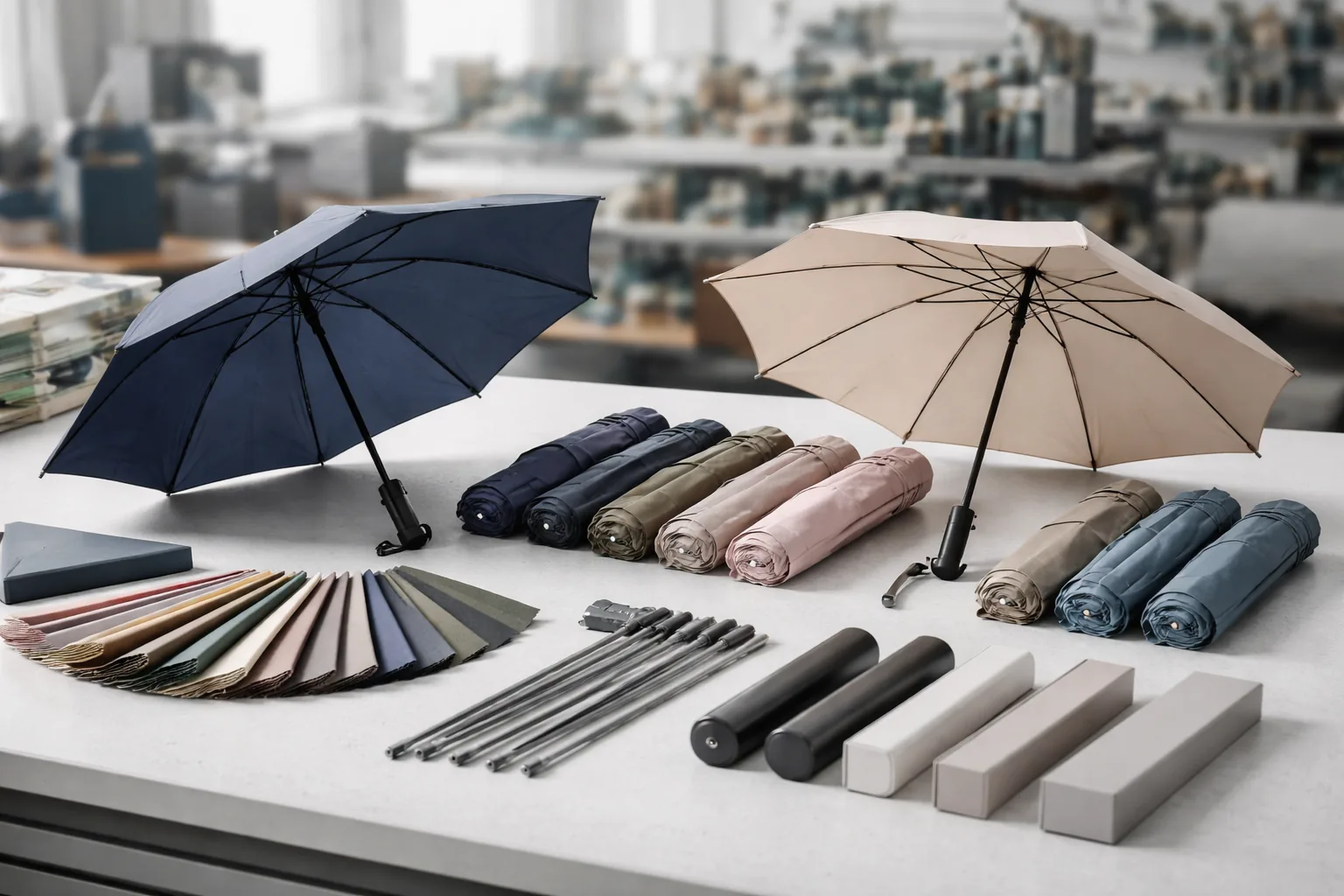
Retail buyers like flat mini umbrellas because they fit handbags, gift sets, and checkout displays, but the slim profile leaves little room for weak frames, loose stitching, or bulky packaging. When evaluating flat mini umbrellas wholesale, the real cost drivers are the folding structure, rib material, pongee density, coating choice, sleeve fit, and how consistently the factory controls them on the line before cartons are sealed.
Understand the Flat Mini Umbrella Format
Flat mini umbrellas are built around a flattened folded profile, not the round “sausage” shape buyers know from standard compact umbrellas. A normal 21" or 23" compact uses a circular shaft-and-rib stack, so the folded diameter often reaches 5–6 cm and creates a bulge in a handbag or laptop tote. A flat compact umbrella compresses the rib package into a wide, thin rectangle, commonly around 17–19 cm long, 5–7 cm wide, and 2.5–3.5 cm thick depending on the frame. That format matters at retail because shoppers can slide it beside a phone, notebook, cosmetics pouch, or power bank instead of treating it like outdoor gear. For flat mini umbrellas wholesale programs, the sellable feature is not only rain coverage; it is everyday carry convenience.
The construction is usually either 5-fold or slim 3-fold, and I would not treat those as interchangeable in a sourcing spec. A 5-fold flat mini can fold very short, sometimes under 18 cm, but the extra joints add tolerance risk if the rib rivets, runner, and stretchers are not controlled tightly. A slim 3-fold construction is longer, often 21–23 cm, but stronger and easier to pass repeated open-close testing. Most retail mini umbrella supplier quotes will offer steel ribs for cost, fiberglass end ribs for better wind recovery, or a mixed frame to balance weight and durability. For canopy fabric, 190T pongee is the practical baseline; 210T feels denser and supports better water beading when paired with a Teflon coating.
Shelf presentation is where custom flat umbrellas can justify a higher perceived retail value than basic round compacts. The flat case gives buyers a clean front panel for a woven label, heat-transfer logo, barcode sticker, or color-blocked EVA/PU sleeve, so it displays more like a lifestyle accessory than a cheap emergency umbrella. In counter displays, a rectangular unit stacks neatly in trays of 12, 24, or 48 pieces, while round compacts roll, twist, and hide the branding. For OEM compact umbrellas, our standard practice at ZheBrella is to confirm folded thickness, case material, and display orientation before sampling, because a 3 mm change in folded depth can decide whether the product fits a retail peg hook, gift box insert, or airline amenity pouch.
Balance Portability With Frame Strength
Frame strength matters more on a flat compact umbrella than most spec sheets admit, because the folded profile forces shorter rib segments, tighter hinges, and less canopy depth to spill wind. For true pocket-size retail programs, I do not recommend judging only by weight. Lightweight aluminum ribs keep a 21" manual unit around 180–220 g, which feels good at checkout, but aluminum deforms after repeated gust loading if the rib wall is too thin. Steel ribs are cheaper and stronger in straight pull, yet they add weight and can rust if plating is weak, especially when wet umbrellas sit in polybags during transit. A practical middle spec is steel shaft with aluminum ribs for low-cost retail, or steel shaft with fiberglass end ribs for better recovery. For flat mini umbrellas wholesale orders, ask the supplier to state rib material by section, not just “metal frame,” because many factories mix parts to hit price targets.
Rib count is the next real decision. A 6K structure is common on custom flat umbrellas because it folds slimmer and keeps the panel count low, which reduces sewing bulk at the tips. It is acceptable for gift shops, hotel amenities, and light commuter use, but it should not be sold as a storm umbrella. An 8K frame spreads canopy tension more evenly and gives better shape retention after opening, especially on 190T or 210T pongee with a Teflon-style water-repellent finish. The tradeoff is a slightly thicker folded body, more runner friction, and a higher chance of inconsistent folding if the rib geometry is not controlled. Our standard practice at ZheBrella is to test 6K and 8K samples through repeated open-close cycles before approving mass production, because a flat body can look clean in a photo but bind badly after 200–300 cycles.
Wind expectations must stay realistic for OEM compact umbrellas. A 23" double-canopy golf umbrella can be engineered to survive 50+ mph wind-tunnel testing with fiberglass ribs and venting; a 19"–21" flat mini cannot be judged by the same claim. The short shaft gives the user less leverage control, the shallow canopy catches gusts abruptly, and the thin rib profile has limited elastic travel before inversion. For a retail mini umbrella supplier, a good target is controlled flexibility: fiberglass tips or reinforced joints that recover from moderate inversion, not impossible “windproof” language. If the program needs better field performance, specify 8K ribs, pongee instead of cheap polyester, reinforced stretchers, and a manual or smooth auto-open mechanism with low runner resistance. That combination costs more, but it prevents the common failure pattern: bent middle ribs, loose rivets, and canopies that no longer sit flat after the first windy commute.
Select Canopy Fabric, Coating, and Coverage
For flat mini umbrellas wholesale, I usually start fabric selection with 190T versus 210T pongee because it decides how the umbrella feels in the hand and how fat it becomes after folding. A 190T pongee canopy is lighter, packs flatter, and dries fast enough for convenience-store or travel retail, especially on 21" and 23" flat compact umbrella frames. The tradeoff is a slightly thinner hand-feel and less tolerance for sloppy sewing tension; if the panel edges are stretched during assembly, you see puckering near the rib tips. A 210T pongee costs more but gives better opacity, smoother color depth, and a more premium touch, which matters for gift sets, boutique retail, and branded OEM compact umbrellas.
Print behavior is not the same on both fabrics. On 190T pongee, screen printing and heat transfer logos look clean when artwork is simple, but large solid blocks can show more texture and minor color variation after water-repellent treatment. 210T pongee holds sharper edges for multi-color logos and gives sublimation artwork a richer surface, though the added fabric density makes the folded bundle slightly thicker. For custom flat umbrellas, I advise buyers to confirm a folded sample after printing, not just a loose canopy swatch, because ink layer, seam allowance, and Velcro strap position all affect whether the umbrella still slides easily into a flat pouch.
For dual sun-and-rain positioning, specify either black coating or a tested UPF 50+ coating on the underside, not vague “UV protection” wording. Black-coated pongee improves shade and visual opacity, but it can add stiffness and slow drying compared with uncoated water-repellent pongee. A proper UPF 50+ finish is better for retail claims if supported by lab testing, and it pairs well with silver, navy, or pastel outer colors for summer travel programs. As a retail mini umbrella supplier, ZheBrella’s standard practice is to check coating adhesion after folding cycles and wet rub, because poor coatings crack first along the fold lines on flat mini umbrellas.
Specify Mechanism, Handle, and Case Design
For flat mini umbrellas wholesale programs, the opening mechanism should be chosen before artwork, because it changes the shaft diameter, folded thickness, spring load, and return rate. Manual open is still the safest choice for a flat compact umbrella: fewer parts, lower weight, and less chance of a jam after the buyer tosses it in a handbag for six months. A 21" manual 6K or 8K frame can stay around 180–230 g depending on steel versus aluminum shaft and fiberglass rib tips. Auto-open adds convenience but needs a stronger spring and button housing, so the folded profile becomes thicker and the cost usually rises by USD 0.25–0.60 FOB. Auto-open-close is the riskiest in this size class; it feels premium, but the reverse spring and runner lock add weight, increase closing force, and create more failure points during AQL 2.5 testing, especially if the canopy is tight after Teflon coating or dense 210T pongee sewing.
Handle design is where many retail mini umbrella supplier quotes look cheaper than they really are. A thin plastic rectangle handle keeps the umbrella flat, but if the mold has sharp edges or weak ultrasonic welding, it cracks during drop tests. Rubberized ABS feels better and supports a recessed logo plate, but it adds cost and can show oil marks in hot containers. For custom flat umbrellas, I prefer a slightly rounded rectangular handle with a positive button travel of 2.5–3.5 mm on auto models, because shallow buttons misfire after plating or paint buildup. Wrist straps should be bar-tacked into the handle or fixed with a metal pin, not just knotted through a weak plastic hole. If the order is for OEM compact umbrellas with retail packaging, confirm whether the handle must align with a peg-hole sleeve, shelf tray, or counter display, because a few extra millimeters can break the carton count.
Flat cases sell the product, but they also create inspection problems if the buyer does not specify materials clearly. A basic pongee sleeve is cheapest, yet it wrinkles and hides poorly on retail hooks. EVA pouches give the best “flat tech accessory” look and protect printed canopies, but the pouch thickness, zipper quality, and heat-sealed edge width must be approved by pre-production sample; cheap EVA turns cloudy or smells after packing. Zipper sleeves are useful for travel and gift sets, but the zipper pull must clear the folded rib tips or it will snag the canopy. For flat mini umbrellas wholesale, hang-tags should include barcode, country of origin, fiber content where required, warning text, open/close instructions, and wind or UPF 50+ claims only if tested. Our standard practice at ZheBrella is to test packed samples in the final pouch, not only the umbrella, because many complaints come from tight cases, broken zipper heads, or crushed hang holes after export cartons are stacked.
Control MOQ, Inspection, and Retail Packing
Control MOQ by colorway first, not by total order quantity, because fabric cutting and handle injection are where small retail programs lose money. For flat mini umbrellas wholesale, a practical starting point is 500–1,000 pcs per color for stock 190T pongee with a standard black or silver frame, while custom flat umbrellas with Pantone canopy, matching sleeve, logo plate, or molded handle usually need 1,000–3,000 pcs per colorway. A pre-production sample normally takes 5–7 days if using existing tooling, 10–14 days with new print screens or heat-transfer artwork, and 18–25 days if you change the flat compact umbrella shell mold. Bulk lead time is usually 25–35 days after sample approval and deposit, but add 5–10 days before Q4, Canton Fair season, or heavy rain periods when Songxia frame suppliers are congested.
Retail packing should be locked before production, not after inspection, because barcode position, hangtag hole direction, and sleeve fit all affect store receiving. A typical 21" manual flat compact umbrella packs 12 pcs per inner carton and 48 or 60 pcs per master carton, with master carton dimensions around 43 × 28 × 26 cm depending on case thickness and sleeve material. For chain retail, specify UPC/EAN barcode on hangtag and outer carton, SKU color code, country-of-origin marking, suffocation warning if polybags are used, and carton drop-test expectations. Our standard practice at ZheBrella is to confirm one packed carton sample before mass packing, because a sleeve that looks fine loose can become too tight once the canopy has a Teflon coating or thicker 210T pongee.
Use AQL 2.5 for major defects and define critical defects separately, especially for auto-open-close OEM compact umbrellas where a failed runner or sharp rib tip can become a safety issue. Inspection should include open-close cycle testing, usually 300–500 cycles for manual models and 500 cycles for auto-open-close, plus checks for rib alignment, shaft straightness, button release force, cap tightness, and no canopy rubbing against the flat case. Fabric tension matters on flat mini umbrellas wholesale orders because the compressed frame shape can create loose panels near the short ribs; inspectors should check panel symmetry, stitch skipped holes, print registration, water repellency, and whether the sleeve slides on smoothly without forcing. A good retail mini umbrella supplier will also separate minor issues like thread ends from major issues such as broken ribs, crooked logos, mis-scanned barcodes, or mixed color cartons.
Frequently Asked Questions
Are flat mini umbrellas as windproof as standard compact umbrellas?
Usually not. The flatter, slimmer build prioritizes portability, so buyers should specify reinforced ribs and realistic wind-performance claims rather than positioning them as storm umbrellas.
Should a flat mini umbrella use manual or auto-open-close operation?
Manual open keeps the umbrella lighter and simpler, which suits low-cost retail and promotional programs. Auto-open-close feels more premium but adds weight, cost, and more mechanism QC requirements.
What specifications should retail buyers confirm before ordering flat mini umbrellas?
Confirm the folded size, open diameter, rib count, shaft material, fabric weight, coating type, and handle shape. For retail programs, common specs include 190T or 210T pongee fabric, 6 or 8 ribs, manual or auto-open structure, and a flat sleeve or gift box.
What is a typical MOQ for custom flat mini umbrellas?
For logo printing on existing flat compact umbrella models, MOQ is often around 500 to 1,000 pieces per color. Fully customized frames, handles, fabric colors, or retail packaging may require 2,000 to 3,000 pieces depending on material availability.
Which QC checks are important for flat compact umbrellas before shipment?
Buyers should check open-close performance, rib alignment, fabric tension, stitching, coating consistency, logo placement, and packed carton strength. A practical inspection standard is AQL 2.5 for major defects and AQL 4.0 for minor defects.
Looking to Launch Your Custom Umbrella Line?
ZheBrella is a Zhejiang-based OEM/ODM umbrella manufacturer with 17 years of export experience. Free design, low MOQ from 100 pieces, windproof construction, full-color print.
Get Free Quote Now »People Also Search For
Related Articles
Mini Pocket Umbrellas: Sourcing Guide for Promo and Retail Kits
Compare mini pocket umbrella builds, 5-fold frames, pongee fabrics, auto-open limits, MOQ, QC, and packaging for retail ...
Read More »
Walking Cane Umbrellas for Retail: OEM Buyer Spec Guide
Source walking cane umbrellas with the right shaft, crook handle, ribs, canopy fabric, tip design, MOQ, and QC standards...
Read More »
Blackout Coated Rain Umbrellas: Retail Buyer Spec Guide
Specify blackout coated rain umbrellas with UPF 50+, pongee fabric, frame choices, print limits, MOQ, and AQL checks for...
Read More »