Boutique Fashion Umbrellas: OEM Specs for Premium Retail
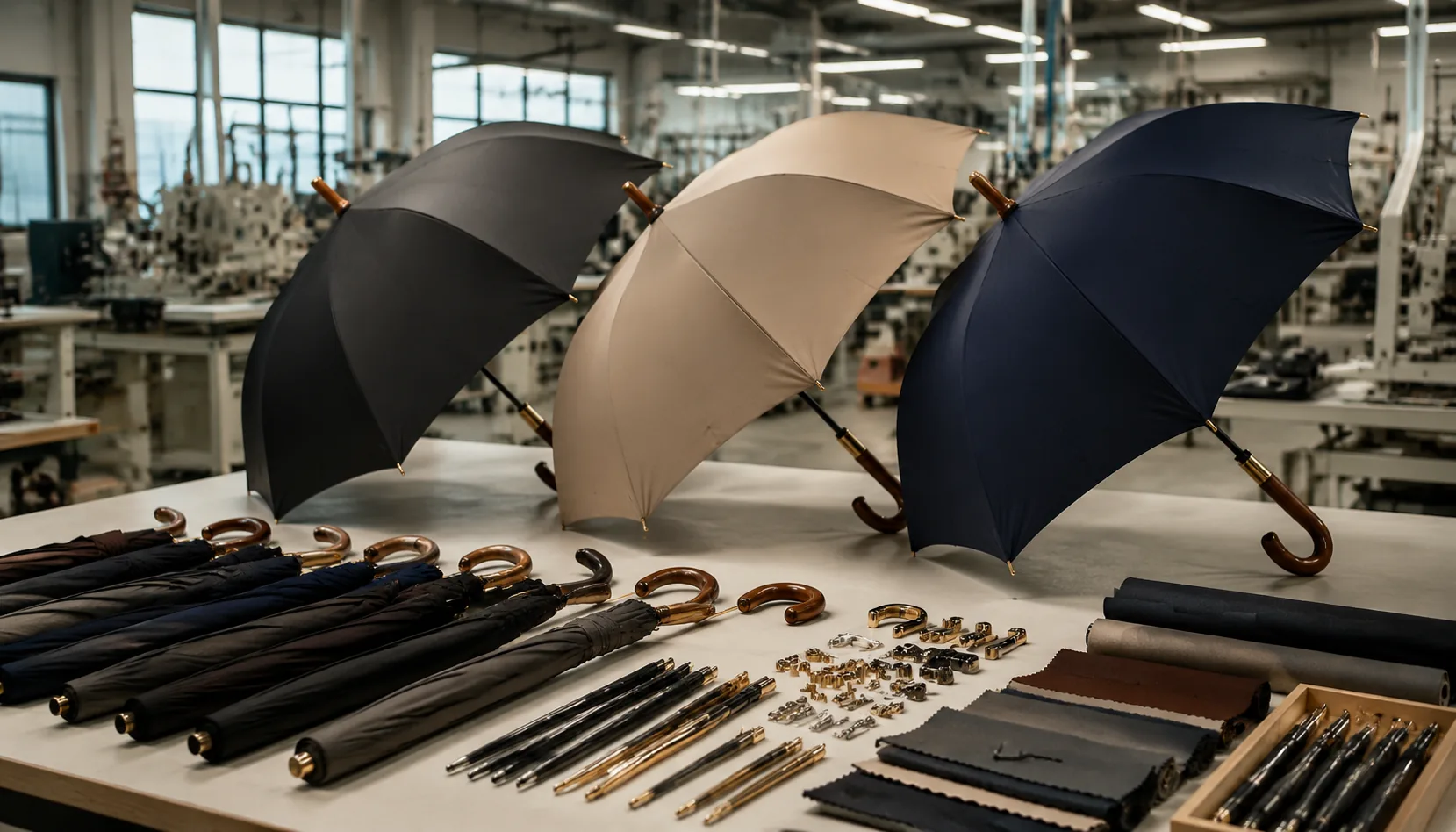
Boutique umbrella buyers are not just choosing a pretty canopy; they are locking in fabric hand-feel, print alignment, handle weight, frame finish, packaging presentation, and a defect rate their retail customers will notice immediately. As a fashion umbrella OEM manufacturer on the Songxia factory floor, we see how small spec gaps become sampling delays, MOQ surprises, and AQL 2.5 rework when they are not defined before cutting, printing, and assembly.
Define the Boutique Retail Positioning
Boutique positioning has to be settled before anyone draws the canopy artwork, because a fashion accessory, a seasonal capsule item, and a premium rainwear add-on are built to different cost targets. A fashion accessory usually needs stronger visual codes: custom Pantone ribs, color-matched tips, electroplated shaft, PU leather or resin handle, and a canopy in 210T pongee with a soft hand feel rather than basic 190T. A seasonal capsule item can accept tighter SKU timing, bolder prints, and limited packaging, but it still needs repeatable designer umbrella production controls so the second 3,000 pieces look like the sales sample. A rainwear add-on sold beside coats or handbags should feel quieter and more durable, often with 8K or 10K fiberglass ribs, Teflon water-repellent coating, and a reliable auto-open frame instead of decorative parts that fail after a few uses.
Retail price must drive the spec, not the other way around. For premium retail umbrellas at $35–$60, buyers can usually support 210T pongee, fiberglass ribs, a straight wooden or rubberized crook handle, custom woven label, and a printed sleeve without destroying margin. At $75–$120, the umbrella needs more brand language: custom color hardware, matte black or rose-gold plating, carved wood, acrylic, or vegan leather handles, double-canopy venting for wind resistance, and stricter AQL 2.5 inspection on stitching, print registration, and opening force. As a fashion umbrella OEM manufacturer, I would rather remove one decorative trim than downgrade the frame, because a returned umbrella damages the boutique’s trust faster than a simpler hangtag.
Clear custom fashion umbrella specs also prevent the common mistake of sampling a luxury-looking umbrella and then mass-producing a cheaper version that no longer matches the retail story. A boutique umbrella supplier should lock the target size early: 21" compact auto-open-close for handbags, 23" stick umbrellas for gift walls, 27" golf-style silhouettes for dramatic window display, or 30" coverage if the product is tied to outerwear. MOQ usually rises when hardware colors, handles, and canopy prints are exclusive; 500 pieces may work for stock-frame testing, while 1,000–3,000 pieces is more realistic for custom color components. For boutique launches, we normally plan 7–10 days for sample adjustment and 30–45 days for bulk production after approval, with FOB Ningbo or Shanghai and DDP options depending on carton volume and delivery deadline.
Select Frame Shape and Finish Details
Frame shape decides whether a boutique umbrella looks intentional on a retail wall or just decorated after the fact. Straight 23" or 27" styles give the cleanest premium read because the shaft line is visible, the handle can carry real material weight, and the canopy sits with a smoother arc. For premium retail umbrellas, I usually specify a powder-coated steel shaft in matte black, champagne, cream, or gunmetal, then pair it with fiberglass ribs so the umbrella has spring under wind load instead of the brittle bend you get from thin steel ribs. An 8K layout is enough for most 190T or 210T pongee canopies, while 16K makes sense when the design needs a rounder dome, heavier trim, or a more architectural silhouette.
Slim folding umbrellas sell well for handbags and travel capsules, but the frame tolerance is less forgiving. A 21" auto-open-close folding frame must keep rib joints clean, or the canopy will wrinkle around the panels and cheapen the print. As a fashion umbrella OEM manufacturer, our standard practice is to confirm folded length, shaft coating thickness, rib color, and runner movement before approving strike-off samples, because a beautiful canopy print cannot hide a noisy spring or scratched telescopic shaft. For custom fashion umbrella specs, I prefer fiberglass end ribs with a steel center shaft on compact models; all-fiberglass folding frames are possible, but they add cost and bulk that many boutique buyers do not want.
Pagoda-inspired silhouettes need to be engineered, not forced by sewing tension. The higher crown works best on straight manual-open or auto-open frames with a reinforced top notch, accurate panel grading, and an 8K or 16K rib set matched to the canopy curve. The ferrule, rib tips, cap, runner, and even the snap button should be color-matched before bulk production, not chosen from stock bins after assembly. A serious boutique umbrella supplier will also check whether plated metal parts conflict with powder-coated shafts under salt-spray or rub testing. In designer umbrella production, these small finish decisions are what separate a controlled collection from mixed hardware that looks assembled from leftovers.
Control Fabric, Print, and Color Accuracy
Pantone matching should be treated as a controlled approval process, not a promise from a catalog swatch. Dyed 210T pongee, printed ink, satin-look polyester, and black-coated UV fabric all reflect light differently, so the same Pantone color can look warmer or duller once it is on a curved canopy. A competent boutique umbrella supplier will provide lab dips for solid fabric, strike-off samples for printed panels, and preferably one assembled pre-production umbrella before bulk cutting. For premium retail umbrellas, I recommend checking color under D65 daylight and store-style warm lighting, then recording an acceptable delta E tolerance if the brand has strict standards. These custom fashion umbrella specs reduce disputes later, especially when the order ships FOB Ningbo or Shanghai and the buyer’s inspection follows AQL 2.5 after production is already packed.
Upgrade Handles, Closures, and Retail Packaging
Handles and closures are where premium retail umbrellas either feel expensive or get exposed as commodity stock. For boutique programs, I tell buyers to lock the handle material before approving canopy art: natural wood for a warm designer look, rubberized PU for grip, or color-matched plastic only when the price target is tight. Wood handles need clear varnish, smooth sanding at the ferrule joint, and individual scratch protection; otherwise the carton looks fine but the retail shelf shows dents. Faux leather straps should be specified by width, thickness, edge paint, and stitch color, not just “leather look.” Metal snaps are cleaner than hook-and-loop for fashion lines, but the cap finish must match the shaft, runner, tip cup, and any logo plate. A fashion umbrella OEM manufacturer should confirm whether the snap is brass, iron, or alloy because cheap plated iron can rust after salt-spray or humid warehouse storage.
Woven labels, hangtags, and printed sleeves should be treated as part of the custom fashion umbrella specs, not late-stage decoration. A woven brand label on the tie strap usually looks more premium than a heat-transfer logo, but it must be positioned so it does not twist when the canopy is wrapped around 8K or 10K ribs. Hangtags need reinforced string holes and enough clearance from the handle so they do not crease inside the master carton. For premium retail umbrellas, I prefer a 190T or 210T pongee sleeve with piping and a small woven side tab; PVC sleeves can look cheap unless the line is intentionally transparent or rainwear-inspired. Printed sleeves should be checked for colorfastness, rub resistance, and barcode readability after polybag packing. In designer umbrella production, these small trim items often create more QC disputes than the canopy print because buyers approve them from flat artwork instead of finished samples.
Retail carton protection should be specified in the purchase order, not left to the packing team. Handles need tissue wrap, foam sleeves, or divided inner cartons when using glossy PU, painted wood, plated metal, or soft-touch coatings. Canopies should be rolled with consistent tension; over-tight wrapping leaves hard rib marks on 190T pongee, while loose wrapping causes sleeve wrinkles and poor shelf presentation. For boutique umbrella supplier programs shipping FOB Ningbo or DDP to retail DCs, our standard practice at ZheBrella is to use inner cartons of 12 or 24 pieces, moisture-resistant master cartons, corner protection, and drop-test packing before bulk. Add AQL 2.5 checks for handle scratches, snap alignment, label placement, sleeve sewing, barcode scanning, and carton crush. If the order includes mixed colors, require color-coded carton marks and a packing list by SKU, because retail receiving teams will not sort 23-inch auto-open fashion umbrellas by canopy print after arrival.
Confirm Sampling, MOQ, and Quality Standards
Sampling has to be treated as a three-gate process, not one pretty prototype photo. For premium retail umbrellas using custom pongee 190T/210T, jacquard, satin-touch polyester, POE panels, plated shafts, molded handles, or matched zipper sleeves, the first prototype confirms structure and visual direction: 21", 23", or 27" size, 8K/10K/16K rib count, manual, auto-open, or auto-open-close mechanism, canopy depth, handle ergonomics, and logo placement. A boutique umbrella supplier should also test whether the chosen fabric accepts screen print, heat-transfer, or sublimation without bleeding, puckering, or losing hand feel. At this stage, expect 7–12 days for standard materials and 15–25 days when dyeing fabric, casting a custom handle, or developing metal trim. A serious fashion umbrella OEM manufacturer will flag construction risks early, especially on light-colored canopies where frame shadows, seam tension, or adhesive marks show easily under retail lighting.
The pre-production sample is the contract sample for bulk work, so it must lock every custom fashion umbrella spec before fabric cutting starts. This means Pantone or LAB color tolerance, print artwork scale, rib material, shaft diameter, runner color, tip style, ferrule finish, strap width, care label, hangtag, barcode sticker, sleeve construction, and retail carton packing. For designer umbrella production, I prefer one approved open sample, one closed sample, and one packaged sample because problems often appear only when the umbrella is folded: misaligned panels, twisted straps, thick seams, or a sleeve that is too tight after coating. Pre-production approval usually takes 3–5 days after the sample arrives at the buyer’s office, but any change after approval should restart checking on the affected part. Our standard practice at ZheBrella is not to release bulk cutting until the signed sample, artwork file, BOM, and packing method all match.
Bulk samples and inline inspection protect the order from drifting after the first 500–1,000 pieces. For premium retail umbrellas, AQL 2.5 should cover color variance against the approved sample, print alignment across panel seams, loose threads at tips and straps, canopy stains, frame finish scratches, runner smoothness, handle bonding, cap tightness, and auto-open consistency over repeated cycles. On auto-open and auto-open-close models, inspectors should test spring response, locking position, closing force, and failure to latch, not just open one piece and move on. For fashion programs, MOQ depends on material risk: 300–500 pieces per color for stock 190T pongee, 1,000+ pieces for custom-dyed fabric, and often 2,000+ pieces when special handles, plated hardware, or exclusive prints require separate setup. Lead time after sample approval is typically 25–35 days for normal premium retail umbrellas, longer if the program needs UPF 50+ coating, Teflon treatment, windproof double-canopy testing, or DDP delivery scheduling.
Frequently Asked Questions
What makes a boutique umbrella different from a standard promotional umbrella?
Boutique umbrellas usually rely on premium fabric feel, tighter color control, custom handles, coordinated hardware, and retail packaging. The QC focus is as much on appearance consistency as on open-close function.
Can a factory match a fashion brand’s seasonal color palette?
Yes, but buyers should provide Pantone references and approve lab dips or fabric strike-offs before bulk production. Color can shift between 190T, 210T, coated fabrics, and printed panels.
What MOQ should a boutique retailer expect for custom fashion umbrellas?
For boutique fashion umbrellas, typical MOQ is 500–1,000 pieces per design, depending on canopy fabric, handle customization, and print method. Lower MOQs may be possible if using stock frames and standard handle molds.
How do factories control print registration on premium retail umbrellas?
Factories usually confirm artwork with a digital layout and pre-production sample, then check panel alignment during cutting and sewing. For repeat logos or border prints, buyers should specify acceptable tolerance, commonly within 2–3 mm at panel seams.
What should be included in a boutique umbrella QC checklist?
A practical AQL 2.5 checklist should cover canopy stains, print defects, seam strength, frame opening and closing, handle finish, ferrule alignment, carton labeling, and retail packaging condition. Premium retail orders often add a 100% open-close function test before final packing.
Looking to Launch Your Custom Umbrella Line?
ZheBrella is a Zhejiang-based OEM/ODM umbrella manufacturer with 17 years of export experience. Free design, low MOQ from 100 pieces, windproof construction, full-color print.
Get Free Quote Now »People Also Search For
Related Articles
Boutique Fashion Umbrellas: Spec Choices for Retail Buyers
Plan boutique fashion umbrellas with canopy shape, 210T pongee, handle materials, 8K/16K frames, packaging, and AQL 2.5 ...
Read More »
Wooden Handle Umbrellas: Specs for Premium Retail Programs
Source wooden handle umbrellas with the right shaft, ribs, pongee canopy, finish, branding, packaging, MOQ, and QC stand...
Read More »
Executive Stick Umbrellas: Buyer Specs for Retail Brands
Compare executive stick umbrella specs, from 8K/16K frames and pongee fabrics to handles, QC, MOQs, and shipping terms f...
Read More »