Branded Umbrellas for Beverage Brands and Retail Sampling
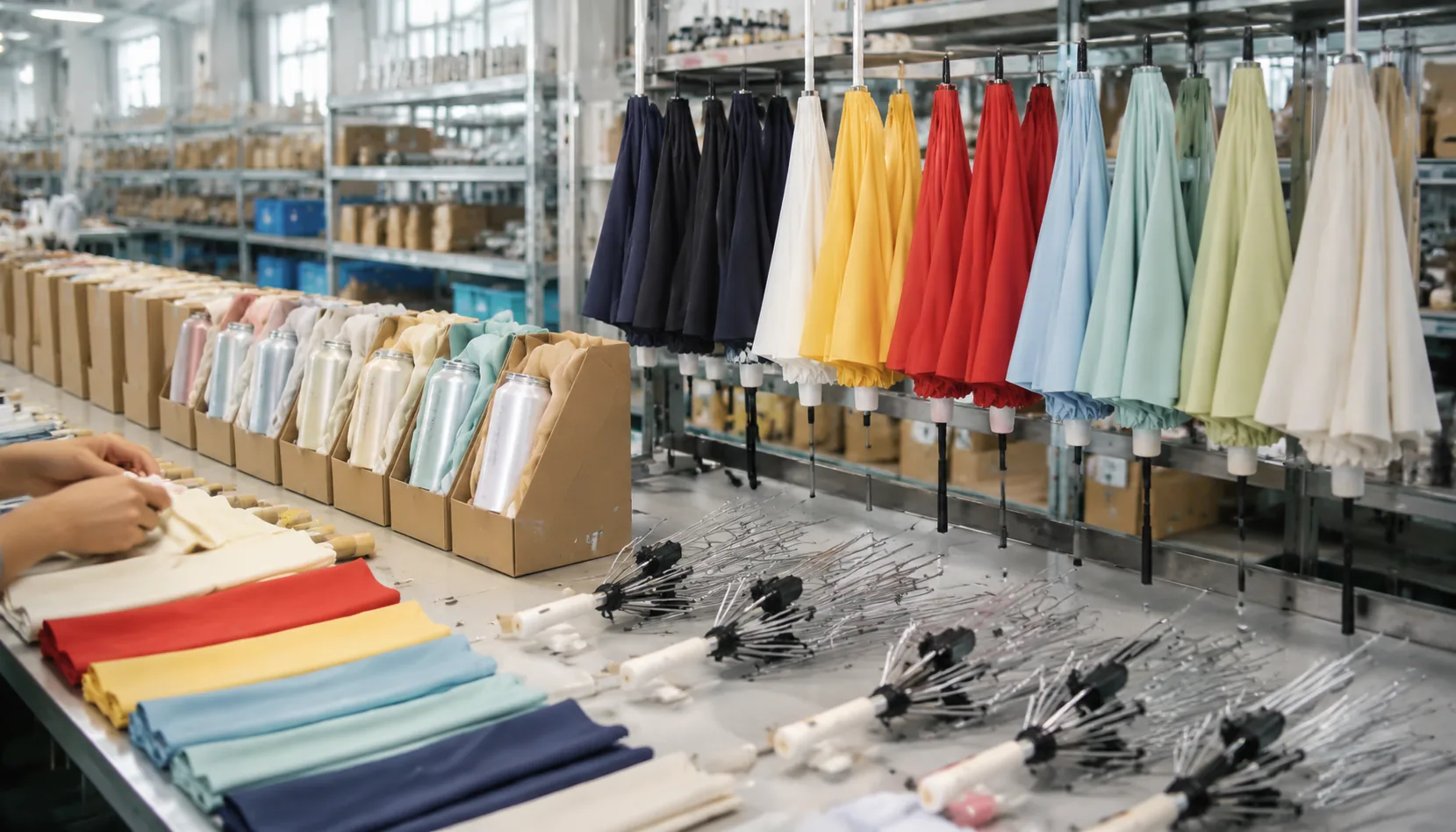
For beverage launches and retail sampling, the umbrella is not just shade—it is a mobile signboard, a safety item, and a replenishment SKU that has to survive real field use. When buyers specify beverage brand umbrellas, the hard parts show up on the factory floor: logo placement across panels, frame strength in gusts, fabric compliance, carton counts, and repeat-order color consistency for teams spread across multiple stores or events.
Where Umbrellas Fit Beverage Activation Programs
Beverage activation works best when the item has enough surface area to carry the brand and enough utility to leave the venue. Beverage brand umbrellas fit grocery sampling tables, liquor store demos, campus launches, patio tastings, and retailer co-op promotions because the canopy becomes mobile signage without needing a power outlet, a permit, or a fixture install. For grocery and liquor retail, I usually recommend 23" or 27" auto-open stick umbrellas with 190T pongee, steel shaft, fiberglass ribs, and a simple one- or two-color screen print so the logo reads from 20 feet away. For campus launches and street teams, 21" promotional folding umbrellas are easier to pack into cartons, sales vans, and backpacks, especially when teams are moving between dorms, transit stops, and convenience stores in one day.
Retail sampling umbrellas should be specified differently from throwaway swag. A low-cost keychain disappears into a drawer; a well-built umbrella comes back out every rainy week, which means the beverage logo keeps showing in parking lots, sidewalks, tailgate lines, and outdoor dining areas long after the tasting cups are gone. For distributor sales kits, we often see 10K or 16K golf umbrellas used as premium leave-behinds for chain buyers, bar owners, and regional managers; 30" double-canopy vented models with fiberglass ribs can survive 50+ mph wind-tunnel tests when the frame is correctly tensioned. For patio handouts, POE or EVA transparent umbrellas also work well because they keep the sightline open while still carrying a printed border logo or bottle-color accent.
The practical production decision is matching the umbrella to the activation channel, not choosing the cheapest unit on a spreadsheet. Branded activation umbrellas for retailer co-op promotions may need two logos on opposite panels, PMS-matched handle tags, and carton markings separated by store region; that affects artwork approval and packing time more than buyers expect. As a custom umbrella factory, our standard practice is to check print position, opening force, rib alignment, canopy seam tension, and color fastness under AQL 2.5 before release, because field teams cannot fix a weak runner or crooked logo at a sampling table. Typical MOQ starts around 500 pieces for folding umbrellas and 1,000 pieces for fully customized canopy layouts, with about 25–35 days for production after approved artwork; FOB Ningbo or Shanghai is common, while DDP works better when a distributor needs cartons delivered directly to multiple event warehouses.
Matching Umbrella Formats to Campaign Goals
For consumer handouts, compact folding umbrellas win because they fit the way shoppers actually carry things after a tasting or checkout promotion. A 21" or 23" 3-fold frame with 8 ribs, 190T pongee, and a matching sleeve gives enough coverage without becoming a burden in a grocery bag or tote. For beverage brand umbrellas used as mass giveaways, I usually avoid heavy 10K frames unless the retail price point supports it; the extra ribs look nice, but they add cost and weight that shoppers notice. Manual-open is cheaper, but auto-open is worth considering when the umbrella is distributed outdoors, near stadium entrances, or at wet-weather sampling tables. A good target is a steel shaft with fiberglass ribs, 300–360 g finished weight, and logo placement on one or two panels by screen print or heat transfer. Keep the print simple: one brand mark, one color-block canopy, and no tiny nutrition-copy graphics that will crack or blur after folding.
Sales reps and field teams need a different tool: an 8K stick umbrella, usually 23" or 27", with a J-handle or straight EVA grip and a stronger center shaft. These retail sampling umbrellas are opened and closed all day, leaned against coolers, tossed into vans, and used to walk buyers from parking lots into stores. I prefer fiberglass ribs over painted steel ribs for this use because steel bends after side gusts, while fiberglass flexes back if the runner and tips are assembled correctly. Auto-open is useful here because one hand is often carrying POS materials, sample cases, or clipboards. For beverage route teams, 210T pongee with Teflon water-repellent coating dries faster between stops than basic 170T polyester. If the umbrella will sit in a sales kit, specify a reinforced ferrule, thicker runner, and AQL 2.5 inspection on open-close function, rib alignment, and panel tension, not just logo appearance.
Premium bundles and outdoor demos justify a 16K golf-style umbrella, typically 27", 30", or 32" arc, because the umbrella becomes part of the activation environment instead of a throwaway gift. For branded activation umbrellas used beside sampling carts, beer gardens, convenience-store forecourts, or launch events, a double-canopy vented windproof build is the right call. The vent lets gusts pass through instead of inverting the frame, and a fiberglass shaft with 16 fiberglass ribs can survive 50+ mph wind-tunnel testing when the canopy is sewn with correct seam allowance and bar-tack reinforcement. This format is also the best match for premium beverage brand umbrellas in distributor incentives or retail display bundles, where the buyer expects a gift that feels durable. MOQ is usually higher than basic promotional folding umbrellas because 16K frames and oversize panels need dedicated cutting and slower sewing. Allow 25–35 days after artwork approval for a custom umbrella factory run, longer if sublimation panels or UPF 50+ coating are specified.
Canopy Materials, Color, and Logo Execution
For beverage brand umbrellas used in retail sampling, I normally push buyers toward 190T pongee when the job is cost-sensitive but still needs a clean retail look. It handles screen printing and heat-transfer logos better than cheap polyester, dries faster, and gives a smoother hand feel on 21", 23", and 27" promo umbrellas. For premium launches, especially spirits, energy drinks, bottled tea, or canned cocktails, 210T pongee is worth the upgrade because the tighter weave holds darker solids and gradient artwork with less show-through. If the campaign involves repeated outdoor use, ask for a water-repellent coating and confirm whether the frame is steel, fiberglass, or mixed construction; a good canopy on a weak 8K steel frame will still disappoint in wind. Our standard practice at ZheBrella is to cut pre-production panels from bulk fabric and check print registration before sewing, because color drift often starts before the umbrella is assembled.
Full-panel printing is the right choice when the umbrella needs to read like a mobile billboard: one large lemon slice, beer can graphic, bottle silhouette, or striped brand pattern across all eight panels. For smaller logos, screen printing remains the most reliable and economical method, especially on 190T pongee, while heat transfer works well for sharper small type and multi-color badges. Pantone matching should be specified by coated/uncoated reference, not just a brand PDF, and dark canopies usually need a white underbase before the logo color goes down. Without that underbase, red, yellow, and light blue marks can look muddy on navy, black, forest green, or burgundy fabric. For branded activation umbrellas, I also recommend approving a strike-off under both indoor warehouse light and outdoor daylight, because a color that looks correct at the sewing table can shift badly at a sampling tent or parking-lot event.
Retail sampling umbrellas sometimes sit beside coolers, cup trays, cans, bottles, or giveaway packaging, so artwork claims need discipline. The canopy is not a food-contact surface, even if the campaign is for drinks, so avoid language that implies FDA approval, antimicrobial protection, or direct packaging compliance unless the material and coating have actually been tested for that use. Safer wording is usually around weather protection, UPF 50+ shade if tested, water repellency, and brand visibility. Promotional folding umbrellas can carry QR codes, launch dates, distributor information, or redemption messaging, but the print area must be sized realistically around seams, tips, and vent openings. A custom umbrella factory should provide artwork templates showing live area, bleed, panel direction, and seam allowance before sampling. For beverage brand umbrellas, the best result comes when procurement locks fabric weight, Pantone targets, print method, and claim language before the pre-production sample, not after mass cutting has started.
Forecasting MOQs Across Regions and Retail Chains
MOQ planning for beverage brand umbrellas should start at the SKU level, not the total campaign number. A 23" auto-open straight umbrella for grocery sampling, a 21" promotional folding umbrella for convenience-store giveaways, and a 27" golf umbrella for distributor events are three different production streams, even if the logo is the same. Fabric color, handle color, rib count, printing method, and carton spec all affect MOQ. For most retail sampling umbrellas, I advise buyers to separate core SKUs by state distributor and retailer window: for example, 1,200 pcs for a Texas beer distributor using 7-Eleven and H-E-B, 800 pcs for a Florida hard seltzer launch, and 500 pcs for a Northeast wine promotion. If the canopy uses stock 190T pongee with one-color screen printing, a custom umbrella factory can usually keep the MOQ lower. PMS-dyed fabric, custom molded handles, or full-panel sublimation should be forecast in larger batches because setup waste and color matching become real costs.
Retailer timing matters more than many marketing teams expect. Walmart, Kroger, Costco, Target, and regional grocery chains often lock display calendars 60-90 days before the sampling window, while the factory still needs 30-45 days after artwork approval for material booking, printing, sewing, frame assembly, AQL 2.5 inspection, packing, and export handoff. Summer campaigns for beer, soda, sparkling water, and RTD cocktails should be forecast by March or April, not when the weather turns hot. Rain-season campaigns need a different mix: more 23" or 27" auto-open umbrellas, stronger fiberglass ribs, and sometimes double-canopy vented windproof frames rated around 50+ mph for outdoor activations. For beverage brand umbrellas used at parking-lot tastings or stadium tailgates, I would rather reduce the number of SKUs than under-order the hero item; splitting 3,000 pcs across six colorways often creates avoidable shortages and higher unit cost.
Use FOB when the importer, distributor, or 3PL already has freight contracts and can consolidate umbrellas with other beverage POS materials from China. FOB Ningbo or Shanghai works well for full-container or larger LCL programs where regional warehouses in California, Texas, Illinois, and New Jersey will handle final allocation. Use DDP when the brand needs landed-cost certainty by warehouse or when multiple state distributors are receiving smaller quantities and do not want customs, duty, ISF, or last-mile freight work. DDP is usually cleaner for branded activation umbrellas going to event agencies, retail sampling teams, or alcohol distributors without import departments. Our standard practice at ZheBrella is to quote carton dimensions, gross weight, HS code, and loading quantity early, because freight can change the SKU decision: a compact 21" folding umbrella ships very differently from a 30" golf umbrella with 16K fiberglass ribs and a large EVA handle.
Quality Assurance for Brand-Controlled Promotions
For beverage brand umbrellas, inspection has to protect the campaign artwork first, because a crooked logo under store lighting is what shoppers notice. Our standard AQL 2.5 final inspection checks print registration against the approved PDF and physical color swatch, not just a phone photo. For screen print and heat-transfer logos, I use a practical tolerance of within 2 mm from the marked position on 21", 23", and 27" panels, with no ghosting, pinholes, adhesive edge lift, or ink bleed into 190T/210T pongee. PMS color is checked under D65 light, and for coated canopies we confirm that Teflon, UV UPF 50+, or silver backing has not changed the shade beyond the signed sample. For retail sampling umbrellas used at beverage aisles, pop-up booths, and outdoor tasting tables, the logo must read correctly from 3 to 5 meters, so panel orientation and repeat placement are inspected before carton packing, not after goods reach the distributor.
Frame reliability is the second checkpoint, especially for branded activation umbrellas that may be opened hundreds of times by field staff. AQL 2.5 sampling includes rib strength checks on steel, fiberglass, and hybrid frames, with attention to 8K and 10K folding models because low-cost promotional folding umbrellas often fail at the stretcher joint before the canopy wears out. Auto-open and auto-open-close samples are cycled repeatedly to catch weak springs, loose runners, slow release buttons, and handle wobble; for stick umbrellas, we check shaft straightness, tip alignment, and runner locking force. Seam waterproofing is tested by spray and visual backlight inspection, especially along the top notch, tie strap stitch line, and panel seams where needle tension can create leakage paths. Double-canopy vented windproof models also need vent overlap checks, because an oversized gap can expose the underside print and let rain blow through during outdoor beverage promotions.
Packaging accuracy matters because campaign goods often ship DDP to multiple retail regions with strict launch dates. Each carton inspection verifies SKU label, barcode, inner polybag warning text, handle tag, instruction sheet, carton mark, and mixed-color ratio against the packing list. For repeat beverage brand umbrellas, ZheBrella retains a signed pre-production sample, print swatches, frame component record, and carton photo set so a reorder six months later does not drift in rib gauge, canopy tone, or logo size. The inspection report should include close-up photos of logo position, color comparison, rib and runner details, seam tests, open/closed product views, packed carton layout, and random carton weights. I also recommend keeping two retained samples per PO: one sealed for dispute control and one working sample for future production matching. That small discipline prevents most reorder arguments and keeps retail sampling umbrellas consistent across seasonal campaigns.
Frequently Asked Questions
What umbrella spec works best for beverage sampling giveaways?
A 21-23 inch folding umbrella with 190T pongee and an 8K fiberglass or fiberglass-steel hybrid frame balances cost, portability, and perceived value. Use 210T pongee for premium launches or gift-with-purchase programs.
Can beverage brands split one umbrella order by region or retailer?
Yes. A factory can carton-label by distributor, retailer, or territory, as long as the artwork and SKU plan are locked before production. This is easiest when the total order meets MOQ and uses shared components.
What umbrella styles work best for beverage sampling teams?
Compact 3-fold umbrellas are easiest for field teams to carry, while 23-inch straight umbrellas give larger logo exposure for retail entrances and outdoor activations. Many beverage brands order both styles under one campaign color system.
Can umbrella materials meet retailer compliance requirements?
Yes. Common B2B options include azo-free fabrics, REACH-compliant coatings, fiberglass ribs, and nickel-safe metal parts. Buyers should confirm test standards before sampling, especially for EU, UK, and North American retail programs.
How should beverage brands plan replenishment for umbrella campaigns?
For ongoing retail sampling, keep 10–20% buffer stock after the first shipment and schedule repeat production 45–60 days before peak rainy or summer promotion periods. Factory lead time is typically 30–45 days after artwork and sample approval.
Looking to Launch Your Custom Umbrella Line?
ZheBrella is a Zhejiang-based OEM/ODM umbrella manufacturer with 17 years of export experience. Free design, low MOQ from 100 pieces, windproof construction, full-color print.
Get Free Quote Now »People Also Search For
Related Articles
Custom Umbrella Programs for Beverage and Brewery Brands
Plan brewery and beverage umbrella programs for distributor promos, taproom retail, and field sales with print specs, ca...
Read More »
Branded Umbrellas for Beverage Brands and Retail Launches
Build beverage-brand umbrella programs for retail activations, distributor incentives, and patio visibility with practic...
Read More »
Branded Umbrellas for Wineries, Breweries, and Tastings
Create winery and brewery umbrella programs for tasting rooms, patio service, and retail with fabric, frame, branding, M...
Read More »