Branded Umbrellas for Luxury Retail Clienteling Programs
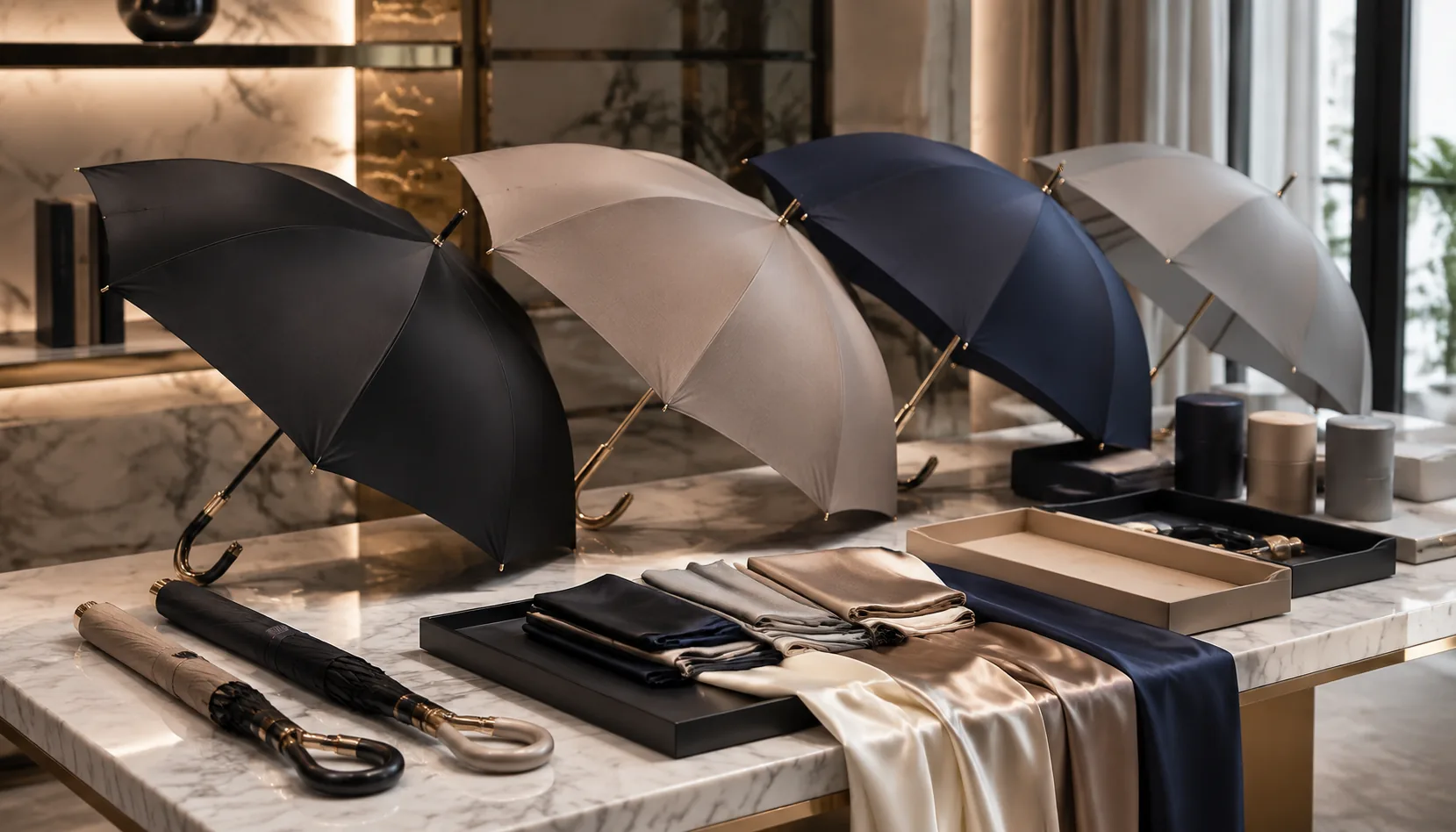
For a clienteling gift, the umbrella has to feel like the brand before the customer ever sees the logo: balanced in the hand, quiet in its hardware, clean at every seam. On our Songxia production floor, luxury retail umbrellas usually succeed or fail in the details buyers specify early—fabric handfeel, rib strength, discreet mark placement, color tolerance, carton protection, and inspection gates that hold up under tight boutique delivery windows.
Where Umbrellas Fit in Clienteling Strategy
Luxury retail umbrellas work best when they feel like a service gesture first and a branded product second. In clienteling, I see four practical uses: a VIP gift packed with a seasonal lookbook, a private-shopping amenity placed in fitting suites during bad weather, an after-sales thank-you item for watch, jewelry, leather goods, or fragrance clients, and a rainy-day boutique service where staff hand one to a customer leaving the store. The mistake is treating these like trade-show giveaways. A 23" auto-open umbrella with a steel shaft, fiberglass ribs, 190T or 210T pongee, and a matte rubberized handle already sits in a different perceived-value bracket than a cheap folding unit. For higher-ticket customers, I would rather reduce logo size to a tonal print or woven label than over-brand the canopy. Premium branded umbrellas should look usable in Milan, New York, or Shanghai without shouting the brand from across the street.
For clienteling gift umbrellas, the right production run is usually 300 to 1,000 units, not 10,000. That quantity lets a retail team match umbrella design to a holiday capsule, store opening, VIC dinner, hotel partnership, or localized rainy-season campaign without locking up too much inventory. At 300 units, costs rise because fabric cutting, frame setup, screen preparation, sample approval, and AQL 2.5 inspection are spread over fewer pieces, but the gift lands better when it feels limited. Boutique customer gifts should be specified like retail accessories: color-matched pongee, clean seam alignment, smooth auto-open action, corrosion-resistant black electroplated ribs, and a sleeve that does not look like an afterthought. Our standard practice at ZheBrella is to push clients away from the absolute lowest FOB price if the handle coating, tip finish, or canopy tension will make the item feel disposable after three openings.
Perceived value matters because the umbrella is used in public, often in the exact environment where the brand wants to be remembered. A compact 21" auto-open-close model fits handbag and travel use, while a 27" or 30" straight umbrella with 8K or 16K fiberglass ribs reads more like a luxury service object for door staff, concierge desks, and private-shopping appointments. For high-end promotional umbrellas, I recommend testing open-close force, rib recovery after inversion, water repellency, and print durability before approving bulk; a logo that cracks on heat-transfer film or bleeds on a dark canopy damages the gift. UPF 50+ coating, Teflon water repellent finish, double-canopy venting, and 50+ mph wind-tunnel targets can be useful, but only if they serve the clienteling moment. For DDP programs, allow about 25-35 days for sampling and bulk production, then add transit time by market.
Premium Frame and Mechanism Choices
For luxury retail umbrellas, the frame choice should match the clienteling moment, not just the target price. A compact 21" or 23" auto-open folding umbrella fits after-purchase gifting because it slips into a handbag, gift drawer, or hotel room welcome kit without looking bulky. I prefer fiberglass ribs over painted steel on premium branded umbrellas because fiberglass recovers better after inversion and avoids the cheap “wire frame” feel customers notice when opening the umbrella. A good compact auto-open should use a clean push-button release, controlled shaft travel, and rib tips that sit evenly against the canopy; if the runner scrapes or snaps upward too aggressively, the product feels promotional, not premium. For most boutique customer gifts, 8K fiberglass with a 190T or 210T pongee canopy is the practical baseline, while 10K gives a rounder canopy profile and slightly more stable wind behavior without making the folded size too heavy.
Manual folding umbrellas still have a place in high-end promotional umbrellas, especially for brands that want a quieter, more deliberate product experience. A manual 3-fold with a slim aluminum shaft, fiberglass ribs, and a rubberized or leatherette handle feels refined when the mechanism is tight and the canopy tension is balanced. It also reduces mechanism failure risk compared with low-cost auto-open-close systems, which can fatigue quickly if the spring, cord, and plastic runner are not specified correctly. For luxury packaging, manual folding umbrellas are easier to sleeve in rigid gift boxes because there is no large button protrusion, and they allow more freedom for shaped handles or debossed end caps. Our standard practice at ZheBrella is to cycle-test folding samples before bulk approval, usually 500 to 1,000 open-close cycles depending on order value, then check runner lock, rib symmetry, canopy pull, and handle bonding before confirming the pre-production sample.
Full-size stick umbrellas create the strongest luxury impression for VIP events, store openings, and private client appointments because the customer feels the scale immediately. A 27" stick umbrella with fiberglass ribs, a steel or fiberglass shaft, and a curved wood handle works well for heritage fashion houses, jewelers, hotels, and department stores that want a classic silhouette. If the brand direction is more modern, a matte rubberized straight handle with a hidden logo plate can look cleaner than lacquered wood. For a more architectural canopy, 16K rib construction gives a noticeably rounder dome and better visual balance for edge-to-edge printing, though it adds labor cost and weight. I would reserve 16K for luxury retail umbrellas where the umbrella is part of the brand experience, not a giveaway bin item. For wind positioning, a double-canopy vented 27" or 30" model with fiberglass ribs can be built to survive 50+ mph tunnel testing, but the sample must be tested with the final 210T pongee, Teflon coating, and print coverage because heavy ink changes canopy behavior.
Fabric, Color, and Logo Execution
For luxury retail umbrellas, the canopy fabric is where buyers feel the difference before they read the logo. I would specify 210T pongee over standard 190T when the umbrella is handled in a boutique, hotel suite, or VIP lounge because the yarn density gives a smoother hand, cleaner drape, and less “crinkly” sound when opening. It also takes water-repellent and UV coatings evenly, which matters if the piece is positioned as a sun-and-rain travel accessory rather than a giveaway. For resort boutiques and airport travel retail, UPF 50+ coating is worth adding; it lets the sales associate explain real function without making the umbrella look technical. On compact 21" auto-open-close models, 210T pongee keeps the folded profile neat, while on 23" stick umbrellas it gives enough surface tension for a crisp canopy line.
Color control needs to be treated like packaging, not like ordinary promotional printing. Premium branded umbrellas often use deep navy, warm ivory, tobacco brown, oxblood, forest green, or black-on-black palettes, and those shades shift badly if the mill dyes fabric by eye. We normally ask for PMS targets, lab dips before bulk dyeing, and a tolerance window under D65 light, then compare cut panels again after heat setting because pongee can move slightly in shade. Tone-on-tone printing is usually the safest choice for clienteling gift umbrellas: a matte black logo on black pongee, champagne ink on beige, or gloss clear over navy keeps the brand visible at arm’s length without shouting across the street. If metallic ink is requested, I prefer a restrained one-position print rather than full-panel coverage because cracking risk increases on fold lines.
Logo execution should look intentional when the umbrella is closed, not only when the canopy is fully open. For boutique customer gifts, subtle placements work best: a small screen print on one lower panel, a woven label sewn into the tie wrap, an embossed PU handle badge, or a discreet end-cap mark. Woven labels are especially useful for high-end promotional umbrellas because they read like apparel trim and survive abrasion better than a heat-transfer sticker on the strap. I would avoid oversized white logos unless the retail team specifically wants street visibility; for clienteling, the point is recognition by the recipient, not mass advertising. Luxury retail umbrellas also need clean sewing around branded areas, so artwork should stay away from panel seams by at least 15–20 mm, and inspection should include print registration, thread color matching, label alignment, and canopy stains under AQL 2.5 before packing.
Packaging That Matches Luxury Retail Standards
Packaging is where many luxury retail umbrellas fail before the customer ever opens them. A 23" auto-open or 27" golf umbrella may pass AQL 2.5 on frame, canopy, and print, then arrive with rubbed corners, crushed sleeves, or a scuffed resin handle because the inner pack was treated like normal promotional goods. For clienteling gift umbrellas, I prefer a rigid 1.5–2.0 mm grayboard gift box with matte lamination, a shaped paper insert or EVA tray, and acid-free tissue between the canopy and handle. Fabric sleeves should be cut from matching 190T or 210T pongee, not thin nonwoven, with a woven label or subtle heat-transfer logo. If the handle uses a debossed metal plaque, the plaque needs a peel-off protective film and a separate tissue wrap so it does not mark the canopy during vibration testing.
Luxury retail umbrellas also need operational labeling that warehouse teams can trust. Each gift box should carry a removable barcode label with SKU, color, handle type, canopy size, and boutique allocation code; the master carton should repeat the same data on two adjacent sides for scanning on pallets. For boutique customer gifts, mixed-store allocations must be packed by destination, not by production color sequence, because repacking in a 3PL warehouse creates fingerprints, box dents, and allocation errors. Our standard practice at ZheBrella is to apply inner carton dividers for boxed umbrellas, then use 5-ply export cartons with edge protectors when the order moves by FOB Ningbo or DDP air/sea service. For a typical 500–3,000 piece run of premium branded umbrellas, this adds a little material cost but prevents the expensive problem: luxury packaging that looks handled before the sales associate presents it.
Carton protection should be specified as clearly as the umbrella itself. A safe retail pack for high-end promotional umbrellas usually means one umbrella per sleeve, one sleeve per gift box, 12–24 gift boxes per master carton depending on 21", 23", or 27" size, and no carton weight above about 15–18 kg if boutique staff will handle it manually. Add desiccant when using paper-wrapped handles, leather-look grips, or metallic plaques, especially during humid Zhejiang production months and ocean freight. For tissue wrapping, avoid dark dyed paper touching light pongee canopies because rub transfer can appear after compression. If the project includes UPF 50+ coating, Teflon finish, or a double-canopy vented windproof frame, the packaging must still allow the canopy to relax; over-tight bands create permanent crease lines that make a premium product look like clearance merchandise.
Supplier Controls for Premium Consistency
Premium consistency starts with a locked golden sample, not a mood board or Pantone code in an email. For luxury retail umbrellas, I want the buyer to approve one signed physical sample covering canopy fabric, rib count, handle finish, logo size, print method, sleeve, hangtag, and packaging before bulk materials are cut. The golden sample should state whether the canopy is 190T or 210T pongee, recycled PET pongee, POE, PVC, or EVA; whether the frame is steel, aluminum, fiberglass, or a hybrid; and whether the mechanism is manual, auto-open, or auto-open-close. For clienteling gift umbrellas, small cosmetic drift looks expensive in the wrong way, so the standard should include Delta E color tolerance, usually under 1.5 for solid luxury colors, plus approved Pantone references for every panel, binding, sleeve, and logo ink. Our standard practice at ZheBrella is to keep one golden sample in the sample room and one on the production line, both signed across the canopy so they cannot be swapped quietly.
A pre-production sample must be made from bulk fabric, bulk ribs, bulk handles, and the actual logo process, not leftover sample-room material. This is where problems show up before they become 3,000 defective boutique customer gifts: canopy symmetry off by 5 mm, logo registration drifting across curved panels, heat-transfer edges lifting after flexing, or a plated handle with orange peel under clear coat. For premium branded umbrellas, I require panel-to-panel shade matching under D65 light, logo position checked from rib seam to print center, and handle finish checked for scratches, glue marks, burrs, and uneven lacquer. Opening force should be measured, not guessed; compact auto-open-close umbrellas often feel cheap if the spring is too weak and unsafe if it snaps too hard. A good range is typically 25–45 N depending on size, with 21 inch compacts lower and 27 inch or 30 inch golf umbrellas higher. Writers should also call out windproof details, such as fiberglass ribs, 8K or 10K construction, and double-canopy venting if the brand promises durability.
Inline checks should happen at fabric cutting, printing, sewing, frame assembly, and packing, because final inspection cannot repair a bad production culture. Cutting operators should verify panel direction, grain, and color lot before bundling; sewing QC should measure seam allowance, tip alignment, canopy tension, and roundness after mounting. Printing QC should check logo registration against a jig, especially for centered crest marks, metallic inks, or tone-on-tone logos used on high-end promotional umbrellas. Final inspection should follow AQL 2.5 for major defects and a tighter internal screen for critical brand issues such as wrong logo color, crooked logo, stained canopy, loose handle, sharp rib tip, failed open-close cycle, or mismatched sleeve. For luxury retail umbrellas, I also recommend 100-cycle open-close testing on random units, water spray testing for Teflon-coated pongee, UV coating verification when claiming UPF 50+, and carton drop checks before FOB or DDP shipment. Inspection photos should include open front, open back, sleeve, handle close-up, logo close-up, carton marks, and defect samples so the retail team can approve shipment without ambiguity.
Frequently Asked Questions
What is the best umbrella fabric for luxury retail gifts?
210T pongee is a strong choice because it feels smoother and denser than 190T pongee. It also supports crisp printing and a cleaner drape for premium presentation.
Can luxury umbrellas be produced in low MOQs?
Many OEM factories can support 300-500 units for selected existing frames, while fully custom handles, molds, or packaging usually require higher MOQs. Buyers should confirm MOQ by component, not just by finished umbrella.
What branding methods work best for luxury retail clienteling umbrellas?
For luxury programs, subtle decoration usually performs best: tone-on-tone printing, small woven labels, debossed tags, or a single-panel logo. Many buyers keep branding under 5% of the canopy area to preserve a premium look.
What MOQ is typical for premium branded umbrella orders?
For custom luxury retail runs, MOQ is often 300 to 1,000 pieces per style, depending on frame, fabric, and decoration method. If you need multiple colorways or store-specific packaging, plan for a higher total order to keep unit costs stable.
How long should a luxury umbrella gift program take from sample approval to delivery?
A typical timeline is 25-45 days after sample approval for production, plus shipping time. If you need custom materials, gift boxes, or seasonal launch timing, start planning 60-90 days ahead.
Looking to Launch Your Custom Umbrella Line?
ZheBrella is a Zhejiang-based OEM/ODM umbrella manufacturer with 17 years of export experience. Free design, low MOQ from 100 pieces, windproof construction, full-color print.
Get Free Quote Now »People Also Search For
Related Articles
Branded Umbrellas for Luxury Retail Clienteling Gifts
Source premium retail umbrellas with refined materials, subtle branding, gift packaging, AQL 2.5 inspections, and timeli...
Read More »
Custom Rain Umbrellas for Luxury Retail Clienteling Programs
Design premium umbrellas for luxury retail clienteling with refined fabrics, discreet branding, durable ribs, packaging,...
Read More »
Umbrella Sourcing for Luxury Fashion and Beauty Launches
Build premium umbrella programs for fashion and beauty launches with materials, branding, QC, packaging, and timelines a...
Read More »