Commuter Folding Umbrellas: Specs for Daily Urban Retail
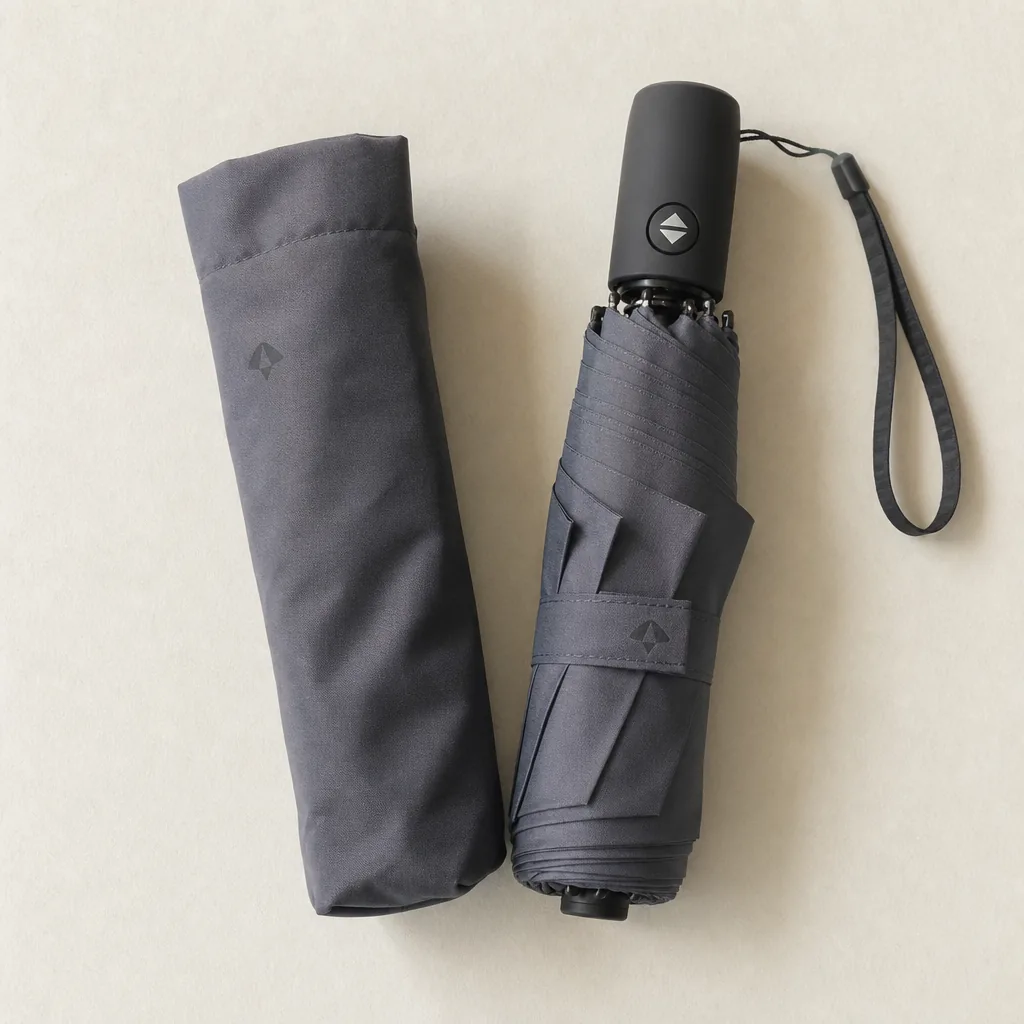
Urban retail buyers need compact umbrellas that survive crowded train exits, wet office floors, and daily bag carry without pushing the price beyond impulse-buy range. When we quote commuter folding umbrellas bulk from our Songxia floor, the real decisions are usually 21–23 inch canopy coverage, 8K frame balance, auto-open reliability, 190T versus 210T pongee, and a lead time that allows for fabric booking, printing, assembly, and final AQL inspection.
Start With the Commuter Use Case
Daily commuter umbrellas fail when buyers treat them like mini golf umbrellas instead of tools for crowded sidewalks, subway stairs, and office storage. The target user is carrying one in a backpack side pocket, handbag, briefcase, bike pannier, or bottom desk drawer, so folded length matters almost as much as open arc. For retail programs, I usually start with 21" and 23" canopies: 21" is the safer compact choice for handbags and student packs, while 23" gives better shoulder coverage for office commuters wearing a laptop bag. A typical 21" 8K folding umbrella lands around 28–30 cm folded, depending on shaft section count and handle shape; a 23" model is often 30–33 cm. If the packaging must fit a narrow shelf tray or counter display, confirm the sleeve diameter after fabric compression, not just the bare frame drawing.
The frame should match the abuse pattern: repeated opening in rain, quick closing before boarding transit, and being shoved wet into a tote. An 8K folding umbrella frame is the practical baseline for commuter folding umbrellas bulk orders because it balances cost, weight, and repair risk better than 6K promotional frames. Steel ribs lower the unit price but bend after side gusts; fiberglass ribs or fiberglass tips add resilience without making the umbrella feel heavy. For urban travel umbrella specs, I prefer a 3-section chrome-plated steel or black electroplated shaft, 8 ribs, manual or auto-open mechanism, and a straight ABS or rubberized handle that does not snag in a bag. Auto open compact umbrellas sell well at retail, but the spring and runner must be tested for 500+ cycles, because a sticky button creates returns faster than a small canopy does.
For canopy fabric, a 210T pongee umbrella is a better daily retail spec than thin 170T polyester because it folds cleaner, prints sharper, and resists the wrinkled “cheap giveaway” look after wet storage. A 21" canopy is usually enough for one person in dense pedestrian traffic; 23" is the better spec for commuters who walk 10–15 minutes from station to office. We typically check finished samples for rib tip symmetry, panel tension, seam leakage, and sleeve fit before confirming bulk cutting, because compact umbrellas have less tolerance for sloppy sewing than 27" stick umbrellas. For commuter folding umbrellas bulk programs, I would set AQL 2.5 for major defects, specify water-repellent coating consistency, and keep carton weights under roughly 15 kg so distributors and store staff can handle replenishment without crushing retail boxes.
Frame Specs That Balance Weight and Durability
For commuter folding umbrellas bulk programs, the frame decision should start with the failure point, not the catalog weight. A typical 21" or 23" 8K folding umbrella frame uses eight ribs, usually 3-section or 4-section, with a steel center shaft, aluminum middle runners, and either steel or fiberglass rib tips. Full steel frames are cheap and stiff, but they punish the wrist and deform after repeated reverse bending in subway-stair wind. Aluminum drops weight by 15-25%, yet it is easier to kink at the rib joint if the canopy is pulled open by hand instead of the runner. Fiberglass is strongest where flex is needed: outer ribs, rib tips, and sometimes the stretcher link. That is why a good urban travel umbrella specs sheet should separate shaft, rib, stretcher, and tip materials instead of writing vague words like “metal frame.”
An 8K folding umbrella frame with fiberglass outer ribs gives better wind recovery because fiberglass bends and returns instead of taking a permanent set. In our floor testing, the difference shows up after 20-30 forced inversions: steel tips often stay slightly twisted, while fiberglass tips recover enough for the canopy to sit evenly against the 190T or 210T pongee umbrella fabric. For daily retail, I prefer a steel shaft plus fiberglass rib ends over an all-aluminum frame, especially for auto open compact umbrellas where the spring action adds shock to the runner. A double-canopy vent can help, but it does not replace rib elasticity; it only reduces pressure under gusts. If a buyer wants a claimed 40-50 mph wind-tunnel rating, the sample must be tested open, inverted, recovered, and reopened, not just held in clean airflow for a photo.
Steel shafts still make sense when the target is a reliable commuter item under tight landed cost. A black electroplated steel shaft controls wobble better than thin aluminum, keeps the auto-open mechanism aligned, and helps factories hold pricing when MOQ is 1,000-3,000 pieces per color. The tradeoff is weight: a 23" 8K auto-open folding umbrella with steel shaft and fiberglass tips usually lands around 330-390 g, while a lighter aluminum-heavy build may cut 40-70 g but cost more and feel less stable in hand. For commuter folding umbrellas bulk orders, ZheBrella’s standard practice is to specify 210T pongee, steel shaft, fiberglass outer ribs, nickel-plated joints, and AQL 2.5 inspection on opening force, rib symmetry, runner lock, and post-inversion recovery before FOB Ningbo or Shanghai shipment.
Canopy Fabric and Weather Performance
For commuter folding umbrellas bulk programs, canopy fabric is where I would not over-save. 190T pongee is acceptable for entry retail: it has decent hand feel, packs small, and sheds rain better than cheap polyester. But for daily urban use, 210T pongee umbrella fabric is the safer spec because the weave is tighter, the surface looks cleaner after printing, and the canopy flutters less on a 21" or 23" folding frame. In our factory checks, 190T is usually paired with 8K steel ribs for budget promotions, while 210T is a better match for fiberglass-reinforced or 8K folding umbrella frame builds targeting repeat use. The buyer should confirm yarn density by weight and feel, not just trust the label, because some mills sell light 190T as “210T style.” For retail, I prefer specifying 210T pongee with a smooth outside finish, black or color-matched inside binding, and shrinkage control before cutting.
Water-repellent performance depends more on coating consistency than on fabric name alone. A basic WR treatment makes rain bead at first, but commuter umbrellas need a durable finish that still beads after rubbing, packing, and drying in a subway bag. Teflon-style coating is common on mid-range urban travel umbrella specs because it improves runoff and reduces wet carry weight, though buyers should avoid overcoated fabric that feels plastic and sticks when folded. Seam quality matters just as much: the canopy panels should be cut on grain, stitched evenly at about 8–10 stitches per inch, and reinforced at rib tips and top notch points. Poor seam tension causes water tracking along the thread line, especially near the ferrule and runner. On auto open compact umbrellas, extra attention is needed because the opening shock can pull weak seams out of alignment after 200–300 cycles.
For rain-and-sun commuter positioning, UPF 50+ can be added with a black UV coating, silver coating, or specialized UV-blocking layer laminated to pongee. The black coating is usually the most retail-friendly because it hides dirt, reduces glare under the canopy, and gives more stable shade during summer commuting. Silver coating blocks heat well but scratches more visibly when users fold the canopy carelessly, so I would reserve it for price-sensitive seasonal programs rather than premium daily-carry lines. For commuter folding umbrellas bulk orders, ask for both water repellency and UPF test reports from the fabric batch, not a generic catalog certificate. The canopy should also be tested after printing, because heat-transfer logos and sublimation temperatures can affect coating behavior. A realistic retail spec is 21" 8K auto-open or 23" manual compact, 210T pongee, WR plus optional UPF 50+, with AQL 2.5 inspection focused on seam leakage, coating marks, and panel symmetry.
Opening Mechanisms and Handle Comfort
For daily retail, the opening system matters more than most buyers think because commuters operate the umbrella one-handed while holding a phone, coffee, or subway card. Manual folding umbrellas are cheapest and mechanically simple, but they feel slow in a sudden downpour and rely on the user to lock the runner cleanly. Auto-open compact umbrellas are a better baseline for urban travel umbrella specs: press the button, canopy deploys fast, and the shaft stays less stressed than full auto-open-close designs. A proper 8K folding umbrella frame with fiberglass ribs and a steel or aluminum shaft should open smoothly without rib kickback. For commuter folding umbrellas bulk orders, I usually push buyers away from ultra-cheap manual runners unless the target is a giveaway, because retail returns often come from sticky sliders, bent stretchers, and customers forcing the lock.
Auto-open-close mechanisms are convenient, but they need tighter QC because the closing spring carries real load. On a 21" or 23" three-fold umbrella, we normally test repeated open-close cycles at 500 to 1,000 operations before approving mass production; poor springs lose snap, buttons jam, or the shaft rebounds dangerously when compressed. Button safety is not cosmetic: the button should sit slightly recessed in the handle, require firm pressure, and not fire when rubbed inside a backpack pocket. For a 210T pongee umbrella with Teflon coating, the canopy dries fast, but water weight still adds stress during closing, especially on 10K ribs or wider arc models. Our standard practice at ZheBrella is to check button alignment, runner locking, shaft compression force, and spring rebound during inline inspection, then pull finished cartons under AQL 2.5 before shipment.
Handle comfort decides whether the umbrella becomes a daily carry or stays in a drawer. ABS handles are hard, clean-looking, and economical for private-label retail, but they can feel slippery when wet unless the mold includes texture or a rubberized coating. EVA handles cost more, yet they give better grip in cold rain and reduce pressure on the palm during a 15-minute walk from station to office. For commuter folding umbrellas bulk programs, specify handle diameter, button position, and strap anchoring instead of just saying “comfortable handle.” A wrist strap should be bar-tacked or looped through a molded channel, not glued into the cap, because commuters hang compact umbrellas from bags and hooks every day. I also prefer a flat or oval handle profile on auto-open-close models, since it helps users push the shaft closed against a wall or floor without twisting the wrist.
MOQ, Sampling, and Bulk Lead Time Planning
For commuter folding umbrellas bulk planning, do not start with the factory’s catalog MOQ; start with the parts that force MOQ. A plain 21" or 23" 8K folding umbrella frame in black steel or fiberglass with a standard manual or auto-open runner can often be sourced from shared component stock, so 500–1,000 pcs per color is realistic. Once you specify a custom molded handle, matched Pantone ribs, special tips, or a private-label sleeve zipper, the MOQ usually moves to 1,500–3,000 pcs because plastic injection, electroplating, and fabric dye lots become the bottleneck. For a 210T pongee umbrella with solid color canopy and one-position screen print, sampling is straightforward; for all-over sublimation, reflective trim, or UV UPF 50+ coating, allow more trial time because shrinkage, seam alignment, and coating hand-feel need checking before bulk cutting.
Prototype samples normally take 5–7 days when we use existing frame tooling and available 190T or 210T pongee colors. If the buyer needs a true custom urban travel umbrella specs package—say 23" auto open compact umbrellas, 8K folding umbrella frame, matte rubber handle, Teflon water-repellent finish, and branded woven label—plan 10–14 days for a proper sample. Pre-production samples should not be skipped; they are the bridge between a nice showroom sample and a repeatable production unit. Our standard practice at ZheBrella is to build the pre-production sample from actual bulk materials, then confirm folded length, canopy arc, print position tolerance, runner smoothness, and sleeve fit before releasing fabric to the cutting room. A buyer should approve this sample in writing, because changing logo size or fabric color after cutting can scrap hundreds of panels.
Bulk lead time for commuter folding umbrellas bulk is usually 25–35 days after deposit and pre-production sample approval for common styles, but 40–55 days is safer during March–June peak season or before major retail resets. Printing method affects the calendar: one-color screen printing is fast, heat transfer needs extra curing and peel checks, and sublimation requires panel-by-panel color control before sewing. For inspection, specify AQL 2.5 for major defects and make the checklist practical: 20–30 opening and closing cycles on sampled units, rib symmetry under full tension, shaft wobble, runner locking, loose tips, skipped stitches, oil marks, and fabric defects such as slubs, shade bands, pinholes, and coating streaks. For DDP programs, add 7–12 days for consolidation, customs documents, carton marking, and final inland delivery planning.
Frequently Asked Questions
Is an 8K frame enough for a commuter folding umbrella?
For most urban retail programs, 8K is the standard balance of weight, cost, and durability. Buyers wanting a premium wind-resistant line can upgrade to reinforced fiberglass ribs or 10K/12K frames.
Should commuter umbrellas use 190T or 210T pongee?
190T pongee is common for cost-controlled orders, while 210T feels denser and more premium. For retail brands, 210T is often worth testing when the umbrella is positioned above basic promo pricing.
What canopy size works best for daily urban commuters?
For most retail programs, a 21 to 23 inch canopy gives a good balance of coverage and portability. It fits standard bag storage while still covering one person in rain without feeling bulky.
Is an 8K frame enough for commuter folding umbrellas sold in bulk?
Yes, 8K is a common spec for entry to mid-range commuter umbrellas because it keeps the frame lighter and lower cost. For higher durability or stronger wind performance, buyers often compare 8K against 10K or reinforced rib options.
What lead time should importers expect for OEM folding umbrellas?
Typical bulk lead time is about 30 to 45 days after sample approval and deposit, depending on print complexity and fabric availability. If custom packaging or special components are needed, plan for a longer timeline.
Looking to Launch Your Custom Umbrella Line?
ZheBrella is a Zhejiang-based OEM/ODM umbrella manufacturer with 17 years of export experience. Free design, low MOQ from 100 pieces, windproof construction, full-color print.
Get Free Quote Now »People Also Search For
Related Articles
Travel Umbrella Specs for Airline, Hotel, and Retail Buyers
Compare travel umbrella specs that affect resale and guest use, from folded length and weight to frame materials, canopy...
Read More »
Choosing a Folding Umbrella for Retail and Promo Buyers
Compare folding umbrella sizes, frames, and mechanisms so buyers can match retail or promo programs to target price, win...
Read More »
Commuter Umbrella Buying Guide for Daily Carry Programs
Specify a commuter umbrella that works for daily carry with the right compact size, weight, wind resistance, opening mec...
Read More »