Golf Umbrella Sponsorships: Branding That Delivers ROI
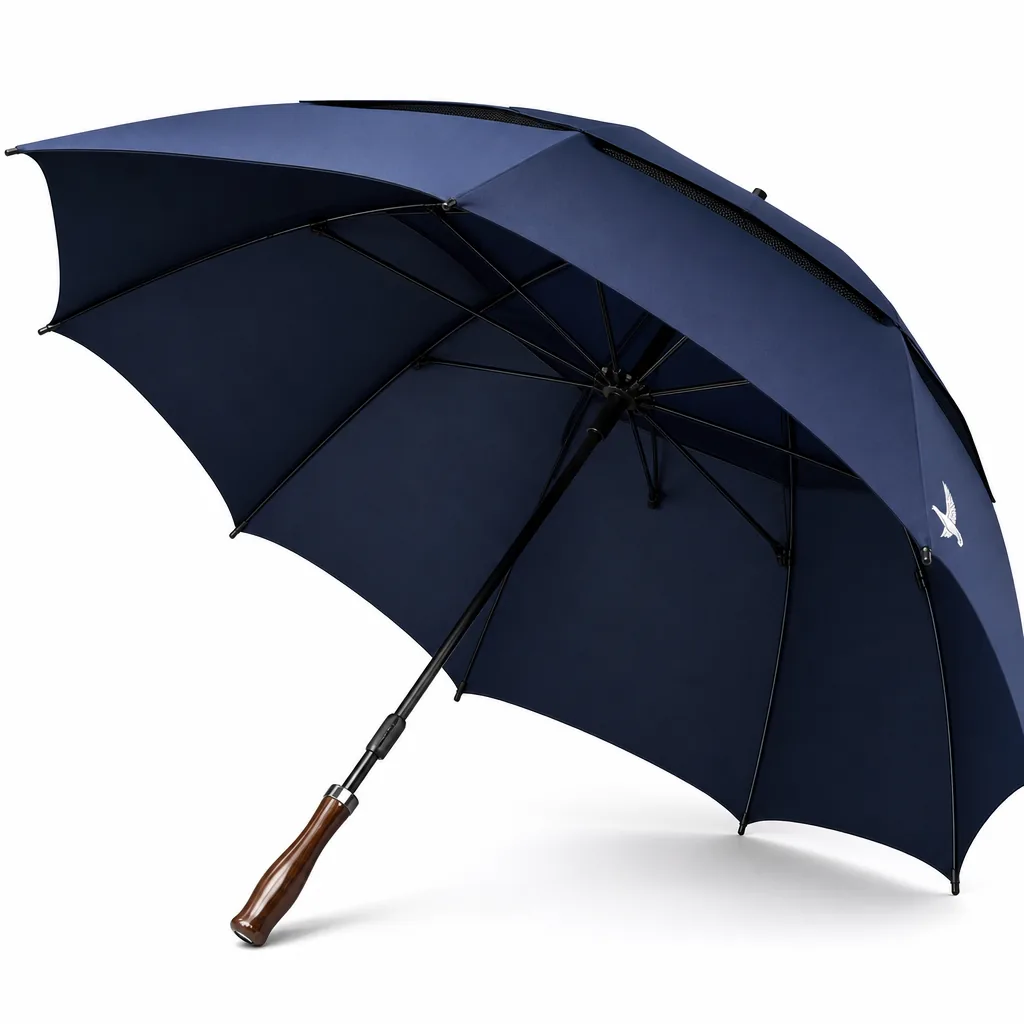
For brands, a golf umbrella sponsorship only works if the canopy is visible on the course, the build survives real weather, and the program lands within budget. At the factory level, that means balancing panel layout, print accuracy, frame strength, and minimum order economics so the umbrella performs as a walking billboard instead of a short-lived giveaway.
Why golf umbrellas suit sponsorship
A golf umbrella sponsorship works because the format gives you a lot of printed area without looking forced. A 62-inch or 68-inch canopy can carry a logo, sponsor line, and event mark on multiple panels, and that visibility holds up whether the umbrella is open on the tee box, at the clubhouse, or walking between holes. Compared with smaller giveaway items, a branded golf umbrella stays in use for months or years, so the impression count is high. In practical terms, that makes golf event umbrella roi easier to defend than many other promo buys: one well-made umbrella can show up in rain, sun, and shade, then keep working after the tournament ends.
The hardware matters as much as the print. For sponsor umbrella golf programs, I would rather specify fiberglass ribs, a double-canopy vented frame, and an auto-open or auto-open-close mechanism than spend the budget on oversized artwork that fails in wind. A 190T or 210T pongee canopy with Teflon or UPF 50+ coating gives the umbrella more utility, which means more carry time and better brand exposure. From the floor, the best golf umbrella sponsorship orders are the ones where the sponsor wants a real tool, not a disposable handout. ZheBrella’s standard practice on these runs is to match the panel layout to the logo placement early, because clean visibility on a 23" or 30" frame is what makes the sponsor notice the return, not just the event attendee.
Designing for on-course and broadcast
For a golf umbrella sponsorship, the logo has to read at 20 to 40 yards first and only look refined up close second. Thin line art, small taglines, and low-contrast color blocking disappear the moment the umbrella is moving in wind or filmed from a fairway camera. I push buyers toward one dominant mark, usually 1 to 2 colors with a hard edge against the canopy, because a branded golf umbrella is not a brochure panel. On 58-inch and 62-inch canopies, the cleanest placement is often one large panel or two opposing panels, with the logo sized to survive partial folds and movement. If the sponsor umbrella golf needs sponsor recognition from broadcast footage, contrast matters more than decoration; a white or metallic logo on navy, black, or forest green usually outperforms a subtle tonal print by a wide margin.
Broadcast and on-course visibility are not the same problem, so the artwork should be built for both. In television or social clips, the frame often catches the canopy at an angle, which means centered logos get cut off and small text becomes noise. Put the primary mark where it will appear in the most common holding positions, then test it against overhead shots, side shots, and walking shots. For golf event umbrella roi, the value comes from repeated impressions across spectators, players, caddies, and camera operators, not from a single perfect photo. High-contrast imprint methods like screen print or heat transfer usually outperform complex gradients, especially on pongee 190T or 210T canopies where fabric texture already softens fine detail.
The rest of the build should support the artwork instead of fighting it. A double-canopy vented frame keeps the logo visible in wind because the top panel does not collapse the same way a flat single canopy does, and fiberglass ribs help the umbrella hold shape better than cheap steel when gusts hit 50+ mph. Our standard practice is to check logo legibility at both open and walking height, because what looks good in a mockup can vanish once the umbrella is angled over a shoulder. For procurement teams, that is the practical filter: if the branding cannot be recognized quickly from distance and in motion, it is not doing its job as a golf umbrella sponsorship asset.
Single sponsor vs shared layouts
A single-sponsor canopy is the cleanest way to get a golf umbrella sponsorship to work as a real branding asset instead of a cluttered banner. When one logo owns the full panel set, you get readable art from 20 to 30 feet away, which matters on the tee box, the cart path, and in photos. On a 62-inch or 68-inch golf umbrella, that usually means 6 to 8 panels with one consistent message, one color system, and no dead space. If the client cares about recall, this is the format that survives motion, wind, and imperfect handling. Our standard practice is to size the artwork to the canopy shape first, then choose print method, because a clean screen print or heat-transfer layout on pongee 190T or 210T will beat a crowded multi-logo setup every time.
Shared layouts only make sense when the sponsor list is fixed and the event is treating the umbrella as a revenue panel, not a premium brand item. In that case, the canopy becomes a partitioned media surface: top cap, alternating panels, or paired opposite panels for co-sponsors. The downside is obvious on course: small logos disappear once the umbrella opens and the user is walking or turning into the wind. A branded golf umbrella with three or four sponsors can still work if the logo count is low, the art is high-contrast, and each party accepts limited visibility. If they want a golf event umbrella roi calculation, shared layouts usually win on upfront cost per logo, but they lose on individual imprint value and post-event recall.
The decision should come down to use case, not preference. If the umbrella is a client gift, premium giveaway, or VIP cart accessory, dedicate the canopy and put one sponsor on the inside, outside, or sleeve instead of splitting the surface. If it is a tournament inventory item sold to multiple vendors, a shared layout can reduce MOQ pressure and improve margin, but it also pushes you toward simpler graphics and fewer print colors. From a production standpoint, single sponsor artwork is easier to QC under AQL 2.5 because alignment, panel registration, and color consistency are all easier to hold. Shared sponsor umbrella golf layouts create more failure points, especially when logos have different file quality, brand colors, or minimum clear-space rules.
Quality tiers for players vs VIPs
For a golf umbrella sponsorship, do not buy one spec for everyone and call it strategy. Players who are carrying bags, walking 18 holes, or standing on a windy tee box need a practical umbrella: 62" to 68" arc, fiberglass ribs, double-canopy vented construction, and at least a 190T or 210T pongee canopy with a UV coating if the event is outdoors all day. That build handles repeated opening, cart storage, and gusts better than a cheap steel-rib model that twists on the first strong crosswind. In factory terms, this is the difference between something that survives a season and something that looks tired before the trophy photos are done.
VIPs are a different category. A sponsor umbrella golf program for executives, clients, or title sponsors should look and feel heavier, with a cleaner print surface, auto-open-close mechanism, soft-touch handle, and tighter finishing on tips, shaft plating, and canopy tension. A branded golf umbrella in this tier can justify details like Teflon water repellent, UPF 50+ coating, and a cleaner 1- or 2-color logo layout placed to read well from the fairway and the clubhouse. For premium recipients, I would rather use a higher-spec 8K or 10K frame with better ferrules and consistent panel registration than push oversized graphics onto a weak frame that rattles in the wind.
The real golf event umbrella roi comes from matching cost to visibility and survival rate. For player giveaways, a mid-tier umbrella with fiberglass ribs and standard screen print is usually the best spend because it gives broad exposure at a controlled unit price and low breakage. For VIPs, the math changes: fewer pieces, higher unit cost, but better retention, more reuse in public, and less risk of a sponsor logo ending up in the trash after one storm. Our standard practice is to separate these tiers at the quoting stage, because MOQ, lead time, and decoration method should reflect the recipient. If the umbrella is meant to be photographed, gifted, and kept, pay for the construction that supports that outcome; if it is meant to move in volume, keep the spec honest and durable.
Measuring sponsorship impact
The cleanest way to measure a golf umbrella sponsorship is by counting visible surfaces, not by guessing at brand awareness. A 60-inch canopy on a 27" or 30" frame has roughly 12 to 15 square feet of printable area across panels, and that space is visible for minutes at a time, not seconds. At a four-hour outing with 100 players, 20 caddies, and steady cart traffic, a branded golf umbrella can generate roughly 1,500 to 4,000 direct impressions if it is actually used in sun or rain. That estimate is conservative: it assumes only people within 20 to 40 yards can read the logo clearly, which is realistic on tee boxes, cart paths, and clubhouse walkways. A golf umbrella sponsorship works best when you track who carried the umbrella, where it was used, and how long it stayed open, because a sponsor umbrella golf placement has more value in motion than sitting in a gift pile.
The better ROI model is exposure time multiplied by audience density. A sponsor umbrella golf program with 50 umbrellas handed to players, VIPs, or volunteers can create 25 to 60 minutes of exposure per umbrella across a round, and the same item is often reused at practice rounds, corporate outings, and later rainy days. If one umbrella is seen by 6 to 12 people per minute in high-traffic zones, that gives you a rough range of 900 to 3,600 visual contacts per unit over one event day, before social photos and post-event reuse. For a golf event umbrella roi calculation, I would separate direct impressions, photo impressions, and carryover impressions. The last category matters because a good 190T or 210T pongee canopy with fiberglass ribs tends to stay in circulation for months, which is where the math gets better than a one-time banner or tee sign.
To make the estimate defensible, use simple field checks: count umbrellas distributed, record open time, note weather conditions, and sample sightlines from the starter area, greens, and hospitality tent. If ZheBrella is supplying the product, our standard practice is to recommend print placement that stays readable at 30 to 50 feet, because tiny logos on low-contrast panels disappear fast in real play. For ROI reporting, compare the cost per unit against the estimated impressions and the expected retention rate after the event. A $12 to $18 branded golf umbrella that stays in use for 30 to 50 outings will usually outperform a cheaper promo item that breaks after two storms. In practical terms, the strongest case for a golf umbrella sponsorship is not one dramatic photo. It is repeated, field-level visibility from a durable canopy that keeps showing up at the course, the clubhouse, and in parking-lot photos long after the tournament ends.
Frequently Asked Questions
Are golf umbrellas good for brand sponsorship?
Yes. Their large canopy is a highly visible branding surface, they are used outdoors for hours, and they photograph and broadcast well. That combination delivers strong exposure per dollar compared with smaller promotional items.
How should a sponsored golf umbrella be designed?
Use a large 30-inch windproof double canopy, place the logo boldly with high color contrast so it reads at distance and on camera, and decide early whether one sponsor owns the canopy or several share alternating panels.
What umbrella size gives the best sponsor visibility on the course?
For golf sponsorship programs, a 60 to 68 inch arc is usually the best balance of visibility and usability. That size gives enough canopy area for a large logo on 2 to 4 panels while still being practical for players and caddies.
What print method works best for a branded golf umbrella?
Screen printing is usually the most cost-effective choice for simple logos in 1 to 2 colors, especially on larger orders. If the artwork is detailed or multi-color, heat transfer or digital printing is often better for clean reproduction across the canopy.
What are typical MOQ and lead times for a sponsored umbrella program?
Many factory programs start around 200 to 500 pieces, depending on the model, fabric, and decoration method. Sample approval often takes 5 to 10 days, and production is commonly 25 to 35 days after approval, with rush options possible on repeat orders.
Looking to Launch Your Custom Umbrella Line?
ZheBrella is a Zhejiang-based OEM/ODM umbrella manufacturer with 17 years of export experience. Free design, low MOQ from 100 pieces, windproof construction, full-color print.
Get Free Quote Now »People Also Search For
Related Articles
Using Branded Umbrellas in Sports Venues and Fan Retail
Explore how stadiums and sports retailers use branded umbrellas for gate giveaways, premium fan retail, and weather-read...
Read More »
Branded Umbrellas for Events and Festivals: A Planning Guide
How to use branded umbrellas at events and festivals for shade, visibility, and shareable moments, and how to plan quant...
Read More »
Custom Umbrellas for Corporate Events and VIP Hospitality
See how custom umbrellas support executive events, VIP arrivals, and hospitality programs with durable specs, logo place...
Read More »