Hotel Loaner Umbrellas: Durable Specs for Guest Programs
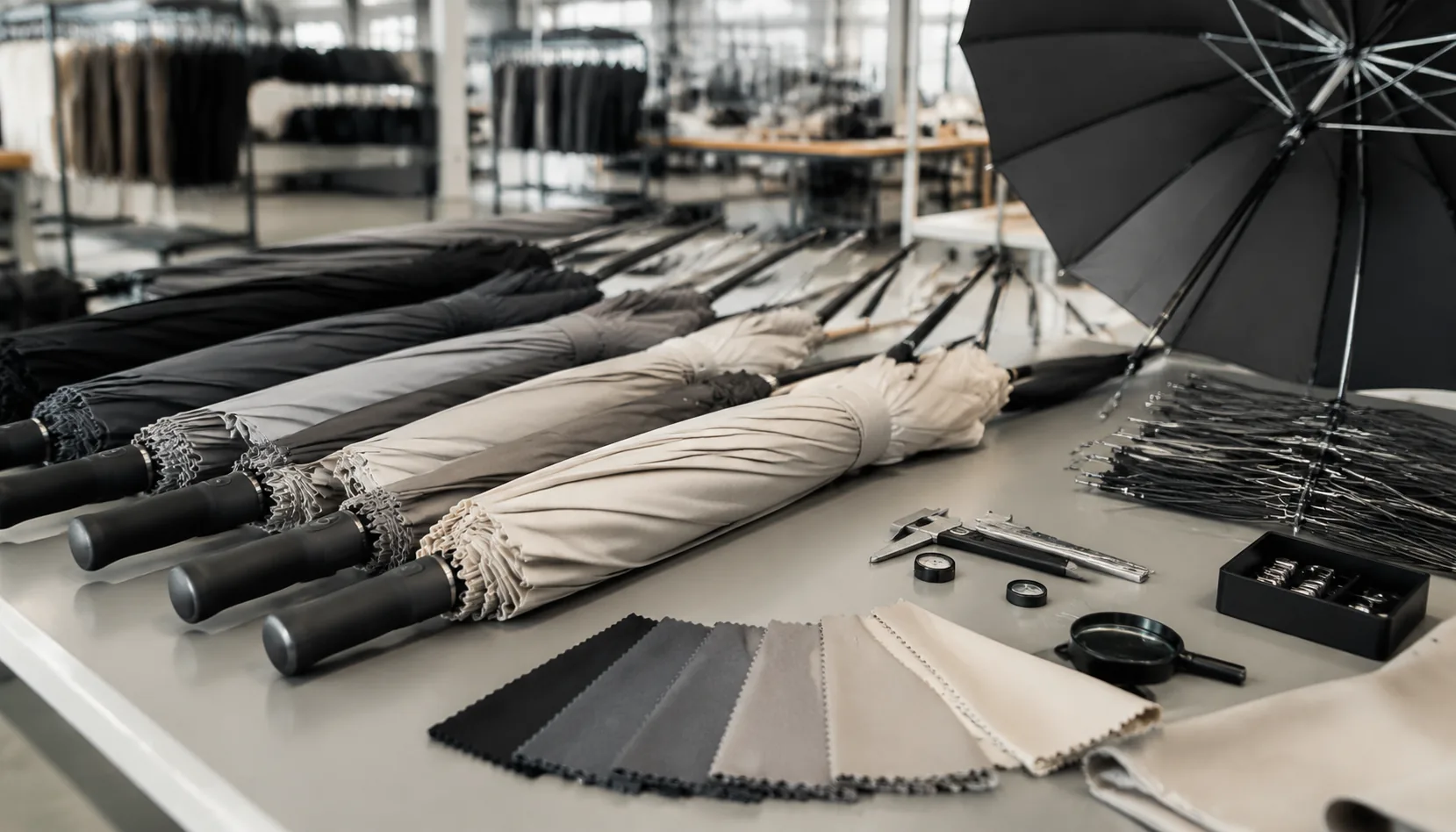
For a hotel program, the umbrella has to survive wet lobby floors, hurried valet handoffs, and guests who may not return it gently. When buyers specify hotel loaner umbrellas, the real cost is not only unit price but rib failures, fabric sagging, logo wear, and replenishment surprises after peak season. On our Songxia factory floor, we build these programs around stronger frames, 190T or 210T pongee, practical branding positions, MOQ planning, and QC checks that match repeated guest use.
Match Umbrella Type to Hotel Service Model
Lobby loaner umbrellas should be treated as shared hotel equipment, not promotional giveaways. For a front-door stand, I normally specify durable stick umbrellas in 23" or 27" size, with a 46"–54" arc depending on the entrance width and local rainfall. A 23" 8K fiberglass frame is comfortable for one guest walking to a taxi; a 27" 8K or 10K frame gives better shoulder coverage for two people and looks more appropriate at a five-star porte cochere. Steel shafts keep cost down, but fiberglass ribs and stretchers recover better after guests fight wind at the curb. For hotel loaner umbrellas, I avoid ultra-light folding frames because they come back bent, wet, and half-closed. A straight EVA or rubberized J-handle also matters: it hangs cleanly on umbrella stands, dries faster than wood, and is easy for staff to count during shift handover.
Concierge rain umbrellas are different because they sit at the valet counter, bell desk, or doorman station and are handed out under staff control. Here the umbrella has to open smoothly, look uniform in photographs, and survive repeated use during short bursts of rain. A manual-open stick frame is still the most reliable choice; auto-open is convenient, but the spring button and runner take abuse when guests force the canopy closed. For city hotels with wind tunnels between buildings, a double-canopy vented 23" or 27" model with fiberglass ribs can be rated around 50+ mph in controlled testing, while a single-canopy steel-rib version may invert earlier. A guest umbrella supplier should also check tip finishing, ferrule tightness, and runner burrs, because those small defects scratch marble counters and snag wool coats. Our standard practice at ZheBrella is to test loaner samples with wet-handle grip, repeated open-close cycling, and AQL 2.5 inspection before bulk packing.
Room amenity umbrellas serve another service model: the guest may pack them, forget them, or treat them as part of the room experience. If the hotel expects guests to carry the umbrella in luggage, a 21" or 23" folding umbrella with 190T or 210T pongee is practical, especially with auto-open-close for business travelers. If the umbrella stays in a closet, suite entry, or branded shopping bag, a compact 23" stick umbrella feels more premium and avoids the weak joints found in cheap 3-fold frames. For resort villas, golf properties, and serviced apartments, larger 27" or 30" stick formats make sense, but they need deeper umbrella sleeves and enough space beside the luggage rack or entry cabinet. A hotel umbrella OEM should ask where the umbrella physically lives before quoting: umbrella stand diameter, valet counter depth, sleeve material, drying workflow, and FOB/DDP replenishment schedule all affect the correct spec. Good hospitality umbrella sourcing starts with that service map, not with the logo size.
Specify Frame Strength for Repeat Handling
For hotel loaner umbrellas, the frame has to survive abuse more than showroom testing: guests lean on them like walking sticks, shake them open half-latched, toss them wet into bins, and sometimes leave them in elevator corners. I recommend fiberglass ribs as the default because they bend and rebound better than painted steel ribs when the canopy inverts in gusts. Steel ribs feel rigid on day one, but repeated bending creates fatigue at the rivet holes. A steel shaft is still worth keeping, especially on 23" or 27" stick umbrellas, because it gives the umbrella a solid, premium hand feel that matches a lobby program better than a lightweight aluminum tube. For durable stick umbrellas, specify anti-rust coating on the shaft, reinforced rib tips, and a runner that locks cleanly without gritty movement after 500 open-close cycles.
Rib count should be chosen by wind exposure and replacement budget, not by the idea that more ribs are always better. An 8K fiberglass frame is the practical workhorse for city hotels, airport properties, and serviced apartments where the umbrella is used mostly for short walks to taxis or restaurants. It keeps weight controlled, lowers FOB cost, and is easier to repair if a rib tip or stretcher gets damaged. A 16K frame spreads canopy tension more evenly and looks more substantial at the entrance stand, but it adds material cost and a little weight. For hospitality umbrella sourcing, I usually steer buyers toward 8K for standard 23" guest umbrellas and 16K for 27" executive or doorman umbrellas where visual presence matters. A good guest umbrella supplier should quote both options with the same canopy fabric, handle, and logo process so procurement can compare the frame cost honestly.
Double-canopy windproof construction is worth the added cost when the property faces real gusts: coastal hotels, island resorts, golf resorts, mountain properties, and high-rise urban entrances with wind tunnels between buildings. The vent lets pressure escape instead of forcing the canopy to invert, and paired with fiberglass ribs it can survive 50+ mph wind-tunnel testing when the frame geometry is correct. It is not necessary for every indoor-to-car valet use case; for a downtown business hotel, a single-canopy 190T or 210T pongee umbrella with 8K fiberglass ribs may be the better value. As a hotel umbrella OEM, ZheBrella’s standard practice is to review site exposure, umbrella size, and expected monthly loss rate before recommending vented construction, because an overbuilt umbrella that disappears after one rainy weekend is still a poor program design.
Choose Fabric, Finish, and Brand Presentation
Fabric choice sets the service life and the guest impression before the handle is even touched. For cost-controlled hotel loaner umbrellas, 190T pongee is usually the practical baseline: tight enough to bead rain with a standard water-repellent coating, light enough to dry quickly in the lobby stand, and economical when the program needs 300 to 2,000 pieces across multiple properties. It works well on 23" and 27" durable stick umbrellas with fiberglass ribs, because the frame adds the strength while the canopy keeps weight and replacement cost under control. For luxury hotels, branded residences, and VIP suites, I prefer 210T pongee. The weave is denser, the surface is smoother under screen printing or heat-transfer logos, and dark colors such as charcoal, navy, forest green, and burgundy look less flat than they do on cheaper polyester. A guest umbrella supplier should send both fabrics under the same lighting, because lobby LEDs can make black, graphite, and deep navy look surprisingly different.
The finish should match the climate and the property type, not just the catalog price. A basic C6 or C0 water-repellent treatment is enough for city hotels where umbrellas rotate through short taxi and restaurant trips; we test for clean runoff rather than claiming waterproof fabric, because stitched seams and tip areas always matter. Resorts, golf hotels, and beachfront properties should consider UPF 50+ coating on 210T pongee, especially for 27" or 30" stick umbrellas used by pool attendants and guests walking between villas. That coating adds cost and can slightly change the hand feel, so approve a production sample before bulk cutting. For hospitality umbrella sourcing, I also recommend specifying colorfastness, not just Pantone matching. Dark canopy fabric with poor dye control can rub onto white marble, pale upholstery, or staff gloves when wet. Our standard practice at ZheBrella is to check coating uniformity, print adhesion, and fabric shade by lot before sewing, not after final packing.
Brand presentation should be visible but restrained, because hotel loaner umbrellas are part of the property experience, not a walking trade-show banner. The safest placement is a one-panel logo, 80 to 120 mm wide on a 23" canopy or 120 to 160 mm on a 27" canopy, positioned low enough to read when the umbrella is open but not so low that rib tips distort the print. Tone-on-tone printing, matte silver, soft gold, or a small woven sleeve label often looks better than oversized white artwork on every panel. A serious hotel umbrella OEM will ask for Pantone references, handle finish, sleeve design, and lobby stand color at the same time, because brand standards fail when the canopy is correct but the ABS handle, tip, or storage sleeve is off shade. For five-star programs, approve a pre-production sample under both daylight and warm lobby lighting, then lock the fabric lot, coating, print method, and carton markings before mass production.
Design Handles, Tips, and User-Friendly Mechanisms
Handle choice is not decoration on hotel loaner umbrellas; it decides whether a guest can control a wet canopy while stepping out of a taxi with luggage in the other hand. EVA foam is the safest budget handle for rainy lobbies because it stays warm, gives grip when soaked, and does not chip like low-grade painted plastic. Rubberized ABS has a cleaner business-hotel look and works well on 23" and 27" stick models, but the coating must pass a 48-hour humidity check or it can turn tacky in coastal properties. Wood crook handles fit heritage hotels and resorts, especially with 190T or 210T pongee canopies, but I would specify sealed beech or maple rather than raw wood. Faux leather wrap is best for executive suites and branded VIP programs, provided the stitching is polyester and the glue line is tested after repeated wet-dry cycles.
For concierge desks, I strongly prefer auto-open stick umbrellas over manual-open models because staff can hand one to a guest and deploy it in one motion at the door. The spring should open smoothly without a violent snap; cheap mechanisms bend the shaft notch after a few hundred cycles, especially on 27" and 30" durable stick umbrellas. Our standard practice at ZheBrella is to cycle-test auto-open runners before bulk packing and reject units that stick, overtravel, or fail to lock firmly. For hospitality umbrella sourcing, steel shafts are economical, but fiberglass ribs reduce guest complaints after gusty rain because they flex instead of staying bent. A 16K frame looks premium, though most hotels get the best cost-performance from 8K or 10K fiberglass ribs with a straight stick shaft and vented canopy if the location sees frequent wind.
Rounded tips are a small specification that prevents large problems. Metal bullet tips look sharp on retail umbrellas, but for hotel corridors, shuttle buses, and crowded event entrances, rounded plastic or resin tips reduce scratch and poke risk without making the umbrella look childish. The top cap should be smooth and firmly riveted, not just friction-fit, because guests often use umbrellas as walking sticks while waiting outside. Loss control also needs to be designed into the product: a wide hook-and-loop strap with a woven hotel label makes folding faster and discourages mix-ups, while a matching sleeve keeps wet canopies from turning the concierge stand into a pile of fabric. A serious guest umbrella supplier should quote sleeves separately, because adding a pongee sleeve, barcode label, or room-number tag changes labor time, packing volume, MOQ, and final FOB/DDP cost.
Set Procurement Terms and Inspection Standards
Procurement terms should be locked before artwork, because hotel loaner umbrellas fail programs more often from vague purchasing rules than from bad fabric. For durable stick umbrellas, I usually set MOQ at 300 pcs per solid-color 23" or 27" style with one-position screen print, 500 pcs for custom PMS canopy panels, and 1,000 pcs for woven jacquard or full sublimation work. Heat-transfer logos on 190T or 210T pongee are practical from 300-500 pcs, while POE clear dome umbrellas often need 600 pcs because cutting waste is higher. Pre-production samples normally take 5-7 days after logo file approval; a full custom strike-off with PMS-dyed canopy can take 10-14 days. Bulk lead time is usually 25-35 days after sample sign-off for repeat hotel groups, and 40-50 days when the frame, handle mold, or canopy color is new.
For hotel loaner umbrellas, freight terms should match how the group receives goods, not just the lowest unit price. FOB Ningbo or Shanghai works well when the buyer already has a China forwarder and wants to consolidate with linens, amenities, or furniture; it also gives cleaner control over ocean freight and destination charges. DDP is better for multi-property rollouts where cartons must land directly at different hotels, but the purchase order needs property names, delivery addresses, carton marks, and consignee tax details confirmed early. A serious guest umbrella supplier should quote both ways: FOB per umbrella and DDP per landed carton, with carton dimensions, gross weight, HS code, and estimated transit days. For North America, air DDP is usually only sensible for event launches or emergency replenishment; sea DDP is the normal choice for annual hospitality umbrella sourcing.
Inspection standards need to be written into the PO, not argued after cartons are sealed. Our standard practice at ZheBrella is AQL 2.5 for major defects and AQL 4.0 for minor defects, with opening force checked across manual, auto-open, and auto-open-close mechanisms so guests are not fighting stiff runners at the lobby door. Rib alignment is checked on every sampled unit: 8K steel frames must sit evenly without twisted tips, and fiberglass ribs must flex back without white stress marks. Canopy inspection covers fabric stains, skipped stitches, loose tie straps, panel shade variation, and coating damage on Teflon or UPF 50+ fabrics. Handle adhesion is tested by pull and twist, especially on EVA, rubberized, and wood handles. Carton labeling should identify brand, property, SKU, color, logo version, PO number, and quantity, because hotel umbrella OEM programs often ship the same black umbrella to 20 properties with different markings.
Frequently Asked Questions
What size is best for hotel lobby loaner umbrellas?
Most hotels choose a full-size stick umbrella with enough coverage for one guest and luggage. For valet or doorman use, buyers can move to a larger canopy, but storage space and handling weight should be checked first.
Should hotel umbrellas use auto-open or manual open?
Auto-open is convenient for concierge handoff and guest use at entrances. Manual open can reduce mechanism cost and may be preferred for simple room amenity umbrellas with lower replacement budgets.
What fabric is better for hotel loaner umbrellas, 190T or 210T pongee?
190T pongee is suitable for cost-controlled guest programs, while 210T pongee offers a denser hand feel and better premium positioning. For 4-star and 5-star hotels, 210T pongee is usually preferred for repeat guest use.
What MOQ should hotels plan for custom loaner umbrellas?
A practical MOQ for OEM hotel loaner umbrellas is often 500–1,000 pieces per design, depending on frame, fabric color, and logo method. Larger hotel groups can reduce unit cost by consolidating orders across properties.
Which QC points matter most for reusable hotel umbrellas?
Key QC checks include rib strength, shaft straightness, runner smoothness, fabric waterproofing, logo adhesion, and open-close cycle testing. For loaner programs, buyers should request reinforced tips, durable handles, and inspection for frame alignment before shipment.
Looking to Launch Your Custom Umbrella Line?
ZheBrella is a Zhejiang-based OEM/ODM umbrella manufacturer with 17 years of export experience. Free design, low MOQ from 100 pieces, windproof construction, full-color print.
Get Free Quote Now »People Also Search For
Related Articles
Hotel Guest Umbrellas: Product Specs for Bulk Sourcing
Compare 23-25 inch hotel guest umbrellas by frame, canopy, handle, packaging, MOQ, and inspection points before placing ...
Read More »
Hotel Guest Umbrellas: Buyer Specs for Durable Loan Programs
Specify hotel guest umbrellas for loan programs with durable frames, easy handling, logo placement, QC checks, and reord...
Read More »
Hotel Guest Umbrellas: Buyer Guide for Durable Loaner Programs
Specify hotel guest umbrellas with durable ribs, 190T/210T pongee, logo placement, QC checks, MOQ, lead time, and FOB/DD...
Read More »