Hotel Guest Umbrellas: Buyer Guide for Durable Loaner Programs
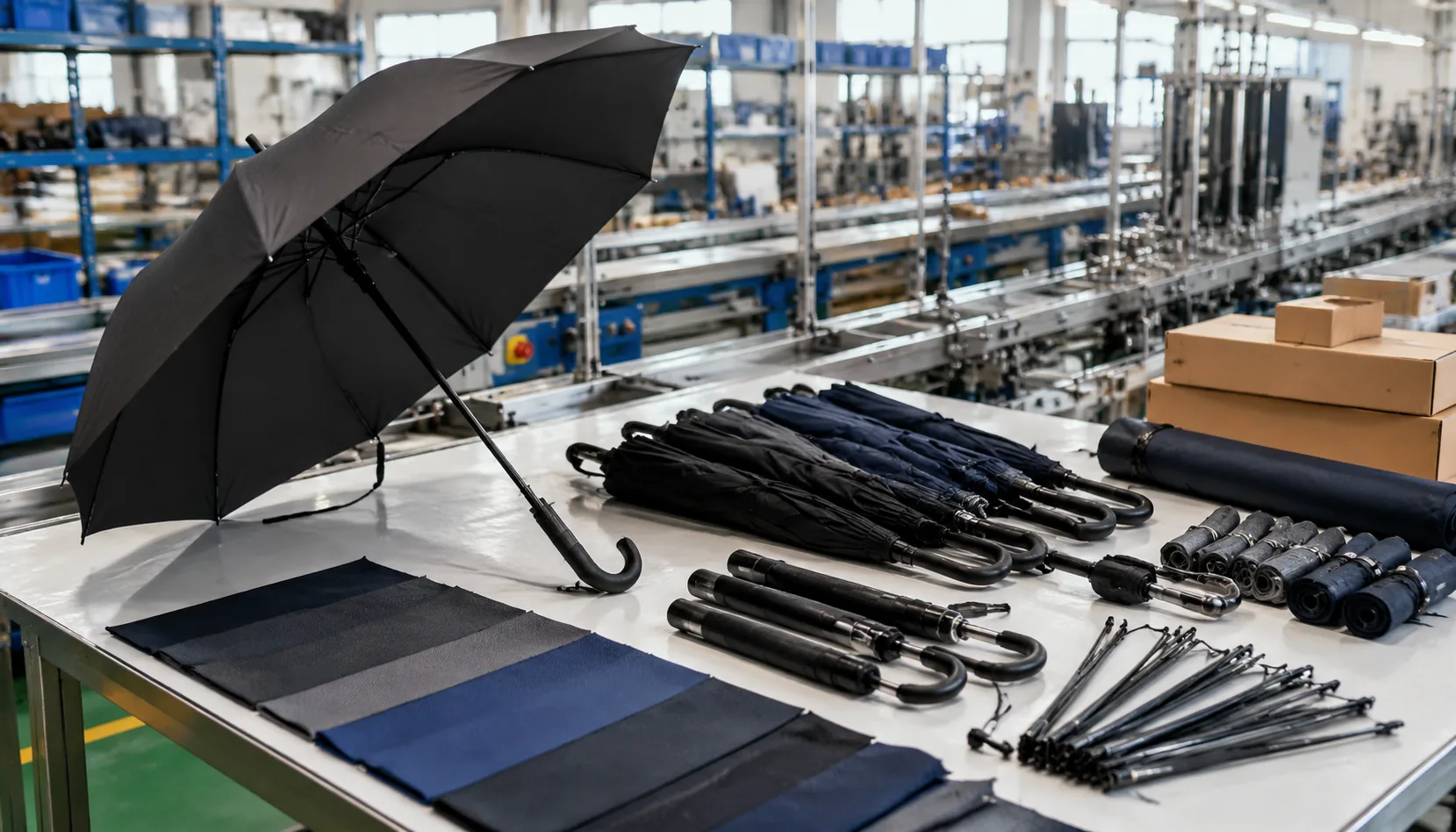
A loaner umbrella program fails when frames bend, fabric wets out, or logos peel after a few rainy checkouts, leaving purchasing teams to replace stock too often. When we build hotel guest umbrellas on the factory floor in Songxia, the real decisions start with rib gauge, 190T or 210T pongee, handle durability, print position, carton packing, and QC checks before shipment—not just the unit price.
Match the Umbrella Type to Hotel Use Cases
The safest default for concierge desks is a 23" or 27" straight umbrella with an auto-open shaft, 190T or 210T pongee canopy, and fiberglass ribs rather than painted steel ribs. A 23" model is easier for guests stepping into taxis, while 27" gives better shoulder coverage for two people walking to a restaurant or parking area. In factory testing, I would expect a well-built straight umbrella to handle roughly 300-500 open/close cycles before the runner, spring, or tips become the weak point; cheap steel-rib versions can look fine at delivery and still bend after one windy weekend. For hotel guest umbrellas at the front desk, specify black, navy, or dark green fabric with a discreet woven label or one-panel screen print, because full-canopy branding tends to encourage “souvenir” loss. A hotel umbrella supplier should quote spare tips, sleeves, and carton-level barcodes, not just unit price, because concierge teams lose control when umbrellas move between lobby, bell desk, and valet.
Compact auto-open models make sense for guest rooms, suites, and minibar-style amenity placement, but they should not be treated like heavy loaner stock. A 21" or 23" 3-fold umbrella with a metal shaft, fiberglass end ribs, and 190T pongee is convenient for luggage and housekeeping carts, yet its hinge points are more vulnerable than a straight frame when guests force it closed wet or toss it into a suitcase. I usually rate compact auto-open umbrellas for about 150-250 normal cycles, less if the hotel is in a coastal city with salt air and frequent gusts. Auto-open-close mechanisms are attractive for premium rooms, but they raise both cost and failure risk if the spring calibration is poor. For branded loaner umbrellas placed in rooms, theft is not a side issue; it is part of the program math. Some hotels print “Please return to room” on the sleeve, use non-retail colors, or add a small room-number tag to reduce shrinkage without making the product feel cheap.
Resorts, golf properties, and beachfront hotels need larger loaner builds, especially 27" or 30" straight umbrellas with 8K, 10K, or 16K frames depending on wind exposure and guest profile. An 8K fiberglass rib umbrella is enough for normal rain shuttle service, but a 16K double-canopy vented windproof model is the better choice for open driveways, pools, and coastal walkways where umbrellas invert quickly. I would ask for a wind-tunnel reference around 50+ mph, reinforced rib joints, a thicker central shaft, and a non-slip EVA or rubberized handle; wood handles look elegant but suffer more dents and water staining in high-volume loaner bins. For hotel guest umbrellas in resort programs, run AQL 2.5 inspection with extra checks on rib symmetry, runner lock strength, canopy seam leakage, logo adhesion, and sleeve fit. Loss rates can easily reach 10-25% per rainy season, so MOQ, reorder lead time of 25-45 days, and FOB versus DDP replenishment cost matter as much as the first purchase price.
Choose Frames, Ribs, and Shaft Materials
For hotel guest umbrellas, the frame choice should start with abuse tolerance, not catalog price. Fiberglass ribs outperform painted steel ribs when guests force the canopy against wind because fiberglass flexes and returns instead of taking a permanent bend. In coastal properties or poolside resorts, fiberglass also avoids the orange rust spots that migrate from cheap steel rib tips onto 190T pongee after repeated wet returns. I still use steel where it makes sense: a black electroplated steel shaft on a 23" manual or auto-open model can cut unit cost without hurting normal lobby-to-car performance, especially if the ribs are fiberglass. For higher traffic loaner racks, specify 8K fiberglass ribs with reinforced stretchers at minimum; if the umbrella is expected to survive open plazas or valet stands, move to a double-canopy vented build rated around 50+ mph in a controlled wind test.
Rib count changes both strength and guest comfort. An 8K frame is the normal commercial balance for hotel umbrella supplier programs: lighter, easier to close, and less likely to feel overbuilt for short walks. A 16K frame spreads load more evenly around the canopy and gives a premium retail feel, but it adds weight, extra sewing points, and more inspection checkpoints. On a 27" golf-style loaner, 16K fiberglass rib umbrellas can be excellent for resorts, golf clubs, and convention hotels, but on compact 21" or 23" lobby umbrellas the added ribs often make the umbrella bulky for housekeeping storage. I would avoid thin 10K steel ribs unless the program is purely decorative; they look strong on a spec sheet but can twist at the runner after a few hard gusts.
Handles should be selected for cleaning, theft control, and brand positioning. EVA foam is light and comfortable but dents faster in luggage carts; rubberized straight handles grip well in rain and suit modern branded loaner umbrellas. Wood-look plastic gives the visual warmth of a classic doorman umbrella without the swelling and finish cracks of real wood. J-handle styles are convenient for hanging on lobby racks and guest room hooks, but they need a stronger shaft joint because guests use them like walking hooks. For a serious program, pair the chosen handle with a pull test, open-close cycle test, and AQL 2.5 inspection covering rib alignment, runner lock strength, handle bonding, and canopy tension. That is where many low-cost loaner umbrellas fail: not in the fabric, but in loose rivets, weak tips, and handles that rotate after the first month.
Specify Canopy Fabric, Coating, and Branding
For hotel guest umbrellas, I would specify 190T pongee only for budget indoor-to-car loaner use; for a real lobby program, 210T pongee is the safer fabric. The difference is not cosmetic. A 210T weave has tighter yarn density, better hand feel, and less light leakage when a guest holds it under entrance lighting. It also takes a Teflon-style water-repellent finish more evenly, so rain beads instead of wetting the canopy after five minutes outside. For coastal resorts or pool villas, add UPF 50+ coating, but confirm it does not stiffen the fabric too much for auto-open frames. On black, navy, burgundy, and forest green canopies, require colorfastness testing against rubbing and water spotting; dark hotel brand colors expose poor dyeing faster than beige or gray. A serious hotel umbrella supplier should confirm fabric weight, coating type, and shrinkage before cutting bulk panels.
Branding should be specified by panel, not by a vague instruction to “add logo.” Screen printing is economical for one- or two-color marks on 23 inch and 27 inch stick umbrellas, while heat transfer is better for gradients, metallic tones, or small crest details. Sublimation works only on suitable light polyester panels, so it is not the right answer for most dark luxury hotel palettes. For branded loaner umbrellas, I prefer one outside panel with a restrained logo, one sleeve logo, and a woven label on the closure strap; too much printing makes a loaner look like a promotional giveaway. If the umbrella has a vented double canopy, confirm whether the logo sits on the upper or lower canopy layer, because misplacement can hide the mark when the vent opens in wind.
Discreet property identification prevents loss without embarrassing the guest. Use a small woven label inside the canopy, a sleeve tag with the hotel name, or a debossed handle plate rather than a giant “Do Not Remove” print. For luxury properties, matching the sleeve fabric to the canopy and adding a barcode or room-control code inside the sleeve works better than visible numbering. Before mass production, approve a pre-production sample under lobby lighting and daylight, because gold, cream, and gray ink shift noticeably on 210T pongee. Our standard practice is to include canopy adhesion checks, print alignment checks within 3 mm, and AQL 2.5 inspection for open-close function, stains, skipped stitches, and logo defects. Fiberglass rib umbrellas with 8K or 10K frames deserve the same canopy discipline as the frame, because a strong frame with bleeding print still fails the guest experience.
Set Quality Checks for Loaner Durability
Loaner durability starts with the parts guests abuse first: the auto-open mechanism, runner lock, tip joints, top cap, end caps, seam tension, and strap/snap closure. For hotel guest umbrellas, I would not approve bulk production until the pre-production sample passes at least 300 open-close cycles on the exact shaft, spring, button, and runner specified in the PO. The runner should lock cleanly without hand forcing, the button should release without sticking, and the shaft should not rattle after cycling. Tips need pull testing because loose tips are the most common complaint on 23" and 27" guest umbrellas; we normally check that metal or plastic tips stay seated after rib flexing and light torsion. Caps should sit flush with no sharp edge, especially on wooden or EVA handles where guests grip hard when exiting cars.
Canopy QC matters as much as frame QC because loaners are often closed wet, shoved into stands, and reopened by the next guest. On 190T or 210T pongee, seam tension should be checked along each panel edge, not only at the crown, because skipped stitches and puckering become leaks after repeated wet use. Strap and snap strength should be tested with repeated pull-open force; weak snaps fail faster than the fabric. If the program uses branded loaner umbrellas, print adhesion also belongs in the durability check: screen print, heat transfer, and sublimation samples should pass wet rub and fold-line inspection before approval. Fiberglass rib umbrellas usually outperform painted steel ribs for hotels near coastal or windy areas, but only if rib rivets are tight and the stretchers do not bind under load.
Use AQL 2.5 inspection for the finished shipment, but do not treat AQL as a substitute for sample approval. The hotel umbrella supplier should submit a signed pre-production sample showing canopy fabric, rib count such as 8K or 10K, shaft diameter, handle material, logo position, strap type, and packaging before cutting bulk fabric. For windproof double-canopy designs, require functional testing separately: vent alignment, overlap depth, rib recovery, and a wind-tunnel or field test target such as 50+ mph when the buyer requests it. Our standard practice at ZheBrella is to lock the approved sample in the QC room, then compare bulk production against it at incoming material, in-line assembly, and final packing stages so the loaner rack receives consistent umbrellas, not mixed parts from different lots.
Plan MOQ, Lead Time, and Import Terms
FOB Ningbo or FOB Shanghai makes sense when the buyer already has a freight forwarder, consolidates umbrellas with towels, slippers, or room amenities, and wants control over vessel booking, customs brokerage, and destination charges. Ningbo is usually the most practical port for Shangyu-made umbrellas, while Shanghai can be useful for consolidation with suppliers in Jiangsu or the broader Yangtze River Delta. FOB also gives better transparency on unit cost versus freight cost, which matters when comparing a hotel umbrella supplier across China, Vietnam, or domestic wholesalers. DDP is often better for multi-property rollouts where the hotel group wants landed cost by address and does not want each property handling import paperwork. Under DDP, cartons can be labeled by hotel name, city, or opening date, then delivered directly to warehouses or individual properties. The tradeoff is less visibility into freight margins and stricter planning: carton dimensions, HS code, declared value, and delivery contacts must be locked before production finishes.
Frequently Asked Questions
What umbrella size works best for hotel loaner programs?
Most hotels choose 23-27 inch straight umbrellas because they feel premium, fit lobby stands, and provide better coverage than mini folding models. Resorts or valet desks may use larger 27 inch builds with fiberglass ribs.
Should hotel umbrellas use manual or auto-open mechanisms?
Auto-open is convenient for guests and lobby staff, but it needs stronger spring and runner QC. Manual-open umbrellas can reduce cost and failure points for high-loss loaner programs.
What umbrella size works best for a hotel loaner program?
For most city and business hotels, a 23-inch to 25-inch straight umbrella balances coverage, durability, and storage. It is large enough for daily guest use but still fits lobby stands, valet stations, and room-entry storage areas.
How should hotels plan reorder quantities for guest umbrellas?
A practical starting point is 3% to 8% of room count for active inventory, then add backup stock for rainy season and loss replacement. Many buyers place initial orders from 300 to 1,000 pieces depending on property count, climate, and whether umbrellas are kept in rooms or at the front desk.
Which QC points matter most before shipping branded loaner umbrellas?
The most important checks are opening and closing function, rib alignment, logo position, fabric stitching, and carton drop resistance. B2B buyers commonly request AQL 2.5 final inspection plus a 100% visual check on logo artwork and color before packing.
Looking to Launch Your Custom Umbrella Line?
ZheBrella is a Zhejiang-based OEM/ODM umbrella manufacturer with 17 years of export experience. Free design, low MOQ from 100 pieces, windproof construction, full-color print.
Get Free Quote Now »People Also Search For
Related Articles
Hotel Guest Umbrellas: Buyer Specs for Durable Loan Programs
Specify hotel guest umbrellas for loan programs with durable frames, easy handling, logo placement, QC checks, and reord...
Read More »
Hotel Guest Loaner Umbrellas: Durability Buyer Guide
Specify hotel guest loaner umbrellas with durable frames, logo placement, AQL checks, MOQ planning, and FOB/DDP delivery...
Read More »
Hotel Loaner Umbrellas: Durable Specs for Guest Programs
Build hotel loaner umbrellas with durable ribs, 190T or 210T pongee, practical branding, MOQ planning, and QC specs for ...
Read More »