How to Specify Branded Umbrellas for Retail and Corporate Programs
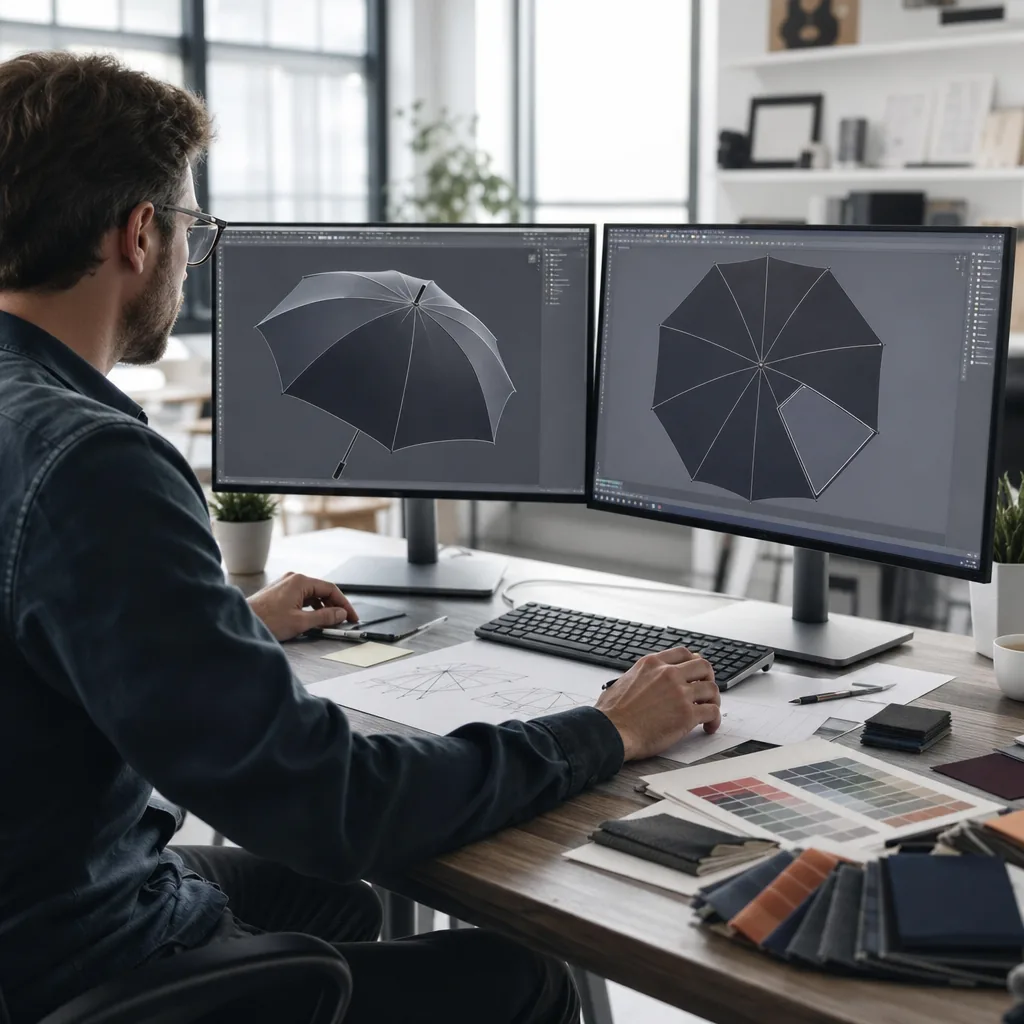
A branded umbrella specification is where a retail or corporate program either becomes repeatable or starts leaking margin through logo drift, color mismatch, weak packaging, and last-minute freight surprises. On our factory floor in Songxia, we see that most problems trace back to vague decisions on canopy fabric, print method, panel layout, handle finish, carton pack, and inspection standard. A practical spec gives buyers control before sampling, not after production has already locked in.
Choosing the Right Umbrella Format for the Channel
Start with carry behavior, not artwork. It has more impact on sell-through and perceived value than a larger printed logo. For retail shelves, commuter programs, and broad event use, a 21" or 23" compact auto-open-close model is usually the safest branded umbrella specification because it fits handbags, laptop bags, car pockets, and carry-on luggage. A practical mid-market build is 190T pongee with 8K steel/fiberglass ribs and a rubberized handle: durable enough for repeat use without drifting into executive-gift pricing. Straight 23" umbrellas work better where the umbrella stays near the door than in a backpack. Hotels, reception desks, and in-store displays favor straight builds because they merchandise cleanly, feel more traditional in hand, and are easier for staff to stack, lend, and recover. Keep daily-carry and presentation SKUs separate at the briefing stage; one shared format often ends up too bulky for commuters and too plain for gifting.
Choose golf builds when coverage and visibility justify the extra size. A 27" or 30" vented double-canopy umbrella with 8K or 10K fiberglass ribs is the better format for tournaments, outdoor staff, hospitality, dealer programs, and executive gifts, especially when wind performance matters; with the right runner, rib tips, and shaft wall thickness, these builds can test at 50+ mph. The larger canopy also gives you more usable panels for logo placement umbrella layouts. The tradeoff is poor portability: a golf umbrella is a weak conference giveaway if attendees must carry it all day or pack it into luggage. Reverse umbrellas serve narrower programs—automotive, real estate, and sales teams entering cars and offices—because the inward fold reduces wet transfer and a C-handle can free one hand. They also bring higher unit weight, larger carton volume, and more frame-related defect risk if the construction is light. For private label umbrellas in retail, compact and straight formats usually deliver the best mix of shelf density, margin, and after-sales risk. In corporate umbrella sourcing, quote FOB DDP umbrella costs separately; a 30" golf and a 21" compact can land with very different freight and duty cost per usable unit, and hotel loss rates should be included before locking MOQ umbrella branding.
Logo Placement Rules That Avoid Rework
Treat the canopy as separate print fields, not a circular billboard. A branded umbrella specification should start with frame count: an 8K umbrella has 8 triangular panels, while 10K and 16K frames create narrower artwork windows that may force the logo lower, smaller, or onto a single panel to avoid rib seams. On a 23-inch straight umbrella, a realistic screen-print area is typically 180-220 mm wide by 120-160 mm high per panel, depending on arc depth and canopy material such as 190T pongee, 210T pongee, POE, PVC, or EVA. A 27-inch or 30-inch golf umbrella allows larger marks, but vented double-canopy styles add overlap zones that should remain unprinted. The logo placement umbrella dieline should state whether the logo is centered on one panel, repeated on alternate panels, split across two panels, or rotated for visibility when carried closed.
Lock secondary branding before sampling, especially in corporate umbrella sourcing programs with several approval layers. Specify artwork size, color, and placement for the strap, sleeve, handle end cap, shaft label, tie tag, and retail hangtag. A woven or printed strap usually fits a compact mark around 40-70 mm wide; heat-transfer film should not cross thick hook-and-loop stitching because it can crack. Sleeves give private label umbrellas more space for care text, barcode, importer address, and a 1-color or 2-color logo when the canopy remains solid. Handle marking depends on substrate: EVA foam performs poorly with debossing, plastic J handles can be pad printed, and wooden handles suit laser engraving or metal badges. ZheBrella confirms each position on a scaled dieline before the first sample because a 20 mm logo shift can require a new screen, sewing adjustment, and packaging insert revision.
Define safe zones, orientation, and print method before sampling to protect cost and lead time. Keep artwork 20-30 mm from panel seams, 25-40 mm from the canopy edge, and clear of the top cap reinforcement, especially on auto-open and auto-open-close frames where opening tension is higher. State the reading direction in writing: readable from the user side when open, readable to people facing the canopy, or readable when folded on the strap. Match print method to artwork: screen printing fits 1-3 spot colors and MOQ umbrella branding runs of 300-500 pieces; heat transfer supports gradients but can feel stiff; sublimation suits full-panel artwork on white polyester; reflective and silicone prints require extra curing time. For any branded umbrella specification tied to a launch date, confirm FOB Ningbo/Shanghai or DDP delivery early, because revised samples can add 7-10 days before AQL 2.5 inspection and bulk production.
Color Matching Across Fabric, Print, and Parts
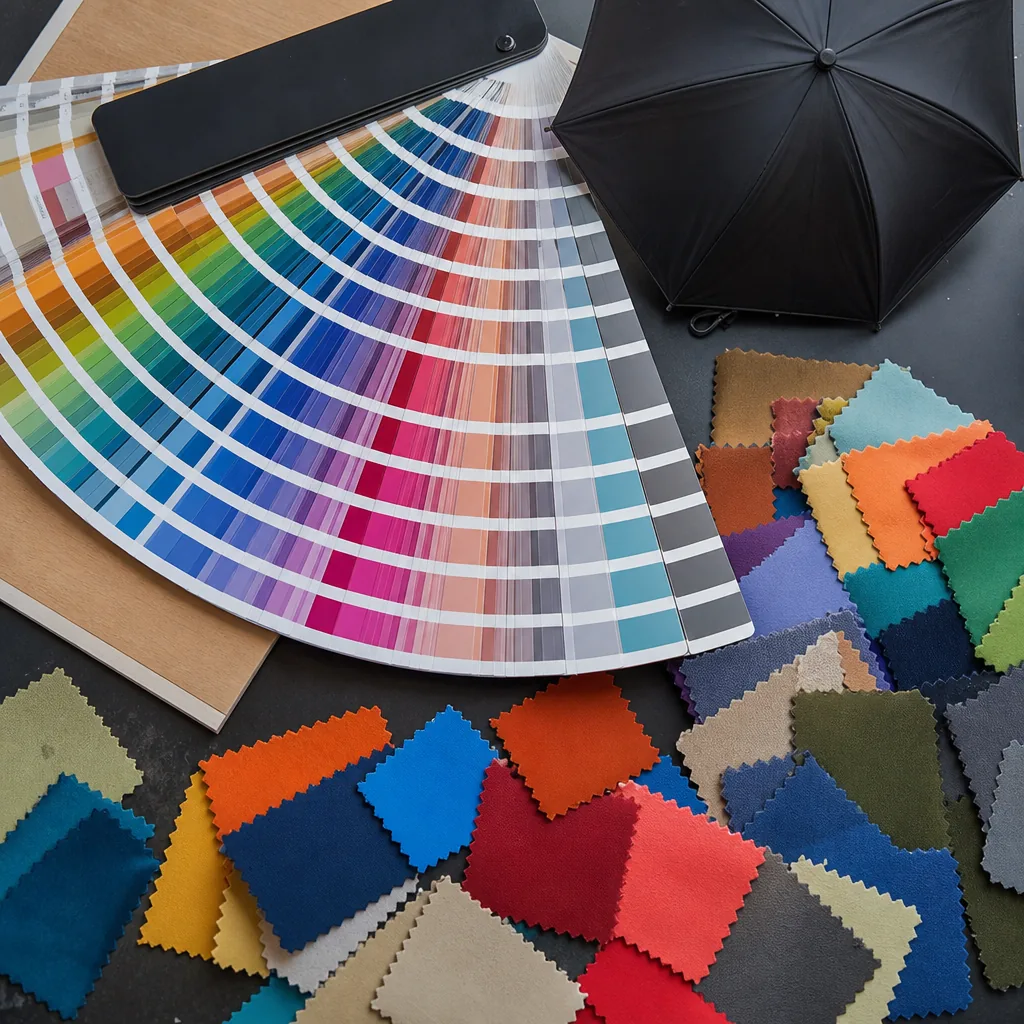
Color matching should be treated as a controlled tolerance, not a promise that every component will look identical. For a serious branded umbrella specification, we ask buyers to provide a Pantone Solid Coated or TCX reference, then we match separately for canopy fabric, print ink, handle resin, shaft coating, and tips. A 190T or 210T pongee canopy absorbs dye differently than POE, PVC, or EVA, and the same Pantone target can read warmer on matte pongee than on glossy transparent plastic. Screen printing, heat transfer, and sublimation also behave differently: screen ink gives strong spot color on dark panels but needs a white underbase; heat transfer can hold sharper logos; sublimation is best for full-panel artwork on white polyester but cannot print true opaque white. Logo placement umbrella decisions should be confirmed on an actual strike-off, especially when the logo crosses sewn seams or sits near the lower panel curve.
The hard matches are usually not the canopy; they are handles, frame finishes, and mixed-material assemblies. Plastic handles can be molded close to Pantone, but resin batches drift, especially with translucent colors, metallic effects, or rubberized coatings. Powder-coated steel shafts and aluminum tubes have a different surface gloss than dyed fabric, while fiberglass ribs are normally black, dark gray, or custom wrapped only at higher MOQ. Wood handles and bamboo finishes cannot be made to a flat corporate color without losing the natural-grain appearance, so they need an approved color range instead of a single chip. In corporate umbrella sourcing, I prefer to define Delta E tolerance, gloss level, and viewing condition up front: D65 daylight for fabric and print, plus a separate indoor office-light check if the program is for hotels, banks, or employee gifts. That prevents arguments after production when the umbrella looks correct outdoors but slightly dull under LED lighting.
Lightfastness is where many private label umbrellas fail after six months in the field. A red or royal blue canopy may pass incoming fabric inspection and still fade faster if the dye lot is not rated for outdoor exposure; dark handles can chalk, and low-grade black coating on steel ribs can turn gray after repeated wet-dry cycles. For retail programs, I normally specify at least 4-grade colorfastness to light for regular polyester and higher requirements for golf umbrellas or outdoor event use, especially 27 inch, 30 inch, 8K, 10K, or 16K windproof models that stay exposed longer. Our standard practice at ZheBrella is to approve a fabric lab dip, a printed panel strike-off, and one assembled pre-production sample before bulk cutting. MOQ umbrella branding should also be tied to the color plan: custom-dyed pongee, Pantone-molded handles, and special frame finishes usually push MOQs and lead times higher, while FOB DDP umbrella schedules need extra buffer for re-approval if any component misses shade tolerance.
Packaging, Inserts, and Shelf Readiness
Packaging should be part of the branded umbrella specification from the first RFQ, not added after canopy artwork is approved. Start with the sleeve: a stock black polyester sleeve with a 1-color screen print is commonly workable at 300-500 pieces, but woven sleeve labels, molded handle tags, printed gift boxes, and retail hangcards often push MOQ umbrella branding to 1,000-2,000 pieces because paper stock, die-cutting, lamination, and barcode setup have their own minimums. For retail and premium gift programs, list each packaging component as a separate line item: sleeve material, logo placement umbrella position, gift box dimensions, hangtag size, attachment method, barcode type, barcode placement, inner packing, and any retailer carton-label format. For private label umbrellas, require artwork files for the sleeve, box, hangtag, and carton marks—not just the canopy print—so the factory can verify print area, color match, and barcode scan readability before sample approval.
Packaging decisions also change carton count, freight cube, and the real FOB DDP umbrella comparison. State master carton quantity in the quote request: compact umbrellas usually pack 24 or 36 pieces per carton, while golf umbrellas more often pack 12 or 24. If you add a rigid gift box or oversized hangcard, carton quantity can drop, carton dimensions increase, and freight can shift from weight-driven pricing to volume or dimensional-weight pricing. In corporate umbrella sourcing, that usually means FOB Ningbo rises modestly, while DDP landed cost can increase more sharply because of palletization, stronger export cartons, retailer routing labels, and added handling. Before mass production, approve a packed-carton photo, final carton dimensions, gross weight, barcode scan test, and drop-test result. Those checks reduce chargebacks, prevent repacking on arrival, and make the branded umbrella specification usable for both retail shelf readiness and premium gift distribution.
Approval Workflow for Low-Error Reorders
Low-error reorders start with controlled approvals, not a fresh email chain of pasted logos. The first approval file for a branded umbrella specification should be production-ready: panel-by-panel logo placement umbrella details, print size in millimeters, Pantone or CMYK values, print method, handle orientation, seam distance, and exact position on one panel, alternating panels, valance, sleeve, or tie wrap. For screen print on 190T or 210T pongee, keep line art above 0.3 mm; for heat transfer or sublimation, approve gradients against the final canopy color and coating. The same file should freeze the umbrella body: 21 inch folding, 23 inch straight, 27 inch golf, or 30 inch large golf; 8K, 10K, or 16K ribs; fiberglass or steel frame; manual, auto-open, or auto-open-close mechanism; handle material; sleeve construction; carton marks; and barcode position.
Treat the pre-production sample as the physical contract before bulk cutting. It should verify canopy fabric, rib tension, runner movement, tip stitching, logo scale, color match, handle finish, strap, sleeve, carton label, and corrected defects. For corporate umbrella sourcing, use a written sample report with neutral-light photos: one open view, one closed view, logo close-ups, component details, packaging, and any approved repair. For private label umbrellas with UPF 50+ coating, Teflon water repellent finish, POE, PVC, or EVA transparent canopy, double-canopy venting, or a windproof frame rated to 50+ mph, the sample record must show the feature clearly. Photo proof can speed approvals, but quarterly or annual programs still need a retained gold sample. At ZheBrella, the approved gold sample stays with the signed spec sheet and AQL 2.5 inspection checklist.
For repeat orders, lock the spec by version number and require written approval for any factory substitution. Small changes can damage retail consistency: a different black pongee lot, warmer EVA panel, matte instead of glossy handle, lower-gauge steel shaft, or rib supplier swap that changes canopy shape. A stable branded umbrella specification should define tolerances for logo color, canopy diameter, finished weight, packed carton size, and approved component alternatives. Fix MOQ umbrella branding rules before reorder season, such as 300 pieces for one-color screen print, 500 pieces for a custom sleeve, or 1,000 pieces for a molded private-label handle. Lead times stay steadier when the buyer repeats the same fabric, frame, print, and packaging, typically 20 to 35 days after deposit and artwork confirmation. For FOB DDP umbrella planning, add time for vessel or air booking, customs data, and destination delivery.
Frequently Asked Questions
How many logo placements are too many on one umbrella?
There is no fixed limit, but each additional placement adds print setup, QC risk, and cost. Most programs stay focused on one primary canopy logo plus one secondary brand mark on the sleeve or strap.
What should a buyer lock before the first sample?
Lock the umbrella format, canopy fabric, rib count, frame material, logo placement, and packaging target. If those change late, the sample cycle usually expands and the quote becomes less reliable.
What logo files should be included in a branded umbrella specification?
Provide vector artwork in AI, EPS, or PDF format, plus Pantone references for each logo color. If the logo will be printed on multiple panels, include exact panel position, print size in centimeters, and whether the logo should face outward when the umbrella is closed.
How should buyers control color consistency across repeat umbrella orders?
Use Pantone TCX or TPX references for canopy fabric and Pantone Solid Coated references for printed logos. Approve a physical pre-production sample before mass production and keep one signed sample as the control standard for repeat orders.
What packaging details affect the landed cost of branded umbrellas?
Sleeves, hangtags, retail boxes, inner cartons, and master carton dimensions all affect CBM, freight, and DDP cost. A retail box can improve shelf presentation but may increase shipping volume by 15-30% compared with a fabric sleeve and bulk carton packing.
Looking to Launch Your Custom Umbrella Line?
ZheBrella is a Zhejiang-based OEM/ODM umbrella manufacturer with 17 years of export experience. Free design, low MOQ from 100 pieces, windproof construction, full-color print.
Get Free Quote Now »People Also Search For
Related Articles
Private Label Umbrella Programs for Retail Chains and Hotel Groups
Plan private label umbrella assortments with brand control, packaging, MOQ, and FOB/DDP terms that fit multi-location re...
Read More »Custom Umbrella Kitting for Corporate Gifting Programs
Plan umbrella kitting for corporate gifts with insert options, MOQ guidance, QC checkpoints, and lead times for bulk FOB...
Read More »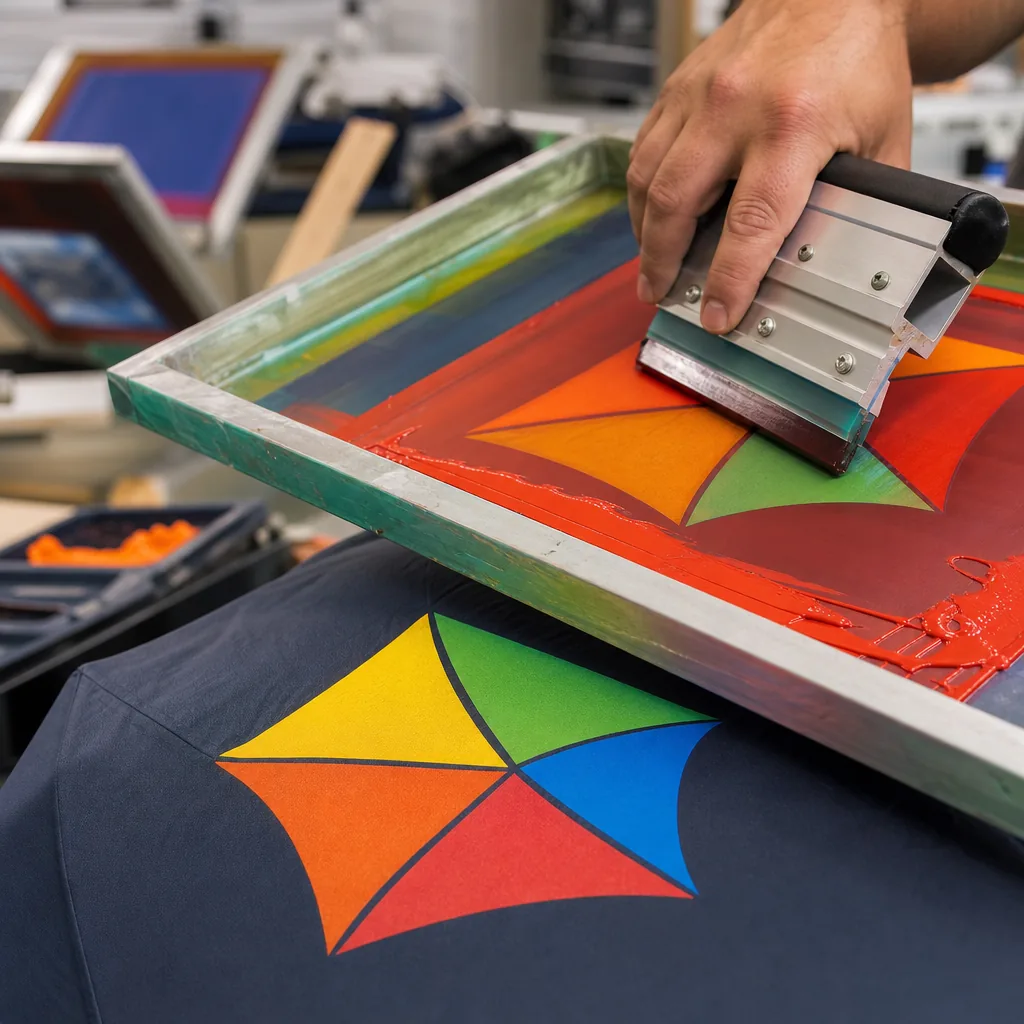
Retail Umbrella Header Cards That Improve Shelf Branding
Design retail umbrella header cards that carry brand identity, product claims, barcodes, and planogram needs without slo...
Read More »